
Harmonic drive gears are widely recognized for their high transmission ratio, compact size, lightweight design, and precision, making them indispensable in fields such as aerospace, industrial robotics, and precision machinery. Understanding the meshing behavior under load is crucial for optimizing performance, durability, and accuracy. In this study, I investigate the distribution of loading backlash and meshing forces in harmonic drive gears, focusing on a theoretical iterative algorithm based on linear circumferential meshing stiffness and initial backlash. This approach aims to provide a more realistic representation of meshing characteristics under varying transmission loads, which is essential for design improvements and reliability assessments.
The core of harmonic drive gear operation lies in the flexible deformation of the flexspline under the action of a wave generator, typically a two-disk type, which enables multi-tooth engagement with the circular spline. Under no-load conditions, the initial backlash—the minimal gap between tooth profiles after assembly—determines the starting point for meshing. However, under transmission loads, this backlash changes dynamically, affecting meshing force distribution and overall stiffness. This study delves into these aspects through a combination of theoretical modeling and finite element analysis (FEA), with an emphasis on the harmonic drive gear’s nonlinear behavior.
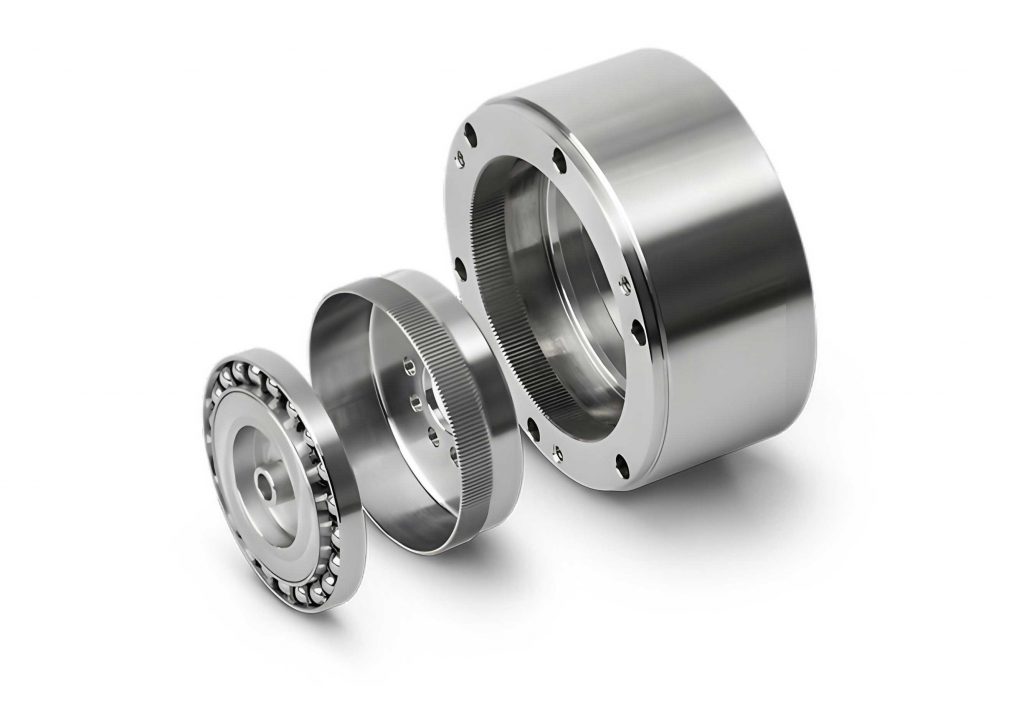
To begin, I explore the calculation of initial backlash in the assembly state. For a harmonic drive gear with involute tooth profiles and a two-disk wave generator, the radial displacement of the flexspline’s neutral layer is derived from deformation theory. The radial displacement, denoted as \( u(\phi) \), varies with the angular position \( \phi \), where \( \phi = 0 \) corresponds to the major axis. For a two-disk wave generator, the displacement is piecewise-defined based on the wrap angle \( \gamma \):
$$ u_1(\phi) = \frac{A_1 \cos \phi – B_1}{A_1 – B_1} u_0, \quad 0 \leq \phi \leq \gamma $$
$$ u_2(\phi) = \frac{u_0}{A_1 – B_1} \left[ (1 + \sin^2 \gamma) \sin \phi + \left( \frac{\pi}{2} – \phi \right) \cos \phi – 2 \sin \gamma – B_1 \right], \quad \gamma < \phi \leq \frac{\pi}{2} $$
where \( u_0 \) is the maximum radial deformation, \( A_1 = \frac{\pi}{2} – \gamma – \sin \gamma \cos \gamma \), and \( B_1 = \frac{4[\cos \gamma – (\frac{\pi}{2} – \gamma) \sin \gamma]}{\pi} \). The circumferential displacement \( v(\phi) \) and the rotation angle \( \theta_{uz}(\phi) \) of the tooth symmetry axis relative to the radial vector are calculated using precise algorithms that account for the non-elongation condition of the neutral layer. For involute profiles, the tooth coordinates are expressed parametrically with the arc length parameter \( s \):
$$ x = r [\cos(s – \theta) + s \cos \alpha_0 \sin(s – \theta + \alpha_0)] $$
$$ y = r [-\sin(s – \theta) + s \cos \alpha_0 \cos(s – \theta + \alpha_0)] $$
Here, \( r \) is the pitch radius, \( \alpha_0 \) is the pressure angle, and \( \theta \) is half of the central angle corresponding to the tooth thickness. The initial backlash \( j_t \) between the flexspline and circular spline teeth is approximated as the minimal circumferential distance between profiles after deformation:
$$ j_t \approx \sqrt{(x_{K2} – x_{K1})^2 + (y_{K1} – y_{K2})^2 } $$
where \( K_1 \) and \( K_2 \) are points on the flexspline and circular spline profiles, respectively. This theoretical calculation forms the basis for load-dependent analyses. To validate this, I developed a 3D finite element model with solid elements for the flexspline and circular spline, incorporating realistic involute profiles. The model simulates assembly deformation under a two-disk wave generator, and the results show good agreement with theoretical predictions, albeit with minor discrepancies due to simplifications in the theoretical model, such as neglecting tooth stiffness effects on circumferential displacement.
Next, I focus on the meshing stiffness matrix, which characterizes the circumferential stiffness at engagement points under load. In a harmonic drive gear, the meshing stiffness is influenced by tooth deformation, contact compliance, and flexspline body distortion. To capture this, I constructed a finite element model of the flexspline using SOLID45 elements for teeth and SHELL63 elements for the cup body. The wave generator is modeled as two symmetric disks with surface-to-surface contact defined between the generator and flexspline inner wall. After solving for assembly deformation, unit meshing forces are applied sequentially at each potential engagement point along the tangential direction, and the resulting circumferential displacements are extracted. This yields a meshing flexibility matrix \( \mathbf{D} \), where each element \( d_{ij} \) represents the displacement at point \( j \) due to a unit force at point \( i \). The meshing stiffness matrix \( \mathbf{K} \) is then obtained by inversion:
$$ \mathbf{K} = \mathbf{D}^{-1} = \begin{bmatrix} k_{11} & k_{12} & \cdots & k_{1n} \\ k_{21} & k_{22} & \cdots & k_{2n} \\ \vdots & \vdots & \ddots & \vdots \\ k_{n1} & k_{n2} & \cdots & k_{nn} \end{bmatrix} $$
Here, \( n \) is the number of engagement points considered, typically within the angular range from \( \phi = -21^\circ \) to \( \phi = 51^\circ \) relative to the major axis, based on initial backlash distribution. The stiffness matrix reflects the coupling effects between teeth, where applying force at one tooth induces displacements at others due to flexspline body deformation. This matrix is central to the iterative algorithm for load-dependent analysis.
The iterative algorithm computes loading backlash and meshing force distribution under progressively increasing transmission loads. In this harmonic drive gear simulation, the wave generator and flexspline cup base are fixed, while the circular spline is subjected to incremental rotational displacement. The algorithm balances the meshing force vector \( \mathbf{F} \) and displacement vector \( \mathbf{d} \) using the stiffness matrix:
$$ \mathbf{F} = \mathbf{K} \mathbf{d} $$
For each tooth pair, meshing occurs if the circumferential displacement of the circular spline point exceeds the sum of the initial backlash and the flexspline point’s displacement. Otherwise, the tooth remains unengaged. The algorithm iteratively adjusts the circular spline rotation step size to identify newly engaging teeth and compute corresponding forces. The loading backlash \( j_{t,\text{load}} \) for each tooth is defined as the updated gap under load, which decreases as transmission torque increases. The meshing force distribution evolves with load, starting from teeth near the minimum initial backlash point (around \( \phi = 5^\circ \) for the studied harmonic drive gear) and spreading symmetrically until multiple teeth engage.
To illustrate the algorithm’s outcomes, I present results for a harmonic drive gear with parameters: module \( m = 0.2 \, \text{mm} \), pressure angle \( \alpha_0 = 20^\circ \), maximum radial deformation \( u_0 = 0.2 \, \text{mm} \), flexspline teeth \( z_1 = 140 \), circular spline teeth \( z_2 = 142 \), and rated torque of approximately \( 7 \, \text{N} \cdot \text{m} \). The table below summarizes key geometric parameters:
| Parameter | Value | Description |
|---|---|---|
| Module, \( m \) | 0.2 mm | Tooth size metric |
| Pressure angle, \( \alpha_0 \) | 20° | Standard involute angle |
| Flexspline teeth, \( z_1 \) | 140 | Number of teeth on flexspline |
| Circular spline teeth, \( z_2 \) | 142 | Number of teeth on circular spline |
| Max radial deformation, \( u_0 \) | 0.2 mm | Deformation under wave generator |
| Rated torque | 7 N·m | Nominal transmission load |
Using the iterative algorithm, I calculated loading backlash and meshing forces for increasing circular spline rotations. The results show that under low loads, meshing forces are linearly proportional to displacement, with distribution symmetric around \( \phi = 5^\circ \). As load rises, nonlinear effects become pronounced, causing the peak meshing force to shift leftward. For instance, at a rotation of \( 3.38 \times 10^{-3} \, \text{rad} \) (corresponding to a torque of about \( 12.44 \, \text{N} \cdot \text{m} \)), the engagement range spans from \( \phi = -13^\circ \) to \( \phi = 18^\circ \), with maximum meshing force amplitude reaching \( 51 \, \text{N} \) in the theoretical algorithm. The loading backlash diminishes to near zero in engaged teeth, indicating full contact.
However, the theoretical algorithm assumes linear meshing stiffness, which may not hold under high loads due to nonlinear contact and flexspline deformation. To verify its validity, I performed nonlinear finite element contact analysis using a detailed harmonic drive gear model. In this model, point-to-point contact elements (CONTA178) are defined between flexspline tooth tips and virtual circular spline points, with initial gaps set to the calculated initial backlash. The enhanced Lagrange contact algorithm is employed with a penetration tolerance below \( 10^{-5} \, \text{mm} \). The circular spline points are displaced circumferentially in steps, simulating load application, and contact forces and updated gaps are extracted.
The FEA results confirm the general trends but highlight nonlinearities. Under low loads, meshing force distribution aligns well with theoretical predictions, but as load increases, the theoretical algorithm overestimates meshing forces due to its assumption of constant stiffness. For example, at the same rotation of \( 3.38 \times 10^{-3} \, \text{rad} \), FEA gives a maximum meshing force of \( 43 \, \text{N} \), about 17% lower than the theoretical value. The loading backlash from FEA also decreases slightly faster, particularly on the left side of the major axis, but differences are minimal (e.g., gap discrepancies under \( 2 \, \mu \text{m} \)). The table below compares key outcomes at a high load state:
| Aspect | Theoretical Algorithm | Finite Element Analysis |
|---|---|---|
| Max meshing force | 51 N | 43 N |
| Engagement range | −13° to 18° | −13° to 18° |
| Loading backlash at φ = 51° | 5.34 μm | 4.96 μm |
| Torsional stiffness | Constant linear | Nonlinear, decreasing |
Further analysis of single-tooth meshing forces reveals that the theoretical algorithm matches FEA closely for rotations below \( 1.5 \times 10^{-3} \, \text{rad} \), but diverges at higher loads. This is attributed to the nonlinear softening of meshing stiffness in the harmonic drive gear under large deformations, which the linear stiffness matrix cannot capture. The torsional stiffness—defined as the slope of the torque-rotation curve after accounting for initial backlash—shows that the theoretical algorithm yields a constant value, while FEA indicates a nonlinear decrease with increasing load. Up to the rated torque of \( 7 \, \text{N} \cdot \text{m} \), both methods agree reasonably, but beyond that, discrepancies grow, with a torque deviation of about 11.2% at the maximum rotation.
To elaborate on the stiffness behavior, I derive an expression for effective torsional stiffness \( k_t \) based on the meshing stiffness matrix. For a harmonic drive gear under load, the total transmission torque \( T \) is the sum of meshing forces multiplied by their effective radii:
$$ T = \sum_{i=1}^{n} F_i r_e $$
where \( r_e \) is the equivalent pitch radius. Using the linear relation \( \mathbf{F} = \mathbf{K} \mathbf{d} \) and approximating displacements proportional to rotation \( \theta \), we get:
$$ k_t = \frac{dT}{d\theta} \approx r_e^2 \sum_{i,j} k_{ij} $$
This simplifies to a constant in the theoretical algorithm, but in reality, the stiffness coefficients \( k_{ij} \) vary with load due to contact nonlinearities and flexspline distortion. The FEA captures this by modeling actual contact conditions, leading to a more accurate representation of harmonic drive gear performance.
In terms of practical implications, the distribution of meshing forces directly affects the flexspline’s stress and fatigue life. Uneven force distribution can lead to premature wear or failure. My study shows that in harmonic drive gears, the number of engaged teeth increases with load, but the force per tooth may not scale linearly due to stiffness coupling. For design optimization, engineers should consider these nonlinear effects to ensure reliability. For instance, modifying tooth profile parameters or wave generator geometry could mitigate peak forces and improve load sharing.
Additionally, the concept of loading backlash is critical for precision applications. In harmonic drive gears used in robotics, minimal backlash ensures accurate positioning. My findings indicate that under load, backlash reduces dynamically, but residual gaps may persist in some teeth, potentially affecting repeatability. The iterative algorithm provides a tool to estimate this for different torque levels, aiding in tolerance design.
To further quantify results, I present detailed data on meshing force distribution across angular positions for various loads. The table below summarizes meshing forces at key angular positions for three load levels, comparing theoretical and FEA results:
| Angular Position φ (°) | Theoretical Force at Low Load (N) | FEA Force at Low Load (N) | Theoretical Force at Medium Load (N) | FEA Force at Medium Load (N) | Theoretical Force at High Load (N) | FEA Force at High Load (N) |
|---|---|---|---|---|---|---|
| −10 | 0.5 | 0.6 | 12.3 | 10.8 | 38.7 | 32.1 |
| 0 (Major Axis) | 1.2 | 1.4 | 15.6 | 14.2 | 45.2 | 38.5 |
| 5 | 8.0 | 9.6 | 25.4 | 22.3 | 51.0 | 43.0 |
| 15 | 3.5 | 4.1 | 18.9 | 16.7 | 42.8 | 36.4 |
| 25 | 0.8 | 1.0 | 10.5 | 9.2 | 30.5 | 25.9 |
This table illustrates how meshing forces evolve, with the theoretical algorithm generally predicting higher forces, especially at high loads. The harmonic drive gear’s performance is thus sensitive to load magnitude, and designers should account for this in safety factors.
Another important aspect is the effect of wave generator type on meshing behavior. While this study focuses on a two-disk wave generator, other types (e.g., cam-based) could alter deformation patterns and stiffness. However, the iterative algorithm framework can be adapted by adjusting the initial deformation equations. For any harmonic drive gear, the key steps remain: compute initial backlash, derive meshing stiffness, and iterate under load. This universality makes the method valuable for diverse applications.
In conclusion, my research on harmonic drive gears demonstrates that loading backlash and meshing force distribution are dynamic and load-dependent. The theoretical iterative algorithm, based on linear circumferential stiffness and initial backlash, offers a efficient way to estimate these parameters, with good accuracy under low to moderate loads. However, for high loads, nonlinear finite element analysis is necessary to capture the true behavior, as meshing stiffness softens and force distribution shifts. This insight is vital for optimizing harmonic drive gear design, ensuring durability, and enhancing precision in demanding applications like robotics and aerospace. Future work could integrate nonlinear stiffness models into the algorithm or explore real-time monitoring techniques for operational harmonic drive gears.
The harmonic drive gear continues to be a pivotal component in modern machinery, and understanding its meshing mechanics under load will drive innovations in performance and reliability. By combining theoretical and numerical approaches, this study contributes to that understanding, providing a foundation for further advancements in harmonic drive gear technology.