
The advancement of robotics for precise manipulation in constrained environments represents a critical frontier in automation, particularly for the assembly and disassembly (A&D) of electromechanical systems. Traditional robotic grippers often lack the adaptability and nuanced control required to handle slender workpieces within long, narrow channels—a common scenario in equipment maintenance and module installation. This work presents the comprehensive design, control system development, and experimental validation of a novel dexterous robotic hand specifically engineered for such challenging A&D operations. The primary objective is to enhance a robot’s capability to perform not only linear feed-in and retraction but also the pivotal 180-degree flipping of a workpiece, all within a single, confined operational envelope, thereby achieving a high degree of operational autonomy and flexibility.
The core innovation lies in the biomimetic, hybrid serial-parallel architecture of the dexterous robotic hand. Unlike conventional parallel jaw or multi-fingered hands with independent but non-cooperative digits, this design enables a coordinated “hand-over” maneuver between its fingers, mirroring human dexterity. The dexterous robotic hand is a fundamental component of a larger hybrid robotic manipulator system. The overall system architecture, conceptualized using SolidWorks, integrates a mobile base, a vertical column, a multi-degree-of-freedom (DOF) robotic arm, and the terminal dexterous robotic hand, as shown in the following system overview.
1. Structural Design of the Dexterous Robotic Hand and Manipulator System
The structural design philosophy prioritizes achieving complex, fine manipulation in a compact form factor. The dexterous robotic hand itself employs a hybrid kinematic structure where the fingers are arranged in a stable tripod (“品”-shaped) configuration and operate under a parallel mechanism relative to each other for cooperative tasks, while each finger segment is serially actuated for individual articulation.
1.1 Manipulator System Overview
The host manipulator features a serial-link arm mounted on a mobile platform, providing the gross positioning required to bring the dexterous robotic hand to the entrance of a confined workspace. The robot’s “head” unit, incorporating vision and proximity sensors, is mounted on a motorized neck joint, allowing for environmental perception and situational awareness adjustment independent of the arm’s position. This modular sensor placement—with cameras and ultrasonic sensors externally mounted and control electronics internally housed—ensures both functional efficacy and structural integrity.
1.2 Detailed Design of the Dexterous Robotic Hand
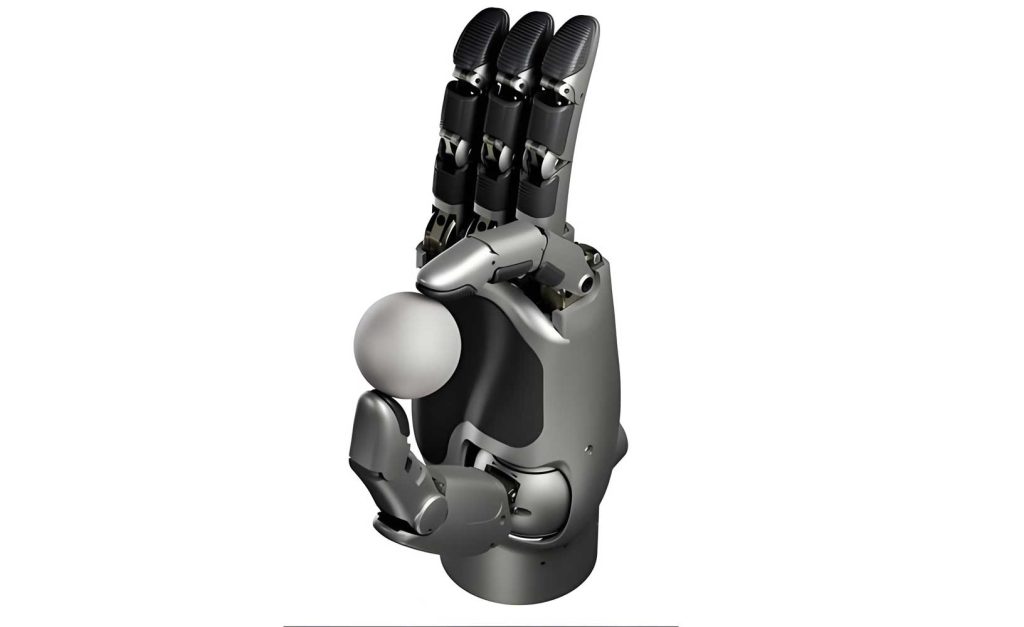
The dexterous robotic hand consists of one palm and three active fingers: an upper thumb and two lower fingers (index and middle). Each finger is modular, comprising several independently actuated “phalanxes” dedicated to specific functions:
- Grasping Phalanx: Provides the primary enveloping or pinching force to secure the workpiece.
- Feeding/Retracting Phalanx: Executes linear translation to push the workpiece forward or pull it backward along its axis.
- Flipping Phalanx (mounted on the thumb tip): Specially designed to engage and rotate the workpiece by 180 degrees.
The kinematic coordination between these phalanxes across the three fingers enables the hand to regrasp and reposition a long, slender object internally, a task impossible for standard grippers. The following table summarizes the key design parameters and functions of the dexterous robotic hand.
| Component | Quantity | Primary Degree of Freedom | Primary Function | Actuation |
|---|---|---|---|---|
| Thumb (Upper Finger) | 1 | 3 (Fold, Translate, Flip) | Primary grip, flipping initiation, cooperative feed | Dedicated DC Motor per Joint |
| Index Finger (Lower) | 1 | 2 (Fold, Translate) | Secondary grip, cooperative feed/retract, support | Dedicated DC Motor per Joint |
| Middle Finger (Lower) | 1 | 2 (Fold, Translate) | Secondary grip, cooperative feed/retract, support | Dedicated DC Motor per Joint |
| Flipping Mechanism | 1 (on Thumb) | 1 (Rotate) | Execute 180° workpiece rotation | Dedicated DC Motor |
| Three-Axis Force Sensor | 1 (Fingertip) | N/A | Grip force feedback and control | Analog Voltage Output (0-5V) |
The kinematics of a single finger with `n` serially linked phalanxes can be described by the transformation from the finger base frame {B} to the fingertip frame {T}. The homogeneous transformation matrix is given by:
$$
T_B^T = \prod_{i=1}^{n} A_i(q_i)
$$
where $A_i(q_i)$ is the Denavit-Hartenberg (D-H) transformation matrix for joint $i$ with joint variable $q_i$. For the cooperative parallel motion of two fingers (e.g., index and middle) performing a linear transfer, their combined constraint ensures the workpiece axis remains fixed, simplifying the path planning for the feeding/retracting phalanx.
2. Control System Architecture and Design
The control system is architected for robustness, modularity, and real-time responsiveness to sensor feedback, ensuring the dexterous robotic hand performs reliably in unstructured environments.
2.1 System Composition and Operational Logic
The core control unit is built around an AT89C52 microcontroller (MCU), chosen for its reliability and sufficient I/O capabilities. The system integrates several key modules through a centralized design, as outlined in the block diagram below. The primary operational flow is:
- Initialization & Self-Test: On power-up, the MCU initializes all subsystems and checks motor positions and sensor status. Any fault triggers an alarm and halts operation.
- Workpiece Detection & Task Arbitration: The system, via camera and proximity sensors, detects a workpiece and the target installation space. A high-level task (Feed, Retract, Flip) is selected either autonomously or via a Wi-Fi remote command.
- Coordinated Motion Execution: The MCU executes the corresponding control subroutine, issuing precise PWM signals to multiple motor drivers while continuously monitoring force and proximity feedback for closed-loop control.
- Completion and Reset: Upon task completion, the dexterous robotic hand returns to a predefined home position, awaiting the next instruction.
| Module | Core Component | Function in Dexterous Robotic Hand Control | Interface with MCU |
|---|---|---|---|
| Main Controller | AT89C52 MCU | Central processor for sensor data fusion, decision logic, and PWM generation for all motors. | N/A (Core) |
| Power & Motor Driver | H-Bridge Circuits (e.g., L298N) | Provides the necessary current and voltage to drive DC motors for each finger joint. | Digital I/O Pins |
| Force Sensing | Three-Axis Force/Torque Sensor | Measures grip force; essential for preventing slippage and damage to the workpiece. | Analog Input (via Signal Conditioning) |
| Vision & Proximity | Camera Module & Ultrasonic Sensor | Provides workpiece identification, pose estimation, and distance measurement to the environment. | UART / Digital I/O |
| Communication | ESP8266 Wi-Fi Module | Enables wireless remote monitoring, emergency override, and high-level command input. | UART |
| Signal Conditioning | Op-Amp Circuit (TLC2262) | Scales and buffers the 0-5V analog force signal to the MCU’s safe 0-3.3V ADC input range. | Between Sensor and MCU ADC |
2.2 Hardware Circuit Design
The main MCU circuit includes a 12MHz crystal oscillator, a power-on reset circuit, and necessary pull-up resistors. A critical part of the hardware design is the interface for the three-axis force sensor. The sensor’s raw analog output ($V_{sensor}$, 0-5V) must be scaled to match the MCU’s ADC reference voltage ($V_{ref} = 3.3V$). A non-inverting operational amplifier (Op-Amp) configuration with a gain of less than unity is used as a voltage follower and scaler. The conditioning circuit, centered on a TLC2262 Op-Amp, provides the following transformation:
$$
V_{mcui} = G V_{sensori} \quad \text{where} \quad G = \frac{R_f}{R_i} < 1
$$
For a desired scaling from 5V to 3.3V, the gain $G$ is set to 0.66. This circuit also provides high input impedance, isolating the sensor from the MCU’s ADC circuit and improving signal stability.
2.3 Software and Control Algorithm Design
The software is modular, comprising a main supervisory routine and dedicated subroutines for each core maneuver: `Feed`, `Retract`, `Flip`. The control strategy for each finger joint employs a Proportional-Derivative (PD) control law based on feedback from joint encoders (for position) and the force sensor (for grip intensity).
The desired trajectory for a feeding operation, for instance, involves synchronized motion of the feeding phalanxes on two fingers. Let $\theta_d(t)$ be the desired angular position vector for the relevant motor joints. The control torque $\tau(t)$ computed by the MCU is:
$$
\tau(t) = K_p \cdot e(t) + K_d \cdot \dot{e}(t)
$$
where $e(t) = \theta_d(t) – \theta_a(t)$ is the position error, $\theta_a(t)$ is the actual position, and $K_p$, $K_d$ are the proportional and derivative gain matrices, tuned empirically for stable and responsive motion of the dexterous robotic hand.
The grip force is regulated separately using force sensor feedback $F_a(t)$. The desired gripping force $F_d$ is set based on workpiece properties. A simple proportional control adjusts the PWM duty cycle to the grasping phalanx motors:
$$
PWM_{grip}(t) = K_{fp} \cdot (F_d – F_a(t))
$$
This dual-loop control (position and force) ensures precise and safe manipulation by the dexterous robotic hand.
3. System Integration, Prototyping, and Experimental Validation
A functional prototype of the dexterous robotic hand and its control system was manufactured based on the detailed SolidWorks models and PCB designs. The prototype fingers were fabricated using CNC machining and 3D printing for complex geometries, ensuring light weight and sufficient strength.
3.1 Experimental Setup and Procedures
The experimental validation focused on the core functionalities using a standardized slender cylindrical workpiece (length: 500 mm, diameter: 20 mm). The tests were conducted in a mock-up confined channel. The key performance indicators (KPIs) were task success rate, positional accuracy, cycle time, and system stability.
- Linear Feed/Retract Test: The dexterous robotic hand picked up the workpiece from outside the channel, inserted it to a specified depth (300mm), held it, and then fully retracted it.
- In-Situ Flip Test: With the workpiece partially inserted, the dexterous robotic hand executed the coordinated finger motion to regrasp and rotate the workpiece 180 degrees about its longitudinal axis within the channel.
- Force Control Test: The system’s ability to maintain a stable, non-damaging grip was tested by monitoring the force sensor output during maneuvers and while holding the workpiece against mild external perturbations.
3.2 Results and Analysis
The prototype dexterous robotic hand successfully demonstrated all designed maneuvers. The experimental results are summarized below:
| Test Maneuver | Success Rate | Average Positional Error (mm) | Average Cycle Time (s) | Notes / Observations |
|---|---|---|---|---|
| Linear Feed (300mm) | 100% (20/20 trials) | ±1.5 | 8.2 | Smooth motion, no workpiece wobble. |
| Full Retract | 100% (20/20 trials) | N/A (return to start) | 7.8 | Consistent performance, reliable grip maintained. |
| 180° In-Situ Flip | 95% (19/20 trials) | Angular: ±5° | 12.5 | One failure due to initial misalignment of workpiece. Handover motion was stable. |
| Grip Force Stability | N/A | Force Variation: < ±0.5N | N/A | Force control loop effectively rejected minor disturbances, preventing slippage. |
The data confirms that the kinematic design and control system meet the specified requirements. The high success rate and low positional error validate the precision of the mechanical design and the effectiveness of the PD control algorithm. The ability to perform the flip maneuver in 95% of trials underscores the practical viability of the novel parallel finger coordination strategy in the dexterous robotic hand. The closed-loop force control ensured safe interaction, with no damage to the workpiece observed in any successful trial.
4. Discussion and Future Work
The design and implementation presented here affirm the feasibility of using a specially designed dexterous robotic hand for complex A&D tasks in confined spaces. The hybrid serial-parallel architecture proved essential for achieving dexterity beyond simple gripping. The modular, feedback-driven control system based on the AT89C52 MCU provided a robust and cost-effective solution for coordinating multiple actuators and processing sensor data.
However, several areas for improvement and further research have been identified. Firstly, the current prototype uses DC motors with gearboxes, which, while powerful, have backlash that limits ultimate precision. Future iterations could employ brushless DC motors or even hybrid stepper motors with higher-resolution encoders for finer control of the dexterous robotic hand. Secondly, the control algorithms could be advanced from PD to model-based or adaptive controllers to better handle dynamic loads and varying friction conditions inside real-world equipment channels.
The most significant future development lies in enhancing autonomy. Integrating the visual data from the camera for real-time pose estimation of both the workpiece and the target socket would allow for fully autonomous operation. This would involve implementing machine vision algorithms on a more powerful companion processor (e.g., an ARM Cortex-M7 or a dedicated vision processor) that communicates with the main MCU, transforming the dexterous robotic hand into an intelligent end-effector capable of decision-making in uncertain environments.
5. Conclusion
This work has detailed the complete development cycle—from conceptual design and kinematic analysis to control system implementation and experimental validation—of a novel dexterous robotic hand for confined space assembly and disassembly. The hand’s unique ability to perform linear translation and in-situ rotation of slender workpieces addresses a significant gap in existing robotic manipulation solutions. The successful prototype tests demonstrate stable and reliable execution of feed, retract, and flip maneuvers, with performance metrics aligning closely with design simulations.
The effectiveness of the system stems from the synergistic combination of a biomimetic mechanical structure, a carefully designed sensor suite (force, vision, proximity), and a modular, feedback-based control architecture. The results conclusively verify that the proposed design for the dexterous robotic hand is both technically viable and practically effective, offering a promising solution for automating intricate manipulation tasks in aerospace, automotive, and heavy machinery maintenance, thereby contributing to the broader goals of operational efficiency and automation in high-precision industries.