
UBTECH Robotics, the Hong Kong-listed humanoid robot company, closed at HK$84.8 on Aug. 31, up 1.56 percent, for a market capitalization of HK$42.688 billion, extending a rally across the prior four trading sessions. The market’s warm reception was tied in part to the company’s interim results, which showed that revenue had doubled and that the humanoid robot business had become a central pillar of the growth story.
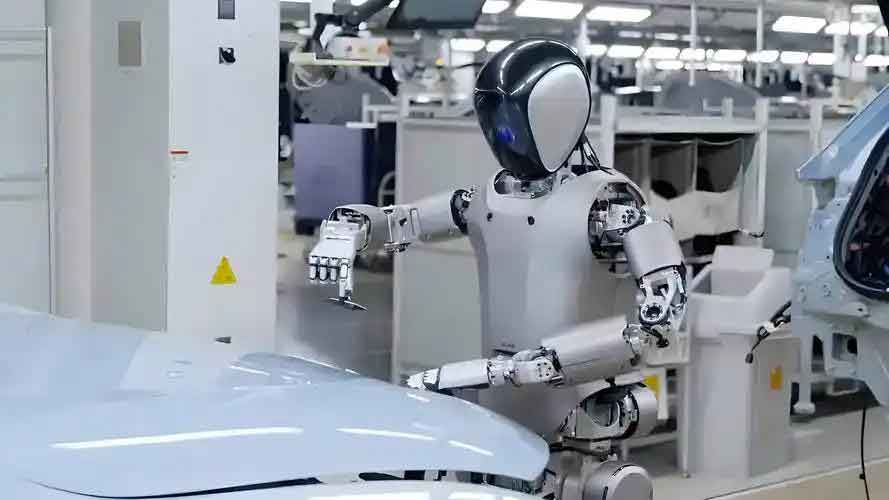
The results, disclosed on Aug. 28, showed first-half revenue of about RMB 1.27 billion, up 104.2 percent from a year earlier. The headline number was strong, but the details made the strategic shift even clearer: full-size embodied intelligent humanoid robot revenue reached about RMB 590 million, up 1,445 percent, and accounted for 46.5 percent of total revenue, up from 6.1 percent a year earlier. That share also exceeded the 41 percent recorded for the full year of 2025.
For a company often described as the first Hong Kong-listed humanoid robot company, the first half delivered a clear answer to one question: can the humanoid robot become a revenue pillar? The answer is yes. The second question is harder: can humanoid robot growth translate into profit? On that measure, the company has delivered only half of the story.
1. Market Reaction Reflects Revenue Delivery, Not Yet Profitability
The share price move on Aug. 31 was modest but symbolically important. UBTECH’s stock has been closely watched as a proxy for the commercial prospects of the humanoid robot industry, and the interim report gave investors a tangible revenue number rather than a promise. The company’s humanoid robot revenue was no longer a small experimental line item. It was the largest disclosed product category by revenue in the first half.
The market reaction also reflected the scale of the revenue increase. Total revenue more than doubled, and the humanoid robot category grew far faster than the company as a whole. The full-size embodied intelligent humanoid robot business generated about RMB 590 million in revenue, compared with a much smaller base a year earlier. That growth rate of 1,445 percent was the most visible sign that humanoid robot demand had moved from demonstrations and pilots into revenue recognition.
Yet the stock reaction should not be read as a verdict on profitability. UBTECH’s loss narrowed 23 percent to about RMB 339 million from about RMB 440 million a year earlier, but the company remained unprofitable. The revenue story and the profit story are moving at different speeds. The first half showed progress on the top line; it did not show that the humanoid robot business had reached a self-sustaining financial model.
That distinction matters for how the interim results should be interpreted. A humanoid robot company can grow revenue quickly by delivering units to early customers, but profitability depends on product mix, deployment costs, service costs and the ability to repeat deployments at scale. The first-half figures show that UBTECH has started to build humanoid robot revenue at scale. They do not yet show that the company has solved the cost and operating leverage challenges that stand between revenue growth and profit.
The market’s positive response therefore looks like a reward for execution on revenue, not a declaration that the humanoid robot business has become financially mature. Investors are watching whether the company can turn humanoid robot demand into a durable earnings stream. The first half provided evidence of demand; the second half will be judged on conversion.
2. Humanoid Robot Sales Reach 16,123 Units, With a Clear Split Between Full-Size and Non-Full-Size Products
UBTECH disclosed that it sold 16,123 humanoid robots in the first half. That total included 921 full-size embodied intelligent humanoid robots and 15,202 non-full-size humanoid robots. The company said total humanoid robot sales, full-size humanoid robot sales and non-full-size humanoid robot sales all ranked first globally. Those are company statements, and they frame the scale of the humanoid robot business in unit terms rather than revenue terms.
The definitions attached to the numbers are important. Full-size embodied intelligent humanoid robots are non-remote-controlled and non-toy products with brain-chip computing power of at least 200T and a height of 160 cm or more. Non-full-size humanoid robots include remote-controlled and pre-programmed products and are below 160 cm in height. The split separates higher-specification humanoid robot units from smaller and potentially lower-specification units.
The unit mix shows that the humanoid robot business is not a single market. The full-size category is small in volume but large in revenue. The non-full-size category is much larger in volume. The first-half revenue disclosure shows that full-size humanoid robots generated about RMB 590 million, while the company did not break out revenue for non-full-size humanoid robots. That makes the full-size category the clearest revenue driver in the humanoid robot portfolio.
The concentration in full-size humanoid robots has strategic implications. Full-size embodied intelligent humanoid robots are closer to the industrial and commercial use cases that require perception, decision-making and physical interaction in complex environments. They are also the products that carry higher technical specifications and more demanding deployment requirements. The revenue contribution from this category suggests that UBTECH’s humanoid robot growth is not only a volume story; it is also a product-mix story.
The company’s claim that all three sales volumes ranked first globally is a useful marketing signal, but the financial relevance depends on the revenue and margin attached to each category. The first-half report gives revenue for the full-size humanoid robot category and unit sales for both categories. It does not provide a full profitability breakdown by humanoid robot product line. That gap leaves investors to judge the quality of the humanoid robot revenue mix from the available segment data.
| Metric | First half of 2026 | Year-on-year change | Share of total revenue |
|---|---|---|---|
| Total revenue | RMB 1.27 billion | +104.2% | 100.0% |
| Full-size embodied intelligent humanoid robot revenue | RMB 590 million | +1,445% | 46.5% |
| Other industry-customized intelligent robots and solutions revenue | RMB 581 million | +810.7% | 45.8% |
| Full-size embodied intelligent humanoid robot revenue within that segment | RMB 569 million | Not disclosed | More than 98% of segment revenue |
| Logistics intelligent robots and solutions revenue | RMB 137 million | +144% | 10.8% |
| Consumer-grade robots and other hardware devices revenue | RMB 288 million | +10.8% | 22.7% |
| Category | Sales volume | Definition disclosed by the company | Company claim |
|---|---|---|---|
| Total humanoid robot sales | 16,123 units | Aggregate of full-size and non-full-size humanoid robots | Ranked first globally |
| Full-size embodied intelligent humanoid robot sales | 921 units | Non-remote-controlled and non-toy; brain-chip computing power of at least 200T; height of 160 cm or more | Ranked first globally |
| Non-full-size humanoid robot sales | 15,202 units | Includes remote-controlled and pre-programmed products; height below 160 cm | Ranked first globally |
3. Revenue Mix Shows the Humanoid Robot Is Now the Main Growth Engine
The segment data explains where the humanoid robot revenue is coming from. The other industry-customized intelligent robots and solutions segment generated about RMB 581 million, or 45.8 percent of total revenue, up 810.7 percent. It was the fastest-growing segment. Within that segment, full-size embodied intelligent humanoid robots generated about RMB 569 million, more than 98 percent of segment revenue. That means the segment’s growth was almost entirely tied to full-size humanoid robots.
The logistics intelligent robots and solutions segment generated about RMB 137 million, or 10.8 percent of total revenue, up 144 percent. However, full-size humanoid robot revenue in that segment fell to zero. The company said other intelligent robot products and solutions contributed the performance. That detail is important because it shows that humanoid robot revenue is not evenly spread across all business lines. It is concentrated in the industry-customized segment.
The consumer-grade robots and other hardware devices segment generated about RMB 288 million, or 22.7 percent of total revenue, up 10.8 percent. That growth rate was much slower than the humanoid robot category. The consumer segment remains a meaningful part of the revenue base, but it is not the primary driver of the first-half acceleration.
The revenue mix sends a clear signal: the full-size humanoid robot has become the company’s main growth engine. That is a significant milestone for a humanoid robot company. It also creates a new set of risks. When one product category accounts for 46.5 percent of total revenue and more than 98 percent of the fastest-growing segment, the company’s financial performance becomes more sensitive to humanoid robot delivery schedules, customer acceptance and deployment costs.
The concentration also affects how investors should read the company’s guidance. If the humanoid robot category continues to grow, it can lift total revenue quickly. If deliveries slip or if customers slow adoption, the revenue impact could be equally direct. The first-half mix therefore supports the growth narrative but also narrows the margin for execution error in the humanoid robot business.
4. Product Matrix Extends From Industrial Tasks to Commercial and Family Scenarios
UBTECH said it has formed a product matrix across industrial, commercial and family scenarios. In the industrial segment, the company’s portfolio is centered on the Walker S bipedal series and the Cruzr wheeled series. Walker S2 mass-production deliveries continue to expand, and Cruzr Y1 is accelerating application. The industrial use cases cover bin handling, loading and unloading, sorting, SPS sorting, parts installation and quality inspection.
The industrial focus is consistent with the revenue concentration in the industry-customized segment. Industrial environments offer repeatable tasks, measurable productivity gains and clearer deployment boundaries. They also demand reliability, safety and integration with existing production lines. For a humanoid robot company, industrial deployments can provide reference cases that support further adoption, but they also require service capability and operational support.
In the commercial segment, UBTECH introduced Walker C1 for exhibition hall guiding, business reception, education and research. The company said Walker C1 once served as the official first silicon-based spokesperson at the Chain Expo. Commercial deployments are different from industrial deployments. They place more emphasis on interaction, navigation and customer experience, and they may have different tolerance for cost and maintenance.
The family scenario is part of the product matrix, but the disclosure does not provide separate humanoid robot revenue for family products. That omission is not unusual at this stage of the humanoid robot market. Family applications are often more complex and cost-sensitive than industrial and commercial applications. The company’s ability to expand into family scenarios will depend on whether humanoid robot products can become safe, useful and affordable for household use.
The product matrix matters because humanoid robot commercialization is not a single market. Industrial, commercial and family scenarios require different product configurations, different service models and different price points. The first-half revenue shows that the industrial and commercial sides of the matrix are already contributing to the humanoid robot story. The family side remains part of the long-term opportunity rather than a disclosed revenue driver.
5. Profitability Remains the Missing Half of the Humanoid Robot Story
UBTECH’s loss narrowed 23 percent to about RMB 339 million in the first half, compared with about RMB 440 million a year earlier. The improvement is meaningful, but the company has not turned profitable. That is the other half of the story. Revenue doubled, and the humanoid robot became a revenue pillar, but the company still needs to show that humanoid robot growth can be converted into profit.
Jiao Ji, a vice president at UBTECH, said during the World Robot Conference that the company had referred to RMB 2 billion in revenue for 2025, a 2026 target of RMB 4 billion to RMB 5 billion with a push for break-even, and profitability in 2027. Jiao said the company cannot only look at revenue while continuing to lose money. The quote captures the central tension in the interim results: revenue is growing, but profitability has not yet followed.
The arithmetic for the 2026 target is demanding. First-half revenue was about RMB 1.27 billion. To reach RMB 4 billion to RMB 5 billion for the full year, the company would need second-half revenue of about RMB 2.7 billion to RMB 3.7 billion. That is more than double the first-half revenue. The implied second-half ramp is steep, and it puts pressure on humanoid robot deliveries, revenue recognition and cost control.
The first half therefore provides a base, not a guarantee. The company has shown that humanoid robot demand can generate significant revenue. It has not shown that the humanoid robot business can generate enough margin to cover operating costs. The loss narrowed, but the company still needs to prove that scale, product mix and deployment efficiency can move the business toward break-even.
For investors, the key question is not whether the humanoid robot can generate revenue. The first half answered that question. The key question is whether the humanoid robot can generate profit. That question will be answered through second-half deliveries, cost trends and the company’s ability to meet its guidance without sacrificing financial discipline.
6. Humanoid Robot Adoption Still Faces Technology, Cost, Integration and Compliance Thresholds
Zhang Xinyuan, research head at Kefangde Think Tank, said humanoid robot applications still face several thresholds. Those thresholds help explain why humanoid robot revenue can grow quickly from a small base while profitability remains difficult. They also explain why the company’s product matrix spans industrial, commercial and family scenarios, each with different requirements.
- Technology maturity: perception, decision-making and execution capabilities must be stable enough to ensure reliable operation in complex environments.
- Cost effectiveness: initial investment and maintenance expenses must match enterprise budgets, and the return-on-investment period must be reasonable.
- Ease of use and integration: humanoid robot systems should be easy to deploy and operate, and they should connect seamlessly with existing production lines.
- Safety and regulatory compliance: products must meet industry standards, ensure human-machine collaboration safety and adapt to data privacy and other legal requirements.
These thresholds are relevant to every humanoid robot deployment. In industrial settings, technology maturity and integration are critical because humanoid robots must operate alongside workers and existing equipment. In commercial settings, ease of use and customer experience matter more. In family settings, safety and cost become even more important because humanoid robots operate in less controlled environments.
The first-half revenue mix suggests that UBTECH has made progress in industrial and commercial humanoid robot deployments. The loss shows that the company has not yet crossed all the thresholds needed for profitable scale. The humanoid robot business is moving from technical validation to commercial validation, and the next phase will test whether the company can improve reliability, reduce costs and integrate humanoid robots into customer operations at scale.
7. The Second Half Will Test Humanoid Robot Execution and Financial Discipline
The second half will be a test of execution. UBTECH needs humanoid robot revenue to accelerate to meet its 2026 target. Investors will watch full-size humanoid robot deliveries, Walker S2 production ramp, Cruzr Y1 adoption and Walker C1 commercial deployments. They will also watch whether the company can narrow its loss while growing revenue.
The company’s guidance implies a significant second-half acceleration. The first half delivered about RMB 1.27 billion in revenue. The 2026 target of RMB 4 billion to RMB 5 billion implies second-half revenue of about RMB 2.7 billion to RMB 3.7 billion. That is a steep step-up. The humanoid robot business will need to contribute a large share of that increase, given its 46.5 percent revenue share in the first half.
The market will also watch whether the revenue mix broadens. The first half was heavily concentrated in the industry-customized segment and in full-size humanoid robots. A broader mix across commercial and consumer applications could reduce concentration risk. At the same time, expansion into new scenarios could increase complexity and cost. The balance between growth and financial discipline will be central to the second-half story.
The humanoid robot narrative is no longer only about product demonstrations. It is about delivery, deployment and financial conversion. UBTECH has shown that it can sell humanoid robots and generate revenue. The next challenge is to show that it can do so profitably. That is why the interim results should be read as a milestone rather than an endpoint.
The company’s first-half performance gives it a stronger platform for the second half. Revenue doubled, the humanoid robot became the main growth engine and the loss narrowed. Those are real achievements. But the profit target remains unmet, and the guidance requires a sharp second-half acceleration. The humanoid robot story is therefore incomplete.
8. Conclusion: The Humanoid Robot Has Become a Revenue Pillar, but Profit Is Still Unproven
The first half gave a clear answer to one question: the humanoid robot has become a revenue pillar at UBTECH. Full-size humanoid robot revenue reached about RMB 590 million and accounted for 46.5 percent of total revenue. Humanoid robot sales reached 16,123 units, including 921 full-size units and 15,202 non-full-size units. The company said all three sales volumes ranked first globally. Those are strong operational and revenue signals for the humanoid robot business.
But the company has delivered only half of the story. The loss narrowed to about RMB 339 million, and profitability remains the missing piece. The 2026 target of RMB 4 billion to RMB 5 billion requires a steep second-half ramp, and the company still needs to prove that humanoid robot growth can translate into sustainable earnings. The humanoid robot revenue story is strong; the humanoid robot profit story is not yet complete.
The second half will show whether UBTECH can convert humanoid robot demand into financial returns. The company has moved the humanoid robot from a promise to a revenue pillar. The next milestone is to move the humanoid robot from a revenue pillar to a profit contributor. Until then, the humanoid robot growth story will remain only half delivered.