
As an educator deeply involved in robotics and engineering, I have witnessed the transformative potential of humanoid robots in modern society. The humanoid robot, with its ability to mimic human behavior and adapt to diverse environments, represents a convergence of mechanical engineering, electronics, control systems, information technology, and materials science. Its applications span healthcare, domestic services, entertainment, education, and disaster relief, making it a critical area for technological advancement. However, the rapid evolution of humanoid robot technology demands a workforce equipped with both theoretical knowledge and practical skills. To address this, our institution has embarked on a comprehensive reform of the humanoid robot training course, leveraging industry-academia collaboration to bridge the gap between education and industry needs. This article outlines our innovations in teaching methodologies, curriculum design, and assessment strategies, all aimed at fostering applied, innovative talents proficient in humanoid robot development.
The humanoid robot is not merely a machine; it is a complex system that requires interdisciplinary expertise. For instance, the dynamics of a bipedal humanoid robot can be modeled using Lagrangian mechanics, where the equations of motion are derived to ensure stable walking. Consider a simplified model with multiple joints: the Lagrangian \( L \) is defined as the difference between kinetic energy \( T \) and potential energy \( U \), expressed as \( L = T – U \). The equations of motion are then given by:
$$ \frac{d}{dt} \left( \frac{\partial L}{\partial \dot{q}_i} \right) – \frac{\partial L}{\partial q_i} = \tau_i, $$
where \( q_i \) represents the generalized coordinates (e.g., joint angles), \( \dot{q}_i \) are the velocities, and \( \tau_i \) denotes the generalized forces (torques). For a humanoid robot with \( n \) degrees of freedom, this results in a system of nonlinear differential equations that must be solved for real-time control. Such theoretical foundations are essential, but they must be complemented with hands-on experience. Our course integrates these concepts through practical modules, ensuring students grasp the intricacies of humanoid robot motion planning and stability.
To visualize the practical aspects of humanoid robot training, consider the following image that highlights quality inspection and assembly processes, which are integral to our实训 sessions:
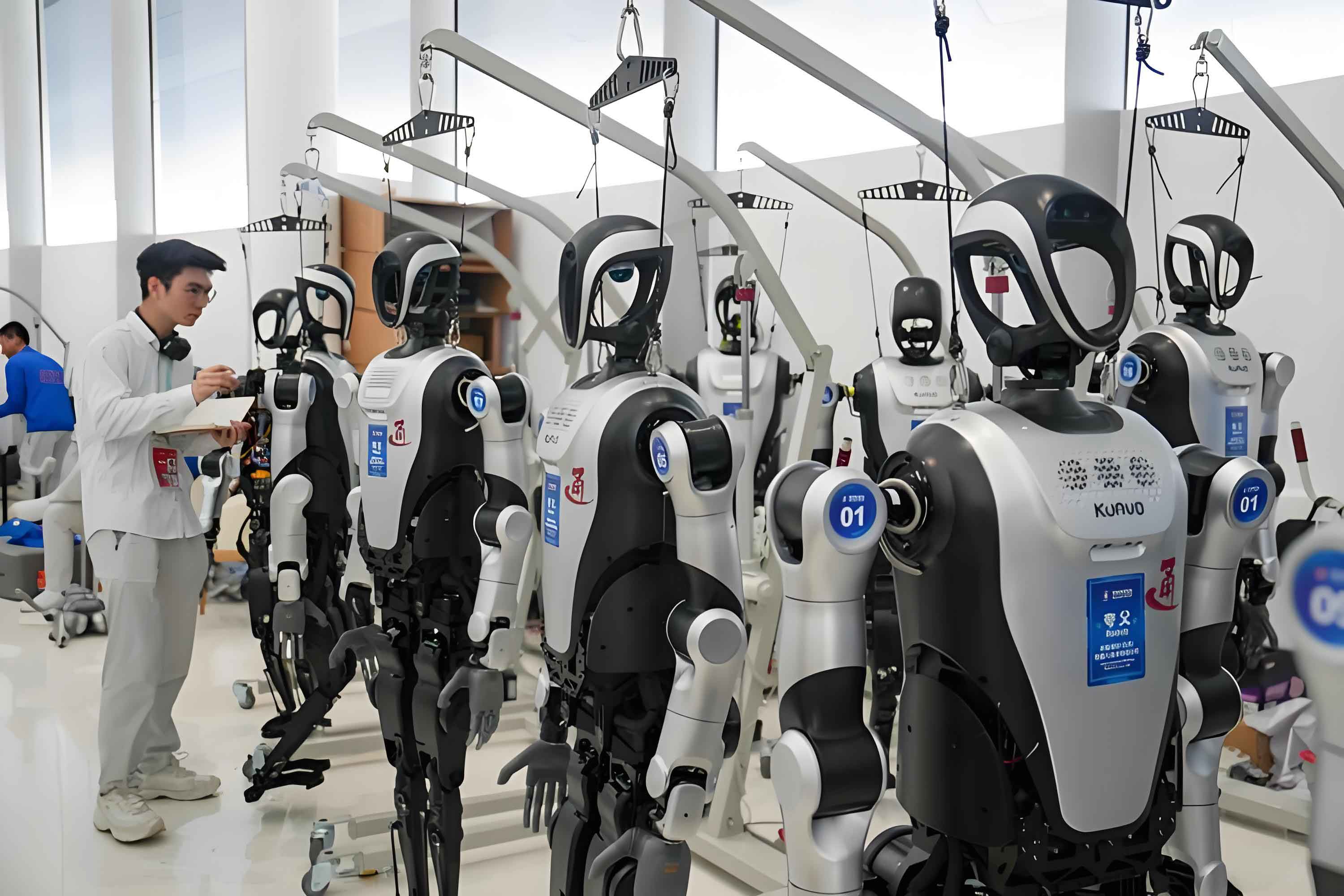
This image underscores the hands-on approach we emphasize, where students engage with actual humanoid robot hardware to understand mechanical integrity, sensor calibration, and performance testing. By incorporating such real-world elements, we make abstract theories tangible and actionable.
Innovations in Collaborative Models
Our first major reform lies in redefining the industry-academia partnership. Traditionally, academic courses focused heavily on theory, leaving students underprepared for industry demands. Recognizing this, we collaborated with leading robotics companies to co-develop the humanoid robot training curriculum. This synergy allows us to integrate cutting-edge humanoid robot technologies into the classroom, such as advanced control algorithms, computer vision systems, sensor fusion techniques, and simulation tools. The collaboration is structured around a mutual goal: aligning market needs with educational outcomes. We established a framework where company experts contribute to curriculum design, provide hardware like bipedal humanoid robots, and offer training sessions for both faculty and students. This model ensures that our course content remains current with industry trends, such as the adoption of machine learning for humanoid robot gait optimization or the use of ROS (Robot Operating System) for software development.
A key aspect is the modular专题 approach, where students form groups based on interests, such as humanoid robot locomotion, vision-based navigation, or human-robot interaction. Each module is designed to be self-contained yet interconnected, fostering deep learning. For example, in a module on humanoid robot balance control, students might derive the dynamics equations and then implement them on a physical robot. The collaboration extends beyond the classroom; we participate in national and international competitions, where students showcase their humanoid robot projects. This “competition-integrated learning” motivates students and exposes them to broader innovations in the humanoid robot field. The table below summarizes the collaborative framework:
| Collaboration Aspect | Description | Impact on Humanoid Robot Course |
|---|---|---|
| Curriculum Co-design | Industry experts help define learning objectives and content. | Ensures relevance to humanoid robot industry standards. |
| Hardware Provision | Companies supply latest humanoid robot models and kits. | Enables hands-on experimentation with real humanoid robots. |
| Joint Training Sessions | Workshops on humanoid robot programming and maintenance. | Enhances practical skills for humanoid robot development. |
| Competition Involvement | Teams participate in humanoid robot contests. | Boosts innovation and exposure in humanoid robot community. |
This collaborative model has transformed our course into a dynamic ecosystem where theory and practice converge. Students no longer view the humanoid robot as a distant concept but as a tangible platform for innovation. For instance, in a recent project, students used a humanoid robot to develop an assistive device for the elderly, applying knowledge from mechanics, control theory, and AI. Such projects are facilitated by industry partnerships, which provide technical support and mentorship.
Curriculum Content Organization: A Modular and Integrated Approach
The second innovation involves restructuring the course content into thematic modules that progress from foundational to advanced topics. We divide the humanoid robot training into three segments: Application Fundamentals, Technical Core, and Intelligent Systems. Each segment comprises multiple modules, as outlined in the table below, which details the Aelos实训-AirTag case study—a pivotal component of our course.
| Module Sequence | Content Outline | Learning Objectives for Humanoid Robot | Duration |
|---|---|---|---|
| 1. Robot Operation Basics | Parameters, hardware structure, desktop software for motion debugging. | Understand humanoid robot anatomy and basic control. | 2 hours |
| 2. Raspberry Pi Environment Setup | OS installation, Linux basics, remote connection, software development. | Set up embedded systems for humanoid robot programming. | 2 hours |
| 3. Python Programming Fundamentals | Variables, loops, functions, objects, library integration. | Code basic scripts for humanoid robot tasks. | 2 hours |
| 4. Python Control of Humanoid Robot | Lua logic on microcontrollers, Python APIs, motion control. | Implement humanoid robot movement via software. | 2 hours |
| 5. Introduction to Vision Processing | Camera data reading, OpenCV for color/shape recognition, ARtag detection. | Enable humanoid robot perception using computer vision. | 2 hours |
| 6. Comprehensive Practice | Dance choreography, obstacle navigation, stair climbing, ball kicking. | Integrate skills for complex humanoid robot missions. | 2 weeks |
This modular design allows students to build knowledge incrementally. In the Application Fundamentals segment, they learn about humanoid robot specifications and basic operations. For example, a humanoid robot’s degrees of freedom (DOF) are critical for mobility; a typical model might have 20+ DOF, enabling complex motions. We introduce formulas to calculate torque requirements for joints, such as:
$$ \tau = I \alpha + m g d \sin(\theta), $$
where \( I \) is the moment of inertia, \( \alpha \) is angular acceleration, \( m \) is mass, \( g \) is gravity, \( d \) is distance from joint to center of mass, and \( \theta \) is the joint angle. Through hands-on labs, students apply this to tune a humanoid robot’s servo motors, ensuring efficient movement.
The Technical Core delves into embedded systems and programming. Here, we emphasize the integration of sensors and actuators in a humanoid robot. For instance, inertial measurement units (IMUs) provide data for balance control, modeled by equations like:
$$ \dot{\omega} = \frac{\tau}{I} – \frac{b}{I} \omega, $$
with \( \omega \) as angular velocity and \( b \) as damping coefficient. Students program Raspberry Pi boards to process IMU data and adjust humanoid robot posture in real-time. This bridges theory with practice, as they see how differential equations translate to stable walking.
The Intelligent Systems segment focuses on AI-driven capabilities. We cover machine learning algorithms for humanoid robot decision-making, such as reinforcement learning for gait optimization. The reward function \( R \) in a Q-learning setup might be:
$$ R(s, a) = -k_1 \cdot \text{energy} + k_2 \cdot \text{stability} – k_3 \cdot \text{deviation}, $$
where \( s \) is state, \( a \) is action, and \( k_i \) are weights. Students train humanoid robots in simulation environments before deploying to physical models, reducing risks and costs. This modular approach ensures that every aspect of humanoid robot technology is addressed, from hardware to intelligence.
Teaching Methodology: From Lecturing to Guided Exploration
The third innovation shifts from traditional teacher-centered instruction to student-driven, guided learning. In our humanoid robot course, we employ a blend of discussion-based sessions, practical demonstrations, and project-based learning. Instead of passive listening, students actively engage with humanoid robot kits, debugging code, and testing algorithms. For example, in a session on humanoid robot locomotion, I might pose a problem: “How can we improve the energy efficiency of a bipedal humanoid robot?” Students then research, simulate, and experiment, using tools like MATLAB or Gazebo for modeling.
We leverage multimedia resources to explain complex concepts. Videos of humanoid robots in action, such as Atlas from Boston Dynamics, illustrate advanced mobility. Interactive software allows students to design humanoid robot motions virtually before implementation. This is complemented by the physical humanoid robots in our lab, where students assemble and calibrate components. The hands-on experience is crucial; as they adjust a humanoid robot’s gait, they learn about zero-moment point (ZMP) theory, which ensures dynamic stability. The ZMP condition is given by:
$$ x_{\text{ZMP}} = \frac{\sum m_i (z_i \ddot{x}_i – x_i \ddot{z}_i)}{\sum m_i (\ddot{z}_i + g)}, $$
where \( m_i \) are masses, \( (x_i, z_i) \) are coordinates, and \( g \) is gravity. By tweaking parameters, students see how theory affects a humanoid robot’s balance.
Group work is encouraged to foster teamwork and creativity. Each team selects a humanoid robot project, such as developing a soccer-playing humanoid robot or a caregiving assistant. They follow an iterative design process: conceptualization, simulation, prototyping, and testing. I act as a facilitator, providing guidance rather than answers. For instance, when a team struggled with a humanoid robot’s vision system for object detection, I directed them to OpenCV documentation and peer-reviewed papers on convolutional neural networks (CNNs). This promotes self-learning, a vital skill in the fast-evolving humanoid robot industry.
Moreover, we incorporate real-time feedback mechanisms. Using sensors on the humanoid robot, students collect data on performance metrics like power consumption or step accuracy. They analyze this data with statistical tools, perhaps applying regression models to optimize parameters. For example, a linear regression for motor torque vs. speed might be:
$$ \tau = \beta_0 + \beta_1 \omega + \epsilon, $$
where \( \beta_i \) are coefficients and \( \epsilon \) is error. Through such activities, students gain a holistic understanding of humanoid robot systems, blending engineering, data science, and problem-solving.
Assessment Reforms: Emphasizing Practical Competence
The fourth innovation overhauls assessment to focus on applied skills and innovation. Instead of relying solely on exams, we evaluate students through comprehensive projects, presentations, and competition performances. At the end of the course, each team demonstrates their humanoid robot in a mock competition scenario, similar to the “Comprehensive Practice” module. They must complete tasks like navigating obstacles, climbing stairs, and performing choreographed dances, all within time limits.
The grading rubric is multifaceted, as shown in the table below, which aligns with humanoid robot competencies.
| Assessment Component | Weight | Criteria Related to Humanoid Robot |
|---|---|---|
| Project Implementation | 40% | Functionality of humanoid robot in tasks (e.g., stability, accuracy). |
| Technical Report | 30% | Documentation of humanoid robot design, algorithms, and results. |
| Oral Presentation | 20% | Clarity in explaining humanoid robot systems and innovations. |
| Peer Evaluation | 10% | Teamwork in humanoid robot development process. |
This approach ensures that students are judged on their ability to integrate knowledge into a working humanoid robot. For example, in a recent assessment, a team developed a humanoid robot that could recognize and respond to voice commands using natural language processing. Their report included mathematical models for speech recognition accuracy, such as:
$$ P(\text{word} | \text{audio}) = \frac{P(\text{audio} | \text{word}) P(\text{word})}{P(\text{audio})}, $$
applying Bayes’ theorem. By presenting this, they demonstrated cross-disciplinary mastery.
Furthermore, we link assessments to external competitions. Top-performing projects are entered into events like RoboCup or IEEE humanoid robot challenges. This “competition as assessment” model motivates students to excel and provides industry recognition. For instance, a student-designed humanoid robot that achieved efficient stair climbing won accolades, reinforcing the value of practical skills. The competition tasks often involve complex equations, such as calculating the trajectory for a humanoid robot to kick a ball:
$$ y = x \tan(\theta) – \frac{g x^2}{2 v_0^2 \cos^2(\theta)}, $$
derived from projectile motion, where \( v_0 \) is initial velocity and \( \theta \) is launch angle. Students must optimize these parameters for their humanoid robot, blending physics with engineering.
Regular formative assessments, like quizzes on humanoid robot concepts, are also used but are low-stakes. They help identify gaps early, such as misunderstandings about PID control for humanoid robot joints, expressed as:
$$ u(t) = K_p e(t) + K_i \int_0^t e(\tau) d\tau + K_d \frac{de(t)}{dt}, $$
where \( e(t) \) is error and \( K_p, K_i, K_d \) are gains. Through iterative feedback, students refine their humanoid robot designs, culminating in a summative project that showcases their growth.
Expanding the Impact: Future Directions and Conclusion
The reforms in our humanoid robot training course have yielded tangible benefits. Student engagement has soared, with participation in robotics clubs and competitions increasing by over 50%. Projects have led to prototypes for assistive humanoid robots, demonstrating social impact. For example, one team created a humanoid robot that helps with physical therapy, using motion capture to guide patients. The success stems from the synergistic industry-academia model, which keeps the curriculum aligned with technological advancements.
Looking ahead, we plan to deepen collaborations by establishing joint research labs focused on humanoid robot AI and ethics. We aim to integrate more simulation tools, such as digital twins for humanoid robots, allowing students to experiment virtually before physical deployment. Additionally, we will expand the course to include modules on humanoid robot safety standards and ethical considerations, ensuring responsible innovation. The mathematical frameworks will evolve too; we might incorporate deep learning models for humanoid robot perception, represented by neural network equations like:
$$ a^{(l)} = \sigma(W^{(l)} a^{(l-1)} + b^{(l)}), $$
where \( \sigma \) is an activation function, \( W \) are weights, and \( b \) are biases. This will prepare students for next-generation humanoid robots capable of autonomous learning.
In conclusion, the humanoid robot training course reforms have transformed education from a theoretical exercise into a dynamic, practice-oriented journey. By embracing industry partnerships, modular content, interactive teaching, and competency-based assessment, we equip students with the skills to thrive in the humanoid robot industry. The humanoid robot is more than a technological marvel; it is a catalyst for educational innovation, and through these efforts, we are nurturing the innovators who will shape its future. As we continue to refine our approach, the focus remains on empowering learners to turn ideas into functional humanoid robots, bridging the gap between academia and the real world.