
In the tile mosaic industry, the process involves cutting ceramic tiles into various components using waterjets and then assembling these components of different materials, shapes, and sizes into a complete mosaic pattern. Currently, this assembly relies heavily on manual labor, leading to inefficiencies and inconsistent quality. With the rapid advancement of robotic technology, there is a growing trend toward automating tile mosaic assembly. A critical aspect of this automation is the robotic picking and placing of tile components, which presents significant challenges due to the diverse shapes and sizes of the parts. Conventional vacuum adsorption methods, often used for flat and regular components, typically employ fixed suction cup arrangements. However, for irregular and variably sized tile components, a more adaptive approach is required. This necessitates the development of a robotic end effector with adjustable adsorption points and an intelligent planning algorithm to ensure stable and reliable grasping.
To address these challenges, I have designed a novel robotic end effector, referred to as the adjustable vacuum adsorption device, along with a multi-point adsorption control system and an optimization algorithm for adsorption point planning. The core innovation lies in the end effector’s ability to dynamically adjust the positions of multiple suction cups based on the component’s contour, thereby achieving optimal adsorption stability. This article details the design, algorithm, and experimental validation of this system, demonstrating its feasibility and adaptability for tile mosaic applications. Throughout this work, the term ‘end effector’ is emphasized as the key component enabling flexible automation.
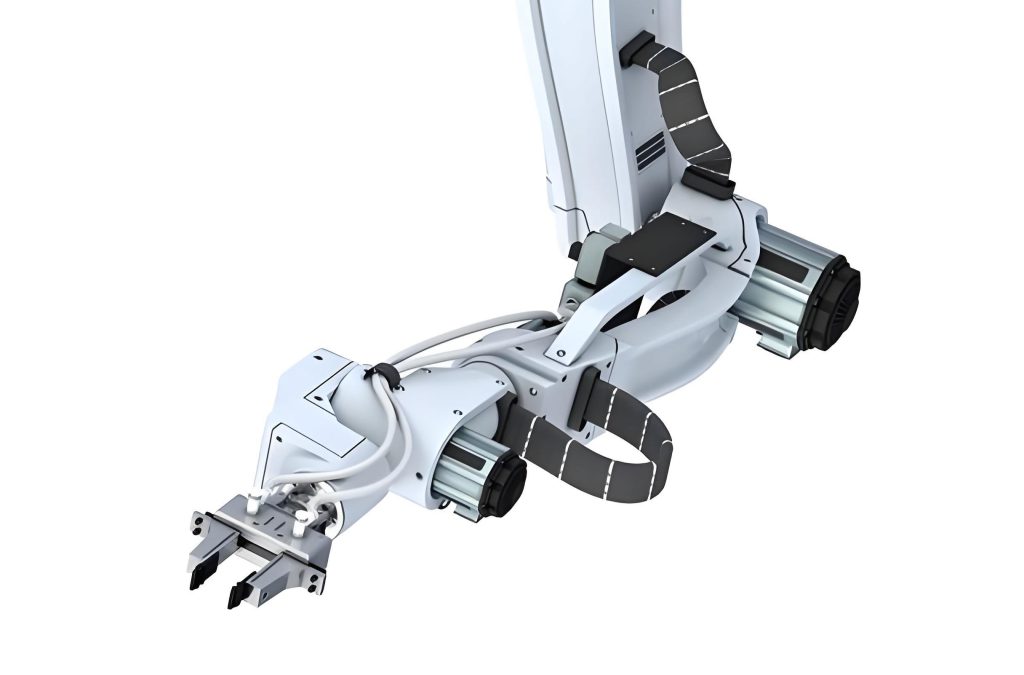
The adjustable vacuum adsorption device is a crucial part of the robotic end effector. It consists of a stepper motor, three vacuum suction cups, three slider-guide rod mechanisms, a synchronous belt, a synchronous pulley, two toothed idler pulleys, three idler pulleys, an upper frame, and a lower frame. The structural layout is designed to allow radial adjustment of the adsorption points relative to the tool center point (TCP) of the end effector. The lower frame features three support arms arranged at 120-degree intervals. Each arm is equipped with a slider-guide rod mechanism, and a vacuum suction cup is mounted at the bottom of each slider. The central TCP also houses a suction cup for small components. The synchronous belt is routed around the pulley and idlers, parallel to each guide rod, with all sliders fixed to the belt. Actuation of the stepper motor rotates the pulley, causing the synchronous belt to move and thereby translating the sliders along the guide rods. This design enables the radial distance of each adsorption point from the TCP to be adjusted within a range of 50 mm to 140 mm, accommodating a wide variety of component sizes. For small components, a single suction cup at the TCP can be used, while larger components employ multiple cups in various configurations. This adjustable mechanism is fundamental to the versatility of the robotic end effector.
The multi-point adsorption control system integrates various hardware and software components to orchestrate the picking and placing operations. The system comprises an industrial camera, an industrial PC, a six-degree-of-freedom industrial robot, the adjustable vacuum adsorption end effector, and a programmable logic controller (PLC). The industrial robot’s end effector is the adjustable vacuum adsorption device. The workflow begins with the industrial camera capturing an image of a tile component placed on a backlit panel. The image is transmitted to the industrial PC via TCP/IP Ethernet. The PC performs image processing and runs the adsorption point planning algorithm. Based on the algorithm’s output, the PC sends the desired end effector pose to the robot and transmits control signals to the PLC via RS485 serial communication. The PLC then generates pulse signals to drive the stepper motor for adjusting the suction cup positions and controls the on/off states of the solenoid valves for the vacuum generators. Pressure sensors monitor the vacuum level at each cup to confirm successful adsorption. This closed-loop control ensures precise and reliable operation of the end effector.
The heart of the intelligence in this system is the multi-adsorption point optimization planning algorithm. Its primary objective is to determine the optimal number and positions of adsorption points on a given tile component to maximize grasping stability. Stability is evaluated based on the distribution of adsorption points relative to the component’s center of mass. For planar components without internal contours, a key metric is the radius of the circumcircle formed by the adsorption points. A larger radius, with points farther from the center of mass, generally reduces the overturning moment during manipulation, enhancing stability. The stability evaluation function can be initially expressed as:
$$ T(R, L) = \beta_1 \cdot R – \beta_2 \cdot L $$
where \( R \) is the radius of the circumcircle formed by the adsorption points, \( L \) is the distance between the end effector’s TCP and the component’s center of mass \( G \), and \( \beta_1 \) and \( \beta_2 \) are weighting factors. If we neglect the offset between the TCP and the center of mass (by planning with \( G \) as the reference), the function simplifies to \( T(R) = R \). However, to account for components of different shapes and sizes, a more generalized stability optimization function is proposed:
$$ T(d, r, n) = \alpha_1 \cdot \frac{d}{r} + \alpha_2 \cdot n $$
Here, \( d \) represents the distance of the adsorption points from the center of mass \( G \), \( r \) is the radius of the minimum enclosing circle of the component centered at \( G \) (describing the component’s spatial extent), and \( n \) is the number of adsorption points used. The weighting factors \( \alpha_1 \) and \( \alpha_2 \) balance the influence of point distance and point count. Maximizing \( T(d, r, n) \) leads to an adsorption plan that optimally trades off between placing points far from the center and using a sufficient number of points for the given shape. This optimization is central to the algorithm’s performance.
The algorithm’s workflow involves several image processing and geometric computation steps. First, the component image is acquired and preprocessed using OpenCV functions for filtering and binarization to separate the component from the background. The contour of the component is extracted using the findContours() function. The contour moments are computed to determine the center of mass \( G \). The algorithm checks for internal contours (hollow regions); if present, the overall center of mass is calculated considering the areas of all contours. To define safe adsorption regions, the contour is eroded inward (and internal contours expanded outward) using a circular structural element with a radius slightly larger than that of a suction cup. This creates a modified contour representing areas where the suction cup can safely contact the component without overlapping edges.
Next, an axis-aligned bounding box (AABB) is constructed for the modified contour. The algorithm decides between a two-point and a three-point planning mode based on the dimensions of this bounding box relative to the end effector’s minimum adsorption range \( R_{min} \). If both length and width exceed \( R_{min} \), the three-point mode is used; if only one dimension exceeds \( R_{min} \), the two-point mode is attempted. For components smaller than \( R_{min} \), a single-point adsorption at the center of mass \( G \) is used.
In three-point planning mode, the algorithm searches for three points on the modified contour that are approximately 120 degrees apart relative to \( G \). It iterates over points on the contour within the admissible radial range \([R_{min}, R_{max}]\) from \( G \). For each candidate point \( A \), the corresponding points \( E \) and \( F \) are found by rotating \( \pm 120^\circ \) around \( G \). If both \( E \) and \( F \) lie within the component’s original contour, the circumcircle radius \( R \) for triangle \( AEF \) is computed. The configuration yielding the maximum \( R \) is selected as optimal. The search ensures that points are within the admissible range and on the modified contour, guaranteeing stable contact.
In two-point planning mode, the goal is to find two opposing points on the modified contour that are as far apart as possible along a line passing near the center of mass. Starting from a point \( E \) on the contour within the admissible range, the line through \( E \) and \( G \) is extended to intersect the AABB at points \( P_1 \) and \( P_2 \). From \( P_2 \) towards \( G \), the algorithm searches for the farthest point \( F \) on the modified contour within the admissible range. This pair \( (E, F) \) is evaluated, and the process is repeated for different starting points \( E \) to maximize the distance \( d \). The algorithm records all viable adsorption point configurations, including their radial adjustment values and the corresponding end effector pose.
The performance of the end effector and algorithm was validated through experiments. The setup included an IRB2600 industrial robot, a MER-2000-19U3M camera, and the custom-built adjustable vacuum adsorption end effector. Tile components with diverse shapes—such as regular polygons, elongated pieces, and components with internal cutouts—were placed randomly on a backlit panel. The camera captured images, and the algorithm computed the adsorption points. The robot then executed the pick-and-place operations successfully. Table 1 summarizes the adsorption parameters and stability evaluation for several representative components, with weighting factors set as \( \alpha_1 = \alpha_2 = 1 \) for illustration.
| Component ID | Shape Description | \( d \) (mm) | \( r \) (mm) | \( n \) | \( T(d, r, n) \) | \( T_{\text{max}} \) |
|---|---|---|---|---|---|---|
| 1 | Elongated rectangle | 117.18 | 165.74 | 2 | 2.71 | 3.0 |
| 2 | Large irregular shape | 155.26 | 255.72 | 4 | 4.61 | 5.0 |
| 3 | Complex polygon | 177.01 | 259.50 | 3 | 3.68 | 5.0 |
| 4 | Shape with internal contours | 146.10 | 198.98 | 4 | 4.73 | 5.0 |
| 5 | Small circular piece | 0.00 | 50.00 | 1 | 1.00 | 1.0 |
| 6 | Thin elongated piece | 128.59 | 219.31 | 2 | 2.59 | 3.0 |
The results indicate that the algorithm successfully plans adsorption points that maximize stability within the constraints of each component’s geometry. For large components (IDs 2, 3, 4), the maximum stability index \( T_{\text{max}} \) approaches 5, utilizing three or four adsorption points. For elongated components (IDs 1, 6), \( T_{\text{max}} \) is 3, reflecting the limitation imposed by their narrow width, which restricts point placement. The small component (ID 5) relies on single-point adsorption at the center of mass. The experiments confirm that the robotic end effector, guided by the planning algorithm, can reliably pick up components of various shapes and sizes. The adjustable nature of the end effector is key to this adaptability.
To further analyze the system’s performance, we can derive the theoretical force balance during adsorption. For an end effector using \( n \) suction cups, each with an effective adsorption force \( F_i \), the total holding force \( F_{\text{total}} \) must counteract the component’s weight \( W \) and any dynamic loads. Assuming the component is planar and the forces are perpendicular, stability against tipping is crucial. The overturning moment \( M \) about a pivot axis depends on the distribution of adsorption points. If the adsorption points are located at positions \( \mathbf{p}_i = (x_i, y_i) \) relative to the center of mass \( G \), and the weight acts at \( G \), then for a tilt angle \( \theta \), the moment is approximately:
$$ M \approx W \cdot h \cdot \sin\theta – \sum_{i=1}^{n} F_i \cdot d_i \cdot \cos\theta $$
where \( h \) is the height of the center of mass above the adsorption plane, and \( d_i \) is the distance from \( G \) to the projection of point \( i \). For stability, \( M \leq 0 \). Maximizing \( \sum F_i \cdot d_i \) enhances stability. In our case, with uniform suction cups, \( F_i \) is constant, so maximizing the sum of distances \( \sum d_i \) is equivalent to maximizing the circumcircle radius \( R \) in the simplified model. This aligns with the optimization function \( T \).
The algorithm’s computational complexity is manageable for real-time application. The image processing steps (filtering, contour extraction) have polynomial time complexity relative to image resolution. The planning steps involve iterating over contour points; in the worst case, for a contour with \( N \) points, the three-point search is \( O(N^2) \), but practical contours have limited points after preprocessing, and the admissible range constraints reduce the search space. The entire process typically completes within a few hundred milliseconds on a standard industrial PC, suitable for production cycles.
Future improvements could involve extending the algorithm to handle non-planar or curved components, incorporating dynamic adjustment during motion to counteract inertial forces, and integrating machine learning to predict optimal adsorption configurations based on historical data. Additionally, the end effector design could be enhanced with more degrees of freedom, such as independent control of each suction cup’s orientation, further increasing its versatility.
In conclusion, the developed robotic end effector and adsorption point planning algorithm effectively address the challenges of automating tile mosaic assembly. The adjustable vacuum adsorption end effector provides the physical adaptability needed for diverse component shapes and sizes. The multi-point adsorption control system ensures coordinated operation. The optimization algorithm, based on a stability criterion, intelligently plans adsorption points to achieve reliable grasping. Experimental validation confirms the system’s feasibility and performance. This work demonstrates a significant step toward fully automated tile mosaic production, highlighting the critical role of an intelligent and flexible end effector in robotic manufacturing applications. The integration of adjustable mechanics, computer vision, and optimization algorithms paves the way for broader adoption of robotics in industries dealing with irregular and variable components.