
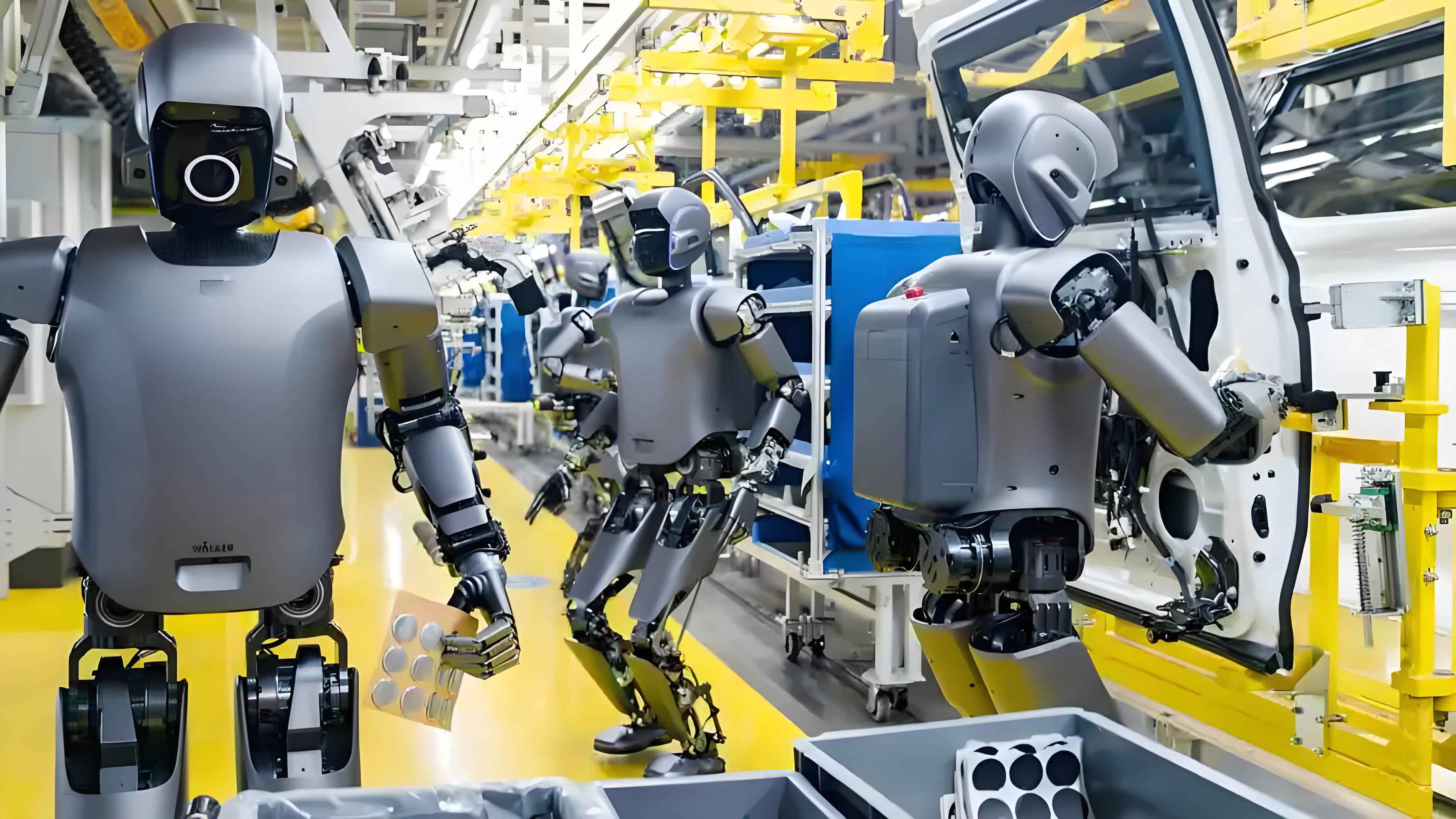
The humanoid robot sector has emerged as a focal point for capital inflows in China’s A-share market. On February 19, robot concept stocks surged across the board, with companies like Sanfeng Intelligent and Shuanglin Co., Ltd. hitting their daily upside limits. Robotics industry ETFs climbed over 6%, while the Choice Robot Concept Index has accumulated gains exceeding 16% year-to-date. This momentum underscores the accelerating expansion of the global robot Industry.
Changshu Bearing exemplifies this trend, reaching a historic peak after its stock rose by the daily limit. Specializing in self-lubricating bearings and high-performance polymers, the company disclosed in its February 18 investor briefing that its collaboration with Unitree Robotics is progressing. Contracts have been signed and orders secured for self-lubricating bearings deployed in robotic joints. While these products have entered small-batch production, they currently represent less than 1% of total revenue. This development highlights incremental advancements within the broader robot Industry ecosystem.
1. Driving Forces Behind the Robot Industry Surge
Analysts attribute the humanoid robot sector’s momentum to a convergence of technological evolution, market demand, and policy support. The thematic investment phase is transitioning toward growth-stage investing, demonstrating robust sector-wide effects. The robot Industry is gaining structural support from government initiatives promoting advanced manufacturing and automation. Industrial upgrading programs across major economies have designated robotics as strategic priority, accelerating commercial adoption. This policy alignment creates fertile ground for sustained expansion across the robot Industry value chain.
Unitree Robotics’ recent achievements have provided immediate catalysts. On February 14, the company announced algorithmic upgrades enabling fluid dance performances by its humanoid robots, accompanied by demonstration videos. Public skepticism about the footage’s authenticity prompted Unitree to release a second video on February 19, showcasing a robot dancing before a mirror while maintaining seamless movements despite physical disruptions from a staff member using a stick. These demonstrations validate significant progress in robotic motion control systems.
2. Industrial Timeline for Commercialization
Unitree CEO Wang Xingxing outlined ambitious projections: “Before the end of 2025, the entire AI humanoid robot Industry will reach a new scale. If development proceeds smoothly, basic applications in service and industrial sectors could become widespread by 2026 or 2027. Household adoption may follow later due to stricter safety requirements.” These forecasts align with analysts’ consensus that 2025 represents the critical mass-production inflection point for the robot Industry.
Meng Pengfei, Chief Machinery Analyst at Kaiyuan Securities, emphasized: “2025 marks the first year of mass production for humanoid robots. Industry leaders like Tesla are approaching final productization, and early suppliers securing contracts will capture substantial growth.” Guojin Securities anticipates a commercial explosion by 2026. Global participation in the robot Industry has intensified dramatically, with established industrial automation firms and tech giants accelerating prototypes toward manufacturing readiness. This transition from laboratory demonstrations to factory production lines signifies maturation within the robot Industry.
3. Hardware Investment Priorities
Market attention concentrates on precision components within the humanoid robot supply chain. Roller screws have emerged as particularly critical according to multiple securities firms. Man Zaipeng, Chief Machinery Analyst at Guojin Securities, noted: “Screw manufacturing presents the highest technical barriers and most severe capacity constraints. Being capital-intensive and labor-dependent, rapid production scaling is challenging. Existing domestic capacity remains insufficient for mass humanoid robot production.” The East China automation cluster reports lead times for precision screws extending beyond 6 months, reflecting acute supply-demand imbalances. This component shortage represents both a bottleneck and significant growth opportunity within the robot Industry.
Component barriers have been systematically evaluated by research teams. Dongwu Securities’ New Energy team established this hierarchy: roller screws > sensors > harmonic reducers > hollow-cup motors. International robotics manufacturers currently source over 80% of high-precision screws from German and Japanese suppliers, creating substantial import substitution potential for Chinese players entering the robot Industry supply chain.
4. Software Architecture Development
Guojin Securities delineates robotic software architecture into “brain” and “cerebellum” functions. The brain handles environmental perception and cognitive decision-making, while the cerebellum manages complex motion control across dozens of degrees of freedom. Advancements in AI large models are enhancing brain capabilities, with multimodal systems now processing visual, auditory, and tactile inputs simultaneously.
The cerebellum remains particularly challenging, requiring integrated sensor fusion, dynamic modeling, and real-time controllers. Current limitations involve insufficient training data for high-dimensional movements and computational latency in motion planning. Research priorities focus on improving algorithm interpretability and real-time performance. Breakthroughs in reinforcement learning have enabled more adaptive locomotion, though dexterous manipulation tasks still require significant development. Progress in this domain will determine how quickly the robot Industry achieves commercial viability for complex applications.
5. Cross-Industry Synergies
Research institutions highlight substantial technological convergence between humanoid robots and smart vehicles. Wu Kaida, Chief Strategy Analyst at Tianfeng Securities, observed: “The robot Industry fundamentally involves manufacturing where cost reduction is paramount. The electric vehicle sector provides an excellent reference point. Robotics currently resembles EVs circa 2017-2018, requiring scaled production to achieve cost targets for broader adoption.”
This synergy manifests in multiple domains: lithium battery systems adapted from EVs power robotic platforms; automotive-grade sensors and control units are being repurposed; and autonomous driving algorithms inform navigation systems. Manufacturing techniques perfected during EV production scaling, particularly high-pressure die casting and automated assembly, directly transfer to robot production. Supply chain overlaps extend to semiconductor solutions, with companies like Nvidia developing chipsets serving both autonomous vehicles and robotic systems. These cross-industry efficiencies accelerate development cycles within the robot Industry.
6. Global Market Implications
International competition within the robot Industry is intensifying. While Chinese firms demonstrate strong component manufacturing capabilities, Japanese and European companies maintain advantages in precision reduction gears and control systems. The United States leads in AI integration and cloud-based robotic learning platforms. Global consultancy data projects the humanoid robot market expanding from $1.5 billion in 2024 to $38 billion by 2030, representing a compound annual growth rate exceeding 60%. This growth trajectory will require unprecedented scaling across the entire robot Industry value chain.
Labor economics research indicates potential displacement of 4 million manufacturing jobs by humanoid robots by 2030, primarily in electronics assembly and automotive sectors. Conversely, the robot Industry itself will generate approximately 2.5 million new positions in robotics engineering, maintenance, and AI training. This workforce transition represents one of the most significant industrial transformations since the digital revolution.
7. Investment Landscape Evolution
Capital allocation within the robot Industry is shifting toward companies demonstrating tangible technological differentiation. Early-stage investments previously concentrated on AI software developers, but recent funding rounds show increasing focus on hardware innovators solving specific mechanical challenges. Venture capital tracking reveals $4.2 billion invested globally in robotics startups during Q4 2024, with 60% directed toward component manufacturers addressing critical bottlenecks like precision actuation and tactile sensing.
Public market valuations reflect this maturation. Companies with verified prototypes and industrial partnerships command significant premiums over concept-stage peers. The divergence highlights investors’ increasing emphasis on commercial pathways within the robot Industry. Manufacturing scalability and unit economics now feature prominently in analyst evaluations, replacing earlier speculative metrics.
8. Technical and Regulatory Challenges
Persistent technical hurdles include energy density limitations, with current battery systems restricting operational duration to 4-8 hours for most humanoid platforms. Materials science innovations in solid-state batteries and hydrogen fuel cells show promise for extending work cycles. Safety certification presents another complex frontier, particularly for human-robot interaction environments. Regulatory frameworks are evolving slower than technological capabilities, with standardization bodies just beginning to establish testing protocols for bipedal robots in workplaces.
Cybersecurity vulnerabilities represent emerging concerns as networked robots handle sensitive industrial data. The robot Industry must develop robust encryption standards and intrusion detection systems specifically for collaborative robotic applications. These challenges notwithstanding, the fundamental trajectory remains clear: the convergence of AI, advanced mechanics, and manufacturing scale is positioning the robot Industry for transformative growth through the latter half of this decade.