
The increasing demand for high-precision optical components across diverse fields, from astronomy to consumer electronics, presents significant challenges for traditional manufacturing methods in terms of both figure accuracy and production throughput. Conventional computer-controlled polishing machines, while highly precise, are often complex, expensive, and designed for singular, large-scale tasks. In this context, industrial robots offer a compelling alternative platform due to their inherent multi-degree-of-freedom flexibility, large working volume, and relatively lower cost, paving the way for more accessible and potentially batch-oriented optical manufacturing. However, the realization of this potential hinges critically on the development of specialized, compact, and efficient end-effectors tailored to the stringent requirements of optical finishing. This article details the design, analysis, and experimental validation of a novel robotic end-effector for spherical wheel polishing, engineered to provide stable polishing force and achieve controllable orbital and rotational motion parameters essential for modern deterministic polishing processes.
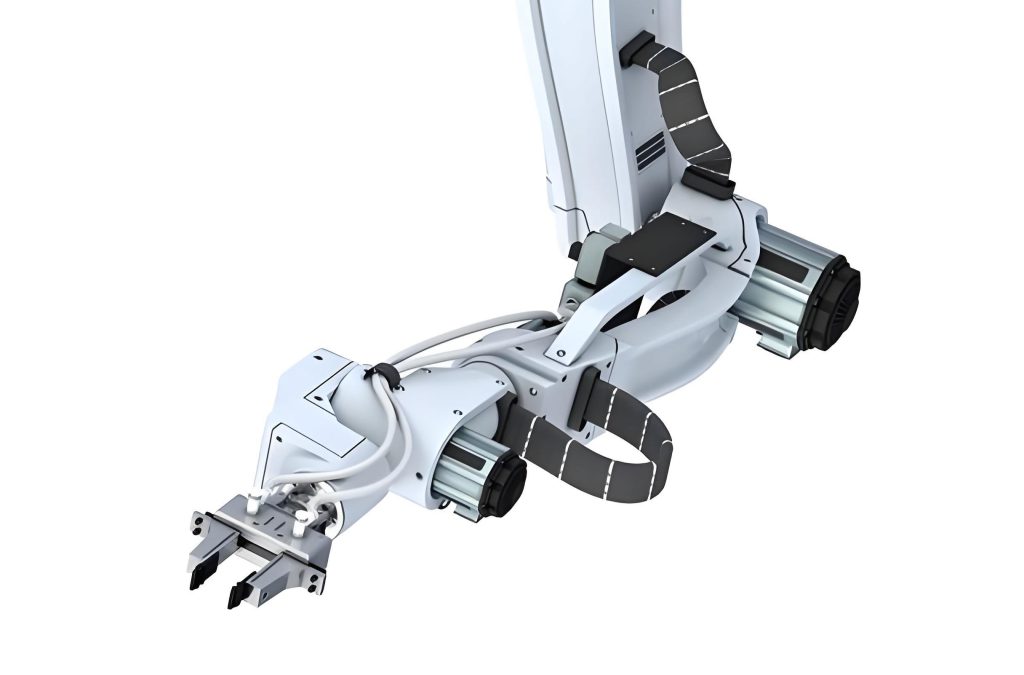
The core requirement for the end-effector is to generate a composite motion where a spherical polishing tool undergoes both its own rotation (spin) and an orbital revolution around a central axis. This dual-motion scheme, compared to spin-only tools, promotes more uniform material removal and higher convergence rates by averaging out tool and process asymmetries. Furthermore, the end-effector must maintain a constant normal force against the workpiece to ensure a stable and predictable removal function, a cornerstone of computer-controlled optical surfacing (CCOS) techniques. The design was driven by objectives of functional integration, precision, stiffness, ease of maintenance, and operational safety, all while maintaining a form factor suitable for mounting on a standard industrial robot flange.
Mechanical Architecture of the Wheel Polishing End-Effector
The developed end-effector, designated KJLP-1.0, is a modular assembly integrating six key functional subsystems: a constant-force output component, a drive motor assembly, a planetary gear train component, a bevel gear shaft assembly, a belt transmission component, and the spherical polishing tool assembly. The overarching design philosophy employs a single servo motor to drive both the orbital and rotational motions through a clever kinematic decomposition, thereby minimizing size, weight, and cost.
The heart of the motion synthesis is the planetary gear train. This assembly consists of a central sun gear (Z3 = 70), two planetary gears (Z2 = 20), and an outer ring gear (Z1 = 30) which is held stationary. The motor drives the planetary carrier. According to the fundamental formula for planetary gear trains, the relationship between the angular velocities is given by:
$$
\omega_{carrier} : \omega_{sun} = (1 + \frac{Z_3}{Z_1}) : 1
$$
Substituting our gear teeth numbers:
$$
\frac{\omega_{carrier}}{\omega_{sun}} = 1 + \frac{70}{30} = \frac{10}{3} \approx 3.33
$$
This means the sun gear rotates approximately 3.33 times faster than the planetary carrier. The carrier’s rotation provides the orbital (revolution) motion for the polishing tool assembly, while the sun gear’s rotation is the input for the tool’s own spin (rotation).
To transmit the spin motion from the sun gear output shaft to the spherical polishing tool, which is mounted off-axis on the revolving carrier, a combination of a 45-degree, 1:1 ratio bevel gear pair and a synchronous belt drive is used. The belt drive, chosen over spur gears for this stage, offers several advantages for this end-effector application: it reduces the need for high-precision gear machining, dampens vibrations, and importantly, increases transmission efficiency. The efficiency of a spur gear stage is typically around 98% per pair, but multiple pairs and alignment issues can reduce overall system efficiency. The belt drive significantly simplifies this path. Comparative analysis indicates the transmission efficiency from the motor to the polishing tool improved from approximately 73.5% in an initial gear-based concept to 85.7% with the implemented belt drive system. The synchronous belt length is determined by the standard equation:
$$
L_p = 2C + \frac{\pi(D_{p1} + D_{p2})}{2} + \frac{(D_{p2} – D_{p1})^2}{4C}
$$
Where \(C\) is the center distance (82 mm) and \(D_{p1}\), \(D_{p2}\) are the pitch diameters of the pulleys. For our 1:1 ratio identical pulleys, this simplifies to \(L_p = 2C + \pi D_p\).
A pneumatic constant-force actuator provides the essential stable polishing pressure. This component maintains a preset force normal to the workpiece surface, compensating for minor surface irregularities and robot positioning errors, which is vital for achieving a consistent material removal rate as described by the Preston equation. The spherical polishing tool itself is composed of a 50 mm radius core covered with a compliant 50 HRB polyurethane pad, which conforms slightly to the workpiece to establish a defined contact area.
The integrated end-effector’s key parameters are summarized below:
| Parameter | Value / Specification |
|---|---|
| Total Height (incl. force actuator & flange) | 535.5 ± 22 mm |
| Maximum Radial Diameter | Ø170 mm |
| Spherical Polishing Tool Radius | 50 mm |
| Total Mass | 11 kg |
| Motor Input Speed Range | 0 – 1000 rpm |
| Orbital (Revolution) Speed Output | 0 – 300 rpm |
| Rotational (Spin) Speed Output | 0 – 1000 rpm |
| Achievable Orbit-to-Spin Ratio (ωorbit : ωspin) | 3 : 10 |
Structural Integrity and Component Analysis
Ensuring the rigidity and durability of the end-effector is paramount, as deflections or vibrations directly translate into errors on the optical surface. Finite Element Analysis (FEA) was conducted on critical load-bearing components.
The bevel gear shaft transmits torque and is subject to belt tension. Static structural analysis under operational loads showed maximum deformation on the order of 95 nanometers and a maximum equivalent elastic strain of \(1.36 \times 10^{-6}\) mm/mm, values which are negligible for the intended application and confirm sufficient stiffness.
The polishing wheel shaft is a critically loaded component, supporting the reaction force from the polishing pressure (e.g., 30 N) and the belt tension. FEA results indicated a maximum deformation of approximately 0.1 micrometers, with the highest stress concentration located at the step where the shaft is supported by the U-shaped bracket. This confirmed the shaft’s design was adequate against bending and shear stresses.
The U-shaped polishing tool bracket connects the polishing wheel assembly to the planetary carrier and must be resistant to vibratory excitations. Modal analysis was performed to determine its natural frequencies. The first six modal frequencies are tabulated below:
| Mode Number | Natural Frequency (Hz) |
|---|---|
| 1 | 420.87 |
| 2 | 487.89 |
| 3 | 639.82 |
| 4 | 757.68 |
| 5 | 1591.2 |
| 6 | 1665.7 |
Given that the operational frequency spectrum of an industrial robot during polishing is primarily in the low-frequency range (typically 10-60 Hz), the bracket’s first natural frequency of 420.87 Hz is sufficiently high to avoid resonance, ensuring stable performance of the end-effector during machining.
Material Removal Function Modeling for the End-Effector
The material removal characteristic, or “removal function,” of a polishing tool is the footprint it leaves per unit time under constant process conditions. Predicting this function is essential for planning deterministic polishing campaigns. The modeling is based on the widely adopted Preston’s hypothesis:
$$
\frac{d\Delta Z(x, y, t)}{dt} = K \cdot P(x, y) \cdot V(x, y)
$$
where \(\Delta Z\) is the material removal depth at point \((x, y)\), \(K\) is the Preston coefficient (encompassing slurry, temperature, and material properties), \(P\) is the local pressure, and \(V\) is the relative velocity between the tool and workpiece. For a rotating and orbiting spherical end-effector, both \(P\) and \(V\) are non-uniform across the contact zone.
Pressure Distribution \(P(x, y)\): The contact between the compliant spherical tool and the rigid workpiece is modeled as a Hertzian contact. For a spherical tool of radius \(R_p\) pressed against a flat with a total force \(F\), the contact area is a circle of radius \(a\), given by:
$$
a = \left[ \frac{3F R_p (1-\nu^2)}{4E} \right]^{1/3}
$$
where \(E\) and \(\nu\) are the effective Young’s modulus and Poisson’s ratio of the tool-workpiece pair. The pressure distribution within this circular contact area follows a hemispherical profile:
$$
P(r) = P_0 \left( 1 – \frac{r^2}{a^2} \right)^{3/2}, \quad \text{with} \quad P_0 = \frac{5F}{2\pi a^2}
$$
where \(r = \sqrt{x^2 + y^2}\) is the radial distance from the contact center.
Velocity Distribution \(V(x, y, \theta)\): The velocity at any point under the tool is the vector sum of the orbital and rotational velocities. In a coordinate frame centered on the instantaneous contact point, with the tool center at a distance \(R_p\) from the orbital axis, the relative velocity magnitude is:
$$
V(r, \theta) = \sqrt{ (\omega_{orbit} R_p)^2 + (\omega_{spin} r)^2 + 2 \omega_{orbit} R_p \omega_{spin} r \cos\theta }
$$
where \(\theta\) is the angular position within the contact zone relative to the orbital direction.
Synthesized Removal Function: The instantaneous removal rate at a point \((r, \theta)\) is \(K \cdot P(r) \cdot V(r, \theta)\). The total removal per tool pass (or per unit time for a stationary tool) is found by integrating this rate over the contact area and the appropriate time interval. For a tool with a fixed orbit-to-spin ratio (e.g., 3:10), the time-averaged removal function \(R(r)\) becomes axisymmetric and can be expressed as:
$$
R(r) = K P_0 \int_{0}^{2\pi} \left( 1 – \frac{r^2}{a^2} \right)^{3/2} \sqrt{ (\omega_{o} R_p)^2 + (\omega_{s} r)^2 + 2 \omega_{o} R_p \omega_{s} r \cos\theta } \, d\theta
$$
where \(\omega_o\) and \(\omega_s\) are the orbital and spin angular speeds, respectively. Numerical evaluation of this integral for our end-effector parameters produces a removal function that is smooth, centrally peaked, and resembles a “Gaussian-like” distribution. This shape is highly desirable for convergence in CCOS, as it provides a stable, localized material removal footprint. This represents a significant advantage over spin-only end-effectors, which tend to produce “bullet-Gaussian” or comet-shaped removal functions that can induce mid-spatial frequency errors.
Experimental Validation of the Robotic End-Effector Performance
The performance of the KJLP-1.0 end-effector was validated through a series of polishing experiments conducted on a KUKA KR2700 industrial robot equipped with a vacuum chuck rotary stage.
1. Removal Function Characterization: Stationary (“spot”) polishing tests were performed on a Ø145 mm flat glass mirror to experimentally determine the removal function. The end-effector was held stationary relative to the workpiece for a fixed duration under controlled conditions: a constant force of 30 N, spindle speed of 100 rpm (resulting in \(\omega_{spin} = 100\) rpm, \(\omega_{orbit} = 30\) rpm), and with a standard cerium oxide slurry. The resulting surface profile, measured with an interferometer, confirmed a rotationally symmetric, Gaussian-like removal footprint with a full-width at half-maximum (FWHM) of approximately 5-6 mm. The shape stability was verified at multiple locations on the mirror, demonstrating the consistency of the end-effector’s performance.
2. Full-Aperture Polishing Experiment: To assess the end-effector’s capability for figure correction, a polishing run was executed on a Ø360 mm K9 glass aspheric mirror with a vertex radius of 2400 mm and a conic constant of -1. The initial surface error was 1576.87 nm PV (Peak-to-Valley) and 289.46 nm RMS (Root Mean Square). A raster toolpath with a 2 mm line spacing and a 2 mm step-over was programmed. The process parameters were: tool center path speed of 5 mm/s, rapid traverse speed of 100 mm/s, constant force of 10 N, and the same 100/30 rpm spin/orbit speeds. The total in-process machining time was 61 hours.
The final surface, measured with a Zygo interferometer, showed significant improvement, converging to 601.45 nm PV and 98.77 nm RMS. Critically, the polished surface did not exhibit pronounced “turned-down” or “turned-up” edges, which are common artifacts in polishing. This indicates that the dual-motion kinematics of the end-effector effectively mitigates edge effects, a major challenge in optical fabrication. The results from both experimental phases are consolidated below:
| Experiment | Workpiece | Key Parameters | Result / Conclusion |
|---|---|---|---|
| Removal Function Test | Ø145 mm Flat Mirror | Fixed-point, F=30 N, ωs=100 rpm, ωo=30 rpm | Stable, rotationally symmetric, Gaussian-like removal function confirmed. Essential for deterministic planning. |
| Figure Correction Test | Ø360 mm Aspheric Mirror (K=-1) | Raster path, F=10 N, ωs=100 rpm, ωo=30 rpm, 61 hrs machining. | Surface error converged from 1576.87 nm PV to 601.45 nm PV. Effective suppression of edge artifacts demonstrated. |
Conclusion
This article has presented the comprehensive design, analysis, and validation of a novel robotic wheel polishing end-effector for optical manufacturing. The end-effector successfully integrates a single-drive motor with a planetary gear train, bevel gears, and a synchronous belt transmission to generate a stable and controllable composite motion of orbital revolution and tool rotation, achieving a designed speed ratio of 3:10. The strategic use of a belt drive enhanced transmission efficiency to 85.7%. Structural integrity was verified through finite element analysis, ensuring the end-effector’s rigidity under operational loads. Based on Preston’s equation and Hertzian contact mechanics, a theoretical model for the tool’s removal function was derived, predicting the favorable Gaussian-like distribution that was later confirmed experimentally.
The practical efficacy of the end-effector was conclusively demonstrated through successful polishing experiments. The removal function was shown to be stable and well-behaved. Most importantly, a full-aperture polishing run on a 360 mm aspheric mirror achieved significant figure improvement while effectively suppressing edge effects, a critical benchmark for any optical polishing tool. The KJLP-1.0 end-effector embodies a compact, efficient, and high-performance solution that leverages the flexibility of industrial robots, making advanced optical polishing techniques more accessible for batch production and complex surface geometries. The design principles and validation methodology established herein provide a solid foundation for the further development of intelligent, robotic end-effectors for precision manufacturing.