
As I observe the rapid evolution of technology, two domains consistently capture my imagination: advanced robotics, particularly the dynamic realm of the robot dog, and the transformative shift towards autonomous retail systems. My journey into understanding these fields has revealed a fascinating interplay between mechanical mastery and digital intelligence. In this exploration, I will delve into the principles, applications, and converging futures of these technologies, frequently revisiting the iconic robot dog as a paradigm of mobility and adaptation.
The concept of a legged machine navigating complex terrain once seemed confined to science fiction. Today, companies pioneering in biomechanics have turned this into reality. The most prominent demonstrations come from entities specializing in dynamic robots, where the robot dog serves as a quintessential testbed. I find the core challenge to be dynamic balance—the ability to maintain stability while in motion or when subjected to external disturbances. This is not merely about standing upright; it’s about continuous, calculated adjustment. The governing physics can be modeled using equations of motion. For instance, the net torque ($\tau$) acting on a legged system is related to its angular acceleration ($\alpha$) and moment of inertia ($I$):
$$ \tau_{net} = I \frac{d\omega}{dt} = I \alpha $$
For a robot dog trotting on a slope, the control system must solve for the required joint torques in real-time to prevent tipping. This involves a complex optimization problem minimizing a cost function ($J$) that penalizes deviation from desired posture ($\mathbf{q}_d$) and excessive control effort ($\mathbf{u}$):
$$ J = \int_{0}^{T} \left( (\mathbf{q} – \mathbf{q}_d)^T \mathbf{Q} (\mathbf{q} – \mathbf{q}_d) + \mathbf{u}^T \mathbf{R} \mathbf{u} \right) dt $$
Here, $\mathbf{q}$ represents the generalized coordinates (joint angles, body orientation), and $\mathbf{Q}$ and $\mathbf{R}$ are weighting matrices. The success of a robot dog like the famed BigDog lies in its hydraulic actuation and sophisticated control algorithms that solve such problems milliseconds, allowing it to recover from a kick or traverse rubble. The evolution from BigDog to more advanced humanoids like Atlas signifies a leap in whole-body coordination. To illustrate the progression, I’ve compiled a comparison of key robotic platforms that emphasize leg-based mobility.
| Platform Name | Type | Key Feature | Balance Principle | Typical Application Scope |
|---|---|---|---|---|
| Early Quadruped Prototypes | Robot Dog (Precursors) | Static walking on flat surfaces | Static stability (always 3+ feet on ground) | Laboratory research |
| BigDog | Dynamic Robot Dog | Active balance via hydraulic legs | Dynamic stability (ZMP control) | Rough-terrain logistics, military load carriage |
| Spot/SpotMini | Agile Robot Dog | Electric actuation, quiet operation | Dynamic balance with perception | Inspection, construction sites, public safety |
| Atlas (Biped) | Humanoid Robot | Whole-body mobility, parkour moves | Model predictive control (MPC) | Search & rescue, advanced manipulation tasks |
The visual embodiment of this technology, particularly the sleek form of a modern quadruped, is compelling.
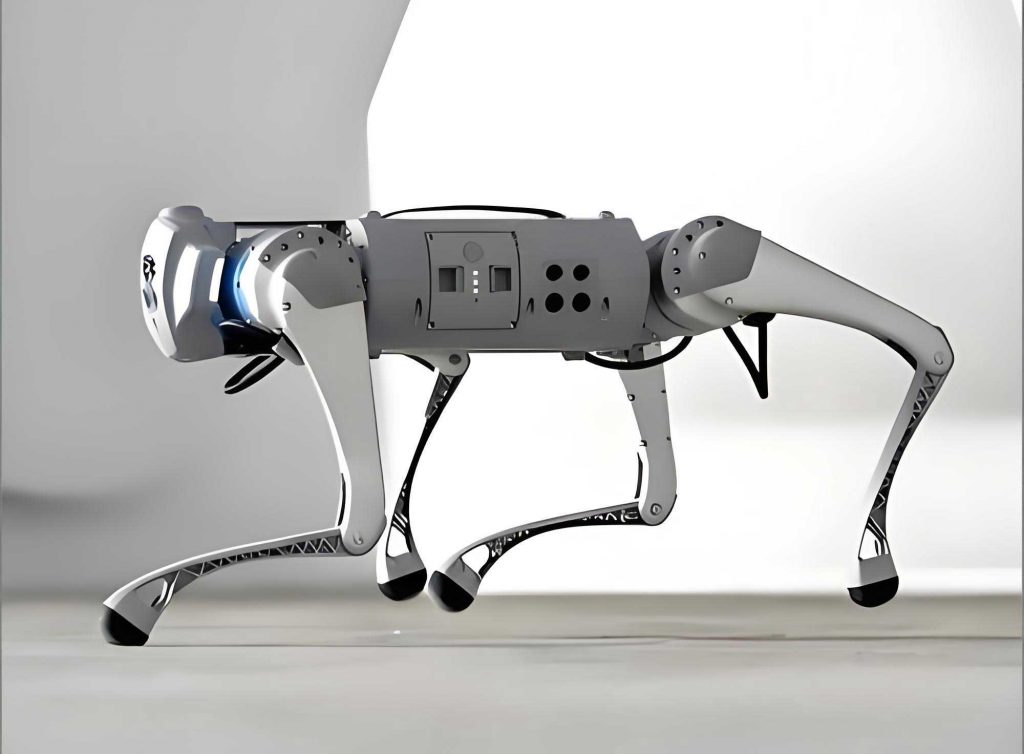
Observing such a machine in action, one appreciates the synthesis of design and control theory. Every step a robot dog takes is a solution to a differential equation. The Zero-Moment Point (ZMP) criterion, a fundamental concept for dynamic walkers, states that for stable walking, the vertical projection of the center of mass (COM) acceleration must lie within the support polygon. The condition is often expressed as:
$$ x_{ZMP} = x_{COM} – \frac{z_{COM}}{g} \ddot{x}_{COM} $$
$$ y_{ZMP} = y_{COM} – \frac{z_{COM}}{g} \ddot{y}_{COM} $$
where $(x_{ZMP}, y_{ZMP})$ is the ZMP location, $(x_{COM}, y_{COM}, z_{COM})$ is the COM position, $g$ is gravity, and $\ddot{x}_{COM}, \ddot{y}_{COM}$ are horizontal accelerations. The controller of a robot dog constantly adjusts leg trajectories to keep the ZMP within the foot’s contact area. When the robot dog is pushed, the sudden change in $\ddot{x}_{COM}$ requires a rapid re-planning of foot placements—a testament to the robustness of its state estimation and reactive control loops.
Transitioning from mechanical fields to commercial environments, I see a parallel pursuit of autonomy: the unmanned store. My interest was piqued by experiments in frictionless commerce, where the goal is to eliminate checkout queues. The underlying challenge here is not dynamics but perception, identification, and transaction integrity. A prominent experiment in this space involved a coffee shop where users could pick items and leave, with payment automatically settled. While not a robot dog, the enabling technology shares a philosophical thread with robotics: creating systems that perceive, decide, and act autonomously in human spaces.
The technical stack for such a store is multifaceted. It involves sensor fusion (cameras, RFID, weight sensors), computer vision for object and person recognition, and secure payment gateways. A simplified model for the automatic checkout process can be seen as a probabilistic inference problem. Let $S$ be the set of items a customer picks, and $O$ be the sensor observations (images, weight changes). The system aims to compute the most likely set $S$ given $O$:
$$ \hat{S} = \arg\max_{S} P(S | O) = \arg\max_{S} \frac{P(O | S) P(S)}{P(O)} \propto \arg\max_{S} P(O | S) P(S) $$
The prior $P(S)$ could incorporate customer purchase history or general item popularity. The likelihood $P(O|S)$ models the sensor accuracy. This is where massive user data from digital ecosystems becomes invaluable, allowing for strong priors and personalized identification—though it raises critical questions about privacy, a concern I constantly weigh.
Different approaches to unmanned retail exist, primarily varying in their level of customer interaction and technological aggression. Below, I contrast two major philosophies.
| Approach | Core Technology | Customer Action | Identification Method | Advantages | Challenges |
|---|---|---|---|---|---|
| Frictionless “Just Walk Out” | Overhead CV, sensor fusion, deep learning | Pick items and leave | Biometric (face) or app-based at entry | Seamless experience, high data integration | High initial cost, complex deployment, privacy scrutiny |
| Enhanced Self-Checkout | Mobile app scanning, traditional sensors | Scan items via phone or kiosk | App login or payment card | Lower tech barrier, easier to scale | Requires customer action, less “magical” |
The first approach, akin to the “Tao Cafe” experiment, demands a robust identity-binding mechanism at entry. This creates a closed, trackable environment. The second, more conservative method, still relies on user cooperation. The former’s ambition reminds me of the robot dog‘s quest for autonomous stability—both systems aim to function with minimal explicit human guidance after initiation.
As I ponder the future, I envision intersections. Imagine a robot dog not just walking in forests but in a warehouse context, its dynamic balance allowing it to carry shelves or navigate narrow aisles filled with obstacles. Furthermore, the perception systems developed for unmanned stores—object recognition, person tracking—could be deployed on a mobile robot dog to create an autonomous store clerk that restocks shelves or assists customers. The kinematic chain of a robot dog could be modeled for such tasks. The forward kinematics for a leg, giving the foot position $\mathbf{p}_{foot}$ relative to the body frame, is a function of the joint angles $\theta_i$:
$$ \mathbf{p}_{foot} = f_{kin}(\theta_1, \theta_2, \theta_3) = \mathbf{T}_{base}^{0} \cdot \prod_{i=1}^{3} \mathbf{T}_{i-1}^{i}(\theta_i) \cdot \mathbf{p}_{tip} $$
where $\mathbf{T}$ are homogeneous transformation matrices. Inverse kinematics, solving for $\theta_i$ given a desired $\mathbf{p}_{foot}$, is crucial for precise foot placement among retail inventory. The same principles that keep a robot dog upright on a hill would allow it to avoid knocking over product displays.
Scalability and energy efficiency are universal concerns. The power consumption of a legged robot dog versus a wheeled counterpart in a store setting could be analyzed. Legged locomotion often has a higher cost of transport (COT). A simplified metric is:
$$ COT = \frac{P}{m g v} $$
where $P$ is power input, $m$ is mass, $g$ is gravity, and $v$ is speed. While a robot dog might have a higher COT, its ability to traverse steps or cluttered spaces in a stockroom could offset this disadvantage for specific tasks, making the system-level efficiency favorable.
Data forms the lifeblood of both systems. The robot dog relies on streams from IMUs, force sensors, and LIDAR to build a state estimate $\hat{\mathbf{x}}_t$, often using a Kalman filter variant:
$$ \hat{\mathbf{x}}_t = \mathbf{F}_t \hat{\mathbf{x}}_{t-1} + \mathbf{B}_t \mathbf{u}_t + \mathbf{K}_t ( \mathbf{z}_t – \mathbf{H}_t \mathbf{F}_t \hat{\mathbf{x}}_{t-1} ) $$
where $\mathbf{F}$ is the state transition model, $\mathbf{B}$ control-input model, $\mathbf{u}$ control vector, $\mathbf{H}$ observation model, $\mathbf{z}$ measurement, and $\mathbf{K}$ the Kalman gain. Similarly, an unmanned store processes terabytes of visual data to track items and people, employing convolutional neural networks (CNNs) whose training involves minimizing a loss function $L$ over parameters $\mathbf{W}$:
$$ \mathbf{W}^* = \arg\min_{\mathbf{W}} \frac{1}{N} \sum_{i=1}^{N} L(f(\mathbf{x}_i; \mathbf{W}), \mathbf{y}_i) + \lambda R(\mathbf{W}) $$
with $f$ being the network, $\mathbf{x}_i$ input image, $\mathbf{y}_i$ label, and $R$ a regularization term. The scale of data needed for training a robust store perception system dwarfs that for a single robot dog, but the core concept of learning from sensor data is shared.
Ethical and societal implications are ever-present in my analysis. The same biometric identification that lets a customer seamlessly exit a store could, if misused, enable pervasive surveillance. The agility of a robot dog, beneficial for disaster response, also raises questions about militarization and job displacement in fields like security or logistics. A framework for evaluating such technologies might include multi-criteria decision analysis. One could assign weights $w_i$ and scores $s_{ij}$ for technology $j$ across criteria $i$ (e.g., privacy, safety, efficiency, cost):
$$ \text{Total Score}_j = \sum_{i=1}^{n} w_i s_{ij} $$
This quantitative approach, while simplistic, forces a structured consideration of trade-offs.
Looking forward, the convergence seems inevitable. I anticipate hybrid environments where mobile manipulators—perhaps descendants of today’s robot dog—operate within sensor-saturated unmanned stores. They could perform inventory checks overnight, their dynamic balance allowing them to reach high shelves or kneel to inspect low stock. The control architecture for such a system would be hierarchical, blending low-level joint control for the robot dog‘ gait with high-level task planning for retail operations. The motion planner might solve a path integral minimizing time and energy while avoiding obstacles ($\mathcal{O}$):
$$ \text{minimize} \int_{t_0}^{t_f} \left( 1 + \beta \| \mathbf{u}(t) \|^2 \right) dt $$
$$ \text{subject to} \quad \mathbf{x}(t) \notin \mathcal{O}, \quad \dot{\mathbf{x}} = g(\mathbf{x}, \mathbf{u}) $$
In conclusion, my deep dive into the worlds of dynamic robotics and autonomous retail reveals a common narrative: the relentless pursuit of systems that interact with the physical world intelligently and independently. The robot dog, with its captivating demonstration of balance and resilience, stands as a powerful symbol of mechanical achievement. Its principles of real-time sensorimotor control echo in the algorithms that power unmanned stores, which seek to create a frictionless commercial experience. Both fields are driven by advances in computation, sensing, and algorithms. As these technologies mature and intersect, they promise to reshape logistics, retail, and many aspects of daily life. However, this journey must be navigated with careful consideration of the ethical dimensions inherent in granting machines greater autonomy in human spaces. The robot dog trotting through a disaster zone and the silent checkout of a futuristic store are two faces of the same technological revolution—one that I will continue to observe, analyze, and reflect upon as it unfolds.