
In my extensive engagement with the robotics industry, I have witnessed a transformative phase where innovation is accelerating at an unprecedented pace. The recent convergence of compact logistics automation and advanced legged platforms marks a significant leap forward. From my perspective, these developments are not merely incremental improvements but foundational shifts enabling broader adoption in complex, real-world environments. This article delves into the technical intricacies, performance metrics, and underlying algorithms that define this new era, with a particular focus on the rising prominence of versatile robot dog platforms.
The push for greater efficiency in manufacturing and logistics has driven the creation of increasingly nimble autonomous mobile robots (AMRs). A prominent example is the introduction of a new, smaller-form-factor logistics robot by a robotics firm specializing in industrial automation. Engineered through rigorous field testing in customer projects, this model addresses challenges such as limited production line space in sectors like 3C (computer, communication, and consumer electronics) manufacturing. The design philosophy centers on retaining core functionalities while achieving a more compact, agile, and flexible footprint, offering superior performance in diverse scenarios and motion control tasks.
To encapsulate the key physical and operational parameters of this advanced logistics robot, the following table provides a comprehensive summary:
| Parameter | Specification |
|---|---|
| External Dimensions (L × W × H) | 760 mm × 545 mm × 260 mm |
| Self-Weight | 92.5 kg |
| Maximum Payload Capacity | 300 kg |
| Maximum Travel Speed | 1.57 m/s |
| Turning Radius | 0 mm |
| Rotation Radius | 400 mm |
| Minimum Operating Aisle Width | 750 mm |
| Precision Docking Accuracy | ±5 mm |
| Volume Reduction vs. Predecessor | Approximately 30% |
This robot leverages a proprietary navigation system based on laser SLAM (Simultaneous Localization and Mapping) integrated with multi-sensor fusion technology. The core localization and mapping problem in SLAM can be framed as estimating the robot’s pose xt and the map m given a sequence of sensor observations z1:t and control inputs u1:t. This is often represented by the posterior:
$$ P(x_{1:t}, m | z_{1:t}, u_{1:t}) $$
The system employs probabilistic algorithms to solve this, enabling intelligent obstacle avoidance, detouring, automatic recharging, and seamless operation across multiple floors and varied scenarios. It delivers robust, flexible logistics services for industries including electronics and automotive manufacturing.
Parallel to these advancements in wheeled logistics, the domain of legged robotics has seen explosive growth, particularly in the development of sophisticated robot dog platforms. I find the progress in this area especially compelling, as it mirrors biological agility and autonomy. A notable release from a research laboratory is a compact, “kung-fu” edition robot dog. This platform emphasizes not only dynamic motion skills like running, jumping, dancing, and performing backflips but also a significant upgrade in “brain” capabilities—environmental perception, autonomous navigation, and intelligent interaction.
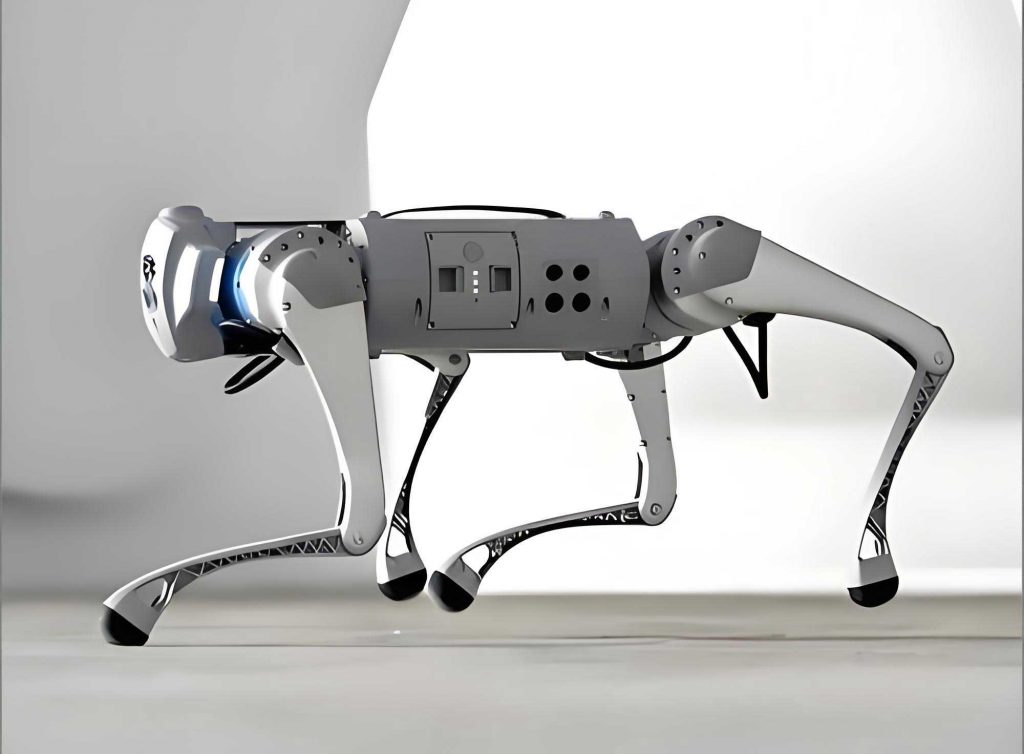
This particular robot dog has a body length of 50 cm and weighs around 9 kg, making it the smallest and lightest in its series. It is equipped with a suite of sensors—laser radar, depth cameras, wide-angle cameras, and ultrasonic sensors—whose data is fused using advanced algorithms. When deployed in an unknown environment, this robot dog can simultaneously locomote and map its surroundings. The mapping process often involves solving an optimization problem to align sensor scans. For instance, scan matching can be formulated to find the transformation T that minimizes the error between two point clouds P and Q:
$$ T^* = \arg\min_{T} \sum_{p_i \in P} || T(p_i) – q_{j(i)} ||^2 $$
where qj(i) is the closest point in Q to the transformed point T(pi). Given a destination, the robot dog can then plan an optimal path and navigate autonomously to it.
The autonomy of a modern robot dog is underpinned by several key technologies. Intelligent obstacle avoidance, for example, relies on real-time sensor data to maintain a safe distance. This can be modeled using potential field methods, where obstacles generate a repulsive force Frep and the goal generates an attractive force Fatt. The total force guiding the robot dog is:
$$ F_{total} = F_{att} + \sum F_{rep} $$
where
$$ F_{att} = -k_{att} \nabla d_{goal}, \quad F_{rep} = \begin{cases} k_{rep} \left( \frac{1}{d_{obs}} – \frac{1}{d_0} \right) \frac{1}{d_{obs}^2} \nabla d_{obs}, & \text{if } d_{obs} \le d_0 \\ 0, & \text{if } d_{obs} > d_0 \end{cases} $$
Here, dgoal and dobs are distances to the goal and obstacle, katt and krep are gains, and d0 is the influence distance of the obstacle.
Furthermore, this robot dog incorporates robust visual tracking for human following, capable of locking onto a target amidst distractions. The motion control system ensures remarkable stability; even under external perturbations, the robot dog exhibits excellent balance. The dynamic motions are achieved through sophisticated whole-body control. For a quadruped, the equation of motion can be expressed using the floating-base dynamics:
$$ M(q)\ddot{q} + C(q, \dot{q}) = S^T \tau + J_c^T f_c $$
where M is the inertia matrix, q are the generalized coordinates, C contains Coriolis and gravity terms, S is the selection matrix for actuated joints, τ are the joint torques, Jc is the contact Jacobian, and fc are the contact forces. Real-time optimization solves for τ and fc to achieve desired accelerations while satisfying contact constraints.
Another groundbreaking development comes from a major technology laboratory, which has publicly demonstrated a multi-modal robot dog named “Max.” This platform features a unique leg-wheel fusion design, an original solution where wheels are integrated into all four legs. This hybrid locomotion system dramatically increases the maximum speed, reportedly up to 25 km/h, by leveraging efficient rolling motion while retaining the terrain adaptability of legs.
The core of this robot dog’s agility lies in its self-developed software and hardware framework, which provides an acute “nervous system” enabling sub-millisecond force control. Key to its dynamic maneuvers is the use of Nonlinear Model Predictive Control (NMPC). The NMPC algorithm solves a finite-horizon optimal control problem online at each time step k:
$$ \min_{u_{k:k+N-1}} \sum_{i=0}^{N-1} \ell(x_{k+i}, u_{k+i}) + V_f(x_{k+N}) $$
subject to:
$$ x_{k+i+1} = f(x_{k+i}, u_{k+i}), \quad x_{k+i} \in \mathcal{X}, \quad u_{k+i} \in \mathcal{U} $$
Here, x is the state (e.g., body position, orientation, joint angles), u is the control input (e.g., joint torques or wheel velocities), f is the nonlinear discrete-time dynamics model, ℓ is the stage cost, Vf is the terminal cost, and 𝒳 and 𝒰 are state and input constraints. The solution provides a control sequence, with only the first step applied before re-solving at the next sample, allowing the robot dog to anticipate and optimize its motions.
This robot dog combines NMPC with Quadratic Programming (QP) optimization for real-time resolution of motion tasks and compliance control algorithms. This integration allows it to execute complex actions like standing up from a prone position, maintaining balance against disturbances, and recovering from falls autonomously. The average computational time for these calculations is reportedly under 0.3 milliseconds, highlighting the efficiency of the underlying algorithms. The fall recovery skill is particularly impressive; even after a high-impact fall, this robot dog can autonomously return to a normal operational state.
The capabilities of these modern robot dog platforms are vast. To provide a clearer comparison of their general characteristics versus the logistics robot, consider the following table:
| Feature Category | Compact Logistics Robot | Advanced Robot Dog Platform |
|---|---|---|
| Primary Locomotion | Wheeled (Differential/Omni-directional) | Legged or Leg-Wheel Hybrid |
| Key Application Focus | Material Handling, Intra-factory Logistics | Inspection, Surveillance, Search & Rescue, Research |
| Navigation Core | 2D/3D Laser SLAM with Multi-sensor Fusion | 3D LiDAR/Vision-based SLAM, Proprioceptive Sensing |
| Environmental Adaptability | Structured, Indoor Floors | Unstructured, Indoor/Outdoor, Rough Terrain |
| Dynamic Maneuverability | High-precision docking, zero-radius turns | Running, jumping, falling and self-righting |
| Autonomy Level | Path following, obstacle avoidance, auto-charge | Goal-directed navigation, human following, task execution |
| Control Complexity | Trajectory tracking, fleet coordination | Whole-body dynamics control, balance maintenance |
Delving deeper into the perception stack of a robot dog, sensor fusion is paramount. The process of combining data from LiDAR, cameras, and IMUs often employs an Extended Kalman Filter (EKF) or an Error-State Kalman Filter (ESKF). For state estimation, the EKF linearizes the nonlinear system dynamics f and measurement model h around the current state estimate. The prediction and update steps are:
$$ \hat{x}_{k|k-1} = f(\hat{x}_{k-1|k-1}, u_{k-1}) $$
$$ P_{k|k-1} = F_{k-1} P_{k-1|k-1} F_{k-1}^T + Q_{k-1} $$
$$ K_k = P_{k|k-1} H_k^T (H_k P_{k|k-1} H_k^T + R_k)^{-1} $$
$$ \hat{x}_{k|k} = \hat{x}_{k|k-1} + K_k (z_k – h(\hat{x}_{k|k-1})) $$
$$ P_{k|k} = (I – K_k H_k) P_{k|k-1} $$
where F and H are Jacobians of f and h, P is the error covariance, Q and R are process and measurement noise covariances, and K is the Kalman gain. This allows the robot dog to maintain a accurate estimate of its pose in complex environments.
The motion planning for a robot dog navigating cluttered spaces involves generating feasible trajectories. A common approach is to use a sampling-based planner like RRT* (Rapidly-exploring Random Tree Star). The algorithm incrementally builds a tree G = (V, E) of collision-free states. The cost of a path from the initial state xinit to a state x is denoted c(x). RRT* aims to minimize this cost by rewiring the tree. For each new sample xrand, it finds the nearest neighbor xnear in V and attempts to connect them with a local planner. If successful, it then looks for nodes in a neighborhood of xnew that could be reached with lower cost via xnew, rewiring the tree accordingly. This asymptotically yields an optimal path, enabling the robot dog to find efficient routes to its goal.
Energy efficiency is another critical consideration, especially for untethered operation. The power consumption of a robot dog is a function of its actuators, computing, and sensors. The instantaneous electrical power Pelec for a motor can be modeled as:
$$ P_{elec} = I^2 R + K_v I \omega $$
where I is current, R is resistance, Kv is the back-EMF constant, and ω is angular velocity. The mechanical output power is τω, where τ is torque. Optimizing gait patterns and control to minimize cost of transport (COT), defined as energy used per unit weight per unit distance, is an active research area for extending the mission duration of a robot dog.
The potential applications for these advanced robot dog systems are extensive and transformative. In security and patrol, a robot dog can autonomously navigate predefined or dynamically generated routes, using its sensors to detect anomalies, intruders, or environmental hazards. Its ability to traverse stairs, debris, and uneven ground makes it far superior to wheeled robots for indoor-outdoor facility patrol. In disaster response and search and rescue, a robot dog’s mobility allows it to enter collapsed structures or hazardous areas where human first responders cannot safely go, carrying sensors to locate survivors or assess structural integrity. The robust robot dog platform can serve as a mobile base for various payloads, from thermal cameras to communication relays.
Furthermore, the research and development surrounding the robot dog paradigm accelerates progress in fundamental robotics challenges: dynamic stability, real-time perception in motion, and adaptive learning. Many platforms now incorporate machine learning, particularly reinforcement learning (RL), to refine locomotion policies. In RL, an agent (the robot dog) learns a policy π(a|s) that maps states s to actions a to maximize the expected cumulative reward R:
$$ J(\pi) = \mathbb{E}_{\tau \sim \pi} \left[ \sum_{t=0}^{T} \gamma^t r(s_t, a_t) \right] $$
where τ = (s0, a0, s1,…) is a trajectory, γ is a discount factor, and r is the reward function. Through simulation and transfer to real hardware, robot dogs can learn to adapt their gait to different surfaces, recover from slips, or optimize speed and energy use.
Looking ahead, the convergence of technologies from compact logistics robots and agile robot dog platforms will likely spawn new hybrid systems. Imagine a logistics robot with limited legged capabilities for climbing curbs or a robot dog optimized for carrying payloads in warehouses. The underlying themes are miniaturization, intelligence, and multi-modal functionality. Sensor fusion will become even more seamless, with deep learning models directly processing raw sensor streams for scene understanding. Control algorithms will grow more robust, allowing a robot dog to operate reliably in ever-more chaotic environments.
In conclusion, from my vantage point, the robotics field is undergoing a profound shift. The development of compact, powerful logistics robots solves pressing industrial needs for flexibility and space efficiency. Simultaneously, the rapid evolution of the robot dog concept—with its emphasis on dynamic agility, strong autonomy, and versatile intelligence—opens up a new frontier for mobile robotics beyond traditional wheels and tracks. The repeated demonstration of capabilities like autonomous navigation, intelligent obstacle avoidance, complex motion skills, and self-recovery in a robot dog platform underscores its growing maturity. These platforms are no longer just research curiosities; they are becoming capable partners for tasks in security, emergency response, and beyond. The formulas and principles governing their operation, from SLAM and NMPC to dynamics and machine learning, provide the rigorous foundation for this exciting progress. As these technologies continue to mature and intersect, I anticipate a future where robotic assistants, whether wheeled or legged, are seamlessly integrated into the fabric of our daily work and safety operations.