
In recent years, the development of quadruped robots, often referred to as robot dogs, has gained significant attention due to their potential in traversing complex terrains and performing diverse tasks. However, the high-dimensional and strongly nonlinear nature of these systems, which involve controlling multiple joint degrees of freedom simultaneously, poses substantial challenges for traditional control methods. These methods often struggle to balance convergence speed and stability, leading to inefficiencies in real-world applications. To address this, I propose a novel robust control approach based on generalized constraint-following theory, which enhances both the convergence rate and stability performance in posture control for quadruped robots. This method leverages the generalized Udwadia-Kalaba (U-K) theory to model the leg dynamics and incorporate constraints such as joint distances, angles, and foot positions, while accounting for system uncertainties to ensure robustness.
The core of this work lies in transforming the posture control problem into a constraint force control problem, where the robot’s legs are governed by distributed control strategies. By applying differential homeomorphic transformations, I extend traditional constraint-following theory to handle both equality and inequality constraints, enabling parallel servo control in complex scenarios. This approach not only simplifies the controller design process but also ensures rapid convergence and strong disturbance rejection. In this article, I will detail the dynamics modeling of the quadruped robot’s legs, the formulation of constraints, the design of robust controllers under uncertainties, and validation through numerical simulations. The results demonstrate that the proposed method outperforms conventional approaches like Linear Quadratic Regulator (LQR) control in terms of speed and stability, making it a promising solution for advanced quadruped robot applications.
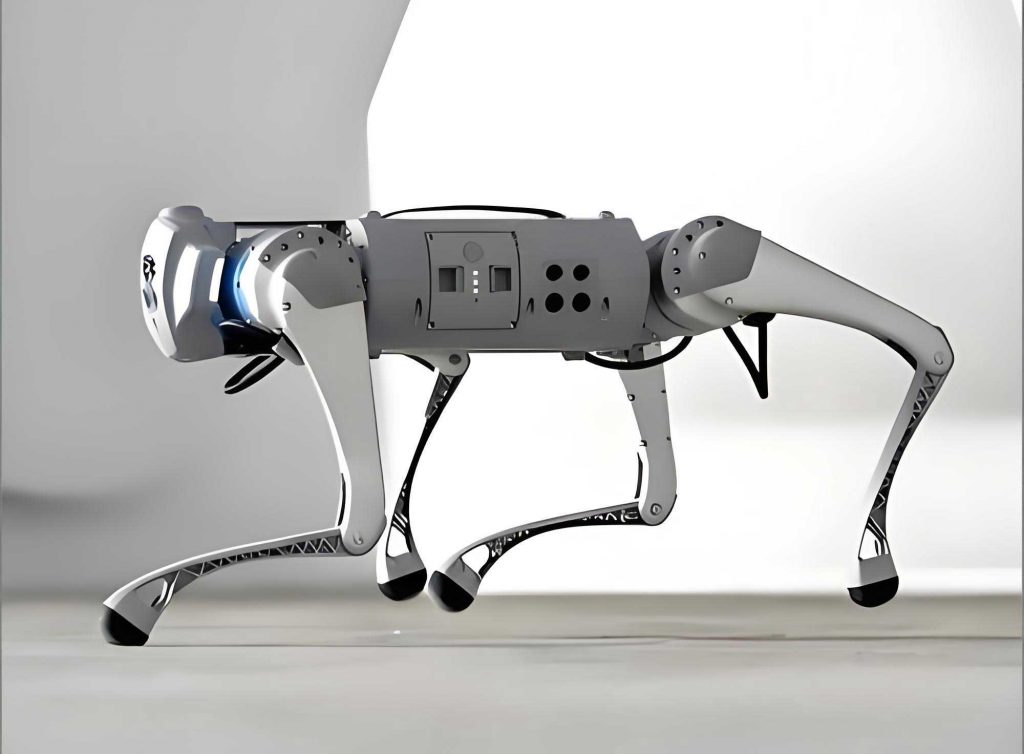
Quadruped robots, or robot dogs, are characterized by their multi-joint structures, which require precise coordination to maintain stability during locomotion. Traditional control techniques, such as Zero Moment Point (ZMP) and Proportional-Integral-Derivative (PID) control, often face limitations in handling the nonlinearities and uncertainties inherent in these systems. For instance, ZMP control relies on accurate mathematical models and extensive computations, while PID control may exhibit oscillations and poor adaptability. In contrast, the generalized constraint-following method offers a model-independent framework that avoids linearization and facilitates multi-objective control. This is particularly advantageous for quadruped robots, where posture stabilization involves regulating hip and knee pitch angles to achieve desired body orientations while avoiding obstacles.
To illustrate the dynamics of a quadruped robot, I consider a simplified model where the robot’s body pitch is controlled by adjusting the front legs’ joints, while the rear legs remain fixed. Each front leg is modeled as a four-degree-of-freedom system, with the hip joint free to move in the pitch plane. The generalized coordinates for the left front leg, for example, are defined as \( q_1 = [x_{10}, y_{10}, \theta_{11}, \theta_{12}]^T \), where \( x_{10} \) and \( y_{10} \) represent the hip joint coordinates, and \( \theta_{11} \) and \( \theta_{12} \) denote the hip and knee pitch angles, respectively. The leg’s kinetic and potential energies are derived using Lagrangian mechanics, leading to the dynamic equation:
$$ M_1(q_1) \ddot{q}_1 + C_1(q_1, \dot{q}_1) \dot{q}_1 + G_1(q_1) = \tau_1 $$
Here, \( M_1 \) is the inertia matrix, \( C_1 \) represents Coriolis and centrifugal forces, \( G_1 \) accounts for gravitational effects, and \( \tau_1 \) is the control input. Similar equations apply to the right front leg, with \( q_2 = [x_{20}, y_{20}, \theta_{21}, \theta_{22}]^T \). The elements of these matrices are computed based on the leg’s physical parameters, such as masses \( m_{ij} \), lengths \( L_H \) and \( L_K \), and moments of inertia \( I_{ij} \). For instance, the inertia matrix \( M_1 \) includes terms like:
$$ M_{1,11} = m_{11} + m_{12}, \quad M_{1,13} = -\frac{1}{2} L_H (m_{11} + 2m_{12}) \sin(\theta_{11}) – \frac{1}{2} L_K m_{12} \sin(\theta_{11} + \theta_{12}) $$
This modeling approach allows for a comprehensive representation of the leg dynamics, which is essential for subsequent constraint analysis and controller design.
The generalized constraint-following theory builds upon the U-K equation to handle both equality and inequality constraints in mechanical systems. Consider a general mechanical system described by:
$$ M(q, \sigma) \ddot{q} + C(q, \dot{q}, \sigma) \dot{q} + G(q, \sigma) = \tau $$
where \( q \in \mathbb{R}^n \) is the generalized coordinate vector, \( \sigma \in \Sigma \subset \mathbb{R}^p \) represents uncertain parameters, and \( \tau \) is the control input. Equality constraints are expressed in the form \( A(q, t) \dot{q} = c(q, t) \), which can be differentiated to obtain the second-order form \( A(q, t) \ddot{q} = b(q, \dot{q}, t) \). According to the U-K theory, the constraint force for equality constraints is given by:
$$ Q_e = M^{1/2} (A M^{-1/2})^+ (b – A M^{-1} (C \dot{q} + G)) $$
where \( (\cdot)^+ \) denotes the Moore-Penrose generalized inverse. For inequality constraints, such as \( a_i < g_i(q) < b_i \), I introduce a differential homeomorphic transformation \( \xi = \phi(q) \) to convert them into unbounded forms. The additional acceleration due to inequality constraints is formulated as \( R_i = (I – A^+ A) r \), where \( r \) is a vector to be determined. This ensures that the inequality constraints do not interfere with the equality constraints, leading to the generalized U-K equation:
$$ M \ddot{q} = M a + M (A M^{-1})^+ (b – A a) + M (I – A^+ A) r $$
This equation effectively combines the effects of both types of constraints, enabling robust control design.
For the quadruped robot, I define specific constraints for each front leg to achieve posture stabilization. The left front leg is subject to equality constraints that ensure the hip joint maintains a fixed distance from the origin, the joint angles track desired values, and the foot remains in contact with the ground. These constraints are expressed as:
$$ e_{10} = x_{10}^2 + y_{10}^2 – d_d^2, \quad e_{11} = \theta_{11} – \theta_{11}^d, \quad e_{12} = \theta_{12} – \theta_{12}^d, \quad e_{13} = y_{10} – L_H \sin(\theta_{11}) – L_K \sin(\theta_{11} + \theta_{12}) – y_{13}^d $$
where \( d_d \) is the body length, and \( y_{13}^d \) is the ground height. The first-order constraints \( \dot{e}_{1j} + l_{1j} e_{1j} = 0 \) are differentiated to form the second-order constraints \( A_1 \ddot{q}_1 = b_1 \), with \( A_1 \) and \( b_1 \) constructed from the error dynamics. Similarly, the right front leg follows equality constraints for hip joint positions and knee angle, along with an inequality constraint to keep the foot above a certain plane:
$$ y_{23} = y_{20} – L_H \sin(\theta_{21}) – L_K \sin(\theta_{21} + \theta_{22}) > y_{23}^d $$
This inequality is transformed using \( \xi = \ln(y_{23} – y_{23}^d) \), and the control ensures \( \xi \) remains bounded, thus satisfying the constraint.
To handle system uncertainties, I decompose the dynamics matrices into nominal and uncertain parts:
$$ M = \bar{M} + \Delta M, \quad C = \bar{C} + \Delta C, \quad G = \bar{G} + \Delta G $$
The robust controller for each leg is designed as \( \tau_i = p_{i1} + p_{i2} + p_{i3} \), where \( p_{i1} \) addresses the nominal dynamics, \( p_{i2} provides feedback linearization, and \( p_{i3} \) compensates for uncertainties. For the left front leg, the control components are:
$$ p_{11} = \bar{M}_1 A_1^T (A_1 \bar{M}_1^{-1} A_1^T)^{-1} (b_1 – A_1 \bar{M}_1^{-1} (\bar{C}_1 \dot{q}_1 + \bar{G}_1)) $$
$$ p_{12} = -\bar{M}_1 A_1^T (A_1 \bar{M}_1^{-1} A_1^T)^{-1} P_1^{-1} \beta_1 $$
$$ p_{13} = -\bar{M}_1 A_1^T (A_1 \bar{M}_1^{-1} A_1^T)^{-1} P_1^{-1} \gamma_1 \mu_1 \Pi_1 $$
Here, \( \beta_1 = A_1 \dot{q}_1 – c_1 \) is the constraint-following error, \( P_1 \) is a positive definite matrix, \( \gamma_1 \) and \( \mu_1 \) are tuning parameters, and \( \Pi_1 \) bounds the uncertainties. The right front leg controller includes an additional term for the inequality constraint, but its stability analysis mirrors that of the left leg. Using Lyapunov theory, I prove that the controlled system exhibits uniform boundedness and uniform ultimate boundedness, ensuring reliable performance under uncertainties.
To validate the proposed method, I conduct numerical simulations comparing it with an LQR controller. The robot parameters are set as follows: masses \( m_{11} = 1.5 \, \text{kg} \), \( m_{12} = 1.5 \, \text{kg} \), lengths \( L_H = 0.15 \, \text{m} \), \( L_K = 0.15 \, \text{m} \), and desired pitch angles \( \theta_{11}^d = 1.02 \, \text{rad} \), \( \theta_{12}^d = 1.1 \, \text{rad} \). Uncertainties are introduced as \( \Delta m_{11} = 0.2 \sin(4t) \, \text{kg} \). The controller parameters are chosen as \( l_{10} = 9.9 \), \( \kappa_{11} = 100 \), and \( P_1 = I_{4 \times 4} \). The simulation results demonstrate that the robust controller achieves convergence in approximately 1 second, whereas the LQR controller takes 3-5 seconds. Additionally, the cumulative errors for joint angles are significantly reduced under robust control, as summarized in the table below.
| Joint Angle | LQR Cumulative Error | Robust Control Cumulative Error | Improvement |
|---|---|---|---|
| \( \theta_{11} \) | 0.3 rad | 0.026 rad | 91.4% |
| \( \theta_{12} \) | 0.35 rad | 0.045 rad | 87.2% |
| \( \theta_{22} \) | 0.44 rad | 0.04 rad | 91.0% |
Furthermore, the inequality constraint for the right foot is strictly maintained under robust control, preventing collisions with the plane, while LQR control occasionally violates this constraint. These findings highlight the superiority of the generalized constraint-following approach in ensuring fast and stable posture control for quadruped robots.
In conclusion, the generalized constraint-following theory provides an effective framework for addressing the challenges of high-dimensional control in quadruped robots. By integrating equality and inequality constraints into the control design, this method achieves rapid convergence and enhanced robustness against uncertainties. The simulation results confirm its advantages over traditional methods like LQR, making it suitable for real-world applications where stability and adaptability are critical. Future work could explore extensions to more complex terrains and dynamic gait transitions, further advancing the capabilities of robot dogs in autonomous operations.
The application of this theory to quadruped robots, or robot dogs, represents a significant step forward in robotics, offering a scalable solution for multi-joint systems. As the demand for agile and reliable quadruped robots grows, such advanced control strategies will play a pivotal role in enabling these machines to perform in unpredictable environments. The mathematical rigor and practical efficacy of this approach underscore its potential for widespread adoption in various fields, from search and rescue to industrial automation.