
The global robotics industry is undergoing a fundamental metamorphosis, shifting from single-task machines towards systems with genuine understanding and physical interaction—the era of the embodied AI robot. We stand at a pivotal strategic inflection point where humanoid robots, as the quintessential vessel for embodied AI, are transitioning from laboratory prototypes to the cusp of scaled manufacturing. Forecasts indicate an industrial explosion period around 2026, unveiling a trillion-dollar “new blue ocean.” Faced with this monumental opportunity, we must undertake a systematic and strategic layout, leveraging our strengths and addressing our weaknesses to accelerate the establishment of a globally influential innovation cluster and application hub for embodied AI robot technology.
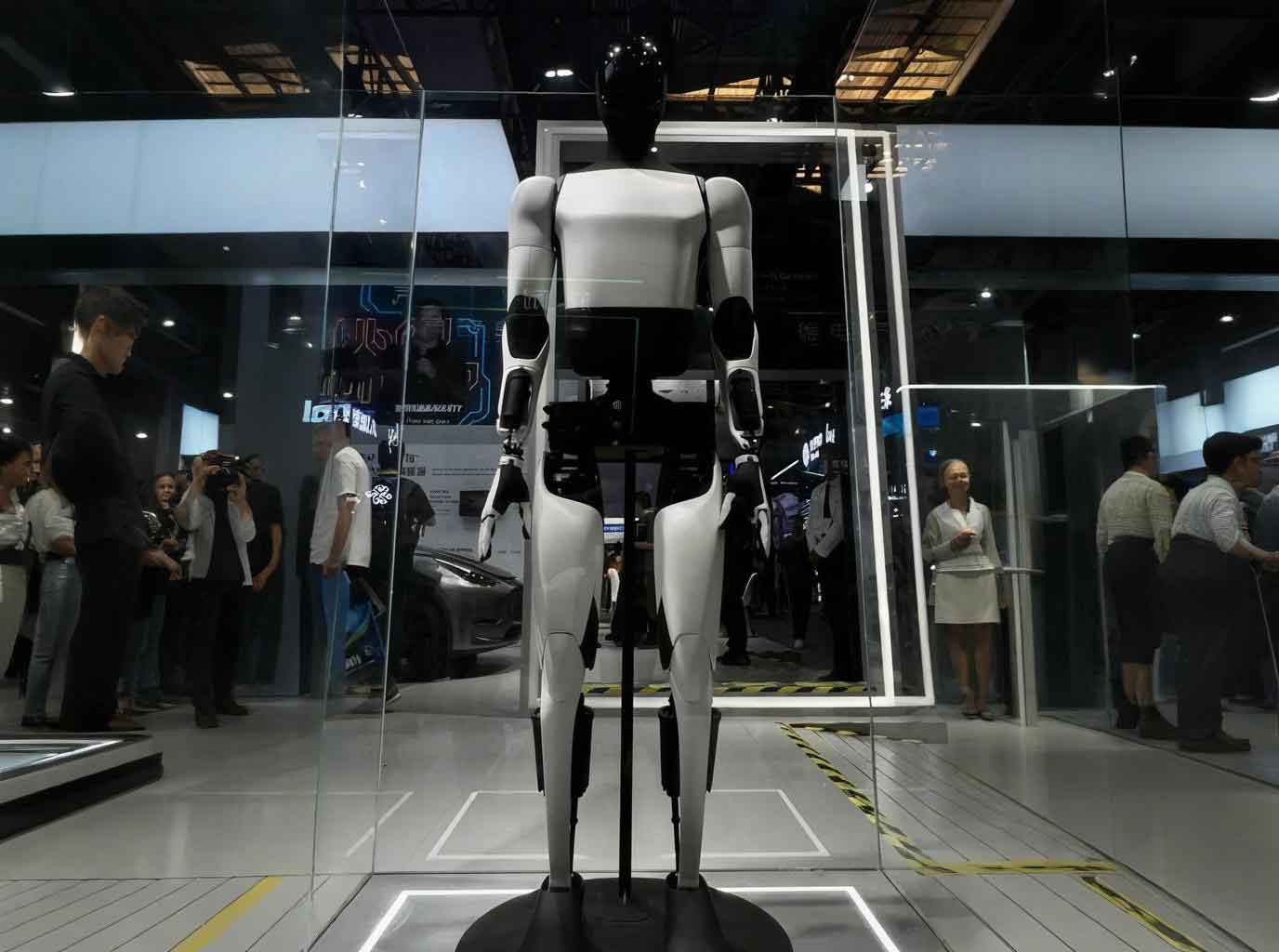
The core proposition of an embodied AI robot is the seamless integration of a perceptual “brain” with a physical “body,” enabling it to learn from and act within a dynamic, unstructured environment. Unlike traditional pre-programmed robots, these systems utilize advanced AI models to process multi-sensory data (visual, tactile, auditory) and generate adaptive, goal-oriented physical actions. This can be abstracted as a continuous perception-action cycle governed by an embodied intelligence policy $\pi$:
$$ o_t = S(s_t) $$
$$ a_t = \pi(o_t, g, m) $$
$$ s_{t+1} = E(s_t, a_t) $$
where $o_t$ represents the multi-modal observation derived from raw sensor state $s_t$ via sensor function $S$, $g$ is the task goal, $m$ is the internal world model, $\pi$ is the policy, $a_t$ is the generated action, and $E$ is the environment dynamics function. The policy $\pi$ is increasingly powered by large foundation models fine-tuned for physical reasoning and control.
Our Foundational Pillars for Leadership
We possess a formidable constellation of advantages that positions us uniquely to capture a leading role in this nascent industry.
| Pillar | Key Strengths | Quantitative/Qualitative Evidence |
|---|---|---|
| Industrial Scale & Manufacturing Prowess | Largest-scale industrial economy nationally; Comprehensive, integrated manufacturing system. | Consistently leads in national scale-based industrial output value; Hosts 16 national-level advanced manufacturing clusters. |
| Core Component Superiority & Supply Chain Resilience | Global competitiveness in key robotic components; Strong precision manufacturing and mature ecosystem. | Accounts for approximately 30% of national industrial robot production; Presence of globally leading supply chain anchor enterprises. |
| Diverse Application Scenarios & Market Potential | Presence in multiple trillion-yuan industrial clusters with urgent automation needs. | Vast application potential in new energy vehicles, high-end equipment, electronics, biomedicine, and modern logistics. |
These pillars are not isolated; they interact synergistically. Our manufacturing depth provides the perfect testbed and scaling base for embodied AI robot innovations, while our component strength ensures supply chain security critical for mass production. The rich application landscapes generate the real-world data and demand necessary to drive the iterative refinement of embodied AI robot capabilities, closing the loop between research and commercialization.
Strategic Actions to Build the Innovation Pioneer Zone
To transform our foundational strengths into global leadership, we propose a concerted, multi-front strategic campaign centered on the following interconnected actions.
| Strategic Action | Primary Focus | Expected Outcome |
|---|---|---|
| 1. “Empower the Brain & Fortify the Core” Offensive | Autonomous, cutting-edge technological innovation system. | Gain product definition authority and core IP in AI “brains” and hardware “cores.” |
| 2. “Strengthen & Interlink the Chain” Enhancement | Resilient, world-class advanced manufacturing cluster. | Become a global supply base for core embodied AI hardware with high domestic配套率. |
| 3. “Open the Scenario Treasury” Initiative | Real-world demand-driven iteration and industrial scale-up. | Establish the region as the premier global testing ground and data generation hub. |
| 4. “Cultivate the Rainforest Ecosystem” Nurturing | Integrated support system of capital, talent, data, and standards. | Create a self-reinforcing, attractive, and sustainable innovation habitat. |
| 5. “Expand Open Collaboration” Outreach | Integration into global innovation networks and industrial cycles. | Position as an indispensable node in the global embodied AI value chain. |
1. The “Empower the Brain & Fortify the Core” Offensive Action
Our goal is to build a technologically sovereign and forward-leading innovation system. The core challenge for an embodied AI robot lies in creating an intelligent “brain” (AI models for reasoning and planning) and a responsive “cerebellum” (real-time motor control), while mastering the critical “core” components that enable physical dexterity.
We propose establishing a cross-regional “Embodied AI Fusion Innovation Center,” integrating software strengths from our AI research hubs with hardware prowess from our precision manufacturing bases. The center’s roadmap should focus on:
- Embodied AI Foundation Models: Developing models that ground language and vision in physical understanding and action generation. This involves training on massive datasets of physical interactions. A key objective is learning a generalizable reward function $R_{\phi}(s, a, g)$ that evaluates the success of action $a$ in state $s$ towards goal $g$.
- Multi-Modal Perception & Fusion: Creating robust algorithms to fuse data from RGB-D cameras, LiDAR, force/torque sensors, and tactile arrays into a unified environmental representation $M_t$.
- Bionic Control & Decision-Making: Implementing hierarchical control architectures. High-level task planning can be model-based: $$ \text{Plan} = \arg\min_{\tau} \sum_{t} C(s_t, a_t) \text{ subject to } s_{t+1}=f(s_t,a_t), $$ while low-level motion control often relies on model-free reinforcement learning or adaptive control laws like: $$ \tau = J^T(K_p (x_{des} – x) + K_d (\dot{x}_{des} – \dot{x})) + \text{gravity comp.} $$ where $\tau$ is joint torque, $J$ is the Jacobian, and $K_p, K_d$ are gains.
We must champion a dual-track technology strategy through provincial “Challenge Grant” programs:
| Track | Focus | Goal for Embodied AI Robot |
|---|---|---|
| Vertical Specialization | Domain-specific models for manufacturing, healthcare, logistics. | Develop industry-specific “expert brains” with superior performance in targeted tasks, creating defensible solutions. |
| Horizontal Foundation | Contributing to and tracking advancements in general-purpose embodied AI models. | Ensure we are not excluded from foundational breakthroughs and can integrate them into our vertical solutions. |
2. The “Strengthen & Interlink the Chain” Enhancement Action
The leap from prototype to cost-effective, reliable mass production of embodied AI robots depends on a resilient, high-performance supply chain. We must execute a precise strong-link, supplement-link engineering project across the lengthy and complex humanoid robot value chain.
A provincial industrial development fund should target critical components currently in early industrialization or import-dependent. The technical specifications and challenges for some are summarized below:
| Core Component | Key Function | Technical Challenge / Target Specification |
|---|---|---|
| High-Precision Planetary Roller Screw | Linear actuation (high force, compact) | Zero-backlash, life >10,000 hrs, efficiency >90% |
| High-Performance Hollow-Cup Motor | Joint actuation (high torque-to-weight) | Power density >1 kW/kg, low rotor inertia |
| High-Dynamic Dexterous Hand | Manipulation (multi-fingered, sensitive) | ≥12 DoF, integrated tactile sensing, payload >5kg |
| High-Sensitivity Electronic Skin | Tactile perception (spatial, pressure) | Density >10 taxels/cm², pressure range 0.1-100 N/cm² |
| 6-Axis Force/Torque Sensor | Force sensing at wrist/feet | Accuracy <0.5% F.S., cross-talk <2%, overload protection |
We must foster an efficient, collaborative industrial network. A proposed functional specialization layout could be:
$$ \text{Industrial Network} = \{ \text{City}_A: f(\text{Components}), \text{City}_B: f(\text{AI Software}), \text{City}_C: f(\text{Integration}), \text{City}_D: f(\text{Sensors}) \} $$
where synergistic flows of parts, data, and expertise are optimized. A provincial supply chain collaboration platform is essential to connect demand and supply in real-time, reducing transaction costs and building cluster cohesion.
3. The “Open the Scenario Treasury” Initiative
Our most potent asset is the density and diversity of our industrial and service sectors. We must weaponize our real-world application scenarios to drive the iterative refinement of the embodied AI robot. The cycle is: Scenario Pain Point → Robot Deployment → Data Generation → Model/Product Improvement → Wider Deployment.
A multi-department task force should compile and regularly update an “Open Scenario List for Embodied AI Robots.” This list will be a public “challenge board” for global innovators. Example entries:
| Industry | Scenario | Key Performance Indicators (KPIs) for Robot |
|---|---|---|
| Automotive Manufacturing | Flexible wiring harness assembly in confined spaces | Cycle time < 120s, insertion success rate > 99.5%, zero part damage |
| Electronics | Delicate PCB inspection and component reseating | Detection of micron-level soldering defects, force-controlled insertion < 2N |
| Logistics | Mixed-SKU palletizing/de-palletizing in unstructured stacks | Items handled per hour > 400, recognition accuracy > 99.9% |
| Healthcare | Patient mobility assistance and rehabilitation guidance | Adaptive compliant force control, natural language interaction, safety certification SIL 3 |
We should establish 20+ “Humanoid Robot Innovation Application Demonstration Sites” (Lighthouse Factories/Parks). For the first deployment of domestic embodied AI robot products in these sites, a comprehensive policy package—combining First-Set Equipment certification, insurance compensation, fiscal subsidies, and priority procurement—must be deployed to de-risk early adoption.
4. The “Cultivate the Rainforest Ecosystem” Nurturing Action
A thriving, self-sustaining ecosystem is built on four interdependent pillars: Capital, Talent, Data & Platforms, and Standards & IP. We must construct this integrated support system meticulously.
| Pillar | Key Initiatives | Impact on Embodied AI Robot Development |
|---|---|---|
| Capital | Provincial引导 Fund + municipal配套 funds; “Patient capital” for deep-tech. | Finances long R&D cycles for components/algorithms; Bridges the “valley of death” for startups. |
| Talent | Four-tier梯队: Scientists, Leaders, Engineers, Technicians. Deep industry-academia fusion. | Provides the complete human stack from theory (AI research) to practice (system integration & maintenance). |
| Data & Platforms | Open-source data platform for simulation & real data; Public test & verification center. | Lowers R&D barrier for SMEs; accelerates certification and time-to-market; fosters benchmarking. |
| Standards & IP | Lead in drafting national/industry standards; Robust patent portfolios and导航. | Shapes the technological playing field; protects innovations; enhances global bargaining power. |
The talent pyramid is critical. It can be modeled as a hierarchical structure where each layer supports the one above:
$$ \text{Talent Pyramid} = \left\{ \begin{array}{ll} \text{Layer 1:} & \text{Strategic Scientists (Theory, Breakthroughs)} \\
\text{Layer 2:} & \text{Industry Leaders (Product Vision, Management)} \\
\text{Layer 3:} & \text{卓越 Engineers (System Integration, R&D)} \\
\text{Layer 4:} & \text{High-Skill Technicians (Deployment, Maintenance)} \end{array} \right. $$
Modern Industry Colleges and municipal industry-education consortiums are essential to mass-produce Layer 3 and 4 talents tailored to the needs of the embodied AI robot sector.
5. The “Expand Open Collaboration” Outreach Action
In a field as globally interconnected as advanced robotics, autarky is not an option. Our strategy must be one of confident openness and active collaboration. We will proactively integrate into global innovation networks while strengthening domestic linkages. This involves:
- Academic & Technical Integration: Encouraging our researchers and engineers to actively participate in top international conferences (e.g., RSS, ICRA, CoRL), contribute to open-source projects (e.g., ROS, Isaac Sim), and engage in pre-competitive research consortia.
- Global Investment Attraction: Executing targeted global investment promotion campaigns to attract “hidden champion” SMEs specializing in niche components (e.g., specialized actuators, novel tactile sensors) and top-tier international teams to establish R&D or manufacturing centers here.
- Domestic Synergy: Deepening collaboration with other national innovation hubs (e.g., Beijing-Tianjin-Hebei, Guangdong-Hong Kong-Macao Greater Bay Area). This could involve joint ventures, shared access to test facilities, or collaborative standard-setting, creating a stronger national front in the global embodied AI robot race.
By hosting major international summits and competitions, we will not only import ideas but also export our vision and capabilities, shaping the global discourse around the embodied AI robot.
The Path Forward
The race for supremacy in embodied intelligence is not just a technological contest; it is a determining factor for future industrial competitiveness and economic security. The embodied AI robot represents the ultimate synthesis of AI and advanced manufacturing—a domain where our historical strengths and future aspirations perfectly converge. By executing the integrated five-action strategy outlined—simultaneously advancing technological autonomy, fortifying our industrial backbone, leveraging our unique scenario advantage, nurturing a holistic ecosystem, and engaging the world with confidence—we can systematically capture the high ground in this defining industry. Our objective is clear: to transform our region into the indispensable nexus where the most advanced embodied AI robot concepts are forged, manufactured, proven, and scaled for the world. The moment to act with urgency and precision is now.