
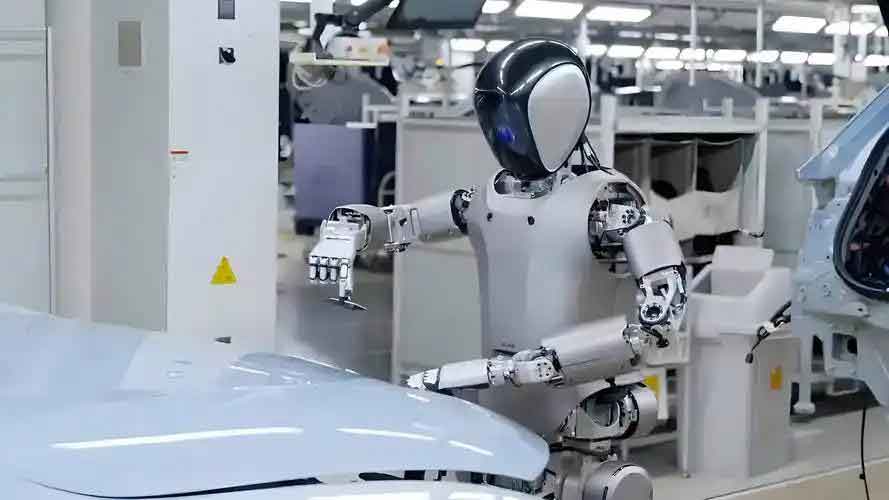
Following the viral fame of humanoid robots performing traditional dances at China’s Spring Festival Gala, Nanjing Tianchuang Electronic Technology Co., Ltd. (Tianchuang Robot) made global headlines in January by unveiling the world’s first explosion-proof humanoid robot. Dubbed “Tiankui-1,” this humanoid robot targets high-risk industrial scenarios like chemical plants and emergency rescue operations. As 2024 emerges as the “first year of commercialization for humanoid robots,” Nanjing – already ranking among China’s top robotics hubs – is strategically positioning itself in this cutting-edge field where intelligent cognition meets agile mobility.
1. Nanjing-Made Humanoid Robots Take Center Stage
Tiankui-1 represents a breakthrough as the world’s first humanoid robot certified with II C T6 explosion-proof standards. “Every component – from its motion structure to power systems and electrical circuits – underwent specialized modifications for operation in hydrogen, methane, and other explosive environments,” stated Liu Shuang, Chairman of Tianchuang Robot. Mounted on a four-wheel, eight-drive explosion-proof chassis, this humanoid robot features robust arms capable of handling 15kg payloads at full horizontal extension. Its hydraulic waist enables vertical reach up to 3 meters, while multi-sensor navigation ensures adaptability across complex terrains.
Meanwhile, Nanjing Estun Automation Co., Ltd. – China’s domestic industrial robotics leader for seven consecutive years – entered the humanoid robot arena through its subsidiary Estun Cuzo. In September 2023, they debuted a 44-degree-of-freedom humanoid robot with fully self-developed components, now backed by Jiangsu Province’s strategic emerging industry fund. “Our next-generation humanoid robot, scheduled for release around April-May this year, will demonstrate practical capabilities in industrial manufacturing,” revealed Estun Cuzo’s R&D lead. Additional Nanjing innovators like Jitri Intelligent Manufacturing and Weilan Technology further strengthen the city’s humanoid robot ecosystem, with Jitri pioneering China’s exclusive electro-hydraulic servo humanoid robot technology.
2. Scenario-Driven Design Philosophy
Tianchuang Robot engineered Tiankui-1 specifically to address industrial pain points. “Unlike inspection robots that merely detect problems, this humanoid robot executes solutions – like automatically opening cabinets and cutting power during overloads,” Liu explained. By combining remote operation with pre-trained AI models, this humanoid robot resolves onsite operational challenges in hazardous settings. The design prioritizes industrial practicality: instead of bipedal locomotion, Tiankui-1 uses wheeled mobility to cover 90% of industrial scenarios while concentrating R&D on upper-body functionality. “Legged humanoid robots face stability and endurance limitations in industrial environments,” Liu noted, “making wheeled platforms more viable for heavy-duty B2B applications.”
Similarly, Jitri Intelligent Manufacturing showcased semi-humanoid service robots at the 2024 World Intelligent Manufacturing Conference, targeting home care, education, and medical sectors. “A humanoid robot’s core value lies in mobility and coordinated arm manipulation,” emphasized Jitri Chairman Luo Minzhou. The company is concurrently developing electric servo humanoid robots for indoor services and electro-hydraulic models for outdoor applications. Luo predicts near-term adoption in agriculture, hazardous material handling, and domestic assistance, while Liu asserts: “B2B humanoid robots may achieve scale faster than consumer models.”
3. Nanjing’s Strategic Ecosystem Development
Tiankui-1’s debut triggered overwhelming market interest. “Numerous organizations sought collaborations immediately, and dozens of investors approached us about financing,” Liu disclosed. As artificial intelligence, machine learning, and computer vision advancements propel humanoid robots toward commercialization, Nanjing is capitalizing on this critical development window. The municipal government launched a three-year Robotics Industry High-Quality Development Action Plan, establishing a “1+N+1” system where the final “1” denotes humanoid robot deployment. This framework prioritizes R&D for “brains” (AI cognition), “cerebellums” (motion control), and “limbs” (actuation systems) to build general-purpose platforms and pilot production capacity.
With nearly 100 robotics enterprises across its industrial chain, Nanjing leverages formidable academic resources including Nanjing University, Southeast University, Nanjing University of Aeronautics and Astronautics, and Nanjing University of Science and Technology for talent and R&D synergies. Jitri recently developed China’s most compact high-explosive electro-hydraulic servo system specifically for humanoid robots. “We’re advancing core components like ultra-realistic bionic faces and hands, preparing to launch China’s first high-dynamic bipedal humanoid robot,” Luo announced.
Zhang Le, Director of Jiangbei New Area’s Economic Development Bureau, outlined regional strategies: “Building on Nanjing’s first-mover advantage in humanoid robots, we’re enhancing policy support and enterprise services while strengthening supply chains through flagship enterprises.” Complementing these efforts, Jiangbei New Area established a 500-million-yuan humanoid robot industry fund to accelerate commercialization across Jiangsu Province. As global competition intensifies, Nanjing’s multi-pronged approach – integrating industrial expertise, academic innovation, and strategic capital – positions it at the forefront of the humanoid robot revolution.