
As a researcher in robotics, I have been deeply involved in the development of advanced sensor systems for dexterous robotic hands. The integration of sophisticated sensors is crucial for enhancing the functionality and intelligence of these robotic manipulators, enabling them to perform complex tasks with human-like dexterity. In this article, I will elaborate on the sensor system designed for a modern dexterous robotic hand, focusing on the principles, implementation, and applications of various sensors. The dexterous robotic hand represents a significant milestone in robotics, incorporating multiple degrees of freedom and rich sensory feedback to interact with the environment effectively. Throughout this discussion, the term “dexterous robotic hand” will be emphasized to highlight its importance in robotics research.
The evolution of dexterous robotic hands has been driven by the need for robots to handle objects with precision and adaptability. Sensor systems play a pivotal role in this context, providing essential data for control, perception, and interaction. In this work, I present a comprehensive sensor system that leverages digital technologies such as Digital Signal Processors (DSPs), Field-Programmable Gate Arrays (FPGAs), and Analog-to-Digital (A/D) converters to achieve high-quality signal acquisition and transmission. This system enhances the reliability and performance of the dexterous robotic hand, making it suitable for diverse applications ranging from industrial automation to service robotics.
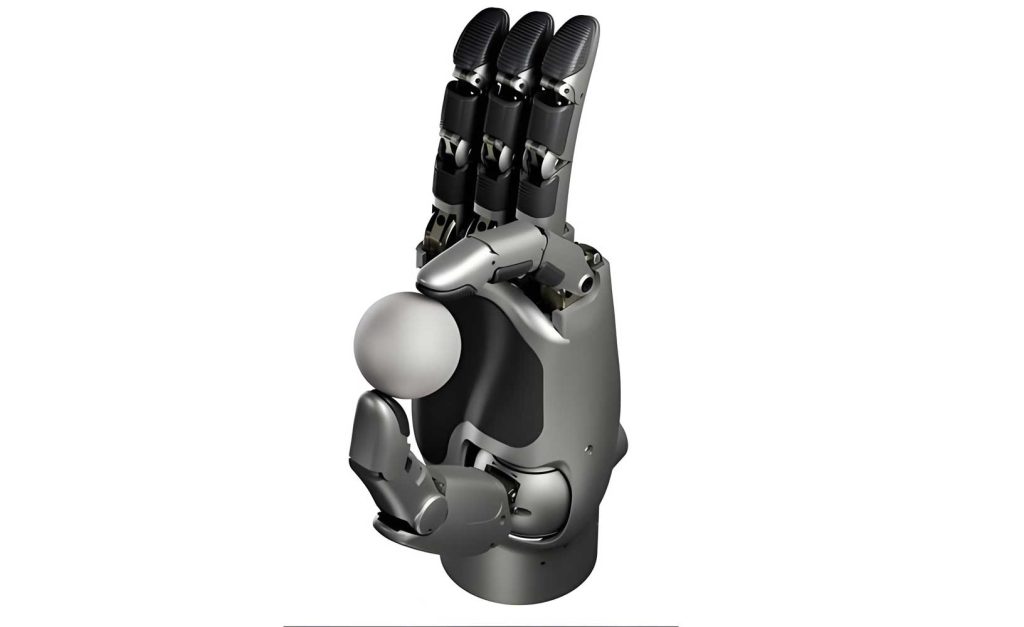
The sensor system architecture for the dexterous robotic hand is designed to be modular and integrated, allowing for seamless communication between various sensing elements and the control unit. The overall structure includes multiple layers: sensor hardware, signal conditioning, data processing, and communication interfaces. This architecture ensures that the dexterous robotic hand can process sensory information in real-time, enabling responsive and adaptive behaviors. Key components of the sensor system include position sensors, force/torque sensors, and tactile sensors, each contributing to the overall perception capabilities of the dexterous robotic hand.
To provide a clear overview, Table 1 summarizes the main types of sensors used in the dexterous robotic hand, along with their functions and characteristics.
| Sensor Type | Function | Key Characteristics |
|---|---|---|
| Position Sensors | Measure joint angles for motion control | High accuracy, low latency, digital output |
| Force/Torque Sensors | Detect forces and moments for interaction | Multi-axis sensing, miniaturized, integrated electronics |
| Tactile Sensors | Sense contact pressure and location | Array-based, flexible, real-time processing |
Position sensors are fundamental for the dexterous robotic hand, as they provide feedback on joint movements, enabling precise positioning and trajectory tracking. In this dexterous robotic hand, two primary types of position sensors are employed: Hall-effect sensors and potentiometers. Hall-effect sensors are used for measuring motor and joint positions in the finger modules. They consist of three digital Hall elements spaced 120 degrees apart, which generate pulse signals as the motor rotates. The position can be calculated by counting these pulses, and with the gear reduction ratio, the joint angle is derived. The relationship between motor rotation and joint position can be expressed as:
$$ \theta_j = \frac{\theta_m}{N} $$
where $\theta_j$ is the joint angle, $\theta_m$ is the motor angle, and $N$ is the gear reduction ratio. This method offers high resolution and reliability, which is essential for the smooth operation of the dexterous robotic hand.
For the base joints, potentiometers are utilized to measure absolute positions in two degrees of freedom: pitch and yaw. These sensors are integrated into differential mechanisms, allowing the dexterous robotic hand to perform complex gestures. The output voltage $V$ from a potentiometer is linearly related to the angle $\alpha$:
$$ V = k \cdot \alpha + V_0 $$
where $k$ is the sensitivity constant and $V_0$ is the offset voltage. Calibration ensures accurate measurements, contributing to the overall precision of the dexterous robotic hand.
Force and torque sensing is another critical aspect of the dexterous robotic hand, enabling it to interact with objects delicately and perform tasks requiring force control. The sensor system includes joint torque sensors and a miniaturized six-axis fingertip force/torque sensor. Joint torque sensors are based on strain gauge technology, with elastic structures designed to measure one-dimensional or two-dimensional moments. For instance, the base joint torque sensor uses a cross-beam structure, where strain gauges are arranged in Wheatstone bridge configurations to decouple forces. The output voltage $V_{out}$ from the bridge is related to the applied torque $\tau$ by:
$$ V_{out} = S \cdot \tau $$
where $S$ is the sensitivity factor. Finite element analysis is used to optimize the design, minimizing cross-talk and hysteresis, which is vital for the dexterous robotic hand’s performance.
The fingertip six-axis force/torque sensor is a standout feature of the dexterous robotic hand, capable of measuring forces ($F_x$, $F_y$, $F_z$) and moments ($M_x$, $M_y$, $M_z$) at the fingertip. This sensor is compact, with a diameter of 20 mm and height of 16 mm, and integrates signal processing electronics using surface-mount technology. The sensing principle relies on strain gauges arranged on a planar elastic body, and Micro-Electro-Mechanical Systems (MEMS) techniques are employed for automated fabrication. The relationship between the applied wrench vector $\mathbf{F} \in \mathbb{R}^6$ and the output voltage vector $\mathbf{V} \in \mathbb{R}^6$ is given by the calibration matrix $\mathbf{C}$:
$$ \mathbf{F} = \mathbf{C} \cdot \mathbf{V} $$
where $\mathbf{C}$ is a $6 \times 6$ matrix obtained through experimental calibration. This sensor enhances the dexterous robotic hand’s ability to perform compliant manipulation, as it provides direct feedback on contact forces.
To illustrate the specifications of the force/torque sensors, Table 2 provides a detailed comparison.
| Sensor | Dimensions | Force Range | Moment Range | Accuracy |
|---|---|---|---|---|
| Joint Torque Sensor | Customized per joint | Up to 10 N | N/A | ±2% FS |
| Fingertip Six-Axis Sensor | 20 mm diameter, 16 mm height | ±10 N | ±200 N·mm | ±5% FS |
Tactile sensing adds another layer of perception to the dexterous robotic hand, allowing it to detect contact pressure and location on the fingertip. The tactile sensors in this dexterous robotic hand are based on piezoresistive materials, where changes in resistance correspond to applied pressure. An array of electrodes is embedded in the fingertip pad, and a programmable system-on-chip (PSoC) handles signal acquisition and processing. The resistance $R$ of a sensing element varies with pressure $P$ as:
$$ R = R_0 \cdot e^{-\beta P} $$
where $R_0$ is the initial resistance and $\beta$ is a material constant. The PSoC scans the electrode array, amplifies signals, and converts them to digital data via an Analog-to-Digital Converter (ADC). This information is transmitted to the central controller through a Serial Peripheral Interface (SPI), enabling real-time tactile feedback for the dexterous robotic hand.
The integration of these sensors into the dexterous robotic hand requires a robust data acquisition and processing framework. The system utilizes DSPs and FPGAs to manage sensor data digitally. DSPs handle complex algorithms for signal filtering, calibration, and fusion, while FPGAs provide reconfigurable logic for high-speed data routing. The A/D converters ensure that analog signals from sensors like potentiometers and strain gauges are digitized with minimal noise. The overall data flow can be modeled as a pipeline:
$$ \text{Sensor} \rightarrow \text{Signal Conditioning} \rightarrow \text{A/D Conversion} \rightarrow \text{DSP/FPGA Processing} \rightarrow \text{Control Unit} $$
This digital approach improves signal integrity and reduces electromagnetic interference, which is crucial for the reliable operation of the dexterous robotic hand. Moreover, the use of standardized communication protocols, such as SPI and Universal Asynchronous Receiver-Transmitter (UART), facilitates interoperability and scalability.
In terms of control applications, the sensor system enables advanced strategies for the dexterous robotic hand. For example, impedance control can be implemented using force feedback from the joint torque and fingertip sensors. The control law for a joint can be expressed as:
$$ \tau_c = J^T \left( K_p (x_d – x) + K_d (\dot{x}_d – \dot{x}) \right) + \tau_f $$
where $\tau_c$ is the commanded torque, $J$ is the Jacobian matrix, $K_p$ and $K_d$ are gain matrices, $x_d$ and $x$ are desired and actual positions, and $\tau_f$ is the feedback torque from force sensors. This allows the dexterous robotic hand to adapt to external forces, mimicking human-like compliance.
Furthermore, multi-finger coordination in the dexterous robotic hand relies on sensor fusion techniques. By combining data from position, force, and tactile sensors, the hand can perform grasping and manipulation tasks with high precision. A fusion algorithm might use a weighted sum approach:
$$ y_{\text{fused}} = \sum_{i=1}^{n} w_i \cdot y_i $$
where $y_i$ are sensor outputs and $w_i$ are weights determined by reliability metrics. This enhances the robustness of perception in the dexterous robotic hand, especially in dynamic environments.
Looking ahead, future developments for the dexterous robotic hand include enhancing sensor miniaturization, improving energy efficiency, and incorporating machine learning for adaptive sensing. For instance, neural networks could be trained to predict wear and tear on sensors, extending the lifespan of the dexterous robotic hand. Additionally, wireless sensor networks might eliminate wiring constraints, increasing flexibility. The dexterous robotic hand will continue to evolve, driven by innovations in sensor technology and control algorithms.
To summarize the technical parameters, Table 3 lists key performance metrics for the sensor system in the dexterous robotic hand.
| Parameter | Value | Unit |
|---|---|---|
| Number of Sensors per Hand | Over 50 | N/A |
| Data Sampling Rate | Up to 1 kHz | Hz |
| Communication Bandwidth | 10 Mbps | bps |
| Power Consumption | Less than 5 W | Watt |
| Operating Temperature | -10 to 60 | °C |
In conclusion, the sensor system for the dexterous robotic hand represents a significant advancement in robotics, enabling sophisticated interaction capabilities. Through the integration of digital technologies and diverse sensor types, this dexterous robotic hand achieves high reliability and performance. The continuous refinement of sensor designs and processing algorithms will further empower the dexterous robotic hand to tackle complex tasks in various domains. As research progresses, the dexterous robotic hand will undoubtedly play a pivotal role in the future of automated systems, bridging the gap between robots and human dexterity.
The development of such sensor systems underscores the importance of interdisciplinary collaboration, combining mechanics, electronics, and computer science. For researchers and engineers, the dexterous robotic hand serves as a platform for exploring new sensing paradigms and control strategies. Ultimately, the goal is to create robotic hands that are not only dexterous but also intelligent, capable of learning and adapting autonomously. The journey towards this vision is ongoing, and the dexterous robotic hand remains at the forefront of innovation.