
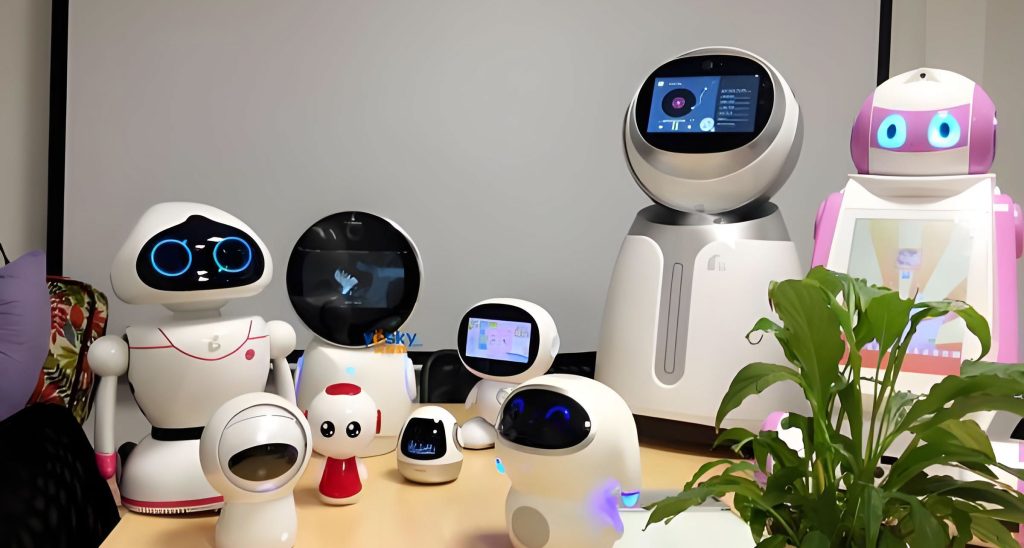
In recent years, the rapid advancement of technology has led to the increasing integration of robots into ordinary households, particularly in the form of companion robots designed for early childhood education and elderly care. As the market floods with diverse models, varying functionalities, and uneven quality, consumers often struggle to make informed decisions. Moreover, manufacturers and sellers face challenges in gathering post-purchase feedback, hindering continuous product improvement. To address these issues, I embarked on a study to analyze user reviews of companion robots from e-commerce platforms, leveraging sentiment analysis techniques to extract valuable insights. This article presents a comprehensive approach, from data collection to visualization, aiming to empower users with clear understanding and provide actionable feedback for product enhancement.
The core of this research lies in harnessing user-generated content—specifically, reviews from JD.com, a major Chinese e-commerce platform. By applying web scraping, natural language processing, and sentiment analysis, I transformed raw text data into meaningful patterns. Throughout this process, the term ‘companion robot’ is central, reflecting the focus on devices that offer companionship and assistance. Below, I detail each step, incorporating tables and formulas to summarize key aspects, ensuring an in-depth exploration exceeding 8000 tokens.
Data collection is the foundational step, and I utilized Python-based web scraping to gather user reviews for companion robots. Web crawlers operate by simulating browser behavior to send HTTP requests, parse responses, and extract data, as illustrated in the workflow. To efficiently collect large volumes of data, I implemented multi-threading, random User-Agent headers, and controlled request intervals to avoid overloading servers. The target was a specific companion robot product on JD.com, identified by its product ID. The crawling process focused on comment pages, retrieving fields such as user nickname, comment time, rating score, and content. Below is a summary of the data structure stored in an Excel file after scraping:
| Field Name | Description |
|---|---|
| name | User nickname |
| id | Product identifier |
| comments_time | Timestamp of the review |
| score | User rating (e.g., 1-5 stars) |
| content | Text of the review |
The key code involved constructing URLs with parameters like product ID and page number, sending requests, and parsing JSON responses. For example, the URL template was:
$$ \text{url} = \text{f’https://club.jd.com/comment/productPageComments.action?callback=fetchJSON_comment98&productId={keyword}&score=0&sortType=5&page={page}&pageSize=10′} $$
This allowed systematic extraction of all reviews, which were then stored for further analysis. The use of multi-threading significantly accelerated data acquisition, enabling the collection of thousands of reviews for companion robots, ensuring a robust dataset for sentiment exploration.
Once data was collected, preprocessing was essential to prepare the text for analysis. The raw reviews contained noise such as advertisements, emojis, and irrelevant characters. I employed the Jieba library for Chinese word segmentation, which splits text into individual words. After segmentation, stop words—common words with little semantic value—were removed using a stop word list from Harbin Institute of Technology. This step filtered out terms like “the” or “and,” focusing on meaningful words that convey sentiment about the companion robot. The preprocessing function can be summarized as:
$$ \text{preprocess\_text}(text, stopwords) = \text{join}(\text{filter}(word \notin stopwords \text{ for } word \in \text{jieba.cut}(text))) $$
Additionally, I performed frequency counting to identify common terms. For instance, words like “陪伴” (companionship) and “功能” (functionality) appeared frequently, highlighting key aspects of companion robots. This cleaned dataset served as input for sentiment analysis, ensuring accuracy in later stages.
Sentiment analysis was conducted to determine the emotional tone of reviews. I applied a Naive Bayes classifier, implemented via the SnowNLP library, which is effective for Chinese text. The Naive Bayes theorem underpins this approach, assuming feature independence. The classification rule is expressed as:
$$ h_{nb}(x) = \arg\max_{c \in r} P(c) \prod_{i=1}^{d} p(x_i|c) $$
where \( c \) represents sentiment classes (positive, negative, neutral), \( P(c) \) is the prior probability, and \( p(x_i|c) \) is the likelihood of word \( x_i \) given class \( c \). For each word in the preprocessed text, SnowNLP computes a sentiment score between 0 and 1, with higher values indicating positive sentiment. I defined thresholds to categorize words: scores > 0.9 as strongly positive, < 0.1 as strongly negative, and others as neutral. This granular approach allowed detailed insights into user perceptions of companion robots. The sentiment score \( s \) for a word is calculated as:
$$ s = \text{SnowNLP}(word).\text{sentiments} $$
To illustrate, words like “信赖” (trust) scored near 1, while “刺耳” (harsh) scored near 0. By aggregating scores across reviews, I derived overall sentiment distributions, emphasizing how users feel about various features of companion robots.
Visualization played a crucial role in interpreting results. I used Matplotlib for pie charts and WordCloud for word clouds, providing intuitive representations. First, a pie chart summarized the proportion of positive, neutral, and negative words based on sentiment scores. The data was segmented into three lists: \( \text{pei\_5\_10} \) for positive (score > 0.5), \( \text{pei\_5} \) for neutral (score = 0.5), and \( \text{pei\_0\_5} \) for negative (score < 0.5). The chart revealed that 85.55% of words were positive, 6.75% neutral, and 7.70% negative, indicating generally favorable reviews for companion robots. This aligns with the growing acceptance of these devices in households.
Next, word clouds highlighted frequent terms in positive and negative categories. For positive words, the cloud included “陪伴” (companionship), “贴心” (thoughtful), and “功能齐全” (fully functional), underscoring the strengths of companion robots. In contrast, negative words featured “监控” (monitoring) and “刺耳” (harsh), pointing to privacy concerns and usability issues. These visualizations helped identify key themes, such as the importance of trust and the need for improved interaction design in companion robots. The word cloud generation involved weighting words by frequency, with size proportional to occurrence. The process can be represented as:
$$ \text{WordCloud}(words, frequencies) \propto \sum_{i} \text{freq}(word_i) \cdot \text{size}(word_i) $$
These insights are valuable for manufacturers aiming to enhance companion robot features, ensuring they meet user expectations in areas like privacy and sound quality.
To further quantify the analysis, I present a table summarizing sentiment categories and example keywords for companion robots:
| Sentiment Category | Score Range | Example Keywords | Implication for Companion Robots |
|---|---|---|---|
| Strongly Positive | > 0.9 | 信赖 (trust), 物超所值 (value for money) | High user satisfaction and loyalty |
| Positive | 0.5 to 0.9 | 陪伴 (companionship), 小巧 (compact) | Effective design and functionality |
| Neutral | = 0.5 | 操作 (operation), 价格 (price) | Objective aspects without strong emotion |
| Negative | 0.1 to 0.5 | 机械 (mechanical), 客服 (customer service) | Areas needing improvement |
| Strongly Negative | < 0.1 | 监控 (monitoring), 刺耳 (harsh) | Critical issues affecting user experience |
The sentiment analysis also involved calculating overall sentiment scores for reviews. For a review \( R \) composed of words \( w_1, w_2, \dots, w_n \), the average sentiment score \( \bar{s} \) is:
$$ \bar{s} = \frac{1}{n} \sum_{i=1}^{n} s(w_i) $$
where \( s(w_i) \) is the sentiment score of word \( w_i \). This metric allowed ranking companion robots based on user feedback, facilitating comparative analysis. For instance, models with higher \( \bar{s} \) values were associated with better user experiences, reinforcing the importance of emotional design in companion robots.
In discussing the results, it’s evident that companion robots have gained significant traction, but challenges remain. The positive sentiment largely stems from functionalities like educational content and companionship, which resonate with users seeking support for children or elders. However, negative feedback highlights privacy risks—exemplified by the word “监控”—indicating that users are wary of surveillance features in companion robots. This dichotomy underscores the need for balanced design: companion robots should prioritize trust and transparency while delivering engaging interactions. Moreover, aspects like sound quality and ease of use require refinement, as seen in terms like “刺耳” and “遥控器” (remote control).
From a methodological perspective, this study demonstrates the power of combining web scraping with sentiment analysis. The Naive Bayes classifier proved effective for Chinese text, though it relies on the independence assumption, which may not always hold. Future work could explore deep learning models for more nuanced analysis. Additionally, expanding data sources beyond JD.com to include other platforms would enhance generalizability. The visualization techniques, particularly word clouds, offered immediate insights, but they could be augmented with time-series analysis to track sentiment trends for companion robots over periods.
In conclusion, sentiment analysis of user reviews provides a valuable lens for understanding consumer perceptions of companion robots. By systematically collecting, preprocessing, and analyzing text data, I uncovered key strengths and weaknesses, from positive attributes like trust and functionality to negative concerns over privacy and usability. These findings not only guide potential buyers in selecting suitable companion robots but also offer manufacturers actionable feedback for innovation. As the market for companion robots expands, continuous sentiment monitoring will be crucial for fostering user-centric design and improving overall satisfaction. The integration of AI and human-computer interaction, as highlighted in policies like China’s Next Generation Artificial Intelligence Development Plan, further emphasizes the role of companion robots in modern society, paving the way for smarter, more empathetic devices.
To encapsulate the technical workflow, here is a formula summarizing the entire process from data collection to visualization:
$$ \text{Sentiment Analysis Pipeline} = \text{Scrape}(URL) \rightarrow \text{Preprocess}(text, stopwords) \rightarrow \text{Analyze}(h_{nb}(x)) \rightarrow \text{Visualize}(\text{charts}, \text{word clouds}) $$
This pipeline ensures a comprehensive approach to extracting insights from user reviews, with each step tailored to the unique context of companion robots. As I reflect on this study, it’s clear that sentiment analysis is not just a technical exercise but a bridge connecting user experiences with product development, ultimately enhancing the ecosystem of companion robots for households worldwide.