
The evolution of intelligent machines is reaching a pivotal juncture with the emergence of the humanoid robot. As a crucial manifestation of embodied intelligence, this technology represents a synthesis of numerous cutting-edge fields. From my perspective, observing the rapid convergence of artificial intelligence, advanced manufacturing, and new materials, it is evident that the humanoid robot stands not merely as a product of engineering but as a defining benchmark for a nation’s capabilities in foundational innovation and high-end manufacturing. Seizing the strategic initiative in this future industry is imperative. It transcends mere technological competition; it is fundamentally about cultivating a new, powerful engine for high-quality economic development and architecting robust solutions for complex societal challenges. In this new race, the potential is vast, necessitating an urgent and comprehensive push to accelerate innovation, refine the industrial ecosystem, and unlock application scenarios to foster the high-quality advancement of the humanoid robot industry.
Grasping the Strategic Significance of Humanoid Robotics
The development of humanoid robots carries profound implications that extend across technological, economic, and social dimensions.
Firstly, the humanoid robot is a focal point for the new wave of scientific and technological revolution. Often described as the pinnacle of manufacturing, robotics’ sophistication is a key indicator of national prowess. The humanoid robot intensifies this technological imperative. It is the ideal form factor for general-purpose machines, demanding breakthroughs and deep integration across AI, precision control, advanced sensing, high-power-density actuation, and novel materials. The pursuit of the humanoid robot actively pulls AI research towards true embodied intelligence, drives the iterative upgrade of core components like high-fidelity sensors and compact actuators, and stimulates fundamental research in biomechanics and cognitive science. It will undoubtedly become a critical metric for assessing a nation’s comprehensive strength in frontier interdisciplinary innovation.
Secondly, the humanoid robot possesses strong industrial multiplier effects, positioning it as a powerful engine for new economic dynamism. As traditional economic pillars mature, there is a pressing need to cultivate新兴产业 with high growth potential and strong downstream linkages. The humanoid robot industry, with its exceptionally long value chain, fits this role perfectly. Its development radiates influence across a vast spectrum of related sectors, from core component manufacturing to system integration and end-user service provision. The economic ripple effect can be summarized by its impact on Gross Domestic Product (GDP) contribution through new value creation:
$$ \Delta GDP_{HR} = \sum_{i=1}^{n} (V_{i, HR} \cdot \eta_{i}) + \sum_{j=1}^{m} (V_{j, induced} \cdot \lambda_{j}) $$
Where $ \Delta GDP_{HR} $ is the GDP contribution from the humanoid robot sector, $ V_{i, HR} $ is the value added in direct humanoid robot industry segment $ i $, $ \eta_{i} $ is its sectoral multiplier, $ V_{j, induced} $ is the value added in induced industry $ j $ (e.g., specialized chips, advanced sensors), and $ \lambda_{j} $ is the corresponding linkage coefficient.
Thirdly, the humanoid robot offers wide-ranging applicability, presenting a key tool for addressing persistent societal challenges. Their anthropomorphic form and AI-driven generality allow them to operate in human-centric environments unlike any previous machine. This “seamless embedding” capability unlocks transformative potential. In hazardous industrial settings like mining or chemical plants, humanoid robots can perform dangerous tasks, mitigating human risk. In social domains, they offer a compelling response to aging populations and workforce shortages, capable of providing physical assistance, daily care, and even companionship for the elderly, while also supporting educational, medical, and domestic services.
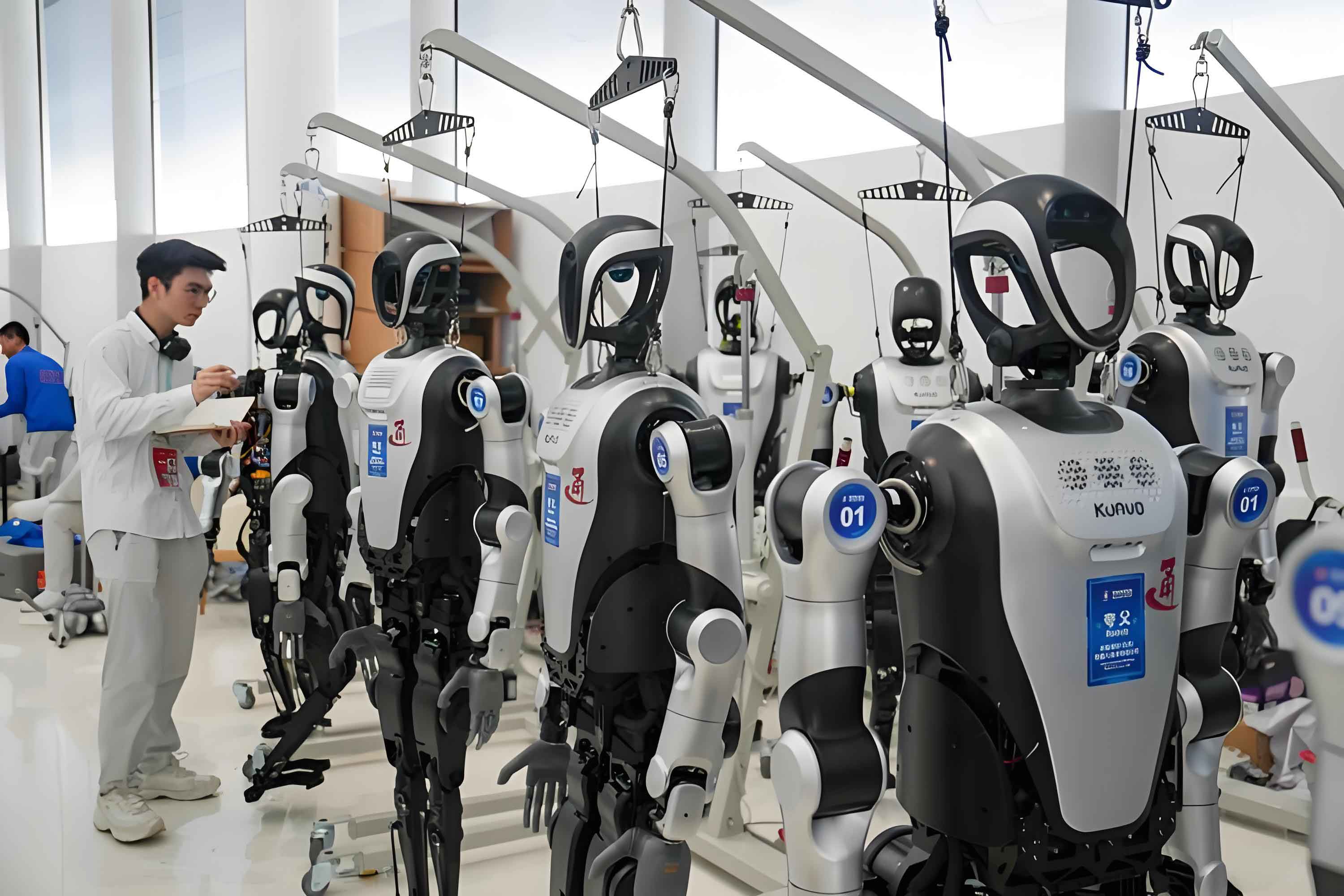
Prospects and Trajectory for the Humanoid Robot Industry
The coming period is poised to be one of accelerated maturation for the humanoid robot industry, characterized by technological breakthroughs, ecological expansion, and scenario proliferation.
1. Technological Breakthroughs: I anticipate that focused R&D efforts will lead to significant leaps in three core areas, establishing a robust technological foundation for the humanoid robot.
- More Agile Limbs: Breakthroughs in lightweight exoskeletons, high-strength structures, and high-precision proprioceptive sensing will enhance physical dexterity. The dynamics of a humanoid robot limb can be modeled using the Lagrangian formulation:
$$ L = T(q, \dot{q}) – V(q) $$
$$ \frac{d}{dt} \left( \frac{\partial L}{\partial \dot{q}_i} \right) – \frac{\partial L}{\partial q_i} = \tau_i $$
where $ T $ is kinetic energy, $ V $ is potential energy, $ q $ and $ \dot{q} $ are generalized coordinates and velocities, and $ \tau_i $ is the generalized force/torque at joint $ i $, crucial for dynamic motion control. - A More Intelligent Brain: Advances in multi-modal environmental perception, real-time behavior control, natural human-robot interaction (HRI), and cognitive decision-making will be driven by embodied AI models. The control policy $ \pi $ for a humanoid robot brain, optimizing for a task reward $ R $, can be seen as:
$$ \pi^* = \arg\max_{\pi} \mathbb{E}_{(s_t, a_t) \sim \pi} \left[ \sum_{t} \gamma^t R(s_t, a_t) \right] $$
where $ s_t $ is the state (from perception) and $ a_t $ is the action taken by the humanoid robot. - More Capable Whole-Body Integration: The synergistic integration of agile limbs and an intelligent brain will elevate overall system performance, marking true progress toward versatile embodied intelligence.
2. Industrial Ecosystem Leap: With technological maturation, the industrial ecosystem surrounding the humanoid robot will experience a qualitative upgrade. This will manifest in two primary ways, as summarized in the table below.
| Aspect | Development Trajectory | Key Features |
|---|---|---|
| Supply Chain Maturity | From component reliance to integrated self-sufficiency | Strengthened dominance in ‘limb’ components (e.g., torque sensors, harmonic drives). Breakthroughs in ‘brain’ & ‘cerebellum’ (balance/motion) AI models. Emergence of a holistic ecosystem encompassing brain, cerebellum, limbs, and full-body integration. |
| Cluster Formation | From scattered efforts to concentrated, competitive hubs | Strategic government focus propelling regional development. Emergence of internationally competitive humanoid robot industry clusters in key metropolitan regions, leveraging local research and manufacturing strengths. |
3. Exponential Expansion of Application Scenarios: The combination of scaled production, cost reduction, and improved capabilities will trigger an explosion in humanoid robot applications. The penetration across sectors can be conceptually modeled by a logistic growth function:
$$ P(t) = \frac{K}{1 + e^{-r(t – t_0)}} $$
Here, $ P(t) $ represents the market penetration of humanoid robots at time $ t $, $ K $ is the carrying capacity or maximum potential penetration, $ r $ is the growth rate, and $ t_0 $ is the inflection point. Different sectors will have distinct parameters $ (K, r, t_0) $.
| Application Domain | Primary Roles | Impact & Examples |
|---|---|---|
| Industrial Collaboration | Precision assembly, quality inspection, flexible logistics, equipment maintenance | Enables highly flexible, customized production lines. Early large-scale adoption expected in electronics and automotive manufacturing, leading to示范 smart factories. |
| Service Sector | Elderly care, education, retail, hospitality, domestic assistance | Addresses labor shortages. Creates new models like “humanoid robot + silver economy”. Roles such as robotic tutors or nursing assistants become feasible. |
| Specialized/Extreme Environments | Search & rescue, hazardous material handling, space/ deep-sea operations, public safety | Operates in complex terrains and under extreme conditions (high temp, radiation, pressure) where human presence is risky or impossible. |
Critical Challenges on the Path to Adoption
Despite the optimistic outlook, the path for the humanoid robot is fraught with significant hurdles that must be navigated carefully.
1. The Commercialization Imperative: The core challenge lies in translating technical feasibility into economic viability. A sustainable business model remains elusive. The primary barrier is the prohibitively high Total Cost of Ownership (TCO), which can be expressed as:
$$ TCO = C_{acquisition} + \sum_{t=1}^{N} \left( \frac{C_{maintenance, t} + C_{operation, t} + C_{downtime, t}}{(1 + d)^t} \right) $$
For a humanoid robot, $ C_{acquisition} $ is extremely high due to complex components, $ C_{maintenance} $ is uncertain, and $ C_{downtime} $ could be significant if reliability is low. Until the TCO undercuts that of human labor or specialized machines in target applications, widespread adoption will stall. In factories, traditional robots are entrenched. In homes and care facilities, cost sensitivity is extreme. Furthermore, regulatory certification, safety standards, and public acceptance pose non-trivial barriers to rapid commercial deployment.
2. The Security and Ethical Quagmire: As humanoid robots become more integrated into daily life, they introduce profound ethical and security risks that escalate with scale.
- Data Privacy and Security: These robots are perpetual data-gathering entities. They collect vast amounts of sensitive audio, visual, and personal environmental data. The risk surface is multi-layered: data at the edge (on the humanoid robot), during transmission, and in the cloud for processing. A breach could be catastrophic. Comprehensive standards for encryption, anonymization, and user data sovereignty are urgently needed.
- AI Ethical Risks with Physical Consequences: The “brain” of a humanoid robot is an AI model susceptible to biases, alignment failures, or malicious manipulation. Unlike a purely digital AI, an embodied agent with a physical form can cause direct harm—whether through misguided actions, manipulation of humans, or being weaponized. The ethical framework for value alignment, decision-making transparency (explainability), and accountability for a humanoid robot‘s actions is perhaps the most profound challenge. The risk function $ R_{ethical} $ encompasses potential harm $ H $, probability of misalignment $ P_{misalign} $, and societal impact $ I $:
$$ R_{ethical} = f(H, P_{misalign}, I) $$
Mitigating this risk requires rigorous safety engineering and robust ethical governance from the outset.
Strategic Recommendations for Cultivating Global Leadership
To navigate these challenges and solidify a position at the global forefront of humanoid robot technology, a multi-pronged, coordinated strategy is essential.
1. Prioritizing Foundational Technological Leadership: The core differentiator will be technological mastery. This requires a dual focus on pioneering research and efficient translation.
- Fortify the R&D Base: Sustained investment in fundamental research and core technology攻坚 is non-negotiable. The goal should be to build a cohesive technological architecture where the AI “brain,” the real-time motion “cerebellum,” and the dexterous “limbs” of the humanoid robot evolve in tight synergy. Pursuing disruptive innovations in materials, control theory, and neuromorphic computing is key to developing unique competitive advantages.
- Bridge the Valley of Death: Establishing specialized infrastructure like proof-of-concept centers, pilot-scale testing facilities, and cross-disciplinary innovation platforms is critical. These entities can de-risk technology transfer by offering prototyping, rigorous performance validation, and system integration testing, accelerating the journey from lab prototype to industrial-grade humanoid robot.
2. Fostering a Vibrant and Collaborative Industrial “Rainforest”: A healthy ecosystem thrives on diversity and symbiosis, not monoculture.
- Cultivate a Multi-Tiered Enterprise Structure: Encourage the growth of integrated “flagship” companies that can act as ecosystem anchors. Simultaneously, vigorously support specialized Small and Medium-sized Enterprises (SMEs) to achieve excellence in niche areas—be it a specific sensor, a unique actuator, or specialized software—becoming “hidden champions” in the humanoid robot supply chain.
- Promote Geographic and Sectoral Clustering: Policy should incentivize the formation of integrated clusters where R&D labs, component manufacturers, system integrators, and end-users co-locate and collaborate. This proximity accelerates feedback loops, reduces transaction costs, and fosters the serendipitous collaborations that drive innovation in the humanoid robot space.
3. Accelerating Adoption Through Scenario-Driven Innovation: Technology matures fastest when tested in real-world conditions. Application must be a primary driver.
- Launch Large-Scale Demonstration Projects: Governments and industry consortia should proactively co-invest in ambitious, public-facing pilot projects in high-impact areas like advanced manufacturing, geriatric care, and disaster response. These “living labs” provide invaluable data, build public familiarity, and force the hardening of humanoid robot technologies.
- Create Open Scenario Platforms: Establish dedicated platforms for matching real-world problem statements from cities, hospitals, and factories with solution providers from the humanoid robot community. By systematically identifying needs, publishing challenge lists, and facilitating solution matchmaking, these platforms can dramatically shorten the deployment cycle and ensure development is grounded in practical utility.
In conclusion, the era of the humanoid robot is dawning. It presents a complex tapestry of extraordinary opportunity and formidable challenge. Success will not belong to those who simply build a robot, but to those who can orchestrate the entire innovation symphony—mastering core technologies, nurturing a resilient and collaborative industrial ecosystem, and boldly pioneering applications that solve real human problems. The journey to shape this global frontier is underway, demanding vision, persistence, and a steadfast commitment to integrating technological progress with ethical foresight and tangible societal benefit.