
In the field of precision transmission systems, the harmonic drive gear stands out due to its high reduction ratio, compactness, and positional accuracy, making it indispensable in robotics, aerospace, and precision instrumentation. As a researcher focused on advancing transmission performance, I have dedicated efforts to understanding the complex meshing behavior under load. The tri-arc spatial tooth profile has emerged as a promising design for harmonic drive gears, offering improved load distribution and contact characteristics. This article presents a comprehensive simulation-based investigation into the load meshing performance of a harmonic drive gear with a tri-arc tooth profile. Utilizing finite element analysis, I explore the multi-tooth contact states, force distributions, and pressure patterns from no-load to maximum allowable torque conditions. The goal is to reveal insights that can enhance the durability, stiffness, and overall efficiency of harmonic drive gear systems.
The harmonic drive gear operates on the principle of elastic deformation, where a flexible spline (flexspline) is deformed by a wave generator to mesh with a rigid spline (circular spline). Under transmission loads, the meshing state becomes critical, as uneven load sharing can lead to premature wear, reduced precision, and failure. Traditional tooth profiles, such as involute or double-arc, often exhibit limitations in contact pressure distribution and load capacity. The tri-arc spatial tooth profile, characterized by three connected circular arcs, aims to optimize the convex-concave engagement, particularly near the major axis of the wave generator. In this study, I establish a detailed three-dimensional finite element model to simulate the meshing process, applying incremental angular displacements to mimic varying load levels. By extracting meshing forces and contact pressures, I analyze the circumferential and axial variations, assessing how the tri-arc design and tooth profile modifications influence performance. This work contributes to the broader understanding of harmonic drive gear behavior, providing a foundation for design optimizations aimed at higher reliability and load-bearing capability.
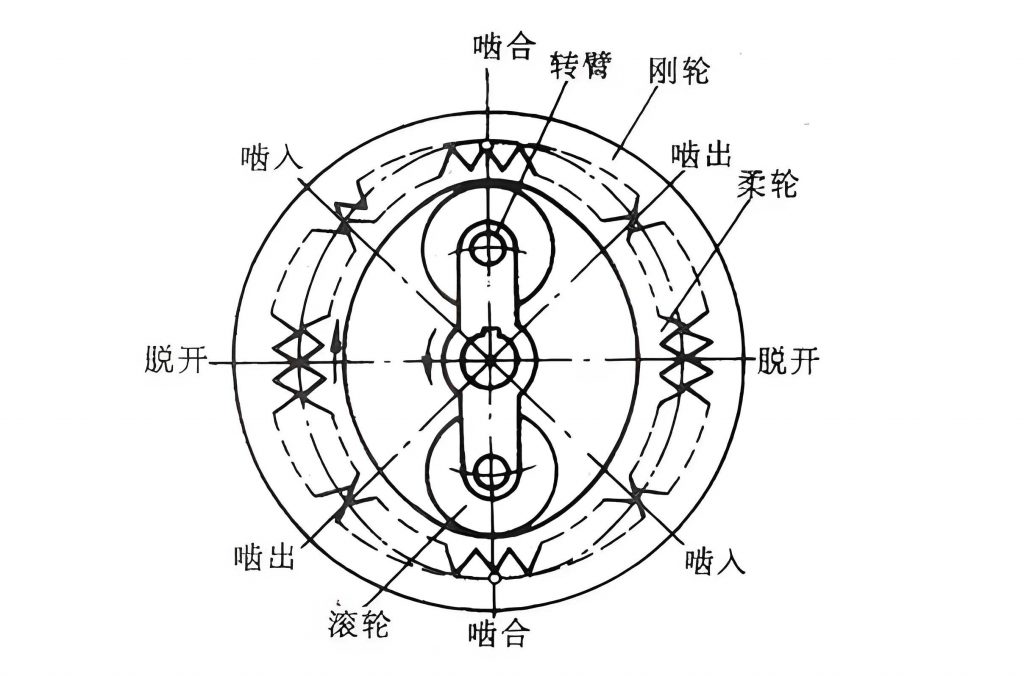
To begin, I developed a solid-element finite element model of a harmonic drive gear with a tri-arc spatial tooth profile. The model is based on a cup-type flexspline, commonly used in applications like robotic joints. The flexspline consists of a tapered tooth ring, a cylindrical body, and a cup bottom, with key structural parameters defined to reflect real-world geometries. The tri-arc tooth profile is constructed from four smoothly connected circular arcs: two convex arcs and one concave arc, designed to minimize initial backlash near the major axis. This design promotes a convex-concave meshing zone, which is hypothesized to reduce contact pressure under load. The circular spline features a conjugate tooth profile derived from envelope theory, ensuring proper meshing with the deformed flexspline. For simulation efficiency, the wave generator is simplified as a rigid elliptical surface, with its major axis deformation set to match standard values. Material properties are assigned, with the flexspline made of steel (Young’s modulus E = 210 GPa, Poisson’s ratio μ = 0.3), modeled using 20-node hexahedral elements (SOLID186). The circular spline is treated as rigid due to its high stiffness, and contact relationships are defined using surface-to-surface contact pairs, with separate real constants for each tooth pair to facilitate analysis and result extraction.
The finite element model incorporates axial tooth profile modification, where the flexspline tooth thickness varies along the width to control initial backlash distribution. This radial modification is crucial for forming a wider contact area under load. Specifically, the minimum initial backlash is set at the middle section near the major axis, with gradual increases toward the front and rear sections. This approach ensures that the middle section, supported radially by the wave generator, engages first and bears a significant portion of the load, thereby enhancing stiffness. The initial backlash distribution is calculated theoretically and validated against finite element results under no-load conditions. The agreement confirms the model’s accuracy, as shown in the side clearance curves across front, middle, and rear sections. For load simulation, I apply fixed constraints to the cup bottom of the flexspline and full constraints to the wave generator. The circular spline is subjected to incremental angular displacements in the counterclockwise direction, simulating torque levels from no-load to the instantaneous maximum allowable torque. Multiple load steps are solved iteratively, with results saved for each step to analyze the evolution of meshing forces and contact pressures.
The simulation covers a range of load conditions, including no-load, rated torque, average allowable torque, start-stop peak torque, and instantaneous maximum torque. The harmonic drive gear model has a reduction ratio of 120, with the flexspline having 240 teeth and the circular spline 242 teeth. Key parameters for the tri-arc tooth profile and structural dimensions are summarized in tables to provide clarity. For instance, the radii of the arcs in the flexspline tooth profile are defined, along with heights from the pitch circle. Similarly, the circular spline tooth profile parameters are listed. These parameters are essential for replicating the design and understanding the meshing mechanics. The use of tables helps consolidate information, as shown below for the flexspline and circular spline tooth profiles.
| Parameter | Value (mm) | Description |
|---|---|---|
| R1 | 0.142 | Radius of the first arc (near tooth tip) |
| R2 | 0.793 | Radius of the second arc (concave section) |
| R3 | 0.516 | Radius of the third arc (convex section) |
| R4 | 0.132 | Radius of the fourth arc (near tooth root) |
| h1 | 0.169 | Radial height of point B from pitch circle |
| h2 | 0.066 | Radial height of point C from pitch circle |
| r0 | 31.712 | Pitch circle radius |
| ra | 31.950 | Tip circle radius |
| rf | 31.395 | Root circle radius |
| s | 0.332 | Tooth thickness on pitch circle |
| Parameter | Value (mm) | Description |
|---|---|---|
| Rg1 | 0.237 | Radius of the first arc (near tooth root) |
| Rg2 | 0.410 | Radius of the second arc (convex section) |
| Rg3 | 0.396 | Radius of the third arc (concave section) |
| Rg4 | 0.083 | Radius of the fourth arc (near tooth tip) |
| xg2, yg2 | 0.558, 32.118 | Center coordinates of arc KM |
| xg3, yg3 | -0.249, 32.000 | Center coordinates of arc IJ |
| hg1 | 0.158 | Radial height of point J from H |
| hg2 | 0.274 | Radial height of point K from H |
| rga | 31.785 | Tip circle radius |
| rgf | 32.273 | Root circle radius |
In the harmonic drive gear, the meshing force distribution is a critical indicator of load sharing among teeth. From the simulation results, I extracted the meshing forces on the flexspline teeth under various torque levels. The meshing force per tooth is calculated as the resultant contact force on the tooth surface, and its circumferential distribution reveals how the load is spread. Under low loads (e.g., 10% of rated torque), only teeth near the major axis engage, with forces concentrated in a narrow region. As the load increases, more teeth participate, extending toward both sides of the major axis. The distribution becomes asymmetric, with the meshing-in side (right of the major axis) showing faster force increments. At rated torque, approximately 30% of the teeth are in contact, and at maximum torque, this increases to about 45%. The maximum meshing force shifts from the minimum initial backlash point (near 3°) toward the right side, forming a plateau-like distribution at high loads. This behavior underscores the effectiveness of the tri-arc profile in distributing load across multiple teeth, enhancing the harmonic drive gear’s capacity.
To quantify the meshing force distribution, I derived a mathematical representation based on the initial backlash and tooth stiffness. The meshing force \( F_i \) for tooth \( i \) can be expressed as:
$$ F_i = K_i \cdot \delta_i $$
where \( K_i \) is the meshing stiffness of tooth \( i \), and \( \delta_i \) is the effective deformation, which depends on the initial backlash \( b_i \) and the angular displacement \( \theta \) of the circular spline. For a harmonic drive gear, the total transmitted torque \( T \) is related to the sum of meshing forces:
$$ T = \sum_{i=1}^{N} F_i \cdot r_0 \cdot \cos(\alpha_i) $$
Here, \( N \) is the number of meshing teeth, \( r_0 \) is the pitch radius, and \( \alpha_i \) is the pressure angle at the contact point. The stiffness \( K_i \) varies along the circumference due to the flexspline’s deformation and tooth profile geometry. In the tri-arc design, the convex-concave engagement near the major axis results in higher stiffness and lower initial backlash, leading to larger force contributions. The following table summarizes the meshing force characteristics at different load levels, illustrating the trends in force distribution and number of engaged teeth.
| Load Condition | Torque (N·m) | Number of Engaged Teeth | Meshing Force Range (N) | Maximum Force Position (° from Major Axis) |
|---|---|---|---|---|
| 10% Rated | 6.7 | ~12 | 5-25 | 3° (right) |
| 50% Rated | 33.5 | ~22 | 10-60 | 5° (right) |
| Rated (RAT) | 67 | ~30 | 15-100 | 8° (right) |
| Average Allowable (AVT) | 108 | ~35 | 20-130 | 12° (right) |
| Start-Stop Peak (STT) | 167 | ~40 | 25-150 | 15° (right) |
| Instantaneous Max (MIT) | 304 | ~45 | 30-180 | 18° (right) |
Contact pressure analysis provides deeper insights into the stress state on tooth surfaces, which directly affects wear and fatigue life. For the harmonic drive gear with a tri-arc profile, the contact pressure distribution is influenced by the tooth geometry and axial modification. Under no-load, the contact is limited to regions with minimal backlash. As load increases, the contact area expands axially and along the tooth height. At rated torque, the contact pressure is highest in the middle section, where the wave generator provides radial support, confirming the design intent. The tri-arc profile facilitates a convex-concave meshing in the major axis region, resulting in lower and more uniform pressure compared to convex-convex contacts in other areas. At higher loads, the pressure distribution develops three peaks circumferentially: one on the left side (meshing-out), one near the major axis, and one on the right side (meshing-in). The maximum contact pressure occurs in the middle section, but at extreme loads, the right side peaks due to convex-convex engagement near the tooth tips.
The contact pressure \( p \) can be modeled using Hertzian contact theory, adapted for the complex geometry of the harmonic drive gear. For two curved surfaces in contact, the maximum pressure is given by:
$$ p_{\text{max}} = \frac{3F}{2\pi a b} $$
where \( F \) is the normal force, and \( a \) and \( b \) are the semi-axes of the contact ellipse. In the tri-arc profile, the radii of curvature vary along the tooth profile, affecting \( a \) and \( b \). The effective radius of curvature \( R’ \) for the contact pair is:
$$ \frac{1}{R’} = \frac{1}{R_{1}} + \frac{1}{R_{2}} $$
with \( R_{1} \) and \( R_{2} \) being the radii of the flexspline and circular spline tooth surfaces at the contact point. For convex-concave pairs, \( R_{1} \) and \( R_{2} \) have opposite signs, leading to a larger \( R’ \) and lower pressure. This explains the beneficial effect of the tri-arc design in the major axis zone. The contact area \( A \) can be approximated as:
$$ A = \pi a b $$
and it increases with load due to plastic deformation and broader engagement. The simulation results show that at MIT, the contact area covers up to 75% of the tooth width axially, demonstrating the efficacy of axial modification. The table below summarizes the maximum contact pressure values and their locations under different loads.
| Load Condition | Torque (N·m) | Maximum Contact Pressure (MPa) | Location (Section, Circumferential Position) | Contact Area Characteristics |
|---|---|---|---|---|
| 10% Rated | 6.7 | 50 | Front, near -5° | Small, front segment only |
| Rated (RAT) | 67 | 150 | Middle, near 3° | Wide, middle segment dominant |
| Average Allowable (AVT) | 108 | 200 | Middle, near 10° | Extended to front and rear |
| Start-Stop Peak (STT) | 167 | 250 | Middle, near 15° | Broad, covering 50% width |
| Instantaneous Max (MIT) | 304 | 400 | Middle/Rear, near 36° | Very broad, up to 75% width |
The axial variation of contact pressure is also critical. Due to the tooth profile modification, the initial backlash increases from the middle to the rear sections, which delays rear section engagement until higher loads. This ensures that the stiffer middle section bears the brunt initially, improving load stiffness. Under MIT, the rear section engages significantly, leading to high pressures in convex-convex regions. However, the overall distribution remains favorable, with the majority of teeth experiencing moderate pressures. The harmonic drive gear’s performance is thus enhanced by the tri-arc spatial design, which balances load sharing and stress reduction.
In discussing the results, it is evident that the tri-arc tooth profile offers distinct advantages for harmonic drive gear applications. The minimum initial backlash set near the major axis creates a convex-concave meshing zone that reduces contact pressure and distributes load more evenly. This is particularly beneficial under rated and peak loads, where the contact pressure increase is gradual, indicating good wear resistance. The axial modification further optimizes performance by widening the contact area along the tooth width, preventing edge loading and improving torque capacity. Compared to traditional profiles, the tri-arc design in a harmonic drive gear allows for more teeth to engage simultaneously, with forces distributed in a plateau-like manner on the meshing-in side. This asymmetry is expected due to the direction of rotation and deformation dynamics, and it does not compromise reliability.
The simulation methodology employed here—using finite element analysis with incremental load steps—provides a robust tool for evaluating harmonic drive gear designs. By defining detailed contact pairs and incorporating material nonlinearities, the model captures complex interactions that analytical methods might miss. For instance, the shift in maximum meshing force toward the right side under high loads is a nuance that could inform design adjustments, such as optimizing the initial backlash distribution. Moreover, the three-peak pattern in contact pressure highlights areas where material strengthening or lubrication might be focused. These insights are valuable for engineers seeking to push the limits of harmonic drive gear performance in demanding applications like space mechanisms or industrial robots.
To generalize the findings, I derived formulas that can guide the design of similar harmonic drive gear systems. The relationship between torque and meshing force distribution can be approximated by a polynomial fit based on the simulation data. For the tri-arc profile, the total number of engaged teeth \( N \) as a function of torque \( T \) is:
$$ N(T) = N_0 + k_1 T – k_2 T^2 $$
where \( N_0 \) is the number of teeth engaged at no-load (approximately 0), and \( k_1 \), \( k_2 \) are constants derived from regression. Similarly, the maximum contact pressure \( p_{\text{max}} \) scales with torque:
$$ p_{\text{max}}(T) = p_0 + c_1 T + c_2 T^2 $$
with \( p_0 \), \( c_1 \), and \( c_2 \) determined from results. These empirical relations, while specific to this harmonic drive gear configuration, illustrate the nonlinear behavior under load and can be adapted for other profiles with proper calibration.
In conclusion, this study demonstrates the effectiveness of a tri-arc spatial tooth profile in enhancing the load meshing performance of a harmonic drive gear. Through finite element simulation, I have shown that the design promotes multi-tooth engagement, reduces contact pressure in critical zones, and improves load distribution via axial modification. The harmonic drive gear exhibits increased stiffness and capacity, with meshing forces spreading across up to 45% of the teeth at maximum torque and contact pressures remaining manageable due to convex-concave interactions. These findings validate the tri-arc profile as a superior choice for high-performance harmonic drive gear systems, offering a path toward more reliable and efficient transmissions. Future work could explore dynamic effects, thermal considerations, or experimental validation to further refine the design. Ultimately, the insights gained here contribute to advancing harmonic drive gear technology, supporting its vital role in precision engineering applications.