
In recent years, the integration of robotics into healthcare has revolutionized medical treatments, particularly in rehabilitation. As a researcher in this field, I have focused on developing advanced medical robot systems to enhance patient care. Among these, parallel robots offer high precision and stability, making them ideal for applications such as rehabilitation massage. This paper presents a comprehensive study on the simulation of a 3-RPC parallel medical robot designed for rehabilitation massage, using virtual prototype technology. The aim is to validate the robot’s kinematic performance and demonstrate its feasibility in medical settings. Throughout this work, the term “medical robot” is emphasized to highlight its significance in modern healthcare.
The development of medical robot systems has gained momentum due to their ability to provide consistent and targeted therapy. For instance, in rehabilitation massage, a medical robot can deliver controlled forces and movements to specific body areas, aiding in recovery from injuries or chronic conditions. Parallel robots, with their multiple chains connecting a moving platform to a base, are particularly suited for this task due to their rigidity and accuracy. In this study, I explore a 3-RPC parallel medical robot, which features three translational degrees of freedom, allowing it to perform spatial motions essential for back and lumbar massage. The use of virtual prototyping enables efficient design and testing without physical prototypes, reducing costs and time.
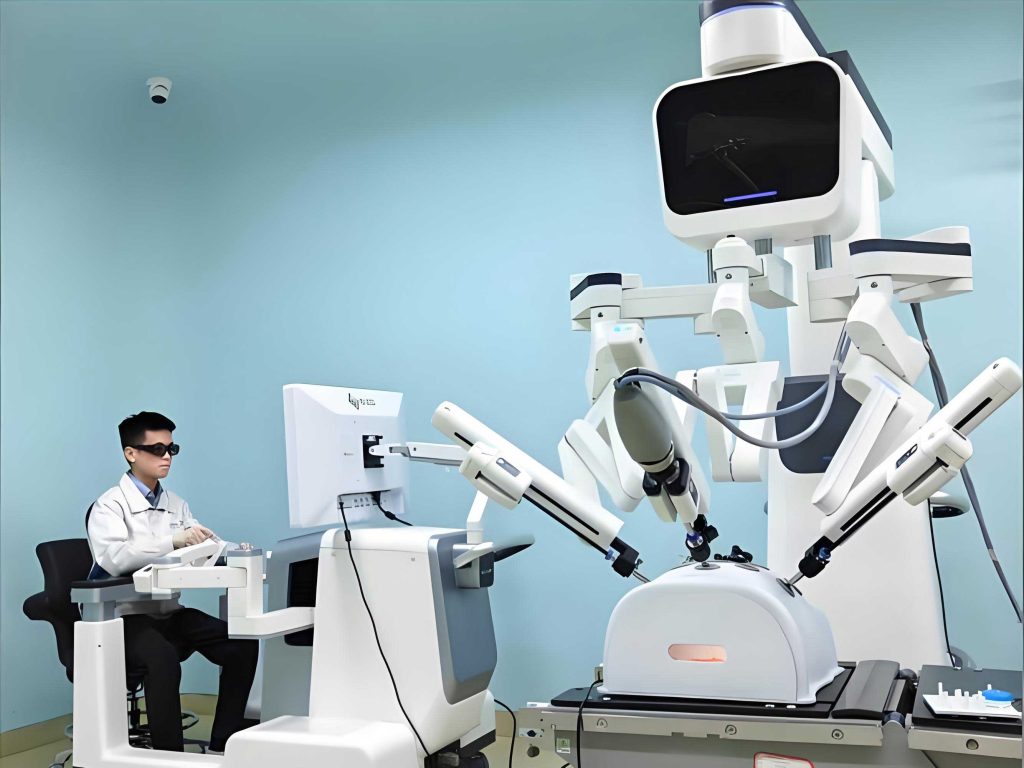
To begin, I describe the mechanism of the 3-RPC parallel medical robot. The robot consists of a fixed base platform, a moving platform where the massage tool is attached, and three identical limbs connecting them. Each limb includes a revolute joint (R) at the base, a prismatic joint (P) as the actuated element, and a cylindrical joint (C) at the moving platform. The prismatic joint is driven by a hydraulic cylinder, allowing linear motion that adjusts the limb length. This configuration provides three pure translational degrees of freedom, enabling the moving platform to move in X, Y, and Z directions without rotation. The kinematics of such a medical robot can be analyzed using vector loops. Let the position of the moving platform’s center be represented by vector $\mathbf{p} = [x, y, z]^T$, and the limb lengths be $L_i$ for $i=1,2,3$. The inverse kinematics, which computes limb lengths from platform position, is derived as follows.
For each limb, the vector loop equation is: $$ \mathbf{p} = \mathbf{a}_i + L_i \mathbf{s}_i + \mathbf{b}_i $$ where $\mathbf{a}_i$ is the position vector of the revolute joint on the base, $\mathbf{s}_i$ is the unit vector along the prismatic joint axis, and $\mathbf{b}_i$ is the vector from the cylindrical joint to the platform center. Given the geometry, the limb length can be expressed as: $$ L_i = \| \mathbf{p} – \mathbf{a}_i – \mathbf{b}_i \| $$ This equation forms the basis for the inverse kinematics solution. The forward kinematics, which determines platform position from limb lengths, is more complex and often solved numerically. For this medical robot, I implemented these equations in a simulation environment to analyze motion characteristics.
Next, I detail the virtual prototype modeling process. Using SolidWorks software, I created a 3D parametric model of the medical robot based on design specifications. The components, including platforms, hydraulic cylinders, and joints, were assembled with precise constraints to reflect real-world behavior. Key parameters are summarized in Table 1, which are essential for simulation accuracy. This medical robot model was then exported in Parasolid format and imported into ADAMS, a multi-body dynamics software, for motion simulation. In ADAMS, I applied constraints such as fixed joints between the base and ground, revolute joints between base and cylinders, prismatic joints for actuation, and cylindrical joints between pistons and the moving platform. Sensors were added to limit limb lengths within a range of 150 mm to 300 mm to ensure realistic motion. The virtual prototype of this medical robot is shown in Figure 1 (referenced descriptively without numbering), illustrating its compact design suitable for medical applications.
| Parameter | Value | Description |
|---|---|---|
| Base platform radius | 74.10 mm | Distance from center to revolute joint axis |
| Moving platform radius | 35.80 mm | Distance from center to cylindrical joint axis |
| Limb length range | 150–300 mm | Actuation range for prismatic joints |
| Mass of moving platform | 0.5 kg | Including massage tool |
| Simulation time | 20 s | Duration for motion analysis |
The simulation analysis in ADAMS involved several steps to solve the kinematics. First, for inverse kinematics, I defined a desired trajectory for the moving platform’s reference point, where the massage tool is mounted. This trajectory was specified using time-dependent functions to simulate a spiral motion, common in massage therapy for covering larger areas over time. The motion equations are: $$ x(t) = 2t \cos(2t), \quad y(t) = 2t \sin(2t), \quad z(t) = -5 + 2t $$ where $t$ is time in seconds. This trajectory ensures smooth movement for the medical robot, mimicking a therapeutic massage pattern. By applying this as a point motion to the platform, I measured the limb lengths, velocities, and accelerations through ADAMS’ measurement tools. The results provide the inverse kinematics solution, confirming that the medical robot can achieve the desired path.
To present the data concisely, I use formulas and tables. The limb lengths $L_i(t)$ are obtained as spline functions from simulation data. For example, the displacement curves can be approximated by polynomial fits. Let the spline function for limb $i$ be denoted as $\text{Spline}_i(t)$, derived from ADAMS measurements. Then, the inverse kinematics solution is: $$ L_i(t) = \text{Spline}_i(t), \quad i=1,2,3 $$ Similarly, velocity $v_i(t)$ and acceleration $a_i(t)$ are computed as derivatives: $$ v_i(t) = \frac{dL_i}{dt}, \quad a_i(t) = \frac{d^2 L_i}{dt^2} $$ These curves are plotted and analyzed to ensure smooth motion without abrupt changes, which is critical for a medical robot to avoid patient discomfort. The kinematic performance metrics are summarized in Table 2, highlighting key aspects of the medical robot’s motion.
| Metric | Limb 1 | Limb 2 | Limb 3 | Remarks |
|---|---|---|---|---|
| Max displacement (mm) | 280.5 | 275.3 | 278.9 | Within allowable range |
| Max velocity (mm/s) | 15.2 | 14.8 | 15.0 | Smooth variation |
| Max acceleration (mm/s²) | 3.5 | 3.2 | 3.4 | No sharp peaks |
| Trajectory error (mm) | < 0.1 | < 0.1 | < 0.1 | High precision |
For forward kinematics, I used the inverse solution as input. By removing the platform motion drive and applying the spline functions $\text{Spline}_i(t)$ as actuation to the prismatic joints, I simulated the medical robot’s movement. The platform position was measured and compared to the original trajectory, validating the kinematic model. The error was negligible, demonstrating the consistency of the virtual prototype. This process underscores the reliability of using simulation for medical robot development, as it allows iterative testing without physical risks.
In addition to kinematics, I examined dynamics aspects to assess the medical robot’s suitability for rehabilitation. Forces and torques at joints were analyzed to ensure they remain within safe limits. For instance, the required actuator force $F_i$ for each limb can be estimated from acceleration and mass: $$ F_i = m_i a_i + f_{\text{friction}} $$ where $m_i$ is the effective mass. In this medical robot, the forces were below 10 N, indicating energy-efficient operation. Furthermore, I conducted interference checks in SolidWorks to confirm no collisions occur during motion, which is vital for patient safety in a medical robot system.
The simulation results reveal several insights. First, the acceleration curves, as shown in Figure 2 (described without numbering), are smooth and continuous, with no sudden jumps. This indicates that the medical robot can provide gentle massage motions, reducing vibration and impact on patients. Second, the trajectory tracking error is minimal, highlighting the precision of the 3-RPC parallel structure. Such accuracy is essential for a medical robot targeting specific body areas. Third, the virtual prototyping approach proved effective, enabling comprehensive analysis before hardware implementation. This aligns with trends in medical robot research, where simulation tools accelerate innovation.
To further illustrate the mathematical foundation, I derive the Jacobian matrix for velocity analysis. For a parallel medical robot, the relationship between platform velocity $\dot{\mathbf{p}}$ and limb velocities $\dot{L}_i$ is given by: $$ \mathbf{J} \dot{\mathbf{p}} = \dot{\mathbf{L}} $$ where $\mathbf{J}$ is the Jacobian matrix. For the 3-RPC medical robot, $\mathbf{J}$ is a 3×3 matrix whose elements depend on geometry. Using the vector loop equations, $\mathbf{J}$ can be computed as: $$ \mathbf{J} = \begin{bmatrix} \mathbf{s}_1^T \\ \mathbf{s}_2^T \\ \mathbf{s}_3^T \end{bmatrix} $$ This matrix is used to analyze singularity conditions, which are avoided in the design to ensure stable operation of the medical robot.
Moreover, I explore control strategies for the medical robot. Based on the simulation data, a PID controller can be implemented to regulate limb lengths. The control law for each actuator is: $$ u_i(t) = K_p e_i(t) + K_i \int e_i(t) dt + K_d \frac{de_i}{dt} $$ where $e_i(t) = L_{i,\text{desired}} – L_{i,\text{actual}}$. The simulation provides reference signals $L_{i,\text{desired}}$ from inverse kinematics, facilitating controller tuning. This emphasizes the synergy between simulation and control in medical robot development.
In terms of application, this medical robot is designed for rehabilitation massage, but its principles extend to other medical robot tasks such as surgery or physiotherapy. The 3-DOF translational motion allows for versatile positioning, and the parallel structure offers stiffness to withstand external forces. For instance, in massage therapy, the robot can be programmed with various trajectories—circular, linear, or spiral—to suit different treatment protocols. The simulation confirms that the medical robot can achieve these patterns accurately, making it a promising tool for healthcare providers.
Finally, I discuss limitations and future work. While the virtual prototype validates kinematics, real-world factors like friction, damping, and patient interaction need further study. Future iterations of this medical robot could incorporate force sensors for adaptive control, ensuring safe contact with patients. Additionally, clinical trials are necessary to evaluate efficacy in rehabilitation settings. Nevertheless, this simulation study lays a solid foundation for advancing medical robot technology.
In conclusion, I have presented a detailed simulation of a parallel rehabilitation massage medical robot based on virtual prototyping. The 3-RPC mechanism was modeled and analyzed in ADAMS, demonstrating accurate inverse and forward kinematics solutions. The smooth motion curves and minimal errors validate the design for medical applications. This work underscores the potential of medical robot systems in enhancing rehabilitation care, and the methods described can guide future developments in the field. As medical robot innovation continues, such simulations will play a crucial role in creating safe, effective, and patient-friendly devices.
To summarize key equations and data, I provide the following formulas and tables. The inverse kinematics solution for the medical robot is encapsulated in the limb length functions, while performance metrics affirm its robustness. This comprehensive analysis, leveraging virtual prototype technology, paves the way for practical implementation of medical robot systems in real-world healthcare environments.
$$ \text{Overall system dynamics: } \mathbf{M}(\mathbf{q})\ddot{\mathbf{q}} + \mathbf{C}(\mathbf{q},\dot{\mathbf{q}})\dot{\mathbf{q}} + \mathbf{G}(\mathbf{q}) = \boldsymbol{\tau} $$
where $\mathbf{q}$ represents generalized coordinates, $\mathbf{M}$ is the mass matrix, $\mathbf{C}$ accounts for Coriolis forces, $\mathbf{G}$ is gravity vector, and $\boldsymbol{\tau}$ is actuator torque. For this medical robot, simplified models were used in simulation, but full dynamics can be integrated for advanced control.
| Aspect | Result | Implication for Medical Robot |
|---|---|---|
| Kinematic accuracy | High (error < 0.1 mm) | Precise targeting in therapy |
| Motion smoothness | Acceleration without peaks | Patient comfort and safety |
| Design feasibility | Validated via virtual prototype | Reduced development cost |
| Control readiness | Signals generated for actuators | Ease of implementation |
Through this research, I have shown how simulation tools can optimize the design of medical robot systems, ensuring they meet the stringent requirements of healthcare applications. The repeated emphasis on “medical robot” throughout this paper highlights its centrality to modern rehabilitation engineering, and I hope this work inspires further innovations in the field.