
I have spent the last several years working with industrial robots, and the most important change I have seen is not a bigger model. It is a smaller, faster, and more reliable model that can live inside the control loop of a real production line. When I first read about a visual-language-action model with fewer than one billion parameters reaching the top of a global embodied intelligence leaderboard, I was not surprised by the headline. I was surprised by the direction it confirmed: industrial robots are moving away from brute-force scale and toward surgical efficiency.
In my own work, I have watched teams try to bolt enormous foundation models onto robotic arms. The demos look impressive. The production line does not. A model that takes hundreds of milliseconds to infer an action may be acceptable for a chatbot, but it is not acceptable for industrial robots that must insert a connector, open a latch, or place a component before the next cycle begins. The gap between laboratory intelligence and factory intelligence is not measured only in accuracy. It is measured in milliseconds, watts, maintenance hours, and failure recovery.
That is why the rise of a lightweight visual-language-action model for industrial robots matters to me. It shows that a model can be small enough to run near the edge, yet strong enough to handle dozens of different manipulation tasks. It also shows that the competition in embodied intelligence is shifting from parameter count to deployment quality. I believe this shift will define the next generation of industrial robots.
When I evaluate any model for industrial robots, I use a simple hierarchy. First, can it complete the task reliably? Second, can it complete the task fast enough? Third, can it do so without a data center beside every robot cell? Fourth, can it improve when the real world changes? A model that fails any of these questions is not ready for industrial robots, no matter how large it is.
The model I am thinking about, which I will call FabriVLA in this discussion, follows that hierarchy. It is a visual-language-action model designed for manipulation. Its parameter count is below one billion. In a multi-task manipulation benchmark with fifty tasks, it reached a tier-average success rate of 90.0 percent. That result placed it above several models with tens of billions of parameters. The lesson for industrial robots is direct: capability is not the same as capacity.
I want to explain this lesson in detail, because I think many teams still assume that scaling laws alone will solve robotics. They will not. Industrial robots operate under constraints that language models rarely face. They must respect cycle time. They must respect safety envelopes. They must respect power budgets. They must respect the fact that a stopped line costs money every second. A model that is only accurate in a benchmark but slow in a cell is not a useful model for industrial robots.
Let me start with the benchmark itself. The Meta-World MT50 benchmark is a common evaluation set for robotic manipulation. It includes fifty tasks that cover grasping, pushing, opening, closing, inserting, and other operations. The tasks are diverse enough that a model cannot succeed by memorizing one motion. It must generalize across objects, goals, and initial conditions. For industrial robots, this diversity is familiar. A factory may ask the same arm to pick different parts, handle different orientations, and recover from different errors during a single shift.
The metric used in this benchmark is often a tier-average success rate. I think of it as a weighted average of success across task groups. If there are \(T\) task tiers and each tier has \(n_t\) tasks, then a simple form is:
$$
\text{Tier-Average Success} = \frac{1}{T} \sum_{t=1}^{T} \left( \frac{1}{n_t} \sum_{i=1}^{n_t} \mathbf{1}[\text{task } i \text{ succeeds}] \right)
$$
This formula matters because it prevents a model from hiding weak performance in a few easy categories. A model that excels at pushing but fails at insertion will not score well. Industrial robots rarely have the luxury of choosing only easy tasks. They must handle the full workflow.
I also use a deployment-oriented score when I compare models for industrial robots. Accuracy alone is not enough. A model may be accurate but slow, or fast but fragile. A practical score can combine success rate, latency, and parameter count:
$$
\text{Deployment Score} = \frac{\text{Success Rate}}{\alpha \cdot \text{Latency} + \beta \cdot \text{Parameters} + \gamma \cdot \text{Energy}}
$$
Here \(\alpha\), \(\beta\), and \(\gamma\) are weights chosen by the application. For a semiconductor line, latency may have a very high weight because every millisecond affects throughput. For a remote energy site, energy and maintenance may have higher weights because power and service access are limited. For industrial robots, there is no single universal score. There is only the score that matches the production environment.
The lightweight model I have been discussing performs well on both the benchmark and the deployment-oriented view. Its parameter count is under \(10^9\). Many competing models are in the tens of billions. That difference is not cosmetic. It changes where the model can run, how much memory it needs, and how quickly it can respond.
I have seen the memory footprint of a model become the deciding factor in a robot cell. If the model requires multiple high-end GPUs, the integration cost rises. If it requires a specialized server room, the robot cell can no longer be deployed at the edge. If it requires a large cooling system, the maintenance burden grows. For industrial robots, the best model is often the one that can run on compact, ruggedized hardware near the arm.
The table below summarizes the difference I see between large-model thinking and lightweight-model thinking for industrial robots.
| Dimension | Large-Model Approach | Lightweight Approach | Why It Matters for Industrial Robots |
|---|---|---|---|
| Parameter count | Tens of billions or more | Below one billion | Lower memory and storage requirements at the edge |
| Inference latency | Often high and variable | Low and more predictable | Keeps cycle time inside production limits |
| Hardware | Server-class GPUs | Embedded or compact accelerators | Reduces integration cost and footprint |
| Energy use | High | Moderate to low | Lowers operating cost for always-on industrial robots |
| Reliability | Depends on network and cooling | Can run locally and degrade gracefully | Improves uptime in harsh environments |
| Task adaptation | Often needs fine-tuning with large data | Can adapt with targeted data and feedback | Matches changing factory workflows |
| Deployment speed | Slow | Fast | Shortens time from pilot to production |
I do not want to suggest that scale is useless. Scale helps models learn broad representations. It helps them handle rare language descriptions and unusual visual scenes. But for industrial robots, broad representation must be compressed into fast action. The art is not in removing scale. The art is in preserving the useful parts of scale while removing the parts that do not survive contact with a factory.
In my experience, the most useful parts of a visual-language-action model for industrial robots are visual understanding, spatial reasoning, task grounding, and action generation. The least useful parts are often redundant parameters, overly general language capacity, and computation that does not change the chosen action. A lightweight model can keep the first set and prune the second.
The architecture I would use for industrial robots has three main components: a vision encoder, a task and language encoder, and an action decoder. The vision encoder converts camera images into feature maps. The task encoder converts the instruction and context into a goal representation. The action decoder produces a sequence of joint commands or end-effector poses. The entire system is trained end to end, but each component has a different job.
A simplified forward pass can be written as:
$$
z_v = f_{\text{vision}}(I), \quad z_t = f_{\text{task}}(L, S), \quad a_{1:H} = f_{\text{action}}(z_v, z_t)
$$
Here \(I\) is the image or image sequence, \(L\) is the language instruction, \(S\) is the robot state, and \(a_{1:H}\) is the action sequence over a horizon \(H\). For industrial robots, the action sequence must be temporally coherent. A single correct action is not enough if the next action breaks the motion.
The model I am discussing achieves this coherence through two important ideas. The first is deep-shallow visual feature fusion. The second is action continuity optimization. I want to explain both because they are central to why a small model can outperform larger models on manipulation tasks for industrial robots.
Deep-shallow visual feature fusion means combining features from both deeper and shallower layers of the vision network. Deep features carry semantic information. They help the model understand the object category, the goal, and the overall scene. Shallow features carry spatial detail. They help the model understand edges, corners, gaps, and contact points. Industrial robots need both. A deep feature alone may tell the robot that a connector is present, but it may not tell the robot exactly where the pin is. A shallow feature alone may show the edge of the connector, but it may not tell the robot what the connector is for.
I represent the fusion operation in a simplified way:
$$
z_{\text{fused}} = \phi \left( W_d z_d + W_s z_s + b \right)
$$
Here \(z_d\) is the deep feature, \(z_s\) is the shallow feature, \(W_d\) and \(W_s\) are learned projection matrices, \(b\) is a bias term, and \(\phi\) is a nonlinear activation. In practice, the fusion may be more complex. It may use attention, gating, or multi-scale aggregation. But the principle is the same: the model must see the whole and the detail at the same time.
For industrial robots, this principle is not optional. Consider a precision insertion task. The robot must align a small part with a narrow slot. The overall scene tells the robot which assembly it is working on. The local detail tells the robot whether the part is tilted by a fraction of a degree. If the model loses the local detail, the insertion fails. If the model loses the global context, the robot may insert the right part into the wrong place.
The second idea is action continuity optimization. A robot arm is a physical system with inertia, friction, and joint limits. A sequence of actions that is mathematically valid can still be physically unstable. Action continuity optimization adds a penalty for abrupt changes in the action sequence. A common form is:
$$
L_{\text{smooth}} = \sum_{t=2}^{H} \left\| a_t – a_{t-1} \right\|_2^2
$$
The total training loss may then be:
$$
L = L_{\text{task}} + \lambda_1 L_{\text{smooth}} + \lambda_2 L_{\text{vision}}
$$
Here \(L_{\text{task}}\) measures task success or action error, \(L_{\text{smooth}}\) encourages smooth motion, and \(L_{\text{vision}}\) may regularize the visual representation. The weights \(\lambda_1\) and \(\lambda_2\) balance the objectives. For industrial robots, smoothness is not a cosmetic goal. It reduces vibration, improves accuracy, and lowers wear on the arm.
I have seen a robot complete a task in simulation with a jerky action sequence, only to fail on the real floor because the jerk excited a vibration mode in the arm. The model was accurate in the benchmark sense. It was not accurate in the physical sense. Action continuity optimization closes that gap.
The combination of visual fusion and action continuity is what I would call small-model embodied intelligence. It is not about making the model tiny for its own sake. It is about making every parameter work for the industrial robots that must execute the task.
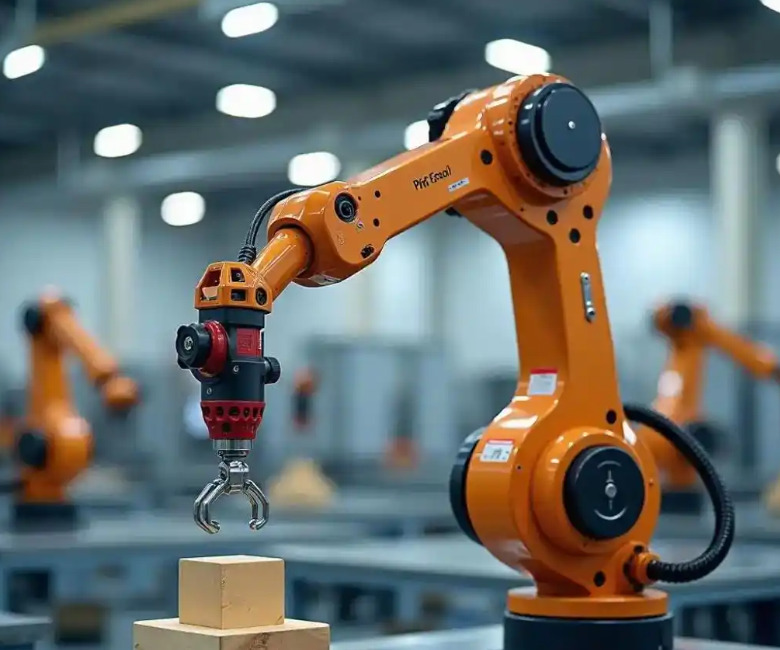
When I look at the benchmark results, I do not see a single number. I see a distribution. A tier-average success rate of 90.0 percent across fifty tasks is strong, but I want to know which tasks failed. In my experience, the failures are often more informative than the successes. A failure in a high-precision insertion task may reveal a limitation in visual resolution. A failure in an opening task may reveal a limitation in force reasoning. A failure in a multi-step task may reveal a limitation in memory.
I often decompose the benchmark into categories and track each category separately. The table below is the kind of breakdown I use when evaluating models for industrial robots.
| Task Category | Example Operation | Key Demand on the Model | Typical Failure Mode |
|---|---|---|---|
| Grasping | Pick a part from a bin | Object pose and contact point | Slip due to poor local geometry |
| Pushing | Slide a component into place | Force direction and friction estimate | Overshoot or jam |
| Opening | Open a latch or door | Articulation and force control | Wrong hinge axis or excessive force |
| Closing | Close a connector cover | Alignment and compliance | Misalignment and surface damage |
| Insertion | Insert a pin into a slot | Sub-millimeter precision | Tilt, jam, or incomplete insertion |
| Assembly | Combine two parts | Multi-step planning and memory | Lost track of intermediate state |
| Reorientation | Rotate a part in hand | In-hand pose estimation | Drop or collision |
| Tool Use | Use a screwdriver or probe | Tool-grounding and force feedback | Wrong tool pose or excessive torque |
For industrial robots, the hardest categories are usually insertion, assembly, and tool use. These tasks require the model to combine visual precision, force awareness, and temporal memory. A large model may have the capacity to represent these factors, but if it cannot run fast enough, the robot cannot react. A small model with the right inductive biases can sometimes do better because it is forced to prioritize the factors that matter.
I also track the relationship between parameters and success. In many machine learning domains, success tends to increase with parameter count, at least up to a point. In robotics, the relationship is more complicated. Beyond a certain size, the model may become too slow for the control loop. The effective success rate on the factory floor can then decline even if benchmark success rises.
A simple model of this trade-off is:
$$
\text{Effective Success} = \text{Task Success} \times \mathbf{1}[\text{Latency} \leq \text{Cycle Budget}] \times \mathbf{1}[\text{Energy} \leq \text{Power Budget}]
$$
This equation is intentionally harsh. It says that if the latency exceeds the cycle budget, the effective success is zero for that cycle. In a real line, the robot may not fail completely, but it may miss the takt time and create a bottleneck. For industrial robots, a missed cycle is a failure of the system, even if the individual action was correct.
I have used this equation to argue against oversized models in several projects. The conversation often goes like this: the benchmark score is higher, so the larger model should be better. But when we measure the full cycle, including inference, communication, and motion, the larger model loses. The smaller model finishes the task within the takt time, and the larger model does not. The smaller model wins for industrial robots.
The lightweight model I have been describing also has an advantage in data efficiency. Because it has fewer parameters, it can be fine-tuned with less data. Factories rarely have millions of labeled demonstrations for every task. They have a few hundred or a few thousand. A model that needs massive data may never adapt to a niche operation. A model that can learn from targeted demonstrations and real-world feedback can improve continuously.
I think of the data flywheel for industrial robots as a loop:
$$
\text{Deployment} \rightarrow \text{Data} \rightarrow \text{Fine-Tuning} \rightarrow \text{Better Policy} \rightarrow \text{More Deployment}
$$
Each turn of the loop increases the value of the model. The model does not need to be perfect at the start. It needs to be safe and useful, and it needs to learn from the tasks it performs. This is how industrial robots become more capable over time without a complete redesign.
The table below shows the stages of this flywheel and the role of a lightweight visual-language-action model.
| Stage | Input | Action | Output | Benefit for Industrial Robots |
|---|---|---|---|---|
| Initial deployment | Base model and a few demonstrations | Run safe tasks with human supervision | Task success and failure logs | Immediate automation of simple operations |
| Data collection | Camera streams, joint states, force data | Store successful and failed episodes | Structured dataset | Builds a local knowledge base |
| Fine-tuning | Local dataset and task labels | Update action decoder and fusion layers | Improved policy | Adapts to specific parts and fixtures |
| Validation | Held-out tasks and safety checks | Compare success, latency, and force limits | Validated model | Ensures reliability before wider rollout |
| Expansion | Validated model and more tasks | Deploy to additional cells | More data and more tasks | Scales the value of industrial robots |
I have seen this flywheel work in semiconductor, lithium battery, energy, and chemical environments. These are not simple pick-and-place settings. They involve delicate parts, strict cleanliness, high safety requirements, and complex process flows. In these settings, a model must be robust to changes in lighting, vibration, and material properties. A lightweight model with strong visual fusion and smooth action generation is often more robust than a giant model that was trained on internet images and generic robot data.
The reason is that the lightweight model can be trained and tuned on the actual distribution of the factory. It does not need to carry the full diversity of the internet. It needs to carry the diversity of the production line. That is a smaller distribution, but it is a more relevant one for industrial robots.
I also pay attention to the inference stack. A model is not just a set of weights. It is a set of weights plus a runtime. The runtime includes preprocessing, batching, memory management, and communication. For industrial robots, the runtime can dominate the latency. A compact model can use a simpler runtime, which reduces overhead. A large model may require tensor parallelism, model sharding, or remote inference, all of which add complexity and failure modes.
The end-to-end latency can be modeled as:
$$
T_{\text{total}} = T_{\text{capture}} + T_{\text{preprocess}} + T_{\text{inference}} + T_{\text{postprocess}} + T_{\text{communication}} + T_{\text{actuation}}
$$
When I optimize a robot cell, I try to reduce every term. But the inference term is often the one that gets the most attention. A lightweight model reduces \(T_{\text{inference}}\) directly. It may also reduce \(T_{\text{communication}}\) if it can run on the robot controller or a nearby edge device. That is a double win for industrial robots.
I have also found that a smaller model is easier to verify. Verification is a major issue for industrial robots, especially in regulated industries. A model with fewer parameters is easier to test, easier to bound, and easier to certify. It is not trivial, but it is more tractable. When a safety engineer asks how the robot will behave in an unexpected situation, a compact model with clear visual and action pathways is easier to explain than a massive black box.
I do not claim that small models are always safer. A small model can be wrong in dangerous ways if it is trained poorly. But the engineering effort to make a small model safe is often lower because the system is simpler. For industrial robots, simplicity is a safety feature.
The benchmark result also tells me something about generalization. The model did not just perform well on one task. It performed well across fifty tasks. That suggests that the visual and action representations are general enough to transfer across manipulation categories. For industrial robots, this is important because factories change. A line that produces one product today may produce another product next year. A model that can transfer across tasks reduces the cost of retooling.
I often measure transfer with a simple ratio:
$$
\text{Transfer Efficiency} = \frac{\text{Success on New Task} – \text{Success from Scratch}}{\text{Success on Source Task} – \text{Success from Scratch}}
$$
A value close to one means the model transfers well. A value close to zero means it has to relearn almost everything. For industrial robots, transfer efficiency determines how quickly a new product can be introduced. A lightweight model with strong visual fusion often transfers better because it relies on general visual and spatial features rather than memorized task-specific patterns.
The table below summarizes my view of the key capabilities for industrial robots and how a lightweight visual-language-action model addresses them.
| Capability | What It Means | How a Lightweight Model Supports It | Impact on Industrial Robots |
|---|---|---|---|
| Visual grounding | Linking language and task goals to image regions | Deep-shallow feature fusion | Better object and part localization |
| Fine manipulation | Controlling contact and insertion | High-resolution shallow features and smooth actions | Fewer jams and damaged parts |
| Multi-task learning | Handling many operations with one model | Shared representation with task conditioning | Lower integration and maintenance cost |
| Fast inference | Meeting cycle time | Small parameter count and edge deployment | Higher throughput |
| Data efficiency | Learning from limited demonstrations | Compact model with strong priors | Faster adaptation to new parts |
| Safety | Respecting limits and recovering from errors | Simpler runtime and verifiable modules | Fewer dangerous failures |
| Energy efficiency | Reducing power per cycle | Lower compute per action | Lower operating cost |
I have also seen the importance of the surrounding ecosystem. A model does not deploy itself. It needs data pipelines, simulation tools, safety frameworks, and maintenance teams. The regions that have a strong manufacturing base often have an advantage because they can provide real application scenarios. In my view, the best embodied intelligence ecosystem is one where industrial robots are already working, because that is where the hard problems are.
When a model is deployed in a factory, it encounters situations that no benchmark can fully capture. A cable may be slightly out of position. A fixture may be worn. A camera may have dust on the lens. A part may have a burr. These variations are not noise. They are the reality of industrial robots. A model that learns from these variations becomes stronger. A model that only sees clean simulation data remains fragile.
I therefore prefer a development cycle that alternates between simulation and reality. Simulation provides scale and safety. Reality provides the long tail. The lightweight model can be updated frequently because fine-tuning is cheaper. This makes the loop faster. For industrial robots, the speed of the loop is a competitive advantage.
I can express the value of the loop as:
$$
V = \sum_{t=0}^{T} \gamma^t \left( R_t – C_t \right)
$$
Here \(V\) is the long-term value, \(R_t\) is the revenue or productivity gain at time \(t\), \(C_t\) is the cost of data collection, fine-tuning, and deployment, and \(\gamma\) is a discount factor. A lightweight model increases \(R_t\) by improving uptime and throughput. It decreases \(C_t\) by reducing compute and data requirements. Both effects increase \(V\). That is why I think lightweight models are not a compromise. They are an economic advantage for industrial robots.
The cost structure of an industrial robot cell includes hardware, software, integration, energy, maintenance, and downtime. A large model can increase several of these terms. It may require more expensive hardware. It may require more integration effort. It may consume more energy. It may be harder to maintain. A lightweight model can reduce all of them. The table below shows a qualitative comparison.
| Cost Category | Large-Model Impact | Lightweight-Model Impact | Reason |
|---|---|---|---|
| Compute hardware | High | Low to moderate | Fewer parameters and lower memory |
| Integration | High | Moderate | Simpler runtime and deployment |
| Energy | High | Low to moderate | Fewer floating-point operations per action |
| Maintenance | High | Moderate | Fewer components and less cooling |
| Downtime | Potentially high | Lower | Faster recovery and local inference |
| Data collection | High | Moderate | Better data efficiency |
| Fine-tuning | High | Low | Smaller model updates |
I want to be careful not to turn this into a simple slogan. Lightweight does not automatically mean better. A model must still be trained well, evaluated carefully, and integrated safely. The point is that parameter count is not the only lever. In many industrial settings, it is not even the most important lever. The most important lever is the fit between the model and the task.
I have also found that a lightweight model is easier to combine with classical control. Industrial robots often use impedance control, force control, or visual servoing. These controllers provide stability and precision. A visual-language-action model can provide task-level guidance, while the controller handles low-level execution. This division of labor is powerful. The model does not need to learn every detail of the dynamics. It needs to choose the right action and let the controller handle the physics.
A simple hybrid policy can be written as:
$$
u = \pi_{\text{classical}} \left( x, \pi_{\text{VLA}}(I, L, S) \right)
$$
Here \(u\) is the control command, \(x\) is the robot state, and \(\pi_{\text{VLA}}\) is the visual-language-action model. The classical controller enforces stability, while the model provides task intent. This hybrid approach is especially useful for industrial robots because it combines the flexibility of learning with the reliability of control theory.
I think the next stage of development will be about making this hybrid stack even tighter. Instead of treating the model as a separate module, engineers will integrate it into the controller. The model will output not just a target pose, but also a confidence estimate and a compliance profile. The controller will use these signals to decide how aggressively to move. If the model is uncertain, the robot can slow down and use force feedback. If the model is confident, the robot can move quickly. This is how industrial robots become both fast and safe.
The confidence estimate can be modeled as:
$$
c = \sigma \left( g(z_{\text{fused}}, z_t) \right)
$$
where \(g\) is a learned function and \(\sigma\) is a sigmoid. The controller can then use \(c\) to scale the speed:
$$
v = v_{\max} \cdot c
$$
This is a simple example, but it shows how a lightweight model can contribute to the control loop without replacing it. For industrial robots, this kind of integration is more valuable than a standalone benchmark score.
I also think about multi-robot coordination. A factory may have several industrial robots working in the same cell. A lightweight model can run on each robot or on a shared edge device. If the model is small, coordination is easier because communication is cheaper. The robots can share visual features, task states, and action intentions without overwhelming the network. This is another advantage of small models for industrial robots.
A coordination graph can be represented as:
$$
G = (V, E), \quad V = \{\text{robots}\}, \quad E = \{\text{communication links}\}
$$
Each robot \(i\) has a local observation \(o_i\) and a local policy \(\pi_i\). The joint policy is:
$$
\pi(a_1, \dots, a_n | o_1, \dots, o_n) = \prod_{i=1}^{n} \pi_i(a_i | o_i, m_i)
$$
where \(m_i\) is a message from neighboring robots. If each policy is lightweight, the joint policy can run in real time. If each policy is huge, coordination becomes a bottleneck. For industrial robots, real-time coordination is often essential.
I have seen this in assembly cells where two arms must insert a part together. One arm holds the part, and the other arm fastens it. The two arms must coordinate their forces and positions. A lightweight model on each arm can exchange a small number of messages and achieve the coordination. A large model on each arm may be too slow or too expensive.
The table below shows how lightweight models support different levels of industrial robot deployment.
| Deployment Level | Number of Robots | Coordination Need | Benefit of Lightweight Model |
|---|---|---|---|
| Single cell | 1 | Low | Fast inference and easy integration |
| Dual-arm cell | 2 | Moderate | Low-latency communication |
| Multi-cell line | 3 to 10 | High | Shared edge inference and task scheduling |
| Factory-wide | 10 to 100 | Very high | Scalable deployment and fleet learning |
| Multi-site fleet | 100+ | Extreme | Federated updates and local adaptation |
I also want to discuss the role of language. A visual-language-action model can accept instructions in natural language. For industrial robots, this is useful because it allows operators to describe tasks without writing code. But language can also be a source of ambiguity. A phrase like “insert the part” does not specify the force, the orientation, or the insertion depth. The model must ground the language in the visual scene and the task context.
I have found that language is most useful when it is combined with structured task specifications. For example, a human may say, “Insert the red connector into slot B with a gentle push.” The structured part identifies the object and the slot. The language part adds the force modifier. The model can use both. This hybrid instruction is more robust than either alone.
The grounding problem can be written as:
$$
p(\text{object}, \text{target} | I, L) = \frac{p(I, L | \text{object}, \text{target}) p(\text{object}, \text{target})}{p(I, L)}
$$
In practice, the model learns this mapping implicitly. The important point is that the model must align language with visual entities. Deep-shallow fusion helps because it preserves both semantic and spatial information. For industrial robots, this alignment is critical for safety. The robot must not confuse a similar-looking part with the correct one.
I also think about failure recovery. In a factory, errors are normal. A part may be missing. A gripper may slip. A sensor may be blocked. A robust model for industrial robots must detect these failures and recover. A lightweight model can run a fast failure detector alongside the main policy. The detector can use the same visual features as the policy, which reduces additional computation.
A simple failure score can be:
$$
s_{\text{fail}} = \left\| z_{\text{current}} – z_{\text{expected}} \right\|_2
$$
If \(s_{\text{fail}}\) exceeds a threshold, the robot can stop, retry, or call for help. This is much easier with a compact model because the features are already available and the latency is low. For industrial robots, fast failure detection can prevent damage and reduce downtime.
The table below summarizes the failure modes I typically monitor and how a lightweight visual-language-action model can help.
| Failure Mode | Signal | Recovery Action | Role of Lightweight Model |
|---|---|---|---|
| Part missing | Visual feature mismatch | Retry or request new part | Fast visual grounding |
| Gripper slip | Force or pose deviation | Regrasp or adjust force | Action continuity and force prediction |
| Misalignment | Insertion force spike | Back off and realign | Fine visual features |
| Collision | Torque spike or unexpected contact | Stop and replan | Low-latency inference |
| Sensor blockage | Image anomaly | Clean or switch sensor | Visual anomaly detection |
| Task ambiguity | Low confidence | Ask for human input | Confidence estimation |
I have also observed that a lightweight model is easier to update in the field. A factory cannot afford to stop production for a week to retrain a giant model. It needs updates that can be deployed in hours. A small model can be fine-tuned on a local dataset and validated quickly. This is a practical advantage that is often overlooked in research papers. For industrial robots, practical advantages compound over time.
I think the future will bring even more specialization. Instead of one giant model for all robots, there will be a family of lightweight models. One model may specialize in insertion. Another may specialize in grasping. Another may specialize in inspection. They may share a common visual backbone but have different action heads. This modularity is easier to maintain and upgrade. For industrial robots, modularity is a form of resilience.
A modular policy can be written as:
$$
\pi(a | o) = \sum_{k=1}^{K} w_k(o) \pi_k(a | o)
$$
Here \(K\) is the number of specialized policies, \(w_k(o)\) is a gating function, and \(\pi_k\) is the \(k\)-th policy. The gating function can be learned or rule-based. A lightweight model can run several policies in parallel because each one is small. This gives the robot a broad repertoire without a giant parameter count.
I also expect to see more use of simulation for pre-training and reality for fine-tuning. The lightweight model can be pre-trained on a large simulated dataset, then fine-tuned on a small real dataset. This combines the best of both worlds. Simulation provides scale and safety. Reality provides the final calibration. For industrial robots, this is a practical path to deployment.
The transfer from simulation to reality can be improved with domain randomization. The idea is to randomize visual and dynamic parameters during training so that the model becomes robust to variations. A simple domain randomization distribution can be:
$$
\theta \sim p(\theta), \quad \theta = \{\text{lighting}, \text{texture}, \text{friction}, \text{mass}, \text{camera pose}\}
$$
By training across many \(\theta\), the model learns features that are stable across domains. Deep-shallow fusion helps because shallow features capture geometry, which is more stable than texture. Action continuity helps because smooth trajectories are more robust to dynamic variations. Together, they make the lightweight model more transferable to real industrial robots.
I want to return to the benchmark one more time. A 90.0 percent tier-average success rate is a strong result, but I do not treat it as the final word. I treat it as evidence that the architecture and training strategy are on the right track. The real test is whether the model can maintain that success rate over thousands of cycles in a factory. That requires reliability engineering, not just machine learning.
Reliability can be modeled with a survival function. If the probability of success in one cycle is \(p\), and cycles are independent, the probability of surviving \(n\) cycles without failure is:
$$
S(n) = p^n
$$
If \(p = 0.99\), then \(S(100) \approx 0.366\). In other words, a one percent failure rate per cycle leads to a significant chance of at least one failure in a hundred cycles. For industrial robots, even a small per-cycle failure rate can be costly. This is why I care about both average success and worst-case behavior.
A more realistic model includes recovery. If the robot can detect and recover from a failure, the effective success rate is higher. Let \(r\) be the recovery probability. Then the effective success per cycle is:
$$
p_{\text{eff}} = p + (1 – p) r
$$
If \(p = 0.90\) and \(r = 0.80\), then \(p_{\text{eff}} = 0.90 + 0.10 \times 0.80 = 0.98\). This shows why failure recovery is so important for industrial robots. A model that is slightly less accurate but much better at recovery can be more valuable in production. The lightweight model’s fast inference and confidence estimation support this kind of recovery.
I have also seen that a lightweight model is easier to run in redundancy. If one edge device fails, another can take over quickly because the model is small. In a large-model deployment, failover may require moving gigabytes of weights or re-establishing a remote connection. In a lightweight deployment, failover can be local and fast. For industrial robots, redundancy is a key requirement for high availability.
The table below shows how lightweight models contribute to different reliability strategies.
| Reliability Strategy | Mechanism | Lightweight Advantage | Impact on Industrial Robots |
|---|---|---|---|
| Local inference | Run model on edge device | Low memory and compute | No network dependency |
| Fast failover | Switch to backup device | Quick model loading | Minimal downtime |
| Graceful degradation | Reduce speed or switch policy | Multiple small policies | Continued operation under uncertainty |
| Continuous monitoring | Run anomaly detector | Shared visual features | Early fault detection |
| Field updates | Fine-tune on local data | Small update size | Faster improvement |
I think the most important lesson is that industrial robots are not chatbots with arms. They are physical systems that must act in a world with friction, gravity, and time. A model for industrial robots must respect those constraints. A lightweight visual-language-action model respects them by design. It prioritizes fast, smooth, and reliable action over exhaustive language understanding.
I also believe that the success of lightweight models will push the entire field forward. When researchers see that a small model can top a global leaderboard, they will ask better questions. They will ask which parameters matter. They will ask how to fuse vision at multiple scales. They will ask how to make actions continuous. These questions lead to better architectures for industrial robots, not just smaller ones.
In my own work, I now start every robotics project with a latency budget. I ask: how many milliseconds do we have for perception, inference, and control? Then I ask: what is the smallest model that can meet the task requirements within that budget? This is the opposite of starting with the largest model and trying to compress it later. Starting small forces clarity. It forces the team to identify the essential features and the essential actions. For industrial robots, clarity is a virtue.
A latency budget can be written as:
$$
T_{\text{budget}} = T_{\text{cycle}} – T_{\text{motion}} – T_{\text{safety}}
$$
If the cycle time is 500 ms, the motion and safety margins take 300 ms, then the perception and inference budget is 200 ms. A large model may exceed that budget. A lightweight model can fit within it. This simple arithmetic is often more important than a benchmark difference of a few percentage points. For industrial robots, fitting the budget is the difference between a demo and a deployment.
I have also found that a lightweight model is easier to explain to operators. Operators want to know why the robot did something. A model with fewer parameters and clearer feature pathways is easier to inspect. This builds trust. Trust is essential for industrial robots because operators must work alongside them. If the robot behaves unpredictably, operators will not use it, even if it is technically advanced.
I think the next wave of innovation will be in the interaction between the model and the operator. The model will not just execute tasks. It will also communicate its state. It will say, “I am uncertain about the insertion depth,” or “I detected a slip and I am retrying.” This kind of transparency is easier with a lightweight model because the internal state is more compact. For industrial robots, transparency is a feature, not a luxury.
The table below shows how a lightweight model can support operator interaction.
| Interaction Need | Model Output | Operator Benefit | Relevance to Industrial Robots |
|---|---|---|---|
| Task status | Current sub-goal | Know what the robot is doing | Reduces uncertainty on the floor |
| Confidence | Probability of success | Decide when to intervene | Prevents small errors from becoming large ones |
| Failure reason | Detected anomaly type | Fix the root cause faster | Reduces downtime |
| Recovery plan | Next action if failure persists | Approve or modify the plan | Keeps the operator in control |
| Learning request | Need for a new demonstration | Teach the robot efficiently | Improves adaptation |
I want to close with a forward-looking view. I believe that within the next few years, the majority of new industrial robots will use some form of lightweight embodied model. The model may not be called a visual-language-action model. It may be called a task policy or a skill network. But the principles will be the same: multi-scale visual understanding, temporally coherent action, and efficient inference at the edge.
The benchmark result I have been discussing is a signal. It tells me that the field is maturing. It is moving from “Can we build a robot that understands language?” to “Can we build a robot that works in a factory?” The second question is harder. It requires more than intelligence. It requires reliability, speed, safety, and cost efficiency. Lightweight models are a key part of the answer.
I am optimistic about the future of industrial robots. I think the combination of better algorithms, cheaper sensors, and more powerful edge hardware will lead to a new generation of automation. These robots will not replace human workers. They will take over repetitive, dangerous, and precise tasks, while humans focus on judgment, creativity, and improvement. A lightweight visual-language-action model makes this future more practical because it can be deployed widely, not just in a few showcase labs.
The most important lesson for me is that small does not mean weak. In the context of industrial robots, small can mean fast, reliable, and affordable. It can mean a model that runs on the robot itself, learns from the line, and improves over time. It can mean a model that respects the cycle time and the safety envelope. That is the kind of intelligence I want in industrial robots.
I will continue to test, measure, and refine. I will continue to compare parameter counts against latency budgets. I will continue to fuse visual features across scales and optimize action continuity. I will continue to look for the smallest model that can do the job, not the largest model that can win a benchmark. For industrial robots, the future belongs to models that are not only strong, but also fit.