
In the complex operational environments of nuclear power plants, traditional automation and remote control methods often face significant challenges, such as high radiation risks, the need for flexible movement in confined spaces, and the demand for rapid response in emergencies. To address these issues, we have developed a spine-driven quadruped robot that mimics the coordinated movement mechanisms of biological limbs and spines. This robot dog can navigate flexibly across flat or rugged terrain and even perform advanced dynamic behaviors like jumping, greatly enhancing its agility and dynamic balance capabilities. However, when environmental conditions change, the quadruped robot’s gait control encounters problems, such as inaccurate landings in fixed areas, positional shifts when approaching targets, and extended time consumption. Existing control methods, like the cross-coupled gait control approach that leverages inter-leg dynamic coupling to adjust step rhythm and landing positions, or the Trot gait strategy that fine-tunes movements using shoulder joint motors, achieve desired control objectives but suffer from poor controllability, high time consumption, and inability to quickly evacuate target areas in complex settings. Therefore, we propose a novel jumping gait control method for spine-driven quadruped robots in nuclear power plants. By analyzing the coordinated motion patterns of spinal joints and limbs, and integrating control algorithms with sensor technology, our method enables stable jumping and precise positioning in challenging terrains, expands control range, improves control effectiveness, and offers more flexible and versatile gait control, thereby contributing to the automation and intelligence of nuclear power operations.
Our approach begins with establishing a control coordinate system, which is crucial for balancing the quadruped robot and planning the coordinated movements of spinal joints and limbs. The global coordinate system serves as the foundation, with the robot’s body center or a fixed point designated as the core. From this point, local coordinates for each joint are defined. The structure of this control coordinate system is designed and analyzed in practice, involving the calibration of core points using angle or displacement parameters to describe the driving mechanisms. The initial control range for the robot’s gait is computed based on this coordinate system, as expressed by the following formula: $$ P = \gamma^2 – (m + n) $$ where \( P \) represents the initial control range, \( \gamma \) is the adaptive coverage area, \( m \) denotes the movement angle, and \( n \) is the displacement parameter. This computed initial control range is set as the standard constraint for coordinate control. By identifying force application points during jumping gaits and collecting real-time data under various working conditions, we ensure the coordinate system’s adaptability to the quadruped robot’s application needs, enhancing the flexibility and stability of subsequent gait control.
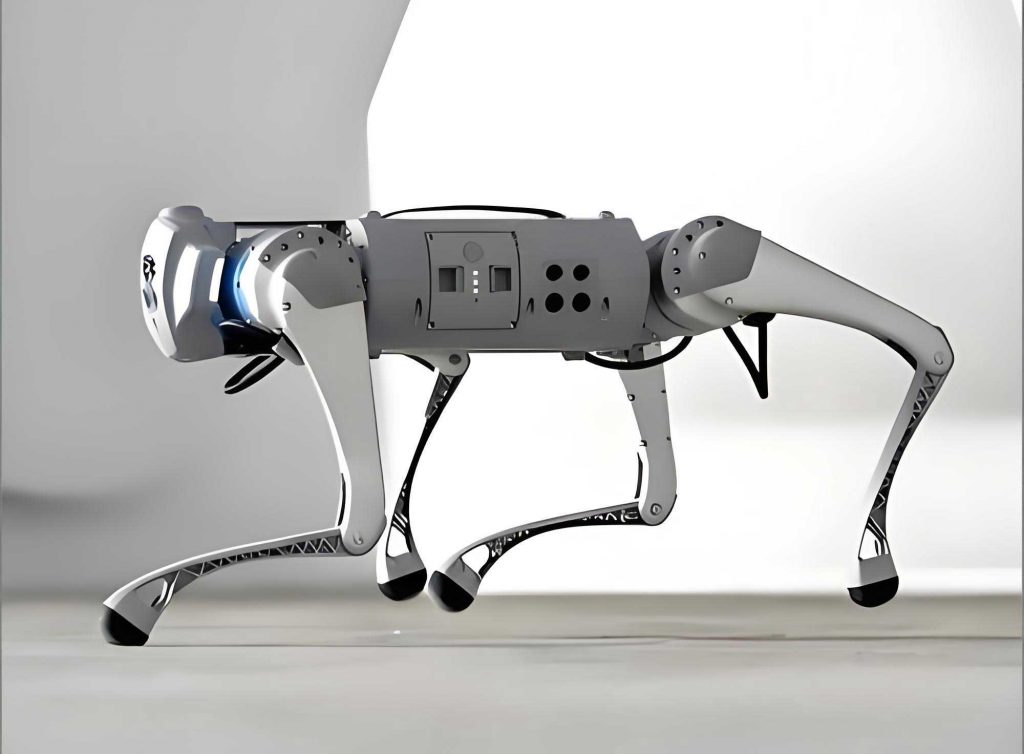
Next, we design a multi-phase control strategy for the robot dog’s jumping gait, tailored to its jumping actions, force directions, and cruising requirements. This strategy divides the jumping process into three phases: touch-down buffering, push-off, and pre-touch-down. During the touch-down buffering phase, the gravitational forces on the quadruped robot vary, converting body potential energy into leg potential energy. If the overall center of gravity lowers, the movement speed decreases accordingly. To maintain balance during this energy conversion, we employ a vertical spring mechanism to buffer the forces between the foot ends and the torso. Since the legs of the quadruped robot are not telescopic, we utilize Semi-Infinite Linear Programming (SILP) techniques to assist in establishing mapping relationships between position and force. By adjusting hip joint positions and preset leg thrust directions, we calculate the maximum push-off speed using the formula: $$ M = \sum_{i=1}^{n} \frac{a \cdot f_i \cdot x}{v + i \cdot (x – i)} $$ where \( M \) is the maximum push-off speed, \( a \) is the thrust distance, \( f \) represents the nodal control distance, \( i \) is the control node, \( x \) denotes the overlap area, and \( v \) is the number of push-off actions. Based on this calculated speed, we further adjust the toe directions of the robot’s hip joints to balance position and force mappings. In the pre-touch-down phase, after push-off, the legs retract toward the base direction. To ensure smooth and continuous foot trajectories, we perform phased control processing by adjusting control standards according to speed changes and computing leg touch buffering time with the formula: $$ O = (h – s)^2 \cdot \pi $$ where \( O \) is the leg touch buffering time, \( h \) is the speed variation during leg buffering, and \( s \) is the damping coefficient. This allows for basic trajectory planning and the formation of a comprehensive, detailed control standard.
Building on these control phases, we construct a jumping gait control model for the spine-driven quadruped robot. This involves analyzing the kinematic relationships and dynamic characteristics of each joint, particularly the relationship between the spinal joint’s torque and angular acceleration, as described by: $$ J_{\text{spine}} = I_{\text{spine}} \cdot \theta + s \cdot \theta^2 $$ where \( J_{\text{spine}} \) is the driving torque of the spinal joint, \( I_{\text{spine}} \) is the moment of inertia of the spine, and \( \theta \) is the angular acceleration of the spinal joint. After adjusting the robot’s operating state to maintain balance, we design the model structure based on changes in driving conditions. Through simulations that test combinations of spinal bending angles and limb thrusts, we determine the optimal gait control solution using: $$ E = \iota – \int B \cdot X \, dQ $$ where \( E \) is the optimal gait control solution, \( \iota \) is the gait control range, \( B \) represents the number of jumps, \( X \) is the limb thrust intensity, and \( Q \) denotes external thrust. By analyzing the results, we dynamically adjust the control parameters for the spinal joints and limbs, ensuring stable and reliable jumping gaits in the complex and variable environments of nuclear power plants.
Gait order balance adjustment is key to coordinating the movements of each foot according to a predetermined sequence, ensuring rational force distribution and连贯 actions during jumping. The gait of the quadruped robot is divided into support and swing phases, which alternate to maintain dynamic balance. We preset multiple cruising simulation environments where the robot dog uses built-in sensors to monitor its posture in real-time and execute actions and jumping gaits according to instructions, enabling rapid responses and stable center of gravity. The balance adjustment process incorporates flexible driving of the spinal joints to adapt to ground changes and improve stability during jumping. The structure for gait order balance adjustment involves establishing support and swing phases, setting balance programs, and performing posture adjustments with spinal joint corrections.
To validate our method, we conducted tests in simulated nuclear power plant environments, comparing it with existing approaches like the cross-coupled gait control method and the Trot gait strategy. We selected three groups of quadruped robots as test subjects, equipped with monitoring nodes for real-time control and adjustments. The control parameters for the quadruped robot tests are summarized in the table below:
| Test Control Item | Leg Thrust (N) | Max Push-off Speed (m/s) | Leg Stiffness (N/m) |
|---|---|---|---|
| Control Standard Value | 1200–1500 | 2 | 22000 |
The jumping gait test cycle was set to 5 hours, with motion stabilizing after acceleration. Pitch angle limits were predefined to ensure stable control of jumping movements. We issued two types of test commands: single-aerial-phase jumps and double-aerial-phase jumps. The quadruped robot performed corresponding gait actions upon receiving instructions, and we used our model to adjust angles and positions in real-time, recording data across cycles. Analysis of the joint angular velocity changes for the quadruped robot showed minimal fluctuations, indicating stable gait control. The control shift difference was calculated using the formula: $$ Z = \epsilon – \xi $$ where \( Z \) is the control shift difference, \( \epsilon \) is the estimated shift value, and \( \xi \) is the actual shift value. The test results are presented in the following table:
| Jumping Gait Type | Cross-Coupled Method Shift Difference (mm) | Trot Strategy Shift Difference (mm) | Our Method Shift Difference (mm) |
|---|---|---|---|
| Single-Aerial-Phase Jump | 3.25 | 2.88 | 1.02 |
| Double-Aerial-Phase Jump | 2.18 | 2.97 | 1.04 |
As shown, our method achieved smaller shift differences in both single- and double-aerial-phase jumps compared to the cross-coupled and Trot strategies, demonstrating its stronger targeting, better control effectiveness, and higher application value. This spine-driven quadruped robot control approach significantly enhances adaptability in special operational environments. By optimizing the协同 control mechanism between spinal joints and limbs, and integrating intelligent perception and decision-making technologies, we continuously improve the jumping stability and efficiency of the robot dog in complex terrains. This advances the capabilities of quadruped robots in autonomous navigation, environmental perception, and task execution, ultimately ensuring the safe operation of nuclear power plants. Future work will focus on refining the control algorithms and expanding the application scenarios for these advanced robotic systems.
In summary, the development of spine-driven quadruped robots represents a significant step forward in robotics for hazardous environments. The robot dog’s ability to perform dynamic behaviors like jumping, combined with precise gait control, makes it an invaluable tool for nuclear power plant inspections and operations. Our method not only addresses the limitations of traditional approaches but also sets a new standard for flexibility and reliability in quadruped robot control. Through ongoing research and testing, we aim to further enhance the performance of these robotic systems, contributing to the broader field of autonomous robotics and industrial automation.