
In recent years, the development of legged robots, particularly quadruped robots or robot dogs, has garnered significant attention due to their potential applications in rescue operations, exploration, entertainment, and military tasks. These systems are complex, multi-body structures that integrate mechanical design, microelectronics, computer science, automatic control, sensors, and artificial intelligence. A key challenge in designing such robots is ensuring stable locomotion, especially under dynamic conditions. While most research has focused on forward gaits, backward gait stability remains underexplored. This study addresses this gap by conducting a comprehensive analysis and planning of backward gaits for a quadruped robot, leveraging stability metrics, kinematic modeling, and experimental validation.
Our research begins with an introduction to the structure of the quadruped robot. The robot dog is modularized into 18 components, including the body, head, neck, tail, and leg segments (e.g., thighs, shanks, and hips). To simplify analysis, we model the system as a mass-point system, where each component is represented by its mass and position. This approach allows us to compute overall system parameters efficiently. The Denavit-Hartenberg (D-H) method is employed to establish a coordinate system for kinematic analysis. For instance, the left front leg is modeled as a series of links with specific parameters, such as link lengths and joint angles. The transformation matrices between coordinate frames are derived to describe the robot’s motion mathematically. For example, the transformation from the body frame to the left front hip frame is given by:
$$ \begin{bmatrix} 0 & -1 & 0 & W/2 \\ 0 & 0 & 1 & L/2 \\ -1 & 0 & 0 & H/2 \\ 0 & 0 & 0 & 1 \end{bmatrix} $$
where W, L, and H represent the width, length, and height parameters of the robot dog. Similarly, joint-specific transformations are defined for other segments. This kinematic model forms the basis for subsequent stability and gait analysis.
Stability is a critical aspect of quadruped robot locomotion. We characterize stability using static and dynamic metrics. The static stability margin is defined as the minimum distance from the projection of the center of gravity (COG) to the edges of the support polygon formed by the ground contact points. For a robot dog to be statically stable, this margin must be positive at all times. Dynamic stability, on the other hand, involves the Zero Moment Point (ZMP), where the resultant of gravity and inertial forces intersects the support plane. The ZMP must lie within the support polygon for dynamic stability. The position vector of the ZMP, denoted as r_OC, can be expressed as:
$$ \mathbf{r}_{OC} = \mathbf{r}_{OQ’} + \frac{\mathbf{Y}_0 \times (\mathbf{M}_Q + \mathbf{r}_{Q’Q} \times \mathbf{F}_Q)}{\mathbf{Y}_0 \cdot (\mathbf{F}_Q + m\mathbf{g})} $$
where Y_0 is the unit vector perpendicular to the support plane, M_Q and F_Q are the resultant moment and force at the COG, and m is the total mass of the quadruped robot. To compute the COG position over time, we use the joint drive functions and mass distribution. The coordinates of the COG in the global frame are calculated as:
$$ G_x_c = \frac{\sum (G_x_i \cdot m_i)}{\sum m_i}, \quad G_y_c = \frac{\sum (G_y_i \cdot m_i)}{\sum m_i}, \quad G_z_c = \frac{\sum (G_z_i \cdot m_i)}{\sum m_i} $$
where (G_x_i, G_y_i, G_z_i) are the coordinates of each component’s center of mass, and m_i is its mass. For the backward gait, we analyze the COG trajectory throughout the gait cycle, which involves phases such as initial backward tilt, right tilt, left front leg lifting, left rear leg lifting, left tilt, right front leg lifting, and right rear leg lifting. The COG displacement curves show that the projection remains within the support polygon, ensuring stability.
In the gait design process, we distinguish between primary actions (leg movements) and auxiliary actions (head and tail movements). Primary actions generate displacement in the backward direction, while auxiliary actions adjust the COG position to maintain stability. The backward gait sequence is planned as follows: lift left front leg → lift left rear leg → lift right front leg → lift right rear leg, with corresponding tilts and swings. For example, when lifting a left leg, the robot dog must tilt right to keep the COG within the support triangle. The optimal swing angles for the head and tail are determined to be approximately 51 degrees, maximizing the moment arm to the support line. The hip joint tilt angle θ_H is constrained to a range of [4.10°, -30.40°] to ensure stability during leg lifting. We select θ_H = -10° for coordinated motion.
The foot trajectory for the backward gait is designed to avoid ground interference and achieve a step length of about 200 mm. The trajectory consists of three phases: lift-off, stride, and landing. The general equations for the foot position in terms of thigh and shank angles (θ_TL and θ_SL) are:
$$ x_d = -L_T \sin \theta_{TL} – L_S \sin (\theta_{TL} + \theta_{SL}) $$
$$ y_d = -L_T \cos \theta_{TL} – L_S \cos (\theta_{TL} + \theta_{SL}) $$
where L_T and L_S are the lengths of the thigh and shank, respectively. For the lift-off phase, we set θ_TL = -38° and θ_SL = 49° to achieve a lift height of 10 cm. The joint drive functions are defined piecewise to control acceleration and deceleration. For instance, the left front shank joint angle θ_SL is governed by a time-dependent function as shown in the table below:
| Time (s) | θ_SL (rad) |
|---|---|
| [0.000, 2.381] | 0.000 |
| [2.381, 2.514] | 1.832t² – 8.722t + 10.383 |
| [2.514, 4.131] | 0.488t – 1.195 |
| [4.131, 4.264] | -1.832t² + 15.621t – 32.450 |
| [4.264, 4.397] | 0.855 |
| [4.397, 4.978] | 0.855 |
| [4.978, 5.112] | -1.832t² + 18.238t – 44.542 |
| [5.112, 6.014] | -0.488t – 3.319 |
| [6.014, 6.147] | 1.832t² – 22.520t + 69.569 |
| [6.147, 19.447] | 0.000 |
| [19.447, 20.447] | -0.174t² + 6.785t – 65.624 |
| [20.447, 21.447] | 0.174t² – 7.483t + 80.240 |
Similarly, the hip joint drive function for the backward gait is defined over time intervals to control the tilt angle. The table below summarizes the hip joint parameters:
| Time (s) | θ_H (rad) |
|---|---|
| [0.000, 0.967] | 0.000 |
| [0.967, 1.674] | -0.174t² + 0.337t – 0.163 |
| [1.674, 2.381] | 0.174t² – 0.831t + 0.814 |
| [2.381, 9.914] | -0.174 |
| [9.914, 10.914] | 0.174t² – 3.459t + 16.971 |
| [10.914, 11.914] | -0.174t² + 4.157t – 24.587 |
| [11.914, 19.447] | 0.174 |
| [19.447, 20.447] | -0.174t² + 6.785t – 65.798 |
| [20.447, 21.447] | 0.174t² – 7.483t + 80.066 |
To validate our approach, we conducted virtual prototype simulations using ADAMS software. The joint drive functions were implemented, and the simulation confirmed that the quadruped robot maintains stability throughout the gait cycle without tipping over. The foot trajectory during simulation matches the planned path, with a step length of approximately 200 mm. The COG projection remains within the support polygon at all times, as evidenced by the stability margin curves. For example, during the left rear leg lifting phase, the stability margin remains positive, indicating dynamic stability.
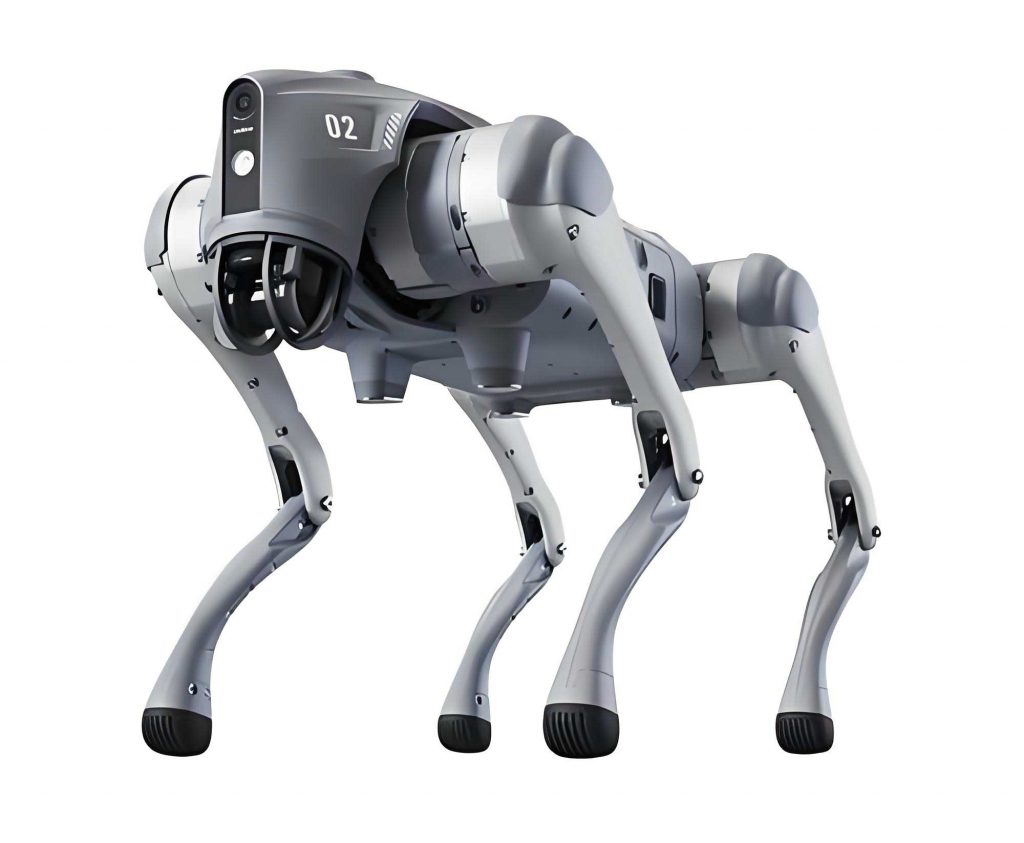
Physical experiments were performed on a prototype quadruped robot with a distributed control system based on CANopen bus. The robot dog has a total mass of 323 kg, with components such as thighs (25 kg each), shanks (25 kg each), body (100 kg), head (15 kg), and tail (8 kg). The experiments demonstrated stable backward walking with a step angle of 10° for the thighs and a step distance of about 20 cm. The robot successfully executed the full gait cycle, including tilts and leg lifts, without instability. The results align with the simulations, confirming the feasibility of our gait planning method.
In conclusion, our study presents a detailed analysis and planning of backward gaits for quadruped robots. By combining kinematic modeling, stability metrics, and coordinated primary and auxiliary actions, we achieve stable locomotion in the backward direction. The virtual and physical validations underscore the effectiveness of our approach. This work provides a foundation for further research on complex gaits and enhances the mobility of robot dogs in diverse environments. Future work could explore adaptive gaits for uneven terrain or higher speeds, leveraging the insights gained from this study.