
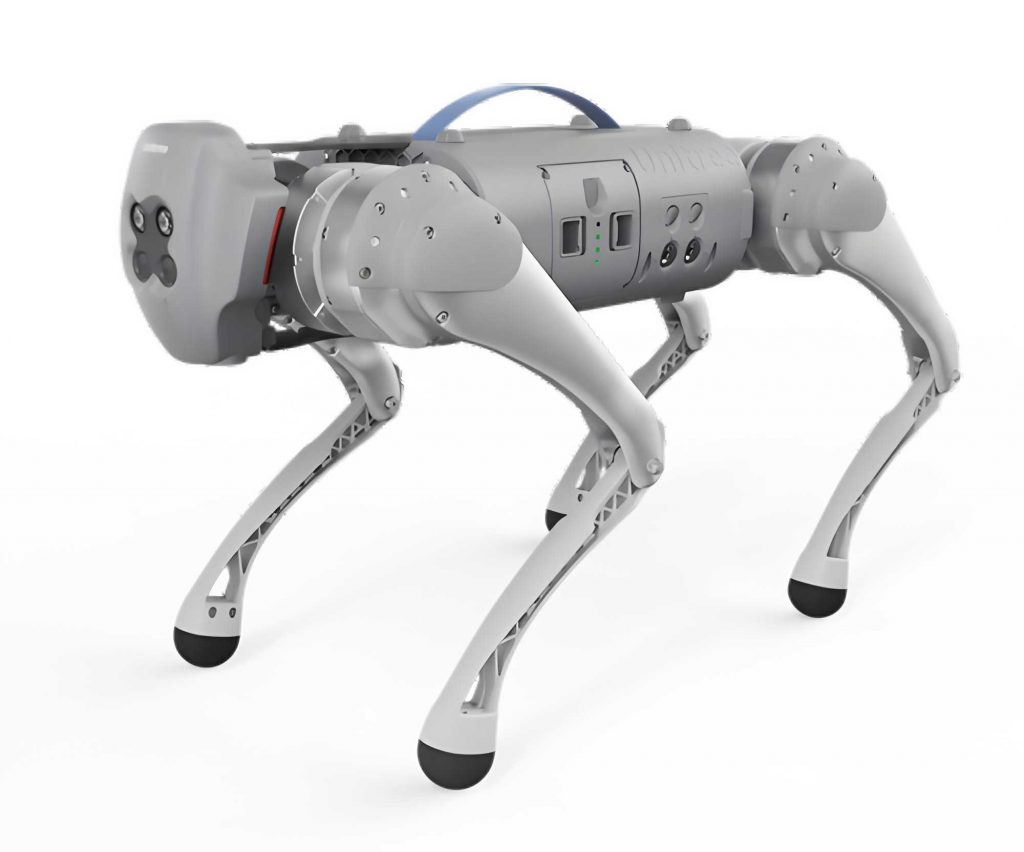
In recent years, the development of legged robots, particularly quadruped robots or robot dogs, has gained significant attention due to their ability to traverse complex terrains such as hills, mountains, and uneven surfaces. Unlike traditional wheeled or tracked robots, which struggle in such environments, quadruped robots offer enhanced mobility and adaptability. However, maintaining stability during motion on inclined planes remains a critical challenge. This paper addresses the instability issues faced by quadruped robots in these scenarios by proposing improvements to the Model Predictive Control (MPC) algorithm. We introduce a novel error compensation strategy and integrate fractional-order calculus into the prediction step length to enhance real-time adjustments and overall stability. Through MATLAB simulations, we demonstrate the effectiveness of our approach in improving motion precision and robustness across various incline angles.
The core of our work revolves around the single-rigid-body model for quadruped robots, where the robot’s body is treated as a single mass with specific dynamics. Traditional MPC algorithms optimize control inputs by predicting future states and compensating for errors, but they often fall short in handling the cumulative errors and low adjustment frequencies encountered on slopes. Our contributions include a dynamic error compensation mechanism that adapts to real-time deviations and a fractional-order prediction step that refines the model’s responsiveness. By repeatedly testing and refining these elements, we ensure that the robot dog can maintain stable gaits even on steep inclines, thereby expanding its operational range in real-world applications.
To provide context, let us first examine the traditional MPC framework applied to quadruped robots. The dynamics of a single-rigid-body model can be described by equations for position and orientation. Let \( p \) denote the position of the center of mass, \( m \) the mass, \( I \) the inertia matrix, \( q \) the orientation, and \( F \) and \( M \) the external force and moment, respectively. The equations of motion are:
$$ F = m \frac{d^2 p}{dt^2} $$
$$ M = I \frac{d^2 q}{dt^2} $$
In discrete time, these are often linearized for MPC implementation. The standard MPC approach involves predicting the system’s behavior over a horizon, optimizing control inputs, and applying error compensation to correct deviations. However, as shown in Figure 1, the traditional method relies on a fixed error correction term, which can lead to instability when errors accumulate on inclined surfaces. The error compensation formula typically used is:
$$ \hat{y}_c(t+j|t) = \hat{y}(t+j|t) + h_j (y(t) – \hat{y}(t)) \quad \text{for} \quad j=1,2,\dots,N_y $$
where \( \hat{y}_c(t+j|t) \) is the corrected prediction, \( \hat{y}(t+j|t) \) is the predicted output, \( h_j \) is the compensation coefficient, \( y(t) \) is the actual output, and \( N_y \) is the prediction horizon. This method, while simple, fails to account for the dynamic nature of errors in complex environments, causing the quadruped robot to deviate from its intended path, as illustrated in Figure 2.
Our analysis reveals that the primary issues stem from inadequate error handling and inflexible prediction steps. To overcome these limitations, we propose an enhanced MPC framework. The improved error compensation strategy dynamically adjusts the compensation coefficient based on the magnitude and trend of the prediction error. Specifically, the modified compensation is defined as:
$$ \hat{y}_c(t+j|t) = \hat{y}(t+j|t) + h_j(e(t)) $$
$$ h_j = \mu_0 (1 + \Delta h_j) $$
$$ \Delta h_j = \mu_1 |e(t)| + \mu_2 \text{sgn}(e(t)) \cdot (e(t) – e(t-1)) $$
$$ e(t) = y(t) – \hat{y}_c(t) $$
Here, \( e(t) \) represents the prediction error, and \( \mu_0 \), \( \mu_1 \), and \( \mu_2 \) are tuning parameters determined empirically. The term \( \Delta h_j \) incorporates both the absolute error and its rate of change, allowing the robot dog to proactively compensate for disturbances. For instance, if the error is increasing, the compensation intensifies to counteract the deviation, thereby enhancing the stability of the quadruped robot on slopes.
In addition to error compensation, we integrate fractional-order calculus into the prediction step length. Traditional MPC uses integer-order discrete steps, which can lead to infrequent adjustments and poor accuracy. By replacing the fixed step size \( T \) with a fractional-order term \( T^\alpha \), where \( \alpha \in (0,2) \), we achieve more granular control. The modified discrete dynamics are:
$$ p(k+1) = p(k) + T^\alpha \cdot v(k) + \frac{1}{2} \cdot T^\alpha \cdot a(k) $$
$$ v(k+1) = v(k) + T^\alpha \cdot a(k) $$
$$ q(k+1) = q(k) \otimes \exp\left(\frac{1}{2} \cdot T^\alpha \cdot \omega(k)\right) $$
$$ \omega(k+1) = \omega(k) + T^\alpha \cdot a_\omega(k) $$
Here, \( p(k) \), \( v(k) \), \( q(k) \), and \( \omega(k) \) are the position, velocity, orientation, and angular velocity at step \( k \), respectively, and \( a(k) \) and \( a_\omega(k) \) are the linear and angular accelerations. The cost function for optimization is also updated to include the fractional-order term:
$$ J = \sum (p_{\text{ref}} – p)^T \alpha \cdot Q \cdot (p_{\text{ref}} – p) + \sum (u – u_{\text{ref}})^T \alpha \cdot R \cdot (u – u_{\text{ref}}) $$
where \( p_{\text{ref}} \) is the reference position, \( u \) is the control input, \( u_{\text{ref}} \) is the reference input, and \( Q \) and \( R \) are weight matrices. This formulation allows for more frequent adjustments, as demonstrated in Figure 4, where fractional-order steps (e.g., \( \alpha = 1.5 \)) show superior control compared to integer-order steps. The robot dog benefits from this by maintaining better alignment with desired trajectories on inclined planes.
To validate our approach, we conducted extensive simulations in MATLAB R2022b. We compared our method against existing MPC-based strategies, including those using heuristic foot placement and full rigid-body dynamics. The initial parameters for the quadruped robot are summarized in Table 1. The robot dog was tested on inclines of 30° and 60°, with performance metrics such as yaw angle and displacement error recorded over a 2-second simulation.
| Parameter | Value |
|---|---|
| Body Mass \( m \) (kg) | 5.5 |
| Velocity (m/s) | 0.43 |
| Ground Friction Coefficient | 0.3 |
| Body Length (m) | 0.3 |
| Body Width (m) | 0.23 |
| Leg Length (m) | 0.15 |
The results, as shown in Table 2, indicate that our method significantly reduces the yaw angle deviation compared to other approaches. For instance, on a 30° incline, the yaw angle with our method is only 0.72°, whereas heuristic-based MPC and full rigid-body MPC yield 11.25° and 9°, respectively. Similarly, on a 60° incline, our approach achieves a yaw angle of 4.95°, outperforming the others. This highlights the enhanced stability of the quadruped robot under our control strategy.
| Control Method | Simulation Time (s) | Yaw Angle at 30° (°) | Yaw Angle at 60° (°) |
|---|---|---|---|
| Heuristic-based MPC | 2 | 11.25 | 32.08 |
| Full Rigid-Body MPC | 2 | 9.00 | 28.35 |
| Representation-Free MPC | 2 | 1.35 | 14.76 |
| Our Method | 2 | 0.72 | 4.95 |
Further analysis of the displacement trajectories reveals that our method keeps the robot dog closer to the reference path. For example, in Figure 5, the position errors in the x, y, and z directions are minimized with our approach, whereas traditional methods exhibit larger deviations. This is crucial for applications where precise navigation is required, such as in search and rescue missions. The integration of fractional-order prediction steps ensures that the quadruped robot adapts quickly to changes in slope, reducing the risk of tipping or slipping.
The error compensation strategy also plays a vital role in handling external disturbances. By continuously monitoring the error trend, the system can preemptively adjust the control inputs. This is particularly important for a robot dog operating on uneven terrain, where sudden changes in slope can lead to instability. Our method’s ability to dynamically modify the compensation coefficient based on both the error magnitude and its rate of change provides a robust solution to these challenges.
In terms of computational efficiency, the fractional-order approach does not significantly increase the complexity, as the additional calculations are manageable in real-time systems. The tuning parameters \( \mu_0 \), \( \mu_1 \), and \( \mu_2 \) were optimized through iterative experiments, with values set to 0.1, 0.05, and 0.02, respectively, for our simulations. These values ensure that the error compensation is responsive without causing overshoot or oscillations in the quadruped robot’s motion.
To further illustrate the benefits, consider the cost function minimization during optimization. With fractional-order steps, the robot dog achieves a lower cumulative cost, indicating better performance. The cost function \( J \) is minimized over the prediction horizon, and our method consistently results in smaller values compared to traditional MPC. This translates to smoother and more stable gaits for the quadruped robot, even on challenging inclines.
In conclusion, our enhanced MPC framework, incorporating a dynamic error compensation strategy and fractional-order prediction steps, effectively addresses the stability issues of quadruped robots on inclined planes. The robot dog demonstrates improved motion precision and robustness, as evidenced by reduced yaw angles and displacement errors in simulations. This work paves the way for more reliable legged robots in real-world environments, though future research could explore adaptive tuning of parameters and integration with sensor-based feedback for even greater adaptability. The continuous evolution of control algorithms for quadruped robots will undoubtedly expand their capabilities in complex scenarios.