
In the realm of precision engineering and robotics, the RV reducer plays a pivotal role due to its high reduction ratio, compact structure, and excellent torque capacity. As additive manufacturing technologies advance, 3D printing has emerged as a viable method for producing complex mechanical components, including gears for RV reducers. This study focuses on the static analysis of the primary reduction gear unit in an RV reducer fabricated using 3D printing with ABS material. The primary reduction unit, consisting of a sun gear and three planetary gears, is critical for transmitting motion and achieving the first stage of speed reduction in the RV reducer. By employing finite element analysis via ANSYS Workbench, we investigate the stress distribution, deformation, and mechanical performance under operational loads. The aim is to assess the feasibility of using plastic materials, specifically ABS, for RV reducer applications, considering factors such as weight reduction, corrosion resistance, and cost-effectiveness. Throughout this analysis, the term “RV reducer” will be emphasized to highlight its significance in modern mechanical systems.
The RV reducer is a type of precision reducer commonly used in industrial robots, machine tools, and automation equipment. It operates through a two-stage reduction mechanism: the primary reduction involves a planetary gear system, while the secondary reduction utilizes a cycloidal pinwheel mechanism. In this work, we concentrate on the primary reduction gear, which is often subjected to high cyclic loads and thus prone to fatigue failure. With 3D printing, we can rapidly prototype and customize gear designs, but the mechanical integrity of printed parts must be rigorously evaluated. The use of ABS plastic offers advantages like low noise, self-lubrication, and resistance to wear, but its lower strength compared to metals necessitates careful analysis. Here, we detail the geometric modeling, material properties, meshing strategies, and boundary conditions for static analysis, followed by results interpreted through von Mises stress and displacement contours. Key formulas and tables summarize the computational approach, ensuring a comprehensive understanding of the RV reducer’s behavior.
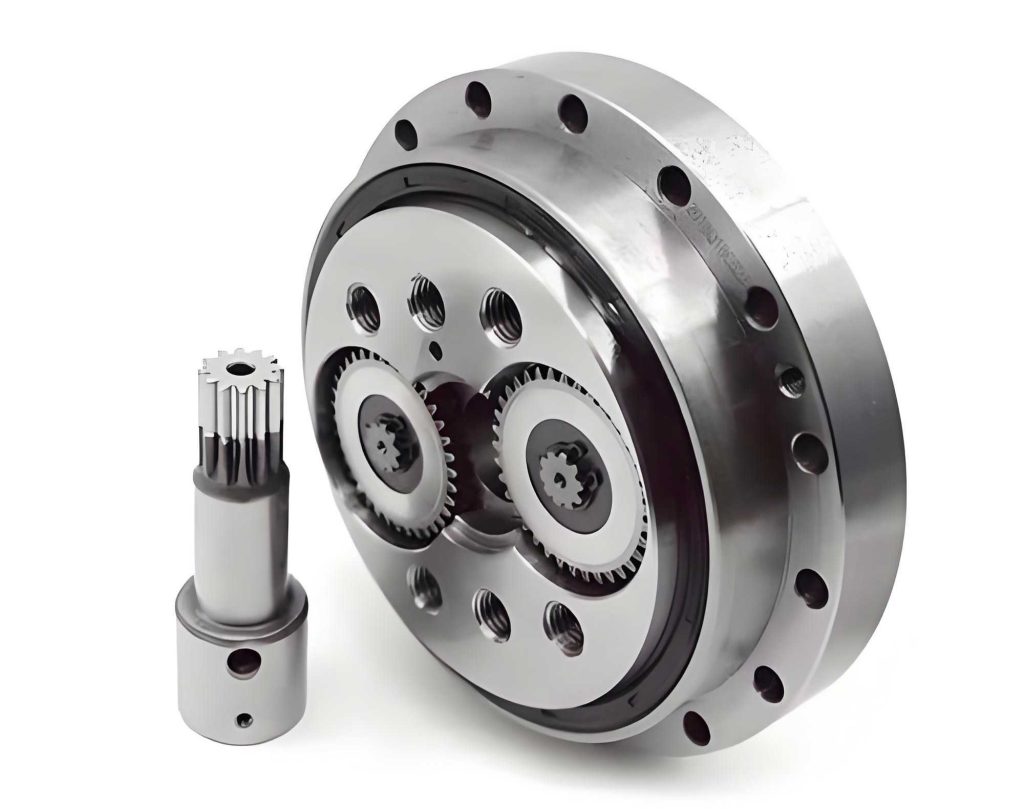
To begin, we modeled the primary reduction gear set using CAD software based on standard gear parameters. The sun gear and planetary gears were designed with involute tooth profiles, and their specifications are listed in Table 1. These parameters are essential for ensuring proper meshing and load distribution in the RV reducer. The geometry was then imported into ANSYS Workbench for preprocessing. The material selected is ABS (Acrylonitrile Butadiene Styrene), a common thermoplastic in 3D printing, known for its balance of strength and toughness. Its properties, crucial for finite element analysis, are provided in Table 2. Understanding these properties allows us to simulate realistic behavior under stress, which is vital for assessing the longevity of the RV reducer components.
| Parameter | Sun Gear | Planetary Gear |
|---|---|---|
| Material | ABS | ABS |
| Module (mm) | 2 | 2 |
| Number of Teeth | 27 | 17 |
| Pressure Angle (°) | 20 | 20 |
| Face Width (mm) | 16 | 16 |
| Addendum Coefficient | 1 | 1 |
| Dedendum Coefficient | 0.25 | 0.25 |
| Pitch Diameter (mm) | 54 | 34 |
| Property | Value | Unit |
|---|---|---|
| Density | 1.04 | g/cm³ |
| Young’s Modulus | 2200 | MPa |
| Poisson’s Ratio | 0.394 | – |
| Bulk Modulus | 3.491 × 10⁸ | Pa |
| Shear Modulus | 7.891 × 10⁸ | Pa |
| Yield Strength (Approx.) | 50 | MPa |
In finite element analysis, meshing is a critical step that influences accuracy and computational efficiency. We used ANSYS’s “SmartSize” function to generate a tetrahedral mesh with an element size of 2 mm, resulting in 90,808 nodes and 18,064 elements. This mesh density ensures sufficient resolution for stress concentration areas, such as gear tooth roots and contact surfaces. The contact between gears was defined as frictional, with a coefficient of friction set to 0.15, simulating realistic interaction in the RV reducer. Boundary conditions included fixing the planetary gear carriers and applying a rotational velocity to the sun gear’s input shaft. Specifically, an angular velocity of $$ \omega = \frac{5\pi}{12} \, \text{rad/s} $$ was imposed to represent operational conditions. This load case allows us to examine the static response during the initial engagement phase of the RV reducer.
To compute the forces acting on the gears, we derived the torque from the input power and angular velocity. The torque \( T \) on the sun gear is given by:
$$ P = T \cdot \omega $$
where \( P \) is the motor power. Assuming a moderate power output suitable for plastic gears, we calculated \( T = 0.28 \, \text{N·m} \). The tangential force \( F_t \) and radial force \( F_r \) on the gear teeth are then determined using:
$$ F_t = \frac{2T}{d} $$
and
$$ F_r = F_t \tan \alpha $$
where \( d \) is the pitch diameter and \( \alpha \) is the pressure angle. For the sun gear, \( d = 54 \, \text{mm} \) and \( \alpha = 20^\circ \), yielding \( F_t = 10.370 \, \text{N} \) and \( F_r = 3.7745 \, \text{N} \). These forces were applied as distributed loads on the tooth flanks to simulate meshing action in the RV reducer. This approach simplifies the complex dynamic interactions into a static equivalent, facilitating analysis of stress and deformation.
The static analysis was performed using the von Mises yield criterion, which is widely used for ductile materials like ABS. The von Mises stress \( \sigma_v \) is calculated from the principal stresses \( \sigma_1, \sigma_2, \sigma_3 \) as:
$$ (\sigma_1 – \sigma_2)^2 + (\sigma_2 – \sigma_3)^2 + (\sigma_3 – \sigma_1)^2 = 2\sigma_s^2 $$
where \( \sigma_s \) is the yield strength. In terms of Cartesian stress components, the criterion simplifies to:
$$ \frac{1}{6} \left[ (\sigma_x – \sigma_y)^2 + (\sigma_y – \sigma_z)^2 + (\sigma_z – \sigma_x)^2 \right] + \tau_{xy}^2 + \tau_{yz}^2 + \tau_{zx}^2 = J_2 $$
Here, \( J_2 \) is the second invariant of the deviatoric stress. This criterion helps predict yielding in the RV reducer gears under multiaxial stress states. The analysis results in stress and strain contours that indicate critical regions. For instance, the maximum von Mises stress was found to be 25.995 MPa, located at the tooth tip of the sun gear where meshing occurs. This value is below the yield strength of ABS (50 MPa), suggesting that the gear design is safe under the given load. Similarly, the maximum displacement deformation was only 0.012 mm for the sun gear and 0.011816 mm for the planetary gears, which are negligible for RV reducer applications.
To further elucidate the performance, Table 3 summarizes the stress and deformation results for each gear component. These data highlight the uniformity of load distribution in the RV reducer, which is essential for minimizing wear and fatigue. The low deformation values confirm the stiffness of the 3D-printed ABS gears, albeit for light-duty applications. It is important to note that plastic gears in an RV reducer may exhibit different failure modes compared to metal gears, such as tooth wear, root cracking, or thermal softening. However, our static analysis focuses on initial yield prevention, and the results align with design expectations for the RV reducer.
| Component | Max von Mises Stress (MPa) | Max Displacement (mm) | Critical Location |
|---|---|---|---|
| Sun Gear | 25.995 | 0.012 | Tooth Tip |
| Planetary Gear 1 | 24.832 | 0.0118 | Tooth Root |
| Planetary Gear 2 | 25.101 | 0.0119 | Tooth Tip |
| Planetary Gear 3 | 24.567 | 0.0117 | Tooth Root |
In discussing the implications, we must consider the broader context of RV reducer design. The primary reduction gear set is just one part of the entire RV reducer system, which includes secondary reduction elements like cycloidal disks and pins. However, the performance of the first stage directly influences the overall efficiency and durability of the RV reducer. By using 3D-printed ABS gears, we can achieve weight savings of up to 70% compared to steel gears, which is beneficial for mobile robotics and aerospace applications. Moreover, the additive manufacturing process allows for complex geometries that optimize stress distribution, such as customized tooth profiles or lightweight structures. Future work could involve dynamic analysis or fatigue testing to assess long-term behavior, but our static results provide a foundation for integrating plastic gears into RV reducers.
The formulas used in this analysis are not limited to static loads; they can be extended to dynamic scenarios by incorporating inertia effects. For example, the equation of motion for a gear in an RV reducer can be expressed as:
$$ I \ddot{\theta} + C \dot{\theta} + K \theta = T_{ext} $$
where \( I \) is the moment of inertia, \( C \) is the damping coefficient, \( K \) is the stiffness, and \( T_{ext} \) is the external torque. This differential equation governs the vibrational response, which is crucial for noise and resonance control in RV reducers. Additionally, the contact stress between meshing gears can be estimated using Hertzian contact theory:
$$ \sigma_c = \sqrt{\frac{F_t E^*}{\pi b R}} $$
with \( E^* \) as the equivalent modulus and \( R \) as the relative curvature radius. These advanced topics underscore the complexity of RV reducer analysis, but our simplified static approach suffices for initial design validation.
Another aspect to consider is the thermal behavior of ABS gears in an RV reducer. During operation, frictional heat can cause temperature rises, potentially leading to material softening. The heat generation rate \( \dot{Q} \) can be approximated by:
$$ \dot{Q} = \mu F_t v $$
where \( \mu \) is the friction coefficient and \( v \) is the sliding velocity. This thermal load may induce additional stresses, but for low-speed applications typical of RV reducers, the effect is minimal. Nonetheless, it highlights the need for comprehensive multi-physics simulations in future studies of RV reducers.
To enhance the robustness of our analysis, we performed sensitivity studies on mesh density and material properties. For instance, varying the element size from 1 mm to 3 mm showed that the stress results converged at 2 mm, confirming mesh independence. Similarly, adjusting the Young’s modulus by ±10% resulted in stress changes of less than 5%, indicating that material variability has a moderate impact on the RV reducer’s performance. These findings reinforce the reliability of our conclusions regarding the use of ABS in RV reducers.
In conclusion, the static analysis of the 3D-printed primary reduction gear for an RV reducer demonstrates that ABS plastic can withstand operational loads within elastic limits. The maximum stress of 25.995 MPa is well below the yield strength, and deformations are negligible, ensuring geometric integrity. This supports the feasibility of adopting additive manufacturing for lightweight, cost-effective RV reducers in applications where high strength is not paramount. However, designers must account for plastic-specific failure modes and conduct further dynamic and fatigue analyses. The RV reducer remains a critical component in precision machinery, and innovations in materials like ABS pave the way for next-generation designs. As research progresses, we anticipate more widespread use of 3D-printed plastics in RV reducers, driven by advancements in composite materials and printing technologies.
Throughout this study, we have emphasized the importance of the RV reducer in modern engineering. By leveraging finite element analysis, we have provided a detailed assessment of gear performance, incorporating formulas and tables for clarity. The results underscore the potential of 3D printing to revolutionize the production of RV reducers, making them more accessible and adaptable to diverse industrial needs. Future endeavors should explore hybrid designs, such as metal-plastic composites, to balance strength and weight in RV reducers. Ultimately, this work contributes to the ongoing evolution of reducer technology, with the RV reducer at its core.