
The RV reducer stands as a critical core component within the drivetrain of heavy-duty industrial robots. Its performance directly dictates key operational metrics of the robotic system, including end-effector payload capacity, motion positioning accuracy, and overall kinematic stability during high-load operations. Among its various performance parameters, torsional stiffness is a fundamental quality indicator. It profoundly influences the transmission efficiency and positional fidelity of the system. Insufficient torsional stiffness in an RV reducer can lead to trajectory deviations, operational failures, and the onset of undesirable chatter or vibration during robot motion. Therefore, comprehensive experimental investigation and precise characterization of the stiffness properties of RV reducers are of paramount engineering significance. This article presents a detailed experimental study on the stiffness characteristics of an RV reducer, utilizing a dedicated test platform, and explores multiple analytical methodologies for evaluating its torsional stiffness.
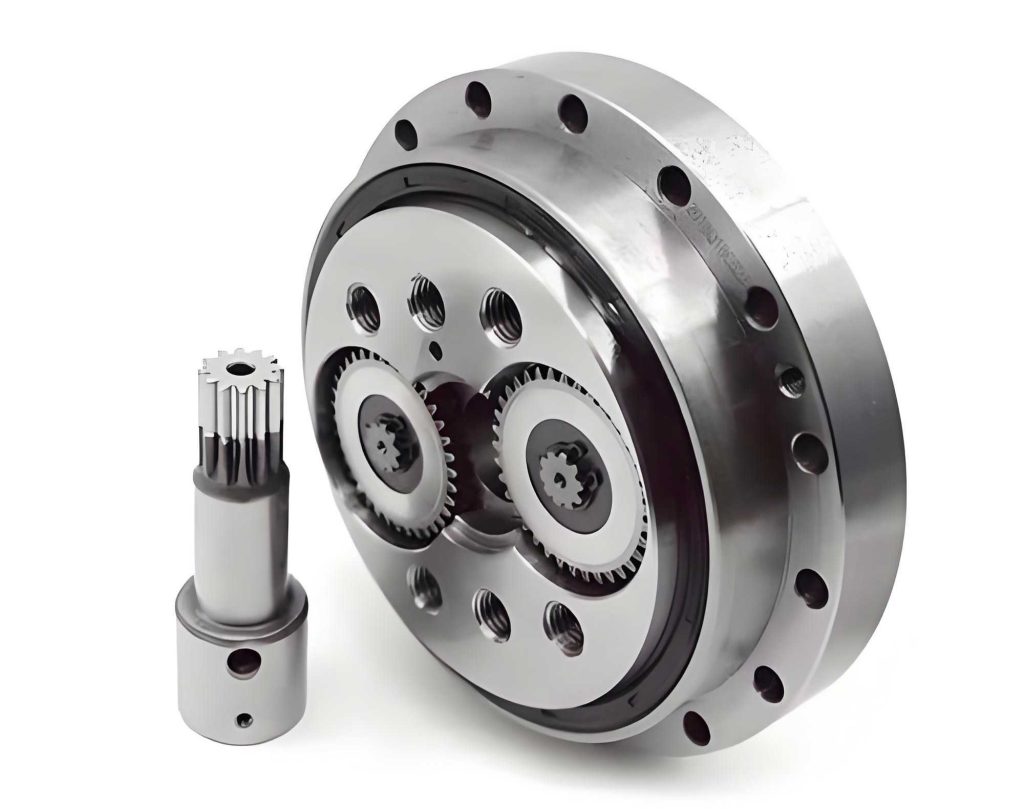
The internal structure of the RV reducer is a compound system, primarily comprising a first-stage planetary gear train and a second-stage cycloidal pinwheel mechanism. This unique design grants it high reduction ratios, exceptional torque density, and compact dimensions. The overall torsional stiffness K of the RV reducer is a synthesized property resulting from the series connection of the stiffness contributions from all its compliant elements, including gear teeth, bearings, shafts, and the housing. It can be conceptually modeled as the inverse of the total compliance:
$$ \frac{1}{K} = \frac{1}{K_{gear}} + \frac{1}{K_{bearing}} + \frac{1}{K_{shaft}} + … $$
When an external load torque T is applied to the output flange, the entire transmission chain undergoes elastic deformation, resulting in an angular displacement θ at the output relative to the theoretically fixed input. The relationship between T and θ defines the stiffness characteristic, which is often nonlinear, particularly near the zero-torque condition due to backlash and under high loads due to material and contact nonlinearities.
1. Experimental Setup and Stiffness Testing Protocol
The stiffness characterization was conducted using a specialized comprehensive performance test bench for precision reducers. The core setup of this RV reducer test platform is illustrated schematically below. The left side constitutes the input side, which is locked during stiffness testing, and the right side is the output/load side where torque is applied and measurements are taken.
The primary components of the test rig include:
- Load Servo Motor: Applies precise rotational motion to the output side.
- High-Precision Torque Sensor: Measures the output torque (T) in real-time.
- Input-side Angular Encoder: Monitors the input shaft angle (theoretically fixed but may have minute deflections).
- Tested RV Reducer Unit: The unit under test (UUT), securely mounted.
- Output-side High-Resolution Angular Encoder: Precisely measures the angular displacement (θ) of the output flange.
- Supporting Bearings and Rigid Frame: To ensure minimal external compliance.
The testing procedure for the RV reducer stiffness was executed as follows:
- The input shaft of the RV reducer was mechanically locked in place.
- The load motor at the output side was programmed to apply a very slow, quasi-static rotational motion at a constant speed of 0.05 r/min.
- The torque was gradually increased from 0 N·m up to the rated torque of the RV reducer (set as an alarm limit at 300 N·m).
- Upon reaching the rated torque, the direction of rotation was reversed, and the torque was gradually decreased back to 0 N·m, completing one full load-unload cycle.
- This cycle was repeated three times to ensure consistency and to capture any repeatable hysteresis behavior.
- Throughout the test, data from the torque sensor and the output angular encoder were synchronously acquired via a National Instruments (NI) data acquisition system and displayed as a real-time curve on the industrial computer.
2. Data Processing and Stiffness Error Compensation
The raw data collected from the test bench represents the combined stiffness of the RV reducer unit and the test fixture components, notably the output shaft coupling and the mounting adapter. To isolate the true torsional stiffness K of the RV reducer itself, a compensation model must be applied. The system’s measured stiffness K_r is related to the individual component stiffness values as follows:
$$ \frac{1}{K_r} = \frac{1}{K} + \frac{1}{K_1} + \frac{1}{K_i \cdot i^2} $$
Where:
- K is the intrinsic torsional stiffness of the RV reducer (N·m/arcmin).
- K1 is the torsional stiffness of the output shaft and connecting components (N·m/arcmin).
- Ki is the torsional stiffness of the input shaft and locking mechanism (N·m/arcmin).
- i is the reduction ratio of the RV reducer (i=121 for the tested RV-40E model).
Rearranging the equation to solve for the true RV reducer stiffness K yields the compensation formula:
$$ K = \frac{1}{ \frac{1}{K_r} – \frac{1}{K_1} – \frac{1}{K_i \cdot i^2} } $$
In practice, K_1 and K_i are estimated or measured separately through calibration tests on the fixture. For the purpose of this analysis focusing on comparative methods, we will primarily work with the measured stiffness K_r, acknowledging that the absolute value requires this correction.
3. Analysis of Stiffness Test Results
Fourteen separate tests were performed on the same RV-40E reducer. In each test, the input shaft was locked at a manually selected, quasi-random angle. Data from tests #1, #4, #7, #10, and #13 were selected for detailed curve plotting. The resulting torque vs. output angle curves for these tests are presented conceptually (as precise numerical plots are not available here). All curves exhibited a primary characteristic: a hysteresis loop.
3.1 The Hysteresis Loop and Backlash
The hysteresis phenomenon is a key nonlinear characteristic of the RV reducer under load. As torque increases from zero to the rated value, the output angle increases along a specific path. When the torque is subsequently decreased back to zero, the output angle does not retrace the same path but follows a different one, resulting in a closed loop. The area within this loop represents energy loss due to internal friction, damping, and micro-slip in contacts within the RV reducer. The vertical width of the loop at zero torque defines the mechanical backlash or “lost motion” (δθ), as shown in the relation derived from the curve:
$$ \delta \theta = \theta_{T \to 0^+} – \theta_{T \to 0^-} $$
A critical observation from comparing the multiple test curves was that the overall shape and slope of the hysteresis loops were remarkably consistent across all tests, regardless of the specific locked angle of the input shaft. This indicates a fundamental property: the macro-scale torsional stiffness characteristic of the RV reducer is effectively independent of its initial engagement angle. Minor variations were observed only in the very initial loading segment of the first cycle, which quickly converged to the consistent main curve in subsequent cycles.
3.2 Key Performance Metrics from Tests
The processed data from all 14 tests yielded two important metrics for each test: Hysteresis Loss and Backlash. The results are summarized in the table below. Hysteresis loss, often quantified as the energy loss per cycle or as an angular difference between loading and unloading paths at a mid-range torque, reflects internal damping. Backlash is a critical parameter for positioning accuracy.
| Test Group # | Hysteresis Loss (arcseconds) | Backlash Value (arcseconds) |
|---|---|---|
| 1 | 7 | 31 |
| 2 | 7 | 31 |
| 3 | 7 | 31 |
| 4 | 8 | 32 |
| 5 | 8 | 32 |
| 6 | 9 | 31 |
| 7 | 8 | 32 |
| 8 | 8 | 32 |
| 9 | 1 | 16 |
| 10 | 1 | 16 |
| 11 | 1 | 16 |
| 12 | 1 | 16 |
| 13 | 4 | 22 |
| 14 | 2 | 27 |
Analysis of Table 1 reveals that the tested RV reducer exhibits relatively low hysteresis loss (mostly between 1-9 arcseconds) and moderate backlash values. According to robot reducer accuracy standards, a backlash ≤ 1 arcminute (60 arcseconds) is typically classified as Precision Grade 1. The maximum measured backlash of 32 arcseconds is well within this limit, confirming the high precision grade of this RV reducer unit.
4. Methodologies for Calculating Torsional Stiffness
While the full curve characterizes the behavior, a single-value torsional stiffness is often required for specification, simulation, and comparison. For the quasi-linear central portion of the curve, this is defined as:
$$ K_{linear} = \frac{\Delta T}{\Delta \theta} $$
However, due to the nonlinearity and hysteresis, the choice of data points (ΔT, Δθ) for this calculation significantly impacts the result. We applied four distinct first-order linear processing methods to the data from Tests #1 and #4 to calculate K_r.
4.1 Estimation Method: This method involves visually estimating the average slope of the primary (loading) curve from the plot. It is quick but subjective and has low repeatability.
4.2 End-Point Selection Method: This method uses the two extreme points of the rated load cycle: the point at rated torque (T_max, θ_load) and the point at zero torque on the return path (0, θ_unload). The stiffness is calculated as:
$$ K_{end} = \frac{T_{max} – 0}{\theta_{load} – \theta_{unload}} = \frac{T_{max}}{\theta_{load} – \theta_{unload}} $$
This method is simple but is heavily influenced by the total hysteresis and backlash, often yielding a lower stiffness value.
4.3 Two-Point Connection Method: This method selects two specific points on the loading curve, typically at 20% and 80% of the rated torque, to avoid the nonlinear regions at the very start and end. The stiffness is:
$$ K_{2pt} = \frac{T_{80\%} – T_{20\%}}{\theta_{80\%} – \theta_{20\%}} $$
This method provides a more consistent representation of the main operational stiffness range.
4.4 Average Analysis Method (Least Squares Fitting): This is the most robust statistical method. It performs a linear regression (least-squares fit) on a large set of data points from the central, most linear portion of the loading curve. The slope of the best-fit line is taken as the torsional stiffness. It minimizes the influence of random measurement noise.
| Test Group # | Estimation Method (N·m/arcmin) | End-Point Selection Method (N·m/arcmin) | Two-Point Connection Method (N·m/arcmin) | Average Analysis Method (N·m/arcmin) |
|---|---|---|---|---|
| 1 | 64.456 | 76.871 | 79.039 | 66.589 |
| 4 | 54.996 | 68.455 | 65.056 | 55.328 |
4.5 Evaluation of Methods for the RV Reducer:
As seen in Table 2, the calculated stiffness value varies with the method.
- The Estimation and Average Analysis methods yield fairly consistent and moderate values, with the Average Analysis method being far superior due to its objective, repeatable algorithm.
- The End-Point Selection Method typically produces a lower stiffness value because the denominator (Δθ) includes the total angular deviation due to both elastic deformation and backlash/hysteresis loss.
- The Two-Point Connection Method can yield a higher stiffness value as it focuses on the steeper, more linear mid-section of the curve, excluding the initial compliance zone.
For the tested RV-40E model, the factory specification for torsional stiffness is K > 49 N·m/arcmin. All calculated values from all methods for both tests exceed this threshold, confirming that the unit meets the specified performance requirement. However, for accurate and comparable reporting, the Average Analysis Method (linear regression) is strongly recommended as the standard for evaluating RV reducer stiffness.
5. Nonlinear Stiffness Modeling Considerations
For high-fidelity dynamic simulation of robotic systems, a single linear stiffness value may be insufficient. The nonlinear torque-angle relationship of the RV reducer, especially near the zero-crossing, can be modeled. A common empirical model uses a piecewise or polynomial function. A cubic polynomial is often effective for capturing the smooth nonlinearity:
$$ T(\theta) = a_1 \theta + a_3 \theta^3 $$
where the linear term coefficient a_1 relates to the main stiffness, and the cubic term coefficient a_3 captures the progressive stiffening or softening behavior. For modeling hysteresis, more complex models like the Bouc-Wen or Dahl friction models can be incorporated into the stiffness representation of the RV reducer.
6. Conclusion and Recommendations
This experimental study on the RV reducer has led to several important conclusions and practical recommendations:
1. The macro-scale torsional stiffness characteristic of a healthy RV reducer, as represented by the slope of the central portion of its torque-angle curve, is independent of the initial meshing angle of its internal gears. This property simplifies the testing procedure as precise angular positioning of the input shaft prior to locking is not critical for stiffness assessment.
2. The performance of the tested RV reducer sample was validated. Its low hysteresis loss indicates good material and manufacturing quality with minimal internal damping. More importantly, its measured backlash values were consistently below 32 arcseconds, which qualifies it for Precision Grade 1 according to common robotic accuracy standards, confirming its suitability for high-precision applications.
3. The method chosen for calculating a single-value torsional stiffness from the test data significantly influences the result. Among the four methods evaluated:
- Avoid Subjective Methods: The Estimation Method is not recommended for formal reporting.
- Understand Method Bias: The End-Point Selection Method tends to underestimate stiffness, while the Two-Point Method may overestimate it if the points are chosen in a very stiff region.
- Standardize on Robust Analysis: The Average Analysis Method (Linear Regression) applied to the loading curve data between approximately 20% and 80% of rated torque provides the most objective, repeatable, and representative value of the operational torsional stiffness for the RV reducer. This should be adopted as the standard calculation protocol.
4. For advanced dynamic modeling, representing the RV reducer’s stiffness with a nonlinear function, potentially incorporating hysteresis, is necessary to accurately predict system behavior during fine motions, direction reversals, and under varying loads.
In summary, rigorous testing and appropriate data analysis are essential for characterizing the stiffness of RV reducers. The findings confirm that a well-manufactured RV reducer exhibits stable and repeatable stiffness properties, meeting the demanding requirements of modern industrial robotics. The standardized use of linear regression for stiffness calculation will ensure consistent and reliable performance evaluation across different RV reducer units and testing laboratories.