
The pursuit of advanced industrial robotics is a key indicator of a nation’s capacity for technological innovation. At the heart of many precision robotic joints lies a critical component: the harmonic drive gear. Renowned for its high reduction ratio, compactness, lightweight design, exceptional positional accuracy, and high transmission efficiency, this gear system is indispensable. However, the development of high-performance harmonic drive gears presents significant technical challenges. A primary focus of ongoing research is the flexspline, a thin-walled cup-shaped component that undergoes continuous elastic deformation during operation. Its structural integrity under cyclic loading is paramount to the reliability and lifespan of the entire harmonic drive gear. This analysis delves into the stress and deformation behavior of the flexspline, particularly under the initial assembly condition with the wave generator and under varying operational loads, providing insights for its design optimization.
The fundamental operation of a harmonic drive gear relies on the controlled elastic deformation of the flexspline. The system typically consists of three primary elements: a rigid circular spline, a flexible spline (flexspline), and an elliptical wave generator inserted into the flexspline. As the wave generator rotates, it produces a traveling wave of deformation in the flexspline, causing its external teeth to engage and disengage with the internal teeth of the circular spline at two diametrically opposite regions. This interaction creates a relative motion between the two splines. The high reduction ratio is achieved because the flexspline has slightly fewer teeth than the circular spline. The continuous flexing of the flexspline subjects it to alternating stresses, making the analysis of its stress distribution a central concern for preventing fatigue failure. The initial stress state, induced purely by the assembly of the elliptical wave generator, sets the baseline for all subsequent operational stresses.
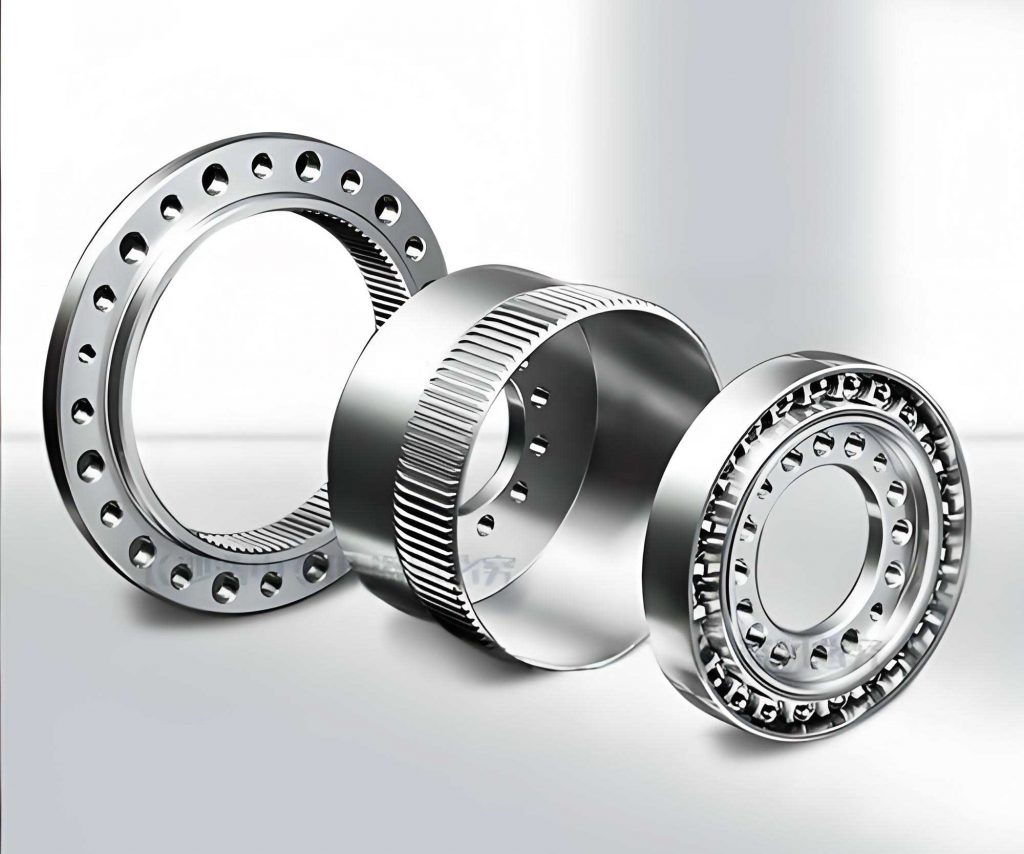
To investigate this complex behavior, a finite element analysis (FEA) approach is employed. The model focuses on a cup-type flexspline with an involute tooth profile. The core of the analysis involves simulating the “interference fit” caused by inserting a cam-type wave generator, whose major axis diameter is slightly larger than the nominal inner diameter of the undeformed flexspline. This assembly process forces the flexspline into an elliptical shape, generating pre-stress. The contact between the wave generator and the flexspline is defined as a “rigid-flexible” surface-to-surface contact, where the wave generator is treated as a rigid body and the flexspline as a deformable one. The material properties for the flexspline are typical of high-strength alloy steel used in such applications: Elastic Modulus, $E = 197 \text{ GPa}$ and Poisson’s Ratio, $\mu = 0.2548$. The base of the flexspline cup is fully constrained to simulate its fixation to the output hub. A high-fidelity hexahedral mesh is generated for the flexspline to ensure accuracy in capturing stress gradients, especially in the critical tooth root and thin-wall regions.
Deformation and Stress Under No-Load (Assembly) Condition
The initial state of the harmonic drive gear after assembly, with no torque applied, reveals the fundamental deformation pattern imposed by the wave generator. The radial deformation of the flexspline’s outer cylindrical wall is extracted along its axis, from the cup’s open end (tooth end) towards the closed end (diaphragm).
The deformation profile shows a characteristic decay. The maximum radial deformation occurs at the open end along the major axis of the wave generator ellipse, with a value of approximately $0.796 \text{ mm}$. This deformation decreases progressively along the length of the cup. The contour of deformation on any cross-section of the tooth ring is elliptical, corresponding to the shape of the wave generator. The magnitude of this elliptical deformation is greatest at the open end ($\text{Section 1, } Z=0$) and smallest at a section deeper inside the cup ($\text{Section 2, } Z=15\text{mm}$). The variation of equivalent (von Mises) stress along the outer wall follows a related trend. Stress is highest in the tooth ring region near the open end and attenuates along the cup’s body. The stress concentration is most severe in the tooth root fillet area at the major axis locations.
A more detailed look at the circumferential stress distribution on the tooth-ring cross-section shows a highly non-uniform pattern. The stress fluctuates significantly along the circumference, with peaks near the major axis and valleys near the regions at approximately $45^\circ$ from the axes. The maximum stress values in the tooth root under pure assembly can reach levels that are a significant fraction of the material’s yield strength, establishing a high mean stress upon which operational alternating stresses will be superimposed. The stress state at this no-load condition can be conceptually related to the bending of a thin cylindrical shell. The induced circumferential stress, $\sigma_\theta$, due to the elliptical deformation can be approximated by shell theory:
$$\sigma_\theta \approx \frac{E}{1-\mu^2} \left( \frac{w}{R} + \mu \frac{\partial u}{\partial x} \right)$$
where $w$ is the radial displacement, $R$ is the nominal radius, $u$ is the axial displacement, and $x$ is the axial coordinate. The high stress in the tooth region is a superposition of this shell bending stress and local contact stresses from the wave generator.
Stress Evolution Under Applied Torque (Load Condition)
The operational state of the harmonic drive gear introduces a torsional load. To simulate this, a tangential force is applied to nodes on the tooth flank at the pitch circle in the major axis region, creating an input torque. Analyses are conducted for increasing torque levels to observe the progression of the stress field.
Under a pure assembly load (0 Nm), the stress distribution is symmetric about both the major (X) and minor (Y) axes of the wave generator ellipse. This symmetry breaks when torque is applied. At a torque of 40 Nm, the region of maximum stress shifts from the pure major axis location towards the direction of the applied torque. This shift occurs because the teeth engaged in transmitting load experience additional bending and contact stresses. At a higher torque of 80 Nm, this shift becomes more pronounced, and the overall magnitude of stresses throughout the flexspline increases substantially. The stress state is now a complex combination of the assembly-induced pre-stress and the load-induced stress. The maximum principal stress, critical for fatigue crack initiation, tends to align with the direction of highest tensile loading, often found in the tooth root on the loaded side of the engagement zone. This demonstrates that the critical failure location in a harmonic drive gear is not static but can migrate based on the load vector.
Parametric Study: Influence of Flexspline Geometry on Assembly Stress
The baseline stress from assembly is highly sensitive to key geometric parameters of the flexspline. A parametric study using the control variable method elucidates these relationships, providing guidance for design optimization of the harmonic drive gear.
Aspect Ratio (Length to Diameter)
The aspect ratio ($L/D$) of the flexspline cup influences its compliance and stress distribution. Holding other parameters constant, the maximum equivalent stress under assembly decreases monotonically as the aspect ratio increases from 0.5 to 1.0. A longer, more slender cup allows for a more gradual transition of the deformation from the forced ellipse at the open end, reducing stress concentrations. The relationship is non-linear, with a particularly sharp decrease in stress observed in the range of $L/D = 0.7$ to $0.8$.
| Aspect Ratio (L/D) | Max. Equivalent Stress (MPa) | % Change from Baseline |
|---|---|---|
| 0.5 | 1050 | +8.6% |
| 0.6 | 990 | +2.4% |
| 0.7 | 920 | -4.8% |
| 0.8 | 780 | -19.4% |
| 0.9 | 700 | -27.7% |
| 1.0 | 631 | -34.8% |
Cup Wall Thickness
The thickness of the cylindrical cup wall ($C_1$) directly affects its bending stiffness. Increasing the wall thickness from 0.7 mm to 1.2 mm leads to an increase in the maximum assembly stress. A thicker wall is less compliant, resisting the deformation imposed by the wave generator and resulting in higher internal stresses. However, the rate of stress increase diminishes with thickness, asymptotically approaching a plateau near 960 MPa. Conversely, a very thin wall, while reducing assembly stress, compromises fatigue life and buckling stability. An optimal thickness balances these competing factors.
| Cup Wall Thickness, $C_1$ (mm) | Max. Equivalent Stress (MPa) | Trend |
|---|---|---|
| 0.7 | 820 | Increasing, with diminishing rate |
| 0.8 | 880 | |
| 0.9 | 925 | |
| 1.0 | 950 | |
| 1.1 | 958 | |
| 1.2 | 965 |
Tooth Ring Width
The axial width of the tooth ring ($B$) is another critical parameter. A wider tooth ring increases the local stiffness of the region where the wave generator applies its force. Analysis shows a strong positive correlation between tooth width and maximum assembly stress. Widening the tooth ring from 10 mm to 15 mm resulted in a 43% increase in stress. This underscores a significant design trade-off: while a wider tooth ring can improve load capacity and tooth contact, it substantially raises the pre-stress level in the harmonic drive gear flexspline, potentially shortening its fatigue life.
| Tooth Ring Width, $B$ (mm) | Max. Equivalent Stress (MPa) | % Increase from Min. Width |
|---|---|---|
| 10 | 550 | 0% |
| 11 | 650 | 18.2% |
| 12 | 750 | 36.4% |
| 13 | 830 | 50.9% |
| 14 | 900 | 63.6% |
| 15 | 967 | 75.8% |
Conclusion and Design Implications
This comprehensive finite element analysis of a cup-type flexspline for a harmonic drive gear elucidates key aspects of its mechanical behavior. The assembly process with the wave generator establishes a critical pre-stress field, characterized by maximum deformation and stress at the open end along the major axis, with values decaying axially. The tooth-root region is identified as the primary stress concentration zone. Under operational torque, this symmetric stress field distorts, with the peak stress migrating in the direction of torque application, and the overall stress magnitude increases proportionally with load.
The parametric study yields vital design guidelines for optimizing the flexspline of a harmonic drive gear:
- Aspect Ratio: A higher aspect ratio ($L/D$) significantly reduces assembly-induced stress, favoring longer, slender cups for lower pre-stress, though this may conflict with space constraints.
- Cup Wall Thickness: An optimal wall thickness exists. While thinner walls reduce assembly stress, they risk other failure modes. The design should avoid excessively thick walls which unnecessarily raise stress without commensurate benefit.
- Tooth Ring Width: This parameter has a profound impact. Increasing tooth width for higher torque capacity comes at a direct and substantial cost of increased assembly stress, requiring careful fatigue life validation.
The interplay of these parameters dictates the baseline fatigue performance. A holistic design approach must balance the assembly stress revealed in this analysis with the dynamic stress amplitudes from loading to maximize the life and reliability of the harmonic drive gear. Future work integrating this analysis with multi-axial fatigue criteria and experimental validation will further solidify the design foundation for these precision components.