
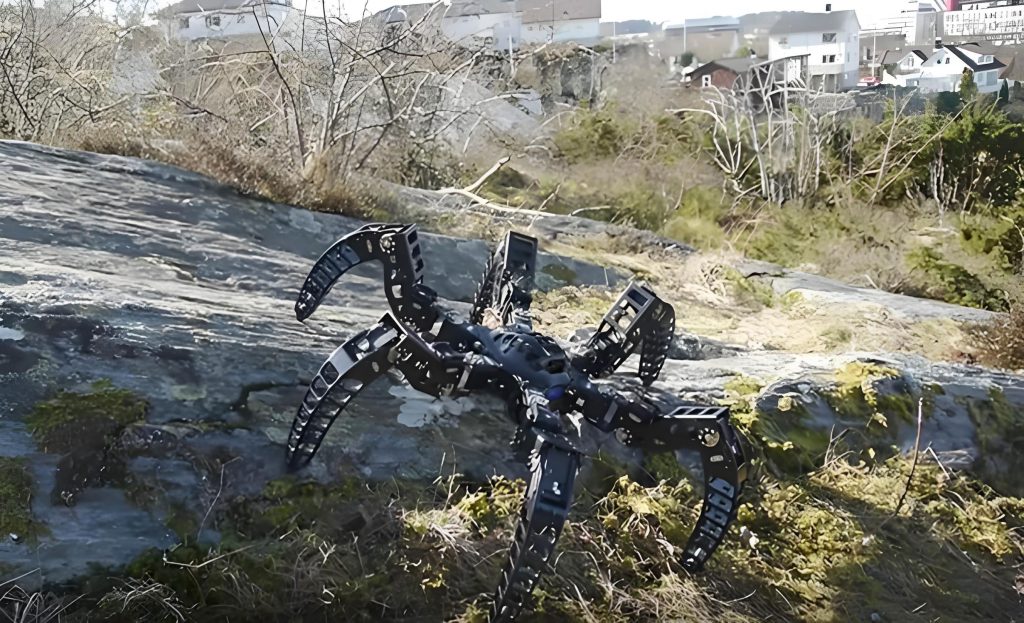
The development of legged robots represents a significant frontier in robotics, aiming to create machines capable of navigating complex, unstructured terrains where wheeled or tracked vehicles fail. Among these, the bionic robot, specifically the bionic quadruped robot, draws direct inspiration from the elegant and efficient locomotion observed in nature’s quadrupeds such as dogs, horses, and cheetahs. This biomimetic approach is not merely aesthetic; it is a functional strategy to solve problems of stability, agility, and energy efficiency. The core challenge in developing a functional bionic robot lies in the intricate coupling of mechanical design, actuation, and control. A robust mechanical structure is the foundational prerequisite, as it must support the robot’s weight, endure dynamic冲击 loads during gait cycles, and provide reliable mounting for actuators and sensors, all while striving for minimal mass to reduce inertia and power consumption. This article presents a comprehensive design and finite element analysis of a 12-degree-of-freedom (DOF) bionic quadruped robot, detailing the process from conceptual modeling to structural validation and optimization.
1. Biomimetic Inspiration and Conceptual Design
The design philosophy for our bionic quadruped robot begins with observing biological counterparts. Key principles extracted include:
- Limb Configuration: A three-segment limb (akin to hip, thigh, and shin) allows for a wide range of motion and effective force application.
- Freedom of Movement: Three primary degrees of freedom per leg are commonly observed: one for abduction/adduction (side swing) and two for protraction/retraction and flexion/extension (forward-backward and up-down movements).
- Gait Patterns: Stable and efficient gaits like the trot and walk are achieved through coordinated, cyclic leg movements.
Translating these principles into engineering specifications, we established the initial design parameters for our bionic robot. The targeted robot has an overall body length of 1.0 m, a width of 0.59 m, and a standing height of 1.2 m. The most critical specification is the allocation of 12 DOFs across four legs, with each leg possessing exactly 3 DOFs. This configuration is summarized in Table 1.
| Leg Component | Degree of Freedom (DOF) | Biological Analogy | Primary Function |
|---|---|---|---|
| Joint 1 (Hip) | 1 (Side Swing / Abduction-Adduction) | Hip joint lateral movement | Steering, lateral balance, wider stance |
| Joint 2 (Hip/Knee) | 1 (Forward-Backward Swing) | Hip/Knee flexion-extension | Leg protraction and retraction |
| Joint 3 (Knee/Ankle) | 1 (Forward-Backward Swing) | Knee/ankle flexion-extension | Leg lift, stride adjustment, shock absorption |
The kinematic ranges for the leg linkages were initially set based on geometric models to achieve a reasonable workspace: the swing angle between the shin and thigh is 56.36°, between the thigh and the side-swing assembly is 53.554°, and the side-swing joint itself has a range of 40°.
2. Three-Dimensional Modeling and Assembly
To transform the conceptual design into a precise, manufacturable model, we employed Pro/ENGINEER (Pro/E), a powerful parametric Computer-Aided Design (CAD) software. The modeling process involved:
- Part Modeling: Individual components such as the body chassis, side-swing housings, thigh links, shin links, custom brackets, and various axles were modeled. Special attention was paid to features like bearing housings, actuator mounting points, and weight-reducing cutouts.
- Material Assignment: All primary structural components were assigned the properties of a high-strength aluminum alloy (e.g., 7075-T6). This material was chosen for its excellent specific strength (strength-to-density ratio), which is crucial for a mobile bionic robot where minimizing mass directly impacts dynamic performance and energy consumption. Key properties are listed in Table 2.
- Virtual Assembly: All parts were assembled with appropriate constraints (mates, alignments, bearings) to create a fully constrained 3D digital prototype. This assembly verified the kinematic feasibility, checked for interferences, and confirmed the installation geometry for the linear actuators (electric cylinder/电动推杆).
| Property | Symbol | Value | Unit |
|---|---|---|---|
| Density | $\rho$ | 2810 | kg/m³ |
| Young’s Modulus | $E$ | 71.7 | GPa |
| Poisson’s Ratio | $\nu$ | 0.33 | – |
| Yield Strength | $\sigma_y$ | 503 | MPa |
| Ultimate Tensile Strength | $\sigma_u$ | 572 | MPa |
3. Finite Element Analysis Fundamentals and Load Case Definition
After completing the CAD model, the focus shifted to structural integrity assessment using Finite Element Analysis (FEA). ANSYS, a premier multidisciplinary simulation software, was chosen for this task. FEA works by discretizing a complex geometry into a finite number of small, simple elements (like tetrahedrons or hexahedrons) connected at nodes. The software then formulates and solves a vast system of equations governing the physical behavior (stress, strain, deformation) of this mesh under applied loads and constraints.
The governing equation for linear static structural analysis, which is the primary method used here, is derived from Hooke’s Law and equilibrium conditions, expressed in matrix form for the entire discretized structure:
$$ [K]\{u\} = \{F\} $$
where $[K]$ is the global stiffness matrix (dependent on material $E$, $\nu$, and geometry), $\{u\}$ is the vector of nodal displacements (the primary unknown), and $\{F\}$ is the vector of applied nodal forces.
Once solved, stresses are recovered. For example, the von Mises stress $\sigma_{vm}$, a scalar value used to predict yielding in ductile materials, is calculated from the principal stresses ($\sigma_1$, $\sigma_2$, $\sigma_3$):
$$ \sigma_{vm} = \sqrt{\frac{(\sigma_1 – \sigma_2)^2 + (\sigma_2 – \sigma_3)^2 + (\sigma_3 – \sigma_1)^2}{2}} $$
The design criterion is $\sigma_{vm} \leq \frac{\sigma_y}{n}$, where $n$ is the chosen safety factor.
Critical Load Case Definition: The most demanding scenario for a legged bionic robot is a dynamic冲击, such as landing from a jump or stepping off an obstacle. We analyzed a conservative case: a 1-meter drop onto a hard surface (e.g., concrete) with poor damping. The impact velocity upon landing is given by:
$$ v = \sqrt{2gh} $$
where $g = 9.81 \, \text{m/s}^2$ and $h = 1 \, \text{m}$, resulting in $v \approx 4.43 \, \text{m/s}$.
Assuming a very short impact/buffering time $\Delta t$ of 0.25 seconds on such a surface, the average deceleration $a$ is:
$$ a = \frac{v}{\Delta t} \approx \frac{4.43}{0.25} \approx 17.72 \, \text{m/s}^2 $$
For a total robot mass (including payload) $m$ of 160 kg, the average冲击 force $F_{avg}$ on the robot is:
$$ F_{avg} = m \cdot (g + a) \approx 160 \cdot (9.81 + 17.72) \approx 4405 \, \text{N} $$
Assuming this force is absorbed by two legs during a trotting or bounding gait, the vertical force per leg $F_{leg}$ is approximately 2202 N. To ensure robustness, we apply a safety factor of $n=2$, leading to a design load of 4400 N per leg. For further analysis margin, we round this up to a benchmark load of 2500 N per critical load path within a single leg for component-level FEA.
4. Component-Level Finite Element Analysis and Results
We performed linear static structural analyses on key load-bearing components of the bionic quadruped robot. For each, the CAD geometry was imported into ANSYS, meshed with suitable elements (typically tetrahedral solids), material properties were assigned, realistic constraints (fixed supports on bolt holes) were applied, and the 2500 N load was distributed appropriately based on the component’s function.
4.1 Thigh Link Plate Analysis
The thigh link is a central component connecting the shin (via an axle), the side-swing assembly (via another axle), and two linear actuators. It experiences complex multi-axial loading.
- Loads & Constraints: The holes for the shin and side-swing axles were subjected to bearing loads (radial force distributions simulating contact with an axle). The small holes for connecting to the actuator rods were subjected to concentrated forces. Mounting surfaces were fixed.
- Mesh: A global mesh size of 2 mm was used, refined around holes.
- Results: The analysis showed excellent structural performance. Maximum deformation was approximately 0.03 mm, indicating high stiffness. The maximum von Mises stress was 25.7 MPa, well below the yield strength of aluminum (503 MPa). The factor of safety is extremely high, suggesting potential for weight optimization.
4.2 Shin Link and Bracket Analysis
The shin is a cylindrical rod connected to the thigh at one end and to an actuator via a small bracket at the other.
A. Shin Rod:
- Loads & Constraints: A concentrated force (simulating the knee joint reaction) was applied at the axle hole. Another force (from the actuator) was applied at the mid-length bracket hole. The ends were appropriately constrained.
- Results: Maximum deformation was about 0.18 mm, and maximum stress was 12.8 MPa. The shin rod’s design is more than adequate for the load case.
B. Shin Bracket (Small Plate): This small component transfers actuator force to the shin rod.
- Loads & Constraints: Fixed support on its two bolt holes. A concentrated force applied on its central axle hole.
- Mesh: A finer mesh of 0.5 mm was necessary due to small features.
- Results: Maximum deformation was 0.018 mm. The maximum stress was higher at 110.1 MPa, which is still only about 22% of the material’s yield strength ($\frac{110.1}{503} \approx 0.22$), confirming a safe design with a factor of safety > 4.5.
4.3 Side-Swing Housing Analysis
The side-swing housing is a critical structural node that connects the leg assembly to the main robot body and hosts the abduction/adduction actuator. It experiences combined loading from the thigh and the actuator.
- Loads & Constraints: Bearing loads were applied in two axle holes (connecting to the thigh and body). Concentrated forces were applied at the two small holes for the lateral actuator.
- Results: This component showed the highest deformation among the large parts, at 0.7 mm, which is acceptable for its function and size. The maximum von Mises stress was 98.4 MPa. This is still safely within the material’s capability, with a factor of safety of about 5.1 ($503 / 98.4 \approx 5.1$).
4.4 Axle Analyses
Axles are simple yet vital components subject to shear and bending. We analyzed four critical axles, modeled as hollow cylinders to save weight.
| Axle Designation | Function | Max Deformation (mm) | Max Von Mises Stress (MPa) | Factor of Safety ($\sigma_y / \sigma_{vm}$) |
|---|---|---|---|---|
| Axle I | Connects Shin to Thigh | 0.007 | 37.4 | 13.5 |
| Axle II | Connects Actuator to Shin Bracket | 0.00138 | 54.8 | 9.2 |
| Axle III | Connects Actuator to Thigh | 0.0116 | 125.7 | 4.0 |
| Axle IV | Connects Thigh to Side-Swing Housing | 0.0318 | 41.8 | 12.0 |
All axles exhibit very low deformation and stress levels significantly below the yield point. Axle III has the highest stress at 125.7 MPa, which still provides a comfortable factor of safety of 4.0. The results validate the use of hollow axle designs for weight reduction.
5. Structural Optimization Insights and Discussion
The FEA results uniformly indicate that the initial design of this bionic robot is structurally conservative, with factors of safety often exceeding 4 or 5. While this guarantees reliability, it also presents an opportunity for optimization. The primary goal for a dynamic bionic quadruped robot is to minimize mass while maintaining sufficient strength and stiffness. Based on our analysis, we can propose several optimization directions:
- Topology Optimization: For components like the thigh plate and side-swing housing, topology optimization within ANSYS can be used. By defining the mounting points and load paths as preserved regions, the software can algorithmically remove material from areas of low stress, resulting in organic, lightweight, yet strong structures reminiscent of biological bones. The objective function would be to minimize compliance (maximize stiffness) or mass, subject to a stress constraint, e.g., $\sigma_{vm} \leq 150$ MPa (safety factor ~3.3).
- Parameter Optimization: Dimensions of components like wall thicknesses, flange sizes, and axle diameters can be parameterized. A design of experiments (DOE) study coupled with FEA can then find the set of dimensions that minimizes mass $M$ subject to constraints on maximum deformation $\delta_{max}$ and stress $\sigma_{max}$:
$$ \text{Minimize: } M(\mathbf{x}) $$
$$ \text{Subject to: } \delta_{max}(\mathbf{x}) \leq \delta_{allowable}, \quad \sigma_{max}(\mathbf{x}) \leq \frac{\sigma_y}{n}, \quad \mathbf{x}^L \leq \mathbf{x} \leq \mathbf{x}^U $$
where $\mathbf{x}$ is the vector of design parameters (thicknesses, diameters, etc.). - Material Selection Trade-off: While aluminum 7075 offers great strength, for highly stressed but small components like Axle III, switching to a material like titanium alloy (e.g., Ti-6Al-4V, $\sigma_y \approx 880$ MPa) could allow for further diameter reduction and weight saving, though at higher cost.
The optimization process is iterative. After modifying the CAD model based on FEA-driven insights, a new analysis loop is performed to verify the improved design. The final, optimized structure of the bionic quadruped robot would achieve an optimal balance between low weight and high stiffness, directly translating into better dynamic performance, longer battery life, and higher payload capacity.
6. Conclusion
This work has detailed the integrated process of designing and analyzing a biomimetic legged machine. We successfully developed a three-dimensional model of a 12-DOF bionic quadruped robot using Pro/ENGINEER, adhering to a leg configuration inspired by nature. The core of the work involved a rigorous finite element analysis using ANSYS to simulate a severe dynamic冲击 load case. The analysis covered all major load-bearing components—thigh link, shin assembly, side-swing housing, and critical axles.
The results conclusively demonstrate that the initial mechanical design, fabricated from high-strength aluminum alloy, possesses substantial structural integrity. All components exhibited maximum stress values far below the material’s yield strength, with associated deformations being negligible for the intended function. This confirms the design’s ability to withstand the targeted loads with a high safety margin. More importantly, the analysis provides a clear quantitative foundation for future structural optimization. The identified low-stress regions present direct opportunities for weight reduction through topology or shape optimization, which is a critical next step in the evolution of this bionic robot platform.
This systematic approach—from biomimetic conceptualization, to precise CAD modeling, to physics-based simulation—forms a robust framework for the development of advanced legged robots. The methodologies and insights presented here are directly applicable and offer significant借鉴 value for subsequent research and development efforts aimed at creating more capable, efficient, and resilient bionic quadruped robots for real-world applications in exploration, logistics, and hazardous environment operations.