
In the modern era of offshore oil extraction, the demand for advanced safety measures has intensified, particularly in hazardous environments like multi-level offshore platforms. Traditional inspection methods often expose personnel to risks such as leaks, explosions, and fires involving oil, gas, toxic substances, and chemicals. To mitigate these dangers, the adoption of explosion-proof inspection robots has become increasingly critical. Among these, the robot dog, or quadruped robot, stands out due to its superior mobility and adaptability in complex terrains, such as navigating stairs on offshore structures. Unlike wheeled or tracked robots, which have limited degrees of freedom and poor performance in rugged environments, the quadruped robot offers enhanced flexibility. This article details the structural design of an explosion-proof quadruped robot tailored for offshore platform inspections, focusing on mechanical architecture, explosion-proof considerations, and optimization for stair climbing. The goal is to replace manual inspections, thereby improving efficiency and ensuring personnel safety while contributing to the intelligentization of offshore operations.
The explosion-proof quadruped robot is primarily composed of a torso and legs, with overall dimensions optimized for stability and functionality. Key parameters include a weight of 45 kg, a width of 550 mm, and a length of 800 mm, enabling a payload capacity exceeding 8 kg and an operational endurance of over 2 hours at speeds up to 1.5 m/s. The robot dog achieves an explosion-proof rating of Ex db IIC T6 Gb, ensuring safety in volatile atmospheres. With 12 degrees of freedom, this quadruped robot can perform complex movements, such as ascending and descending stairs, which are common in offshore environments. The design process involved meticulous consideration of each component’s dimensions, driven by the need to house energy modules, control systems, and inspection equipment while adhering to explosion-proof standards.
Torso Design
The torso of the explosion-proof quadruped robot serves as the central hub for mounting critical modules, including the power supply, control units, and inspection devices. To comply with explosion-proof requirements, the torso is divided into two sealed chambers: an electrical chamber and a control chamber. This segregation is based on the three key elements of explosion-proof design—containment, isolation, and sealing—to prevent ignition sources from interacting with flammable substances. The joints between the chamber covers and the torso body are meticulously engineered to ensure integrity, as illustrated in the exploded view of the torso assembly.
The power module, comprising a battery, battery management system, voltage conversion system, and distribution system, is housed in the electrical chamber. A 36V, 15Ah battery with dimensions of 100 mm × 120 mm × 100 mm was selected to meet the endurance specifications. The voltage conversion system steps down the battery voltage and distributes it via cabling to the control chamber and inspection modules. The control module, which includes a controller measuring 80 mm × 80 mm × 45 mm, along with wiring and communication components, is situated in the control chamber. Each chamber has an internal size of 180 mm × 165 mm × 136 mm to accommodate these elements comfortably while allowing for easy installation and maintenance.
Additionally, the torso is designed as a versatile platform for inspection equipment, featuring multiple mechanical interfaces for flexible attachment of sensors and tools. An external fixed platform extends the torso’s dimensions to 770 mm × 322 mm × 180 mm, providing ample space for mounting devices such as gas detectors or cameras. This modular approach enhances the robot dog’s adaptability in various inspection scenarios on offshore platforms.
Leg Optimization Design
The legs are a core component of the quadruped robot, directly influencing its ability to traverse challenging environments like stairs. For offshore platforms, where stairs can have a height of 260 mm and an inclination of 60 degrees, the leg length must satisfy two primary objectives: adhering to spatial constraints during stair climbing and minimizing the average joint torque during such maneuvers. This optimization ensures efficient and stable locomotion for the robot dog.
Kinematics and Dynamics Formulation
Kinematic and dynamic analyses are essential for translating between joint space and robot space states. The floating-base dynamics of the quadruped robot can be expressed using the following equation:
$$ M(q)\ddot{q} + C(q, \dot{q})\dot{q} + G(q) = Bu + J^T F $$
where \( q \) represents the combined vector of base pose and joint angles, \( M \) is the mass matrix, \( C \) denotes the Coriolis and centrifugal forces, \( G \) is the gravitational vector, \( B \) is the input matrix, \( u \) is the joint torque input, \( J \) is the Jacobian matrix, and \( F \) is the external force applied at the foot end.
For a single leg with three degrees of freedom, the forward kinematics are given by:
$$ x = l_1 \cos(\theta_1) + l_2 \cos(\theta_1 + \theta_2) + l_3 \cos(\theta_1 + \theta_2 + \theta_3) $$
$$ y = l_1 \sin(\theta_1) + l_2 \sin(\theta_1 + \theta_2) + l_3 \sin(\theta_1 + \theta_2 + \theta_3) $$
$$ z = 0 \quad \text{(for planar motion)} $$
The inverse kinematics, which determine the joint angles from the foot-end position relative to the hip joint, are derived as:
$$ \theta_1 = \arctan\left(\frac{y}{x}\right) – \arccos\left(\frac{l_1^2 + d^2 – l_2^2}{2 l_1 d}\right) $$
$$ \theta_2 = \pi – \arccos\left(\frac{l_1^2 + l_2^2 – d^2}{2 l_1 l_2}\right) $$
$$ \theta_3 = 0 \quad \text{(assuming a planar case for simplicity)} $$
where \( d = \sqrt{x^2 + y^2} \), and \( l_1 \), \( l_2 \), and \( l_3 \) represent the lengths between successive joints, with \( \theta_1 \), \( \theta_2 \), and \( \theta_3 \) being the joint angles.
Optimization Problem Setup
The foot-end trajectory during stair climbing was analyzed to derive joint angles and torques through kinematic and dynamic computations. The leg length parameters were constrained as follows:
$$ 750 < l_1 + l_2 < 800 $$
$$ l_1 – l_2 > 180 $$
Using MATLAB’s optimization tools, the optimal leg lengths were determined to be \( l_1 = 380 \) mm and \( l_2 = 380 \) mm. This configuration allows the quadruped robot to navigate stairs efficiently while minimizing energy consumption and joint stress, crucial for prolonged inspections on offshore platforms.
Joint Design
Joint modules are critical for the motion of the robot dog, and their design must incorporate explosion-proof features. To simplify the mechanical structure and reduce potential ignition points, a serial configuration was adopted. The hip joint is designed separately, while the thigh and shank joints are integrated into a compact module with an added explosion-proof housing. This integration facilitates cable management, with all wiring routed through a unified cable entry point.
Each joint module consists of a brushless motor, reducer, motor driver, and encoder. Brushless motors were chosen over brushed alternatives due to their spark-free operation, higher control precision, longer lifespan, and greater speed, making them ideal for explosion-proof applications in the quadruped robot. The reducer amplifies the output torque, with specific ratios tailored to each joint based on simulation results. For instance, the knee joint requires higher torque, while the hip pitch joint prioritizes speed. The joint parameters are summarized in the table below.
| Joint Name | Reduction Ratio | Maximum Torque |
|---|---|---|
| Hip Yaw/Pitch Joint | 29 | >50 Nm |
| Knee Joint | 45 | >80 Nm |
The integrated joint module for the thigh and shank is illustrated schematically, showing how the explosion-proof housing connects to the thigh and drives the shank via uniformly distributed screws. This design ensures robustness and safety in hazardous environments.
Simulation and Physical Prototype
Given the substantial weight and size of the explosion-proof quadruped robot, simulation is vital for validating the design before physical testing. The control system is divided into two main parts: the inspection system and the motion control system for the quadruped robot. The inspection system includes positioning, navigation, and image transmission modules, while the motion system comprises state estimation, balance control, gait planning, and finite state machine modules.
The control framework was implemented in Webots, a robotics simulation environment, to verify the optimized leg length and stair-climbing performance. The simulation demonstrated the robot dog’s ability to ascend and descend stairs smoothly, confirming the effectiveness of the kinematic and dynamic models.
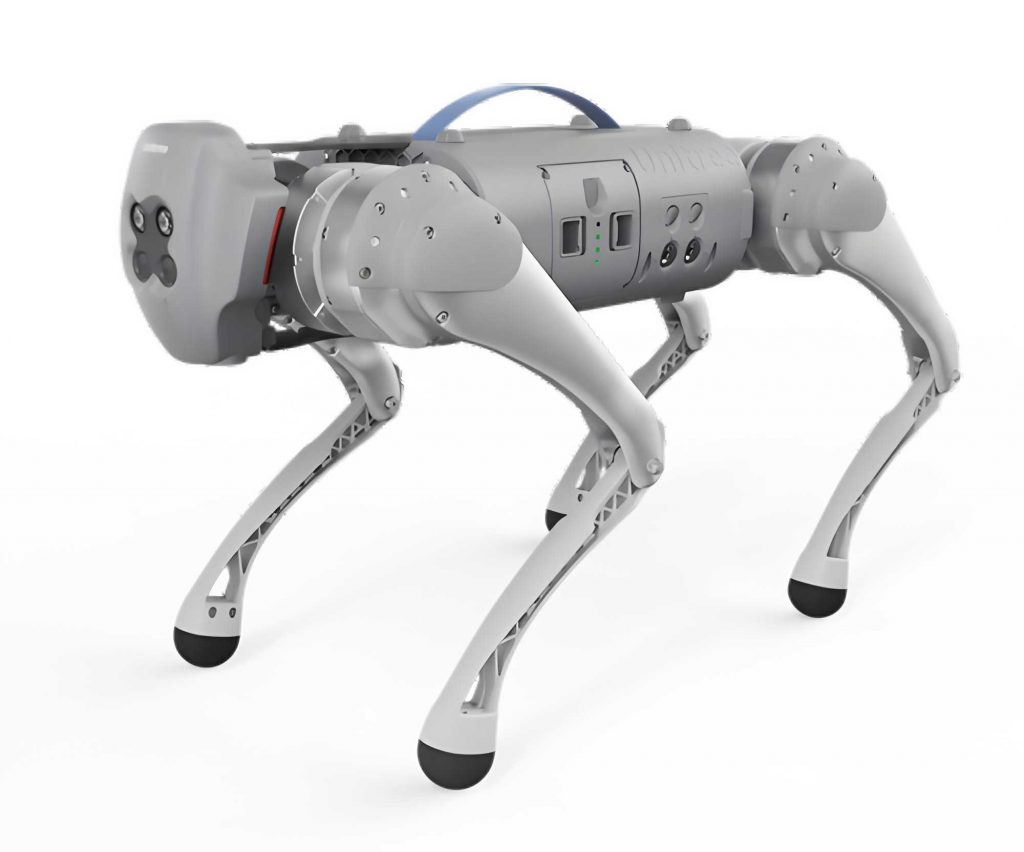
The physical prototype of the explosion-proof quadruped robot was constructed with a focus on durability and safety. Key explosion-proof components were machined from 7075 aluminum alloy and treated with hard anodizing to enhance strength. The remaining parts were made from high-carbon steel plates, known for their tensile strength, shock resistance, and impact tolerance. The legs can be folded to reduce transport dimensions, improving practicality for deployment on offshore platforms. The internal chambers and overall assembly are shown in the physical model, highlighting the integration of explosion-proof features and modular design.
Conclusion
This article has presented a comprehensive structural design for an explosion-proof quadruped robot, or robot dog, intended for inspection tasks on offshore platforms. The mechanical and control aspects were thoroughly analyzed, emphasizing the optimization of leg length for stair navigation and the incorporation of explosion-proof elements in the torso and joints. Simulation results validated the design, and a physical prototype was developed for further testing. The explosion-proof quadruped robot offers significant advantages in hazardous environments, capable of performing complex inspections while reducing risks to human personnel. By enhancing mobility and safety, this robot dog contributes to the advancement of intelligent offshore operations and sets a foundation for future innovations in robotic inspections.