
The evolution of manufacturing towards intelligent and flexible systems has significantly increased the adoption of industrial robots in multi-station production lines. However, the adaptability and operational efficiency of these systems are often constrained by their end-of-arm tooling. Traditional, fixed end effectors, with their cumbersome changeover processes and monolithic designs, struggle to meet the demands of high-mix, low-volume production characterized by frequent product changeovers. This inefficiency directly impacts overall equipment effectiveness (OEE), increases downtime, and limits the responsiveness of the manufacturing system. Therefore, addressing the structural optimization of quick-change end effectors is not merely an incremental improvement but a fundamental enabler for achieving true flexibility and intelligence in modern production cells. This article presents a comprehensive structural optimization approach for a quick-change end effector, developed from a first-person engineering perspective, aimed at resolving the critical pain points of prolonged tool change time, positional inaccuracy, and poor spatial utilization in a multi-station assembly environment.
The core value of a quick-change end effector lies in its ability to decouple the robot manipulator from a single, dedicated tool. By enabling rapid switching between specialized function modules, a single robot can perform a diverse set of tasks—such as gripping, fastening, dispensing, or inspection—within a single work cycle or across different product families. This capability drastically reduces non-value-added time associated with manual tool changes, minimizes capital expenditure on multiple dedicated robots, and enhances the overall agility of the production line. The optimized end effector system transforms the robot from a fixed-purpose machine into a versatile and reconfigurable production asset, which is essential for adapting to the volatile demands of contemporary markets.
Case Background and Problem Analysis
The development of this optimized end effector was driven by a concrete application within an automotive component manufacturing facility. The target was a three-station flexible assembly cell responsible for the handling, precise positioning, and screw fastening of small sensor housings. The cell was equipped with a six-axis industrial robot. Its original configuration utilized a combined fixed gripper and pneumatic screwdriver module, a design inherently suited for only a single product variant.
As customer demand diversified, the production line was required to handle three distinct sensor housing variants with differing geometries and fastener specifications. The limitations of the original end effector became starkly apparent. Each product changeover necessitated a manual replacement of the entire end effector assembly, a process that consumed approximately 18.2 minutes of critical production time. The manual disconnection and reconnection of pneumatic and electrical lines, followed by the mechanical remounting and tedious teaching of a new Tool Center Point (TCP), were the primary contributors to this extensive downtime. Furthermore, the repeated mechanical disassembly and reassembly led to cumulative errors in the TCP calibration, manifesting as inconsistent part placement and compromised assembly quality. The existing quick-change interface, a simple pin-and-latch mechanism, suffered from insufficient rigidity. During high-speed fastening operations, this resulted in perceptible micro-vibrations and angular deflection, which destabilized torque transmission and led to inconsistent clamp load. This directly contributed to an elevated assembly defect rate. An analysis of the cell layout also revealed suboptimal space utilization, estimated at only 62%, due to the bulky, non-integrated nature of the tooling and its support systems. A summary of the identified problems is presented in the table below.
| Problem Category | Specific Issue | Measured Impact |
|---|---|---|
| Changeover Efficiency | Manual tool change process | ~18.2 minutes downtime per change |
| Positional Accuracy | Cumulative TCP error from re-mounting | Repeatability > ±0.2 mm |
| Operational Stability | Low interface rigidity causing vibration | High torque scatter (CV > 12%) |
| Quality | Inconsistent part placement and fastening | Assembly defect rate of 2.73% |
| Space Utilization | Bulky, non-integrated tool modules | Only 62% of envelope space used effectively |
Comprehensive Structural Optimization Design
To systematically address these challenges, a holistic optimization strategy was conceived, focusing on three core subsystems: the connection interface, the functional execution modules, and the drive and control units. The overarching philosophy was to achieve maximum modularity, high rigidity, and rapid, reliable switching through integrated mechanical, pneumatic, and electrical design.
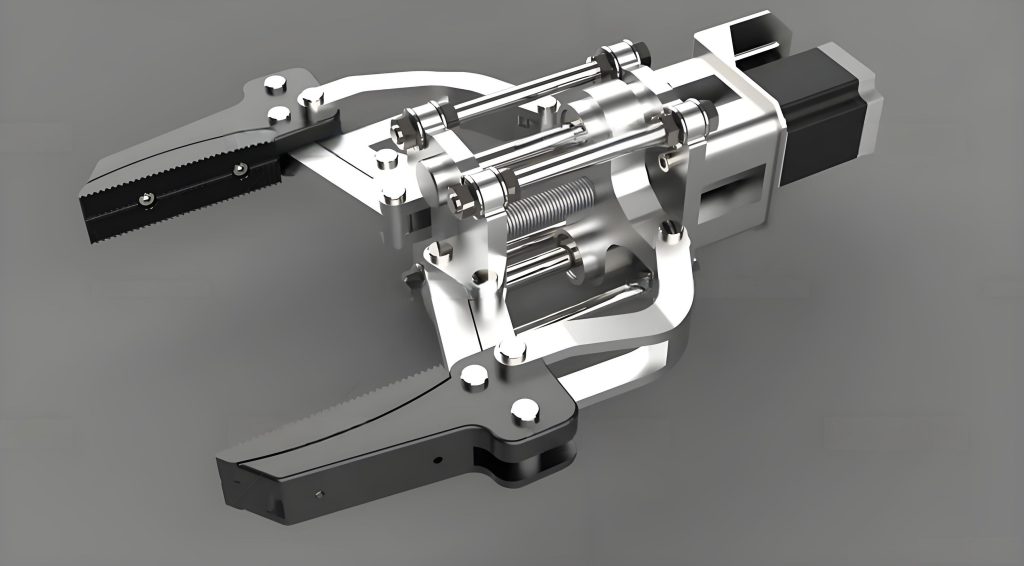
The architectural blueprint for the optimized quick-change end effector system is founded on a layered approach. At its base is the Connection Component, whose sole purpose is to provide a rigid, precise, and fast kinematic coupling between the robot flange and any attached tool module. This component incorporates a self-centering tapered interface and an active locking mechanism. The Execution Component comprises the suite of modular tool heads—each a self-contained unit (gripper, screwdriver, vision probe) performing a specific task. Finally, the Drive Component consists of the localized actuators (miniature valves, motors) and controllers embedded within or immediately serving each execution module, ensuring swift and independent control. This modular partition allows for the independent optimization of each layer while guaranteeing seamless interoperability.
Optimization of the Connection Component
The connection interface is the most critical element governing the performance of the entire quick-change end effector system. It must ensure repeatable sub-millimeter positioning accuracy and withstand operational loads without deflecting. The original pin-latch mechanism was wholly inadequate. The new design centers on a tapered self-centering coupling. The primary mating surfaces feature a 1:10 taper ratio. This geometry ensures that as the male and female cones engage, any radial misalignment is automatically corrected, achieving micron-level concentricity. The material selected for these critical interfacing parts was 7075-T6 aluminum alloy, chosen for its excellent strength-to-weight ratio. The surfaces were hard-anodized to significantly enhance wear resistance and durability over thousands of mating cycles.
The locking mechanism was re-engineered as a pneumatically actuated double-inclined wedge system. Upon receiving a signal from the master PLC, a compact pneumatic cylinder drives a pair of opposing wedges. These wedges engage with a matching groove in the tool-side adapter, generating a substantial radial clamping force that locks the taper interface securely. The system operates at a standard shop air pressure of 0.5 MPa. The locking stroke was analytically determined to be 2.8 mm, calculated to provide sufficient normal force at the taper interface to transmit a maximum torque of 15 N·m without slippage or angular play. The relationship between the pneumatic force $F_{pneu}$, the wedge angle $\alpha$, and the resulting normal force $F_{normal}$ on the taper can be expressed as:
$$ F_{normal} = \frac{F_{pneu}}{2 \cdot \tan(\alpha)} \cdot \eta $$
where $\eta$ represents the mechanical efficiency of the wedge system. This design guarantees a rigid connection that is both quickly established and released, forming the bedrock for precise and stable operation of any attached end effector module.
Optimization of the Execution Component
The execution component embodies the principle of modularity. Instead of a single, multi-function tool, we developed a family of compact, single-purpose modules that share a common connection footprint. Three primary modules were engineered for the sensor assembly cell:
- Pneumatic Parallel Gripper Module: Designed for part handling, with a stroke of 20 mm and an adjustable gripping force range of 15–60 N.
- Electric Screwdriver Module: Equipped with a brushless DC motor and planetary gearbox for precise fastening, offering a programmable output torque range of 0.3–3.0 N·m and speeds up to 3,000 rpm.
- Vision Guidance Probe Module: A compact camera with integrated lighting, providing a resolution of 0.02 mm/pixel and a 45-degree field of view for part location verification.
A key to rapid changeover is standardization. All modules were designed with a unified mechanical interface—an M8 threaded port for the pneumatic/electric screwdriver and a precision-machined flat for the vision probe, both ensuring a direct and stable mount to the connection component. Similarly, all electrical and pneumatic connections were implemented via industry-standard quick-disconnect plugs. The layout and mass properties of each module were carefully optimized to minimize the shift in the system’s center of gravity and moment of inertia when swapped, keeping TCP dynamic compensation requirements manageable for the robot controller. The following table summarizes the key parameters of the modular end effector set.
| End Effector Module Type | Dimensions (L×W×H, mm) | Mass (g) | Primary Interface Standard |
|---|---|---|---|
| Pneumatic Parallel Gripper | 68 × 45 × 32 | 280 | M8 Mount, 4mm Pneumatic Quick-Plug |
| Electric Screwdriver | 70 × 47 × 35 | 310 | M8 Mount, M12 8-pin Electrical Connector (Power+CAN) |
| Vision Guidance Probe | 65 × 42 × 30 | 250 | Precision Mounting Face, M12 5-pin Connector (Power+Ethernet) |
Optimization of the Drive and Control Component
The drive system required a paradigm shift from centralized, slow-responding manifolds to localized, high-speed actuation. For the pneumatic gripper module, the goal was to complete an open-close cycle within 0.5 seconds. The required minimum volumetric airflow $Q_{min}$ was calculated based on the cylinder’s effective area $A$ (120 mm²) and stroke $s$ (15 mm):
$$ Q_{min} = \frac{A \cdot s}{t} = \frac{120 \, \text{mm}^2 \cdot 15 \, \text{mm}}{0.5 \, \text{s}} = 3600 \, \text{mm}^3/\text{s} $$
This calculation informed the selection of a miniature direct-acting solenoid valve with a 2 mm orifice and a flow capacity of 4,200 mm³/s, mounted directly on the gripper module itself to minimize air volume and latency.
For the electric screwdriver end effector, precise torque and speed control were paramount. A 24V brushless DC (BLDC) motor was selected for its high efficiency, low maintenance, and excellent controllability. Paired with a precision planetary gearhead, it delivers the required torque spectrum. The motor is driven by a compact integrated controller that communicates over a CANopen network. This allows the central robot controller or PLC to send target torque and speed commands digitally, enabling sophisticated fastening profiles (e.g., ramp-up, snug, and angle-controlled tightening). The specifications of the key drive components are consolidated below.
| Drive Module | Operating Voltage | Key Performance Parameter | Control & Communication |
|---|---|---|---|
| Pneumatic Valve Pack (per Gripper) | 24 V DC | Flow: 4,200 mm³/s, Response Time < 10 ms | Digital I/O from PLC |
| BLDC Motor Drive (Screwdriver) | 24 V DC | Continuous Power: 24 W, Max Speed: 3,000 rpm | CANopen for torque/speed/position control |
Performance Validation and Experimental Testing
To quantitatively validate the optimization, a rigorous comparative test protocol was executed within the three-station assembly cell. The independent variable was the end effector system: the original fixed configuration versus the newly optimized quick-change end effector. The dependent variables were the five critical performance metrics: tool change time, repeat positioning accuracy, fastening torque consistency, assembly defect rate, and spatial utilization. The tests were conducted under controlled environmental conditions (22°C ± 2°C, 45% ± 5% RH) using identical robot programs and workpiece batches to ensure a fair comparison.
Experimental Methodology
The testing sequence involved a systematic procedure. First, the robot and both end effector systems were calibrated to a common reference frame. For the changeover time test, 30 consecutive tool change cycles were timed for each system—simulating a complete switch from a gripper end effector to a screwdriver end effector, including all mechanical, pneumatic, and electrical reconnections, and TCP validation. For positional accuracy, the robot was programmed to move to a fixed point in space 50 times with each tool attached; the deviation of the actual TCP from the taught position was recorded using a laser tracker. Torque consistency was measured by performing 100 screw fastening operations on a calibrated torque sensor and calculating the coefficient of variation (CV). Assembly defect rates were tracked over a production run of 500 sensor units for each system. Spatial utilization was calculated as the ratio of the volume occupied by the active tooling and its necessary utilities to the total designated work envelope volume of the robot station.
Analysis of Results
The experimental data conclusively demonstrated the superiority of the optimized quick-change end effector design across all measured parameters. The results are presented in the comparative table below.
| Performance Metric | Original Fixed End Effector | Optimized Quick-Change End Effector | Improvement / Achievement |
|---|---|---|---|
| Module Change Time | 18.2 ± 1.5 min | 1.7 ± 0.2 min | ~90.7% reduction, surpassing the <2.0 min target. |
| Repeat Positioning Accuracy (±mm) | ±0.247 | ±0.043 | Significant enhancement, exceeding the ±0.050 mm target. |
| Fastening Torque Coefficient of Variation (CV) | 12.8% | 3.2% | Marked improvement in process stability, well below the 5.0% target. |
| Assembly Defect Rate | 2.73% | 0.87% | 68.1% reduction in defects, achieving the <1.00% goal. |
| Equipment Spatial Utilization | 61.5% | 87.3% | Substantial increase in layout efficiency, above the 85.0% target. |
The drastic reduction in changeover time is directly attributable to the automated, single-action locking of the tapered interface and the quick-disconnect utilities, eliminating manual bolting and hose connections. The improvement in repeatability stems from the inherent self-alignment of the taper and the elimination of cumulative mounting errors; the robot’s TCP remains stable relative to the connection component, and each tool module is precisely located by the same interface. The superior torque consistency (lower CV) confirms that the stiffened connection provided by the wedged taper interface effectively dampens vibrations and prevents energy loss, ensuring that the commanded torque is consistently delivered to the fastener. The resultant drop in defect rate is a holistic outcome of improved positioning accuracy, stable fastening, and reduced human intervention error during changeovers. Finally, the compact, integrated design of the modular end effectors and their localized drive systems allowed for a much cleaner and denser workstation layout.
Conclusion
This structural optimization initiative for a quick-change end effector successfully tackled the fundamental limitations of traditional tooling in a multi-station flexible production environment. By re-architecting the system into a cohesive triad—a high-rigidity tapered connection interface, a family of standardized modular end effectors, and localized intelligent drive units—the project achieved transformative gains. The results confirm that a systematically designed quick-change end effector is not merely a convenience but a strategic component that dramatically enhances operational flexibility, production quality, and asset utilization. The principles of modularity, interface standardization, and localized control demonstrated here provide a scalable blueprint. Future work will focus on expanding the library of end effector modules, integrating more advanced sensors for in-process quality monitoring, and implementing machine learning algorithms to predict and schedule optimal tool change sequences dynamically, further pushing the boundaries of autonomous and flexible manufacturing.