
In modern woodworking and furniture manufacturing, the automation of material handling, such as stacking and transferring large wooden doors and panels, is critical for improving efficiency and safety. Traditional manual methods are time-consuming, costly, and risky, necessitating the development of advanced robotic systems. The end effector, as the core component of a stacking robot, plays a pivotal role in achieving stable and rapid manipulation of heavy, customized workpieces. This article presents a comprehensive design and analysis of a high-speed heavy-load stacking robot end effector, focusing on its structural configuration, mechanical characteristics, and dynamic performance under various working conditions. We will delve into the design principles, derive key mathematical models, and simulate critical scenarios to validate the end effector’s efficacy. Throughout this discussion, the term ‘end effector’ will be emphasized to underscore its importance in robotic automation.
The primary objective of this end effector is to handle large-mass, multi-specification customized wooden doors, enabling quick lifting, flipping, and stacking operations. The design integrates both form-locking and force-locking grasping principles to ensure reliability. The end effector consists of several subsystems: the main body, a vacuum adsorption unit, a positioning mechanism, and upper-lower clamping devices. Each component is meticulously engineered to withstand heavy loads and adapt to diverse workpiece dimensions. The following sections detail the structural design, mechanical analysis, pneumatic system configuration, and dynamic simulations, providing a holistic view of the end effector’s capabilities.
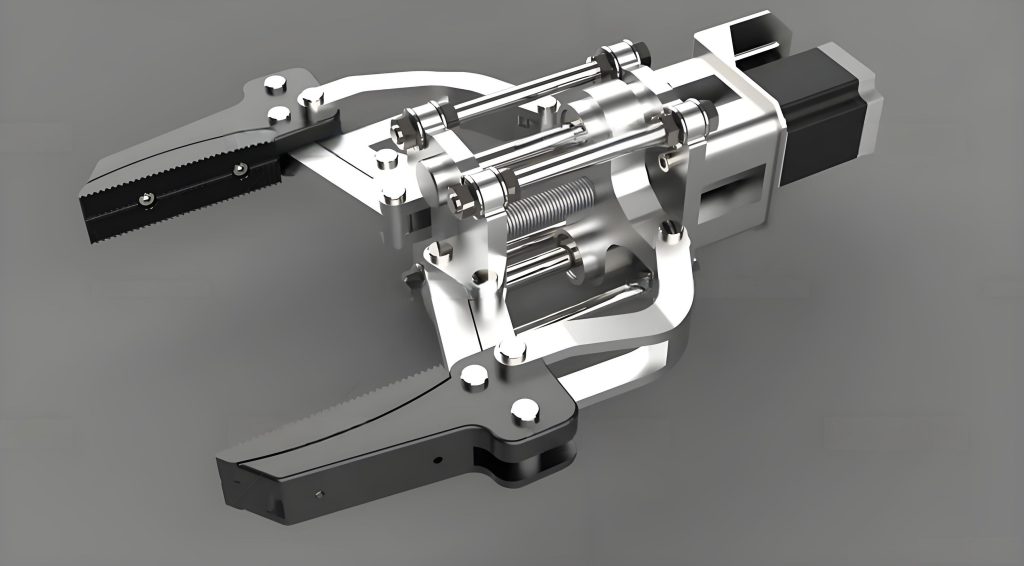
The structural scheme of the end effector is derived from the typical workflow in woodworking facilities, where wooden doors are conveyed horizontally, lifted, flipped vertically, and stacked. To avoid interference with conveyor belts, the end effector is designed to approach from above, utilizing a combination of vacuum adsorption and mechanical clamping. The three-dimensional model of the end effector illustrates its compact yet robust architecture. The main body includes connection plates, a primary board, aluminum profiles, and side plates. The positioning mechanism employs servo motors, trapezoidal screws with opposite threads, nuts, linear guides, and sliders to achieve synchronous movement of side plates. The vacuum adsorption unit uses sponge suction cups with check valves to accommodate uneven surfaces, while the upper-lower clamping devices feature jaws actuated by pneumatic cylinders via a linkage-rocker mechanism. This integrated design allows the end effector to perform multiple tasks, such as adsorption, positioning, and clamping, seamlessly.
To ensure the end effector’s performance, a detailed mechanical analysis is conducted. The vacuum adsorption part relies on sponge suction cups that conform to workpiece surfaces, creating a seal and generating adhesive force. The adsorption force \( p \) required during vertical lifting can be expressed as: $$ p = m(a_y – g) $$ where \( m \) is the mass of the workpiece, \( a_y \) is the vertical acceleration, and \( g \) is gravitational acceleration. The sponge suction cups are selected based on their working characteristics, as summarized in Table 1.
| Parameter | Value | Unit |
|---|---|---|
| Supply Pressure | 0.6 | MPa |
| Maximum Vacuum Flow | 1410 | NL/min |
| Air Consumption | 460 | NL/min |
| Theoretical Maximum Suction Force | 694 | N |
The positioning mechanism uses trapezoidal screw drives to move side plates inward. The positioning time \( t \) is given by: $$ t = \frac{S_1 – S_2}{2 n p_a} $$ where \( S_1 \) is the initial distance between side plates, \( S_2 \) is the door width, \( n \) is the motor speed, and \( p_a \) is the screw pitch. The friction resistance \( F_q \) during positioning is: $$ F_q = 2 \mu G_2 $$ with \( \mu \) as the friction coefficient and \( G_2 \) as the weight of the side plates. The torque \( T_1 \) required to drive the screw is: $$ T_1 = \frac{d_2 F_q \cos \lambda \sin(\rho + \lambda)}{2 \cos \rho} $$ where \( d_2 \) is the screw’s pitch diameter, \( \lambda \) is the lead angle, and \( \rho \) is the friction angle. The transmission efficiency \( \eta \) of the screw is: $$ \eta = \frac{\tan \lambda}{\tan(\lambda + \rho)} $$ This efficiency peaks when the lead angle is around 45°, optimizing the end effector’s energy usage.
The upper-lower clamping mechanism is a critical part of the end effector, ensuring secure grip during manipulation. Based on linkage mechanism evolution, the jaw design employs a slider-link-rocker configuration. The relationship between the jaw rotation angle \( \beta \) and the piston displacement \( x \) is derived as: $$ x = -\sqrt{l_2^2 – (H – l_3 \sin \beta)^2} – l_3 \cos \beta $$ where \( l_2 \) is the link length, \( l_3 \) is the rocker length, and \( H \) is the vertical distance. By optimizing for minimal transmission angle \( \gamma \), the ideal dimensions are determined: \( l_2 = 31 \, \text{mm} \), \( l_3 = 27 \, \text{mm} \), and \( \gamma = 26.5^\circ \). The jaw’s angular velocity \( \omega \) relative to piston velocity \( v \) is: $$ \omega = v k $$ with \( k \) as a coefficient that varies with \( \beta \). Analysis shows that when \( \beta = 180^\circ \), \( k = 0 \), minimizing impact torque on the workpiece. The clamping torque \( M_0 \) around the pivot point is: $$ M_0 = F l_3 \frac{\sin(\beta – \gamma + \delta)}{\cos(\gamma – \delta) + f_s \sin(\gamma – \delta)} $$ where \( F \) is the cylinder output force, \( \delta \) is the equivalent friction angle, and \( f_s \) is the static friction coefficient. This equation demonstrates that increasing the jaw lever arm enhances clamping force, making the end effector suitable for heavy loads. Table 2 lists cylinder output forces under different pressures.
| Supply Pressure (MPa) | Theoretical Output Force (N) | Actual Output Force (N) |
|---|---|---|
| 0.3 | 1507 | 1281 |
| 0.4 | 2010 | 1709 |
| 0.5 | 2512 | 2135 |
| 0.6 | 3014 | 2562 |
| 0.7 | 3516 | 2989 |
| 0.8 | 4019 | 3416 |
The pneumatic system of the end effector is designed for reliability and synchronization. It includes air sources, filters, pressure regulators, vacuum generators, and solenoid valves. The vacuum adsorption circuit independently controls two sponge suction cups, while the cylinder synchronization circuit uses parallel connections and exhaust throttling to ensure uniform motion of multiple cylinders. This configuration allows the end effector to perform sequential operations: first, vacuum adsorption lifts the door; then, side plates position and pre-tighten; finally, jaws clamp the upper and lower edges. The pneumatic circuit’s efficiency directly impacts the end effector’s speed and stability.
Handling工况 analysis is essential to understand the end effector’s behavior during different phases. During adsorption lifting, the vacuum force balances the workpiece weight and inertia. In side clamping, additional forces from side plates and jaws contribute to stability. For horizontal搬运, the workpiece moves along a circular path, experiencing centrifugal and tangential forces. The dynamic equations are derived for each phase. In horizontal motion, the forces in \( x \), \( y \), and \( z \) directions are balanced by frictional and clamping forces. Specifically, the equilibrium equations are: $$ \sum F_x = F_{\mu1} + F_{\mu2} + F_{\mu3} – F_t = 0 $$ $$ \sum F_y = F_a + F_{\mu1} + F_{\mu3} – F_a – F_z = 0 $$ $$ \sum F_z = p + F_{\mu2} + F_N – F_{RN} – mg = 0 $$ where \( F_t \) is tangential force, \( F_z \) is centrifugal force, and other terms represent frictional and normal forces. During flipping搬运, the workpiece transitions to vertical orientation, altering force distributions. The equilibrium conditions adapt accordingly, ensuring the end effector maintains grip. These analyses validate that the end effector can withstand inertial effects during rapid movements.
To further evaluate the end effector, dynamic simulations are performed using ADAMS software. The model includes the robot and end effector, with a workpiece mass of 2000 N. Drive functions are applied to robot axes to simulate lifting, horizontal搬运, and flipping搬运. Simulation results provide insights into clamping force variations under heavy loads. In horizontal搬运, jaw clamping forces peak during acceleration phases, with Jaw 3 experiencing the maximum force of 2630 N and Jaw 1 the minimum of 2250 N. The workpiece acceleration reaches 4.25 m/s², causing force spikes at state transitions. In flipping搬运, additional force fluctuations occur at the 4-second mark due to orientation change, and acceleration jitters at the end lead to clamping force oscillations. These simulations confirm that the end effector design effectively manages dynamic loads, though optimization may be needed to smooth force transitions. Tables 3 and 4 summarize key simulation results.
| Time (s) | Workpiece Velocity (m/s) | Workpiece Acceleration (m/s²) |
|---|---|---|
| 0-1 | 0-1.5 | 0-2.0 |
| 3-4 | 2.5-3.75 | 2.0-4.25 |
| 5.5-6 | 3.75-0 | -4.25-0 |
| Jaw Number | Maximum Clamping Force in Horizontal搬运 (N) | Maximum Clamping Force in Flipping搬运 (N) |
|---|---|---|
| 1 | 2250 | 2400 |
| 2 | 2500 | 2600 |
| 3 | 2630 | 2700 |
| 4 | 2550 | 2650 |
The design and analysis of this end effector demonstrate its capability for high-speed heavy-load stacking. By combining vacuum adsorption and mechanical clamping, the end effector adapts to multi-specification workpieces. Mechanical models for positioning and clamping reveal optimal parameters, such as screw lead angles and linkage dimensions. The pneumatic system ensures synchronized operations, while dynamic simulations validate performance under realistic conditions. Future work could focus on material optimization, control algorithms, and real-world testing to further enhance the end effector’s reliability. In conclusion, this end effector represents a significant advancement in robotic automation for woodworking industries, offering a robust solution for challenging handling tasks.
Throughout this study, the importance of the end effector in robotic systems has been highlighted. From structural design to力学 analysis, every aspect contributes to the overall functionality. The derived formulas, such as those for adsorption force and clamping torque, provide a foundation for further research. As automation demands grow, continued innovation in end effector technology will be crucial. This work serves as a comprehensive reference for engineers and researchers developing similar systems, emphasizing the need for integrated design approaches. The end effector, as the interface between robot and workpiece, ultimately determines the success of automated handling processes.