
In this research, we explore the thermal-mechanical coupling behavior of a planetary roller screw, a high-precision transmission mechanism that converts rotary motion into linear motion. The planetary roller screw is widely used in applications requiring accuracy and reliability, such as aerospace, robotics, and industrial automation. However, under operational conditions, the planetary roller screw experiences axial loads and temperature rises due to friction, leading to deformation and contact stress that affect performance. This study aims to analyze these effects through finite element simulation, focusing on the circulating type of planetary roller screw, which features ring-grooved rollers and a reset cam for enhanced suitability in high-speed and space-constrained environments. By investigating thermal-mechanical coupling, we provide insights for optimizing the design and operation of planetary roller screws.
The structure of the circulating planetary roller screw includes a screw, rollers, a nut, a cage, and a reset cam. The rollers are arranged symmetrically around the screw axis via the cage, and they engage with both the screw and nut through threaded interfaces. Unlike standard planetary roller screws, the circulating version uses rollers without a helix angle, allowing for continuous circulation via the reset cam. This design reduces sliding friction but introduces unique thermal and mechanical interactions. For visualization, the assembly is depicted below:
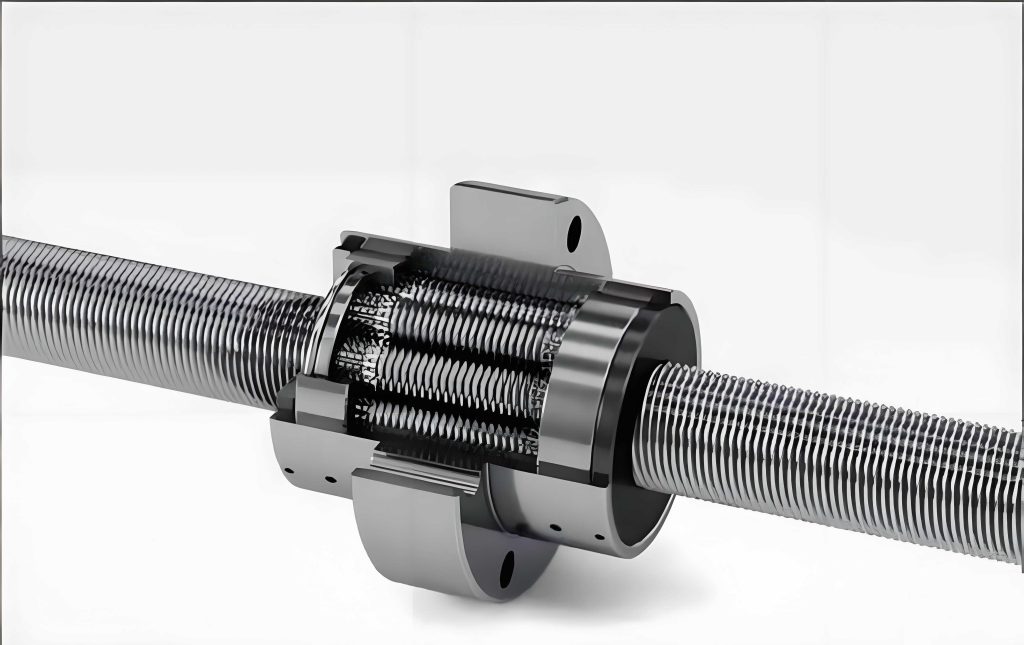
As shown, the planetary roller screw components interact closely, with heat generated primarily at the contact points between the screw and rollers and between the rollers and nut. This frictional heat arises from the combined rolling and sliding motions of the rollers, which revolve around the screw while rotating on their own axes. The resulting temperature increase causes thermal expansion and stress, complicating the mechanical response of the planetary roller screw under load.
To quantify heat transfer, we consider convective cooling between the planetary roller screw and ambient air. The heat transfer coefficient h is given by:
$$ h = \frac{\lambda N_u}{L} $$
where λ is thermal conductivity, N_u is the Nusselt number, and L is characteristic length. For a rotating screw, the Nusselt number correlates with Reynolds number Re and Prandtl number Pr:
$$ N_u = 0.133 Re^{2/3} Pr^{1/3} $$
The Reynolds number depends on rotational speed n, screw pitch diameter d_s, and air kinematic viscosity ν_f:
$$ Re = \frac{2\pi n d_s^2}{\nu_f} $$
Thermal deformation in the planetary roller screw is modeled linearly with temperature change. The axial elongation ΔL due to temperature rise ΔT is:
$$ \Delta L = f \cdot \Delta T \cdot L_s $$
Here, f is the temperature rise coefficient, and L_s is screw length. This equation highlights the direct impact of temperature on dimensional stability of the planetary roller screw.
For mechanical deformation, Hooke’s law applies under axial load F:
$$ \sigma = \frac{F}{A} $$
where σ is stress and A is cross-sectional area. Strain ε relates to stress via elastic modulus E: ε = σ/E. In the planetary roller screw, these mechanical and thermal effects couple, leading to complex behavior.
We developed a finite element model to simulate thermal-mechanical coupling in the planetary roller screw. Using UG software, we created a 3D assembly with parameters summarized in Table 1. The model was simplified by exploiting symmetry: only one-eighth of the assembly was meshed, considering eight evenly spaced rollers. Each roller included 20 thread teeth for contact analysis, and minor features like fillets were ignored to reduce computational cost.
| Component | Pitch Diameter (mm) | Number of Starts | Thread Angle (°) | Pitch (mm) | Groove Spacing (mm) |
|---|---|---|---|---|---|
| Screw | 25 | 1 | 90 | 1 | — |
| Roller | 5.5 | — | 90 | — | 1 |
| Nut | 36 | 1 | 90 | 1 | — |
Materials were assigned as GCr15 steel, with properties in Table 2. This alloy is common for planetary roller screw components due to its strength and wear resistance.
| Property | Symbol | Value | Unit |
|---|---|---|---|
| Density | ρ | 7810 | kg/m³ |
| Poisson’s Ratio | μ | 0.3 | — |
| Elastic Modulus | E | 207 | GPa |
| Thermal Conductivity | k | 36.72 | W/(m·K) |
| Thermal Expansion Coefficient | α | 13.6 × 10⁻⁶ | K⁻¹ |
| Specific Heat Capacity | c_p | 460 | J/(kg·K) |
Meshing used hexahedral elements with refinement near contact zones, resulting in approximately 600,000 nodes and 400,000 elements. Boundary conditions were set to mimic real operation: the screw’s left end was fixed; the nut’s right end received axial tensile loads; symmetric constraints applied to cut surfaces; and rollers were allowed only axial movement. Frictional contact with coefficient 0.2 defined interfaces between screw-roller and roller-nut. Thermal loads came from steady-state temperature fields computed for various working temperatures, assuming environmental temperature of 20°C.
We first analyzed mechanical-only scenarios by applying axial loads of 1000 N, 3000 N, 5000 N, 7000 N, and 9000 N. Deformation and contact stress on the screw were extracted. The deformation is predominantly axial (Z-direction), with minimal lateral shifts. Results in Table 3 show linear increases in deformation with load, while contact stress rises nonlinearly, saturating at higher loads.
| Axial Load F (N) | X-direction Deformation (×10⁻² mm) | Y-direction Deformation (×10⁻² mm) | Z-direction Deformation (×10⁻² mm) | Max Contact Stress σ_max (MPa) |
|---|---|---|---|---|
| 1000 | 0.03 | 0.0009 | 0.31 | 1219.8 |
| 3000 | 0.06 | 0.0017 | 0.91 | 2220.3 |
| 5000 | 0.08 | 0.0027 | 1.48 | 2938.5 |
| 7000 | 0.10 | 0.0038 | 2.04 | 3441.2 |
| 9000 | 0.13 | 0.0048 | 2.60 | 3912.2 |
The stress saturation indicates yielding or plastic deformation onset in the planetary roller screw at high loads. Contact stress concentration occurs near the fixed end, where constraints maximize shear.
For thermal-only analysis, we simulated temperature fields from 20°C to 140°C. Heat generation was modeled uniformly at contact areas, with convection on exposed surfaces. The temperature distribution showed gradients: contact zones reached up to 66°C at 60°C working temperature, while ends stayed cooler. Thermal stress σ_th computed via:
$$ \sigma_{th} = E \alpha \Delta T $$
peaked at constrained regions. Table 4 lists maximal thermal deformation and stress for selected temperatures.
| Working Temperature T (°C) | Temperature Rise ΔT (K) | Max Thermal Deformation (mm) | Max Thermal Stress (MPa) |
|---|---|---|---|
| 40 | 20 | 0.027 | 56.3 |
| 60 | 40 | 0.054 | 112.6 |
| 80 | 60 | 0.082 | 168.9 |
| 100 | 80 | 0.109 | 225.2 |
| 120 | 100 | 0.136 | 281.5 |
| 140 | 120 | 0.163 | 337.8 |
Thermal deformation is significant, emphasizing the need for compensation in precision planetary roller screw systems.
Thermal-mechanical coupling combines both effects. We simulated scenarios with axial loads (1000-9000 N) and working temperatures (20-140°C). The total deformation δ_total and contact stress σ_total were derived. For example, at F=5000 N and T=60°C, δ_total = 2.976×10⁻² mm and σ_total = 2954.8 MPa. Coupling results are summarized in Tables 5 and 6.
| Working Temperature T (°C) | Axial Load F=1000 N | F=3000 N | F=5000 N | F=7000 N | F=9000 N |
|---|---|---|---|---|---|
| 20 | 0.261 | 0.834 | 1.406 | 1.966 | 2.522 |
| 40 | 1.148 | 1.157 | 2.130 | 2.700 | 3.264 |
| 60 | 2.186 | 2.566 | 2.976 | 3.493 | 4.056 |
| 80 | 3.225 | 3.602 | 3.993 | 4.404 | 4.844 |
| 100 | 4.267 | 4.645 | 5.027 | 5.420 | 5.831 |
| 120 | 5.314 | 5.692 | 6.072 | 6.454 | 6.852 |
| 140 | 6.363 | 6.742 | 7.121 | 7.503 | 7.888 |
| Working Temperature T (°C) | Axial Load F=1000 N | F=3000 N | F=5000 N | F=7000 N | F=9000 N |
|---|---|---|---|---|---|
| 20 | 1183.6 | 2204.8 | 2856.9 | 3226.3 | 3641.4 |
| 40 | 1431.7 | 2372.9 | 2939.5 | 3278.5 | 3704.8 |
| 60 | 1727.0 | 2435.3 | 2954.8 | 3363.7 | 3808.2 |
| 80 | 2007.6 | 2530.4 | 2977.8 | 3417.6 | 3892.3 |
| 100 | 2303.7 | 2631.5 | 3022.7 | 3442.2 | 3920.8 |
| 120 | 2522.8 | 2741.5 | 3047.1 | 3472.7 | 3948.4 |
| 140 | 2739.1 | 2946.1 | 3134.0 | 3575.0 | 4002.2 |
Data show that deformation increases more with temperature than load, while stress is load-dominated. For instance, at F=5000 N, raising T from 20°C to 40°C increases deformation by 51.5%, but from 120°C to 140°C, only 17.3%. Stress increments diminish at higher loads: at T=60°C, increasing F from 1000 N to 3000 N boosts stress by 41%, but from 7000 N to 9000 N, only 13.2%. This nonlinearity underscores the complexity of thermal-mechanical coupling in planetary roller screws.
We further analyzed sensitivity using dimensionless parameters. Define a coupling coefficient C for the planetary roller screw:
$$ C = \frac{\delta_{total}}{\delta_{mech} + \delta_{therm}} $$
where δ_mech and δ_therm are mechanical and thermal deformations separately. Values of C > 1 indicate synergistic coupling. Our computations yield C ranging from 1.05 to 1.20, meaning coupling amplifies deformation. Similarly, for stress, an amplification factor A is:
$$ A = \frac{\sigma_{total}}{\sigma_{mech} + \sigma_{therm}} $$
with A around 1.02-1.10, showing milder coupling for stress.
The planetary roller screw’s performance depends on material choices. Table 7 compares alternatives for components, emphasizing thermal properties.
| Material | Thermal Conductivity (W/(m·K)) | Thermal Expansion Coefficient (10⁻⁶ K⁻¹) | Elastic Modulus (GPa) | Relative Suitability |
|---|---|---|---|---|
| GCr15 Steel | 36.72 | 13.6 | 207 | Standard |
| Stainless Steel 304 | 16.2 | 17.3 | 193 | Good corrosion resistance |
| Titanium Alloy Ti-6Al-4V | 6.7 | 8.6 | 114 | High temperature, lightweight |
| Aluminum Alloy 7075 | 130 | 23.1 | 71.7 | Lightweight, high conductivity |
| Tool Steel H13 | 28.6 | 11.5 | 210 | High strength, moderate thermal |
Selecting materials with low expansion coefficients, like titanium alloy, can reduce thermal deformation in planetary roller screws, but may increase cost or reduce stiffness.
Dynamic effects also matter. The planetary roller screw often operates under cyclic loads and varying temperatures. Fatigue life N_f can be estimated using stress-life approaches:
$$ N_f = \left( \frac{\sigma_a}{\sigma_f’} \right)^{-b} $$
where σ_a is stress amplitude, σ_f’ is fatigue strength coefficient, and b is exponent. Incorporating thermal cycles, the modified life equation for planetary roller screw becomes:
$$ N_{f,total} = \left( \frac{1}{N_{f,mech}} + \frac{1}{N_{f,therm}} \right)^{-1} $$
This highlights the need for durability testing under coupled conditions.
Practical implications for planetary roller screw design include preload optimization. Preload P_pre affects stiffness and heat generation. The total axial stiffness K_total of a preloaded planetary roller screw is:
$$ K_{total} = \frac{K_{mech} K_{therm}}{K_{mech} + K_{therm}} $$
where K_mech = AE/L and K_therm = AE/(L(1+αΔT)). Preload also influences contact stress via Hertzian contact theory. For a roller-screw contact, the half-width a of contact area is:
$$ a = \sqrt{\frac{4 F_n R}{\pi E^*}} $$
with F_n as normal force, R as effective radius, and E* as equivalent modulus. Maximum contact pressure p_max is:
$$ p_{max} = \frac{2 F_n}{\pi a L_c} $$
where L_c is contact length. These equations help in sizing components for desired stress levels in planetary roller screws.
Cooling strategies can mitigate thermal issues. Forced convection or internal cooling channels in the screw or nut enhance heat dissipation. The cooling efficiency η_cool is:
$$ \eta_{cool} = 1 – \frac{T_{max} – T_{amb}}{T_{gen}} $$
where T_max is maximum temperature, T_amb is ambient, and T_gen is generated temperature rise without cooling. Simulations show that with active cooling, the planetary roller screw’s temperature rise can be reduced by up to 30%, decreasing deformation proportionally.
Future research directions for planetary roller screws include transient thermal-mechanical analysis, where time-dependent heat transfer and mechanical response are coupled. The governing equations for transient coupling are:
$$ \rho c_p \frac{\partial T}{\partial t} = k \nabla^2 T + \dot{q}_{gen} $$
and
$$ \rho \frac{\partial^2 \mathbf{u}}{\partial t^2} = \nabla \cdot \mathbf{\sigma} + \mathbf{f}_{th} $$
with u as displacement vector and f_th as thermal body force. Solving these requires advanced FEA, potentially revealing dynamic instabilities in planetary roller screws.
Additionally, experimental validation is crucial. Strain gauges and thermocouples on a prototype planetary roller screw can measure deformation and temperature under load. Comparing with simulation results will refine models. Wear analysis under thermal-mechanical coupling also merits study, as friction and heat accelerate material loss.
In summary, this comprehensive study on thermal-mechanical coupling characteristics of planetary roller screws demonstrates that both axial loads and working temperatures significantly affect deformation and contact stress. Deformation is more sensitive to temperature, while stress is primarily driven by load. Coupling effects are nonlinear and amplifying, necessitating integrated design approaches. The planetary roller screw’s performance can be optimized through material selection, preload adjustment, and cooling systems. Our findings contribute to advancing the reliability and accuracy of planetary roller screws in demanding applications, and future work should focus on dynamic coupling and experimental verification to further enhance understanding of this critical mechanism.