
The evolution of intelligent manufacturing represents a pivotal shift in global industrial paradigms. Within this transformation, the humanoid robot emerges not merely as a sophisticated machine but as a quintessential embodiment of advanced artificial intelligence, precision mechanics, and embodied cognition. It stands at the confluence of multiple disruptive technologies, poised to redefine productivity, service paradigms, and human-machine interaction. The development of this industry is therefore not just an economic endeavor but a strategic imperative for nations and regions aiming to secure leadership in the next industrial revolution. This article, drawing upon extensive analysis and practical observation, argues that innovative university-local government (xiaodi) cooperation models are a critical catalyst for nurturing and accelerating the high-quality development of the humanoid robot industry. We will dissect the technological foundations, global competitive landscape, and operational mechanics of such synergistic models, proposing a structured pathway for cultivating a thriving industrial ecosystem.
The technical architecture of a humanoid robot is an intricate integration of three core modules: the Motion Control Module, the Environmental Perception Module, and the Artificial Intelligence (AI) & Human-Robot Interaction (HRI) Module. Unlike traditional robots designed for singular, repetitive tasks, a humanoid robot must operate in unstructured, human-centric environments, necessitating unprecedented levels of adaptability, dexterity, and cognitive understanding.
- Motion Control Module: This governs stability, agility, and precision in movement. Achieving human-like bipedal locomotion and complex manipulation involves solving high-dimensional, non-linear control problems under dynamic constraints. The performance can be summarized by key metrics such as the number of Degrees of Freedom (DoF), torque density of actuators, and energy efficiency. A fundamental challenge is stable trajectory planning and real-time adjustment, often modeled by complex dynamics equations.
- Environmental Perception Module: This serves as the robot’s senses, fusing data from LiDAR, cameras, depth sensors, and tactile sensors to create a coherent 3D understanding of the world. The challenge lies in real-time sensor fusion, semantic segmentation, and 3D scene reconstruction under varying lighting and occlusion conditions.
- AI & HRI Module: This is the “brain,” enabling task understanding, reasoning, and natural communication. With the advent of large foundation models, the focus has shifted towards enabling humanoid robots with embodied AI—the ability to ground language and vision in physical action. The goal is to move from pre-programmed behaviors to goal-directed learning and generalizable skill acquisition.
The convergence of these modules presents unique, interdependent challenges, as summarized in the table below.
| Challenge Category | Specific Challenge | Key Metric / Formula |
|---|---|---|
| System Integration | Co-design of hardware (actuators, structure) and software (control algorithms, AI) for optimal performance, weight, and power consumption. | Total System Cost of Transport (COT): $$ COT = \frac{P}{m \cdot g \cdot v} $$ where \(P\) is power, \(m\) is mass, \(g\) is gravity, \(v\) is velocity. |
| Embodied Intelligence | Translating high-level AI reasoning (from LLMs/VLMs) into safe, precise, and physically feasible low-level motor commands. | Task Success Rate in novel environments: $$ \text{Success Rate} = \frac{N_{\text{successful trials}}}{N_{\text{total trials}}} \times 100\% $$ |
| Safety & Robustness | Ensuring fail-safe operation in close proximity to humans, handling physical disturbances, and managing sensor/actuator failures. | Mean Time Between Critical Failures (MTBCF). Force/Torque limits for compliant interaction. |
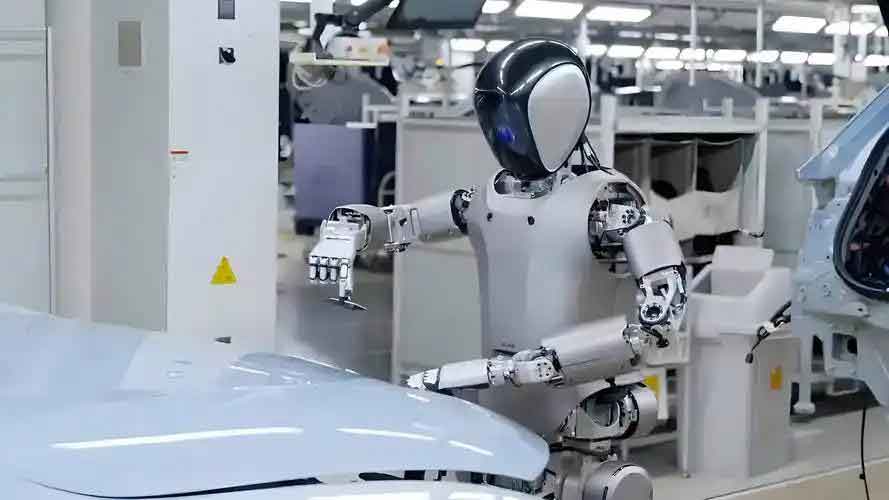
Globally, the race for humanoid robot supremacy is intensifying, characterized by distinct strategic approaches. The United States leverages its dominance in AI and venture capital, with companies like Tesla (Optimus) and Boston Dynamics (Atlas) pushing the boundaries of agility and integrated AI. Japan maintains a deep legacy in robotics, focusing on precision, reliability, and human-centric applications in care and services. The European Union emphasizes rigorous safety standards, ethical frameworks, and collaborative robotics (cobots). China has positioned the humanoid robot as a national strategic priority, launching comprehensive industrial policies aimed at achieving technological self-sufficiency and market leadership by 2027. This global landscape creates both immense pressure and opportunity for regional clusters seeking to enter or advance in this field.
The core premise of our analysis is that traditional, siloed approaches to industrial development are insufficient for the complexities of the humanoid robot sector. The required R&D spans too many disciplines, the talent is too scarce, and the innovation cycle must be too rapid. This is where the university-local government (xiaodi) cooperation model demonstrates its profound value. This model is not merely a loose partnership but a structured, strategic alliance designed to bridge the “valley of death” between fundamental research and commercialized product.
In a prototypical advanced manufacturing region we shall refer to as “P-District,” the implementation of this model has yielded instructive practices. The foundational strategy involves the co-creation of New R&D Institutions. These are not traditional university departments but agile, application-focused entities jointly funded and governed by local government and universities. Their mandate is explicit: to conduct translational research with direct pathways to commercialization for the humanoid robot supply chain, focusing on areas like high-torque density actuators, specialized robot CPUs, or advanced simulation platforms.
A second, powerful mechanism is the “Order-Based” Talent Cultivation Program. Universities collaborate directly with leading local enterprises in the automation and semiconductor sectors—industries that form the essential substrate for humanoid robot development—to design specialized curricula. Students engage in project-based learning on real-world industry challenges, ensuring a pipeline of engineers proficient not just in theory but in the practical integration of mechatronics, AI, and system design required for advanced robotics.
Furthermore, P-District has leveraged platforms like a “Science and Technology Service Alliance” to institutionalize the flow of knowledge. Regular matchmaking events, “innovation afternoon teas,” and technical roadshow sessions systematically expose academic research (e.g., novel compliant control algorithms from a university lab) to industry needs (e.g., a local manufacturer seeking to dexterous assembly robots). This constant friction between idea and application accelerates iteration. The district has also been proactive in creating testbeds and application scenarios, inviting companies and research teams to trial and refine humanoid robot prototypes in settings like smart factories, logistics hubs, and public service centers, providing invaluable real-world data.
However, the path is fraught with challenges commonly observed in such ecosystems. Even with a strong academic base, regions can suffer from a lack of flagship anchor companies in the core humanoid robot domain, limiting their pull-through effect on the broader supply chain. The industry’s value chain—encompassing core components (e.g., reducers, servo systems), ontology manufacturing, AI software, and system integration—is long and complex. A nascent cluster may find gaps, particularly in the specialized, high-performance components essential for a competitive humanoid robot. Finally, the intense global competition for top-tier robotics talent means that regions must offer more than just academic opportunities; they must build a compelling holistic ecosystem comprising competitive ventures, clear career trajectories, and a high quality of life to attract and retain the necessary expertise.
To overcome these hurdles and optimize the university-local government model for the humanoid robot age, we propose a multi-faceted strategic framework.
1. Aggregating Innovation Resources with Global Foresight: The model must look beyond local boundaries. Districts should actively utilize international forums and cooperation channels to attract global R&D centers, venture capital, and expert talent. Establishing “inverted overseas R&D outposts” for local enterprises can tap into global innovation hotspots. Simultaneously, deepening alliances with top-tier domestic universities known for robotics, aeronautics, and AI is crucial to create a dense, multi-institutional knowledge network focused on humanoid robot challenges.
2. Orchestrating Collaborative Breakthroughs in Key Technologies: The local government, in its convening role, should facilitate the formation of “innovation consortia.” These consortia would unite leading local manufacturers (e.g., from automotive, precision machinery), university research groups, and new R&D institutions to tackle specific, high-priority “bottleneck” technologies. Potential targets include:
- High-performance, low-cost joint actuators integrating motor, reducer, and driver.
- Robotic-specific AI chips for real-time motion planning and vision processing.
- Lightweight, high-strength composite materials for structural components.
- Unified robot operating systems (ROS 2.0+) with enhanced security and real-time capabilities.
The consortia should operate with clear roadmaps, shared IP frameworks, and access to public testing infrastructure.
3. Institutionalizing the Synergistic Innovation Mechanism: Success requires moving from ad-hoc projects to embedded systems. A standing inter-departmental committee (spanning science, industry, finance, and talent) should be established to ensure policy coherence and resource alignment for the humanoid robot cluster. The concept of “scenario-driven innovation” should be formalized, where the government proactively defines and opens public application scenarios (e.g., emergency response drills, hospital auxiliary services) as living labs for technology validation and public acceptance building.
4. Cultivating and Attracting a Specialized Talent Ecosystem: The “order-based” education model should be scaled and diversified, leading to the establishment of dedicated Industry-Academia Collaborative Colleges focused on intelligent manufacturing and robotics. These colleges would offer integrated Bachelor’s/Master’s programs with significant immersion in partner companies. To attract global star scientists and entrepreneurial engineers, the region must offer competitive “talent packages” that combine research grants, equity incentives in spin-offs, housing support, and streamlined administrative services for families. A “Science & Technology Mayor/Magistrate” program can be a unique asset, where faculty on assignment act as high-level bridge-builders, connecting their university’s network directly to district enterprises.
5. Fostering a Holistic and Adaptive Industrial Ecology: The ultimate goal is a self-reinforcing ecosystem. Policy should encourage the formation of venture capital funds specifically targeting robotics and AI startups. Incubators and accelerators must provide not just space but access to technical mentoring and the aforementioned component supply chains. A key performance indicator for the ecosystem’s maturity could be the “Robotic Intelligence Penetration Rate” in local manufacturing:
$$ P = \left( \frac{N_{\text{robot}}}{N_{\text{worker}}} \right) \times 100\% $$
where \(N_{\text{robot}}\) is the number of installed advanced robots (including humanoid robot prototypes in pilot lines) and \(N_{\text{worker}}\) is the number of frontline production workers. An increasing \(P\) signals successful technology adoption and diffusion.
In conclusion, the journey to establish a globally competitive humanoid robot industry is a marathon, not a sprint. It demands a long-term, systemic approach that seamlessly connects fundamental knowledge with industrial agility. The innovative university-local government cooperation model, as analyzed and refined through this framework, provides a powerful governance and operational blueprint for this endeavor. By strategically aggregating resources, orchestrating targeted R&D, institutionalizing collaboration, and relentlessly focusing on talent, regions can transform themselves from observers into active shapers of the humanoid robot future. This model does not guarantee instant success, but it builds the essential infrastructure of innovation—the trust networks, the shared goals, and the iterative learning cycles—upon which sustainable industrial leadership in the age of embodied AI will be built. The experience from forward-looking districts serves as a compelling testament that when academia and locality truly synergize, they can power not just the high-quality development of a single industry, but the re-imagination of a region’s innovative capacity for the 21st century.