
As a convergence point for artificial intelligence, mechanical engineering, integrated circuits, and new materials, the humanoid robot represents a transformative class of intelligent agents. Widely regarded as the next-generation terminal product following personal computers, smartphones, and new energy vehicles, the development of humanoid robots has ignited fierce global technological competition. Nations worldwide are implementing strategic plans to foster innovation in this domain, recognizing its potential to reshape industries and societal functions. Concurrently, a robust industrial foundation is being established, encompassing the entire chain from core components and整机 manufacturing to diverse applications.
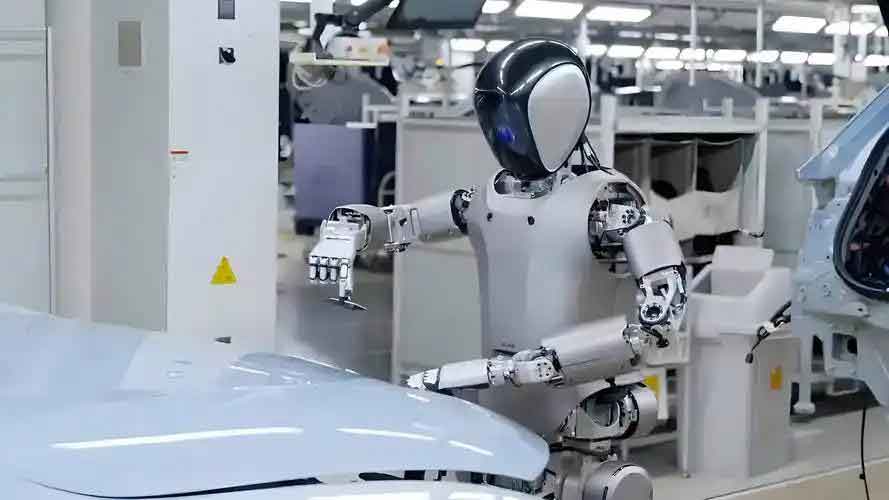
Current State of Humanoid Robot Development
The landscape for humanoid robots is characterized by rapid advancements in intelligence, converging technical pathways, a proliferation of整机 prototypes, and the initial exploration of practical applications.
1.1 Escalating Intelligence Levels
The cognitive capabilities of humanoid robots are undergoing a significant upgrade, primarily driven by advancements in multi-modal large language models (LLMs). The integration of vision, language, and action within a single model framework marks a pivotal shift from mere perception to embodied reasoning and control. This evolution enables the humanoid robot to interpret complex commands, understand contextual scenes, and generate appropriate physical actions. The progression can be summarized by key model developments that enhance a humanoid robot’s ability to learn from diverse data and perform tasks with greater autonomy and generalization.
1.2 Converging Technical Pathways
While still evolving, clearer technical roadmaps are emerging for the “brain,” “cerebellum,” and “limbs” of a humanoid robot. These pathways reflect industry consensus on effective architectures and components.
| Subsystem | Technical Pathways | Description & Trends |
|---|---|---|
| Brain (Cognition/Decision) | LLM + Visual Foundation Model; Vision-Language-Action (VLA) Model; Multi-modal LLM | Focus on integrating reasoning with perception and low-level control. The LLM-based approach is currently the most mature for task planning and interaction. |
| Cerebellum (Low-level Control) | Model-Based Control; Learning-Based Control (Reinforcement Learning, Imitation Learning) | Shift towards data-driven methods (learning-based) for adaptive and robust locomotion and manipulation in unstructured environments. |
| Limbs (Actuation) | Electric Drive (Dominant) | Electric actuation is now the mainstream, replacing hydraulic systems for better efficiency, controllability, and cleanliness. Key debates center on actuator design. |
| Key Components | Actuators: High-reduction-ratio (e.g., harmonic drive) vs. Quasi-direct-drive; Sensors: Vision, 6-axis Force/Torque | Component standardization is nascent. Actuator choice balances torque, speed, and backdrivability. Sensor suites emphasize vision and force sensing. |
The actuation force/torque for a joint in a humanoid robot can be modeled considering the motor and reducer:
$$ \tau_{\text{joint}} = k_{\text{motor}} \cdot G \cdot \eta \cdot i_{\text{motor}} $$
where $k_{\text{motor}}$ is the motor torque constant, $G$ is the gear reduction ratio, $\eta$ is the transmission efficiency, and $i_{\text{motor}}$ is the motor current. The choice between a high-$G$ or low-$G$ system fundamentally impacts the dynamic response and impedance characteristics of the humanoid robot limb.
1.3 Proliferation of整机 Platforms
The past few years have witnessed an explosion in humanoid robot整机 prototypes from leading technology corporations and agile startups globally. This surge in activity underscores the strategic importance attached to this platform. The table below contrasts several prominent platforms, highlighting the diversity in approach and capability focus.
| Developer | Platform Name | Key Characteristics / Focus |
|---|---|---|
| Tesla | Optimus (Gen 2) | Emphasis on manufacturability, cost, and integration with automotive automation processes. |
| Boston Dynamics | Atlas (Electric) | Unparalleled dynamic motion, agility, and balance, setting benchmarks in locomotion. |
| Figure AI | Figure 01 | Focus on commercial deployment in logistics, integrated with advanced AI for task execution. |
| Agility Robotics | Digit | Designed for workplace mobility and material handling, with early pilot testing in warehouses. |
| Various Chinese Startups | Walker S, GR-1, etc. | Rapid iteration, focusing on stable bipedal locomotion, manipulation, and specific application demos. |
1.4 Initial Forays into Application
The application of humanoid robots can be categorized into three broad domains, each with distinct requirements. Early pilots are primarily focused on the latter two, where economic and operational feasibility is being tested.
1. Specialized Application Scenarios: These involve hazardous or extreme environments (e.g., disaster response, deep-sea, space). The humanoid robot here is highly customized, with stringent requirements for durability, resilience, and specialized capabilities.
$$ R_{\text{specialized}} = f(\text{Robustness}, \text{Payload}_{\text{specialized}}, \text{Endurance}_{\text{extreme}}, \text{Safety}_{\text{fail-operational}}) $$
2. Manufacturing Application Scenarios: This is a primary target, aiming to automate repetitive, physically demanding, or precise tasks in factories (e.g., assembly, inspection, parts handling). The key metrics involve precision, cycle time, and integration with existing systems.
$$ \text{Throughput}_{\text{manufacturing}} = \frac{\sum \text{Successful Task Completions}}{\text{Time}} \cdot \text{Reliability}_{\text{task}} $$
3. Service Application Scenarios: Encompassing domestic, healthcare, hospitality, and retail assistance. This domain requires advanced human-robot interaction (HRI), safety in proximity to untrained users, and dexterous manipulation in cluttered environments.
$$ \text{Utility}_{\text{service}} = g(\text{HRI}_{\text{natural}}, \text{Safety}_{\text{proximal}}, \text{Task}_{\text{generalization}}, \text{Cost}_{\text{ownership}}) $$
| Scenario Category | Example Tasks | Critical Performance Metrics |
|---|---|---|
| Manufacturing | Visual Inspection, Component Assembly, Logistics Sorting | Positioning Accuracy (±mm), Mean Time Between Failures (MTBF), Task Completion Rate (%) |
| Service & Logistics | Warehouse Palletizing, Hospital Delivery, Customer Guidance | Navigation Success in Crowds, Safe Force Interaction (N), Object Recognition Accuracy (%) |
| Specialized | Nuclear Facility Inspection, Search & Rescue | Environmental Tolerance (Temp, Pressure, Radiation), Communication Latency (ms), Operational Range (m) |
The Critical Need for a Humanoid Robot Standardization Framework
The current phase of intense technological innovation and early commercialization is precisely the critical window for proactive standardization. The absence of a cohesive standard system presents significant barriers to the sustainable growth of the humanoid robot industry.
2.1 Fostering Industry Synergy and Reducing Fragmentation: The humanoid robot ecosystem currently comprises many SMEs and startups. Without common interfaces or component specifications, development is siloed, leading to redundant efforts, poor interoperability, and increased costs. A standard system acts as a coordination mechanism, enabling modular development, technology reuse, and a healthier supply chain. The economic benefit can be modeled as a reduction in redundant development cost:
$$ C_{\text{saved}} = \sum_{i=1}^{n} (C_{\text{development, i}} – C_{\text{integration, i}}) $$
where widespread adoption of standards reduces the per-company development cost $C_{\text{development}}$ towards a lower integration cost $C_{\text{integration}}$.
2.2 Ensuring Intrinsic Operational Safety: A humanoid robot is a high-degree-of-freedom system with significant mass and potential energy. Failures in control, perception, or decision-making can pose serious risks to humans and infrastructure. Standards are imperative to define safety requirements for:
• Functional Safety: Ensuring safe states under hardware/software failure (e.g., ISO 13849, IEC 61508 adapted for humanoid robots).
• Collision Safety: Defining limits on force, torque, and velocity for human-robot contact. This often involves power and force limiting (PFL) criteria, where the transferable energy upon impact must be below injury thresholds. A simplified model checks:
$$ \frac{1}{2} m_{\text{eff}} v_{\text{impact}}^2 < E_{\text{threshold}} $$
where $m_{\text{eff}}$ is the effective mass at the contact point and $v_{\text{impact}}$ is the relative velocity.
• Electrical Safety & EMC: Guaranteeing safe operation and non-interference with other electronic devices.
2.3 Mitigating Information Security and Privacy Risks: As a mobile sensor platform with cameras, microphones, and network connectivity, a humanoid robot collects vast amounts of sensitive data. Standards are required to mandate:
• Data Security: Encryption of data at rest and in transit, secure boot, and firmware update mechanisms.
• Privacy by Design: Principles for data minimization, anonymization, user consent, and local processing where possible.
• Cybersecurity: Resilience against remote hijacking, denial-of-service attacks, and data exfiltration.
Landscape of Existing Robotics Standards
Traditional robotics domains—industrial, service, and special robots—have well-established standard systems that provide a valuable foundation for humanoid robot standardization. These standards are typically structured hierarchically.
3.1 Industrial Robot Standards: Mature and comprehensive, focusing on safety (e.g., ISO 10218-1/2), performance testing (e.g., ISO 9283 for pose accuracy, path characteristics), communication (e.g., OPC UA for robotics companion specification), and specific application guidelines (e.g., for welding or painting). The emphasis is on precision, repeatability, and safety in structured environments.
3.2 Service Robot Standards: Evolving rapidly, with a stronger focus on personal care robot safety (ISO 13482), which is highly relevant for humanoid robots. These standards address safe physical interaction, emergency stop, and human-robot coexistence. Additional standards cover performance aspects like navigation, manipulation, and specific service tasks (e.g., delivery, cleaning).
3.3 Special Robot Standards: Often domain-specific, covering requirements for robots in extreme conditions (e.g., underwater, explosive atmospheres, medical applications). These provide templates for addressing environmental durability and specialized operational protocols.
The existing standards ecosystem demonstrates a successful model of layering horizontal/generic standards (safety, terminology, testing frameworks) with vertical/application-specific standards. This model is directly applicable to the humanoid robot domain.
Proposing a Framework for Humanoid Robot Standards
Constructing a standard system for humanoid robots must account for their unique attributes while learning from existing robotics frameworks. Key distinctive features include:
• Enhanced Generality: The anthropomorphic form is intended for通用性 across human-centric environments. The standard system can thus focus on a single形态, though it must accommodate diverse component implementations and application-specific profiles.
• Higher-Level Intelligence: Standards must encompass cognitive and perceptual capabilities (the “brain”), not just physical performance. This includes evaluation of task understanding, learning ability, and interactive dialogue.
• Nascent Industry Stage: Standards must be forward-looking yet pragmatic. They should strictly govern safety and security but adopt a more flexible, performance-based, or tiered approach for evolving technical capabilities like intelligence and dexterity.
Given the typically long development cycle for international standards, a pragmatic strategy involves prioritizing industry and consortium standards to address immediate needs. A proposed three-layered framework is illustrated below:
| Standard Category | Purpose & Scope | Example Standard Topics |
|---|---|---|
| Layer 1: Foundation & Generic Standards | Define common requirements, interfaces, and test methods applicable to all humanoid robots. Ensure safety, interoperability, and baseline performance. | • Terminology & Classification • Functional Safety Requirements • Mechanical/Electrical Safety • Information Security & Privacy • Electromagnetic Compatibility (EMC) • Communication/Data Interfaces • Environmental Reliability Testing • Core Component Specifications (e.g., actuator interface, sensor data format) • Intelligence Level Grading & Evaluation |
| Layer 2:整机 Performance & Capability Standards | Specify test procedures and metrics for evaluating the integrated capabilities of a humanoid robot system. | • Locomotion & Balance (Walking speed, stair climbing, stability margin) • Manipulation Performance (Grasping force, positioning accuracy, dexterity) • Perception & Perception-Action Cycle Time • Human-Robot Interaction (Speech recognition accuracy, gesture understanding) • Autonomy & Task-Level Benchmarking |
| Layer 3: Application-Specific Profiles | Tailor generic requirements and define additional performance criteria for specific use cases. Reference tests from Layer 2. | • Humanoid Robot for Light Industrial Assembly • Humanoid Robot for Logistics & Warehousing • Humanoid Robot for Domestic Assistance • Humanoid Robot for Public Guidance • Humanoid Robot for Emergency Response |
4.1 The Central Role of an Intelligence Grading Standard
A pivotal innovation within this framework is a standard for grading the intelligent capabilities of a humanoid robot. This would provide a common language for developers, users, and regulators. Grading could be multi-axis, evaluating different cognitive dimensions. A potential scoring model for a given capability axis could be:
$$ S_{\text{intelligence}} = \sum_{i} w_i \cdot f_i(\text{Task Success Rate}_i, \text{Generalization}_i, \text{Sample Efficiency}_i) $$
where $w_i$ are weights for different task families, and $f_i$ is a function evaluating performance, generalization to unseen scenarios, and the data/training required to achieve it. A simplified grading table might look like:
| Grade | Description – Cognitive & Interactive Ability | Description – Autonomy & Learning |
|---|---|---|
| Level 0: Scripted | Executes pre-programmed sequences only. No environmental adaptation or understanding. | No learning capability. All behaviors manually coded. |
| Level 1: Reactive | Responds to simple, pre-defined sensory triggers (e.g., obstacle stop). Limited command understanding. | May use parameter tuning or basic policy updates from demonstration. |
| Level 2: Context-Aware | Understands multi-step natural language commands within a defined context. Recognizes objects and basic scenes. | Can learn new object manipulations or navigation goals from a modest number of demonstrations (imitation learning). |
| Level 3: Adaptive & Reasoning | Engages in multi-turn dialogue to clarify tasks. Reasons about object affordances and sub-goals in novel situations. | Can use reinforcement learning or model-based reasoning to adapt strategies in unstructured environments. |
| Level 4: Autonomous Learning | Proactively learns from long-term interaction and environmental exploration. Can formulate and execute plans for complex, abstract goals. | Exhibits meta-learning and continual learning, significantly reducing required human supervision for new tasks. |
4.2 Standardizing Core Components and Interfaces
To avoid vendor lock-in and spur innovation, standardizing interfaces for key subsystems is crucial. This does not mandate a specific technology but defines how components communicate and integrate. For example:
• Actuator Module Interface: Standardizing communication protocols (e.g., CAN FD, EtherCAT), command set (position, velocity, torque, impedance modes), and feedback data (position, current, temperature, fault codes) for joint modules. This allows a humanoid robot designer to source actuators from different vendors interchangeably.
• Perception Data Format: Defining common data structures and coordinate frames for point clouds, RGB-D images, and fused sensor data. This simplifies the integration of different sensor suites and perception algorithms.
• Software Middleware: Promoting the use of standardized middleware frameworks (like ROS 2) with defined message types for humanoid robot-specific data (e.g., whole-body state, gait parameters).
Conclusion
The trajectory of humanoid robot development is unmistakably pointing towards a future where they become integral partners in industrial production, healthcare, domestic life, and beyond. Their potential to enhance efficiency, safety, and quality of life is profound. However, realizing this potential in a safe, reliable, and economically viable manner hinges on the timely establishment of a coherent and comprehensive standard system. Such a framework is not a constraint on innovation but rather its enabler—it builds trust, ensures safety, fosters a collaborative ecosystem, and provides clear benchmarks for technological progress. By proactively developing standards that address the unique challenges of generality, intelligence, and safety in humanoid robots, we can steer this transformative technology toward a future of responsible and widespread benefit. The work to define these foundational standards is not merely an academic exercise; it is an essential investment in shaping the technological landscape of the coming decades.