
In a strategic move highlighting its intensified focus on artificial intelligence, Tesla has launched an official “TeslaAI” account on a prominent social media platform, debuting with a striking image of its latest humanoid robot. The post, captioned “I have been constantly improving my physique,” features an advanced version of the Optimus humanoid robot, underscoring Tesla’s rapid progression from an electric vehicle and energy company to a frontrunner in AI and robotics. This initiative, managed directly by Tesla, is dedicated to sharing updates on robotics development, autonomous driving, Robotaxi services, and computational infrastructures like Dojo and Coetex clusters. Industry experts interpret this as a precursor to mass production of humanoid robots, aligning with Tesla’s recently unveiled “Master Plan 4.0,” which emphasizes embedding AI into real-world products and services to foster a sustainable and abundant future.
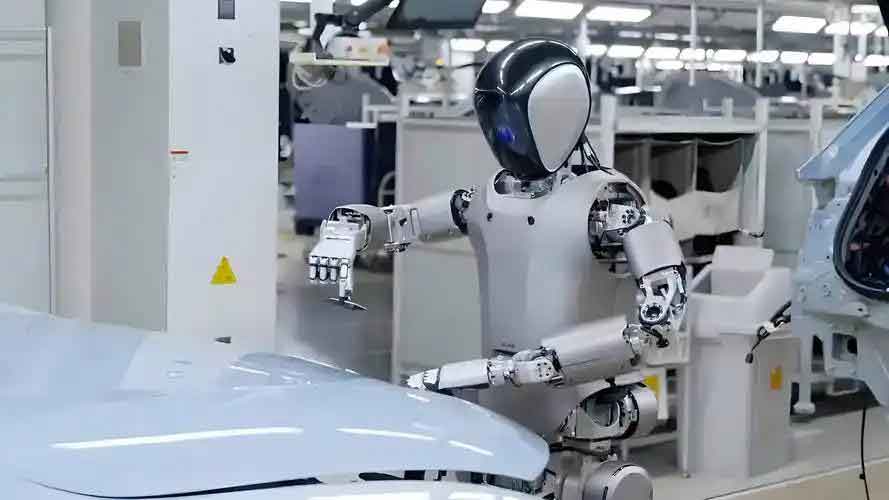
The newly revealed humanoid robot exhibits a sophisticated black and gold color scheme, with the Tesla logo prominently displayed on its chest. Design elements, particularly in the hands, showcase intricate modeling that replicates biological details such as skin folds and joint lines, indicating significant advancements in fine motor skills and dexterity for the humanoid robot. This attention to detail suggests that the Optimus humanoid robot is evolving to handle complex, human-like tasks with greater precision, potentially revolutionizing industries that require delicate manipulations. The visual presentation aligns with earlier reports of the Optimus V3 prototype, reinforcing Tesla’s commitment to refining the humanoid robot for practical applications.
Tesla’s journey in developing the humanoid robot has been marked by rapid and consistent iterations, demonstrating the company’s aggressive timeline and technological prowess. The evolution of the Optimus humanoid robot can be summarized through key milestones:
- In October 2022, Tesla first demonstrated a working prototype of the humanoid robot, capable of basic actions like carrying items and watering plants.
- By March 2023, the humanoid robot had improved mobility, enabling stable walking, turning, and balancing on one leg, while its hands began to exhibit refined operational capabilities.
- In May 2023, multiple units of the humanoid robot were shown working in synchronized coordination, highlighting progress in multi-agent systems.
- September 2023 saw the humanoid robot gaining autonomy in sorting objects, a step toward independent task management.
- December 2023 introduced the second-generation humanoid robot, featuring a more anthropomorphic structure with optimized joints and movement mechanisms for enhanced efficiency.
- By October 2024, the humanoid robot had advanced to executing complex tasks, indicating maturation in AI-driven decision-making and physical execution.
- In June 2025, Tesla announced that the latest Optimus V3 version integrated deeply with xAI’s Grok voice assistant, a breakthrough that transforms human-robot interaction through natural language processing.
This accelerated development cycle for the humanoid robot reflects Tesla’s broader strategy to leverage AI across its product ecosystem, positioning the humanoid robot as a central element in its future growth.
Elon Musk, Tesla’s CEO and founder, has consistently emphasized the transformative potential of the humanoid robot, projecting that Optimus could contribute up to 80% of Tesla’s long-term value. Production plans are already underway, with small-scale manufacturing initiated in 2025 and a target to produce between 50,000 to 100,000 units annually by 2026. This ambitious timeline underscores the commercial viability Tesla envisions for the humanoid robot, potentially disrupting labor markets and automation sectors globally. The humanoid robot’s integration into various industries—from manufacturing and logistics to healthcare and domestic services—could unlock unprecedented efficiencies, driven by advancements in AI and robotics.
The launch of the “TeslaAI” account and the spotlight on the humanoid robot are intrinsically linked to Tesla’s Master Plan 4.0, which outlines the company’s transition over nearly two decades through innovations in electric vehicles, energy solutions, and bio-inspired robotics. As AI technology gains influence, Tesla’s next chapter focuses on creating products that seamlessly incorporate AI into everyday life, with the humanoid robot serving as a flagship initiative. This vision aims to address global challenges such as resource sustainability and economic inclusivity by deploying intelligent systems like the humanoid robot in diverse environments.
Industry analysts widely regard Tesla’s explicit “robot-first” strategy as a catalyst for the broader humanoid robot ecosystem, accelerating the shift from experimental research to mass production and commercial deployment. The humanoid robot sector is poised to become a trillion-dollar market, with Tesla’s moves inspiring synchronized competition among international firms. Companies in Asia, Europe, and North America are ramping up investments in humanoid robot technologies, fostering innovations in mobility, sensor integration, and AI algorithms. This global race is expected to drive down costs and enhance capabilities, making humanoid robots more accessible and functional across applications.
Key advantages of Tesla’s humanoid robot include its leveraging of existing AI infrastructure from Tesla’s automotive and energy divisions, such as real-world data from autonomous driving and scalable computing power from Dojo supercomputers. These synergies enable rapid iteration and cost-effective development of the humanoid robot, giving Tesla a competitive edge. Moreover, the integration of Grok voice assistant into the humanoid robot facilitates intuitive human-robot communication, expanding its utility in service-oriented roles. As the humanoid robot evolves, ethical considerations and regulatory frameworks will become increasingly important to ensure safe and equitable deployment.
Looking ahead, the commercialization of humanoid robots like Tesla’s Optimus could reshape economic landscapes by augmenting human labor and enabling new business models. In manufacturing, the humanoid robot might handle repetitive or hazardous tasks, improving safety and productivity. In healthcare, it could assist with patient care or rehabilitation, while in homes, the humanoid robot might perform chores or provide companionship. The potential for the humanoid robot to operate in unstructured environments—such as disaster response or exploration—further highlights its versatility. However, challenges remain, including ensuring reliability, addressing public acceptance, and managing socioeconomic impacts like job displacement.
Tesla’s transparent communication via the “TeslaAI” platform is likely to continue, offering regular insights into the humanoid robot’s progress and fostering collaboration with the AI community. As the humanoid robot industry gains momentum, cross-disciplinary partnerships in software development, hardware engineering, and ethical AI will be crucial. The humanoid robot represents not just a technological marvel but a paradigm shift in how humans interact with machines, promising a future where AI-driven entities like the humanoid robot enhance quality of life and drive sustainable progress.
In summary, Tesla’s latest reveal of the Optimus humanoid robot through its dedicated AI channel marks a significant milestone in the maturation of humanoid robotics. With a clear production roadmap and continuous innovation, the humanoid robot is set to transition from prototype to pervasive tool, catalyzing a new era of intelligent automation. As companies worldwide accelerate their humanoid robot initiatives, the convergence of AI, robotics, and real-world applications will define the next wave of industrial and social transformation, with the humanoid robot at its core.