
The emergence and advancement of the bionic robot represent a fascinating convergence of biology and engineering. My research and observations in this field have led me to conclude that the developmental trajectory of these machines is undergoing a fundamental shift. Historically, progress was primarily driven by advancements in materials science and mechanical design. However, the current paradigm is increasingly defined by the symbiosis of two powerful technological forces: Artificial Intelligence (AI), which acts as the cognitive core, and modern communication networks, which serve as the vital nervous system. The advent of the 5G era, widely recognized as commencing around 2019, marks a pivotal moment. This is not merely an incremental upgrade in speed; it is the catalyst for a transformative phase where bionic robot capabilities, particularly in real-time remote operation and sophisticated multi-agent collaboration, are being radically enhanced. This essay, from my perspective, delves into the current state, challenges, and future prospects of bionic robot development within this new 5G communication network epoch, emphasizing the pivotal role of connectivity in unlocking their full potential.
The conceptual foundation of a bionic robot is elegantly simple: it is a machine that mimics the form, movement, or functionality of biological entities found in nature. This mimicry is not for mere spectacle but for achieving superior adaptability in challenging environments. Based on their inspiration and operational domain, bionic robot systems can be categorized as shown in the table below:
| Classification Basis | Category | Description & Examples |
|---|---|---|
| Biological Model | Humanoid Robot | Mimics human morphology and bipedal locomotion (e.g., ASIMO, Atlas). |
| Biomimetic Robot | Mimics non-human animals (e.g., robotic fish, bird-like drones, snake robots). | |
| Bio-hybrid Robot | Integrates living biological tissues with artificial components. | |
| Operational Environment | Aquatic Bionic Robot | Designed for underwater exploration, inspired by fish, rays, or cephalopods. |
| Aerial Bionic Robot | Inspired by birds or insects for flight (flapping-wing drones). | |
| Terrestrial Bionic Robot | Operates on ground, inspired by legs of humans, dogs, or reptiles. |
If AI provides the “brain,” enabling perception and decision-making, then 5G constitutes the “lifeblood” and “central nervous system.” Its ultra-reliable low-latency communication (URLLC), enhanced mobile broadband (eMBB), and massive machine-type communications (mMTC) are the key properties that facilitate a qualitative leap in a bionic robot‘s sensory feedback and coordinative abilities. A landmark demonstration occurred in 2019, where a domestically developed bionic robot utilizing 5G technology showcased real-time human motion replication through a glove controller, achieving seamless human-robot collaboration. This was a clear signal that the era of isolated, pre-programmed machines was giving way to an era of networked, responsive bionic robot agents.
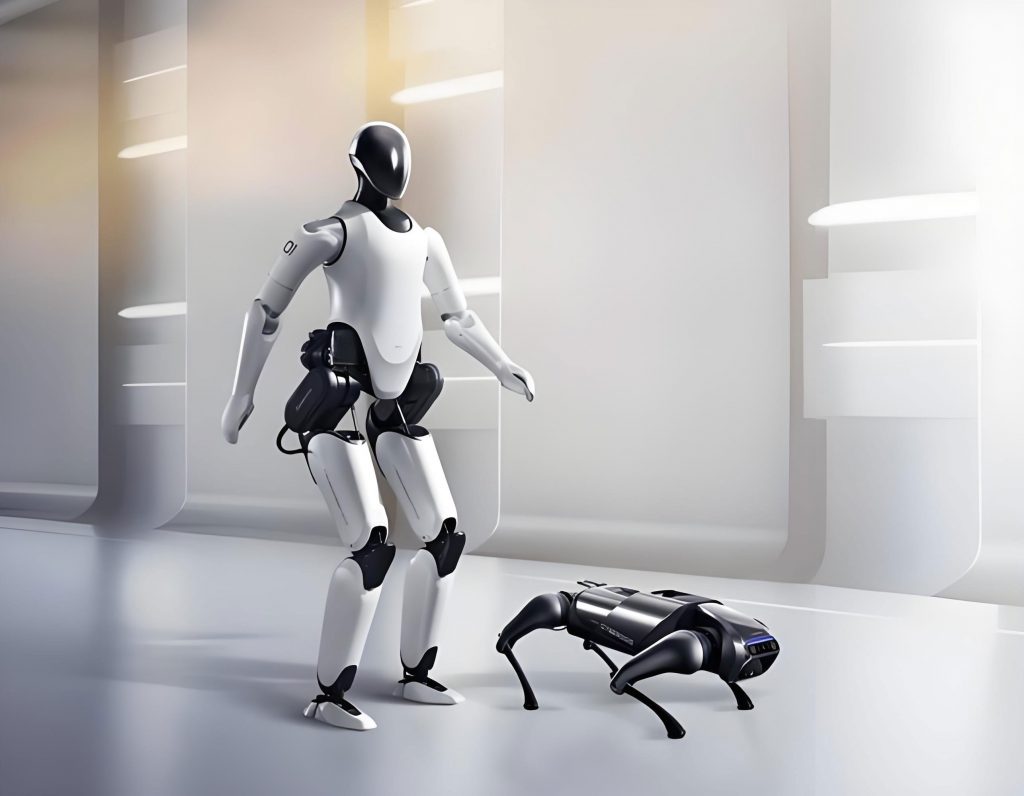
The integration of 5G is fundamentally reshaping the现状 of humanoid robots, a premier subset of bionic robot technology. This transformation is evident across several core technical branches.
1. Control Systems: From Pre-Programmed Gait to Networked Reflex
Control architecture for a humanoid bionic robot is immensely complex, involving the coordination of multiple degrees of freedom in legs, arms, and torso. The evolution of bipedal locomotion control illustrates this journey. Early models, originating from seminal Japanese research, solved basic problems of step initiation and balance using the Zero Moment Point (ZMP) criterion, often formulated as ensuring the ground reaction force passes through a point within the support polygon:
$$ \text{ZMP Condition: } x_{zmp} = \frac{\sum_i (m_i (\ddot{z}_i + g) x_i – m_i \ddot{x}_i z_i)}{\sum_i m_i (\ddot{z}_i + g)} $$
where $m_i$, $x_i$, $z_i$ are the mass and coordinates of the i-th link, and $g$ is gravity. These early bionic robot designs were often bulky and required external support.
The subsequent generations achieved dynamic balance and added social dimensions like facial expression recognition. Today, the control paradigm is shifting. With 5G, high-fidelity sensor data (force, torque, visual, LiDAR) from the bionic robot can be streamed to a remote edge server with minimal delay ($\Delta t < 10ms$). There, powerful AI models process the data and compute optimal control signals, which are instantaneously sent back. This effectively creates a remote “spinal cord” and “brainstem,” enabling real-time adaptive control for complex tasks. The control latency budget can be modeled as:
$$ T_{total} = T_{sensor} + T_{tx} + T_{compute} + T_{rx} + T_{actuator} $$
where $T_{tx}$ and $T_{rx}$ are drastically reduced by 5G, making $T_{total}$ small enough for stable, real-time closed-loop control of a dynamic bionic robot.
Similarly, dexterous hand manipulation has evolved from tendon-driven mechanisms (e.g., Utah-MIT hand) to more integrated, sensor-rich designs. 5G allows the teleoperation of such a bionic robot hand with haptic feedback, where the force reflection loop latency is crucial for operator immersion and precision.
2. Drive Systems: The Quest for Muscle-like Actuation
The drive system is what animates the bionic robot. The quest has been to replicate the properties of biological muscle: high power-to-weight ratio, compliance, and fine control. The progression and comparison of mainstream technologies are summarized below:
| Drive Technology | Principle | Advantages for Bionic Robot | Disadvantages |
|---|---|---|---|
| Electric Motor + Tendon | Motors wind cables/ tendons to pull joints. | High force transmission, design flexibility. | Friction, hysteresis, complex routing, bulky. |
| Pneumatic Artificial Muscle (PAM) | Rubber bladder contracts when pressurized. | High compliance, good power/weight, natural movement. | Non-linear control, requires air supply, lower efficiency. |
| Hydraulic Actuation | Pressurized fluid drives pistons. | Extremely high power density, robust. | Heavy, potential for leaks, noisy, requires pump. |
| Smart Material Actuators (SMA, EAP) | Materials change shape with heat/electric field. | Silent, direct drive, high energy density potential. | Often low bandwidth, hysteresis, control challenges. |
The trend is toward “soft robotics,” using compliant and smart materials to create more natural, safe, and efficient bionic robot actuation. Furthermore, 5G enables a novel paradigm: the “virtual bionic robot.” These are AI-driven digital entities, like the AI anchor developed by Sogou and Xinhua, whose “actuation” is purely computational and whose presence is disseminated via high-bandwidth networks—a new frontier for the bionic robot concept.
3. Application Domains: Enhanced by Connectivity
The 5G-enhanced bionic robot finds profound applications in areas demanding precision, safety, or access to remote/hazardous locations.
a) Medical Tele-intervention: This is perhaps the most impactful application. A surgeon equipped with a haptic interface can control a remote surgical bionic robot with sub-millimeter precision. The critical requirement is end-to-end latency ($T_{total}$) low enough to preserve the surgeon’s sense of direct manipulation. 5G’s URLLC capability makes this feasible. The “MiaoShou” microsurgical robot exemplifies this, combining flexible instruments for natural orifice access with 5G for remote operation, blending the “soft” access with “rigid” precision.
b) Industrial Collaboration and Hazardous Inspection: In smart factories, 5G-connected bionic robot arms or mobile manipulators can perform complex assembly tasks in direct collaboration with humans, receiving real-time updates and instructions. For inspection in hazardous environments (e.g., high-voltage substations, chemical plants, disaster zones), a bionic robot with 5G can stream ultra-high-definition video and sensor data in real-time, allowing experts to conduct remote assessment and even manipulation without physical risk.
c) Exploration and Field Research: Aquatic bionic robot fish, like those developed for underwater archaeology or marine biology, can use 5G surface relays or emerging underwater wireless optical links to transmit high-volume sonar and video data in near real-time, enabling interactive exploration missions rather than simple pre-programmed surveys.
4. Emerging Challenges in the 5G Era
Despite the promise, the rapid integration of 5G and AI into bionic robot platforms surfaces significant challenges that must be addressed.
a) Intellectual Property (IP) and Patent Landscape: The global patent landscape for core bionic robot technologies (e.g., control algorithms, actuator designs) is currently dominated by institutions in the United States and Japan. While activity is growing worldwide, the concentration of foundational IP creates a high barrier to entry. Furthermore, the fast-paced innovation cycle, especially in AI-driven control software for bionic robot systems, often outpaces the slower legal processes for patent examination and grant, leading to potential ambiguities in IP ownership and risks of infringement.
b) Legal and Ethical Risks – Persona and Privacy: As humanoid bionic robot become more lifelike, the temptation to use the likeness of celebrities or public figures for their “face” or voice increases for market appeal. This raises direct legal issues of肖像权 (right of publicity) and privacy infringement. An unauthorized use of a person’s likeness for a commercial bionic robot product, especially in advertising, constitutes a clear legal violation. The risk extends to virtual AI bionic robot personas as well.
c) The “Uncanny Valley” Effect: This well-known hypothesis posits that as a bionic robot appearance becomes more human-like, emotional response becomes positive until a point is reached where subtle imperfections create a strong sense of eeriness and revulsion. The pursuit of hyper-realism in companion or service bionic robot risks triggering this effect, potentially leading to user anxiety and rejection. This is particularly concerning for vulnerable populations (e.g., the elderly, children) who are primary targets for companion bionic robot. The effect poses a fundamental design and psychological challenge for the humanoid bionic robot industry.
d) Security and Safety: The 5G-connected bionic robot introduces a large attack surface. A compromised bionic robot could lead to physical harm, privacy breaches via its sensors, or disruption of critical operations (e.g., remote surgery, industrial processes). Ensuring end-to-end security across the network, the edge servers, and the bionic robot itself is paramount.
5. Future Trajectories and Concluding Perspective
Looking ahead, the fusion of 5G connectivity with advances in AI and materials science will steer the bionic robot field toward several clear trajectories.
1. Theoretical Refinement and Microscopic Modeling: Research will delve deeper into the biomechanical and neurological principles underlying natural movement. Control theories will increasingly incorporate models inspired by biological central pattern generators (CPGs) and proprioceptive feedback loops, moving beyond traditional rigid dynamics. The mathematical modeling of a bionic robot may start to resemble computational neuroscience models:
$$ \tau \dot{u}_i = -u_i + \sum_j w_{ij} v_j + I_i^{ext} $$
$$ v_i = f(u_i) $$
where $u_i$, $v_i$ represent neuron membrane potential and firing rate in a network controlling a bionic robot limb’s rhythm.
2. Material and Structural Evolution: The drive for safer and more adaptable interaction will push bionic robot structures toward full softness or hybrid soft-rigid designs. Integrated sensor-actuator structures, often called “smart skins” or “artificial muscles,” will become commonplace. The goal is a bionic robot with embodied intelligence, where computation and actuation are distributed throughout its compliant body.
3. Neuromorphic and Edge-AI Control: To achieve autonomy and reduce dependency on constant cloud connectivity, the next-generation bionic robot will feature neuromorphic chips that process sensory data with extreme efficiency. 5G will then be used for high-level task updates and swarm coordination, while low-level control and reflexes are handled onboard by these brain-inspired processors.
4. Proliferation of Virtual and Swarm Bionic Agents: The concept of a bionic robot will transcend the physical. Virtual bionic robot assistants, therapists, and instructors will become mainstream, accessible via AR/VR interfaces over 5G. Physically, we will see the rise of collaborative bionic robot swarms—groups of simple biomimetic units (fish, insects) that use 5G/mMTC to coordinate and accomplish complex tasks like environmental monitoring or search-and-rescue, governed by swarm intelligence algorithms.
In conclusion, from my vantage point, the 5G communication network is far more than just a faster pipeline for data; it is the foundational infrastructure for the next evolutionary leap in bionic robot intelligence and utility. It transforms the bionic robot from a sophisticated tool into a networked cyber-physical agent capable of real-time perception, reaction, and collaboration at a distance. While this integration brings formidable challenges in ethics, law, and security, the potential benefits for healthcare, industry, exploration, and society are immense. The future bionic robot, cradled in the low-latency, high-bandwidth embrace of 5G and beyond, will be more adaptive, more collaborative, and more seamlessly integrated into the fabric of our world than ever before.
References
[1] Wang, Y. X. (2018). Design and Motion Simulation of a Novel Pneumatic Humanoid Robot Waist Mechanism. Microcomputer Applications.
[2] Xu, J., Meng, Y. X., & Wang, T. L. (2017). A Control System for Humanoid Robot Based on Kinect. Sensor and Microsystem.
[3] Zhao, T. J., & Sun, J. (2009). Motion Stability Analysis of a Wheeled Heterogeneous Robot. Mechanical Engineering & Automation.
[4] Lou, J. M., & Zhong, Q. B. (2017). A Cooperative Motion Control Method for Humanoid Robots. Journal of Beijing University of Posts and Telecommunications.
[5] Qiu, J. H., & Jiang, G. (2012). Waist Design and Motion Simulation of a Pneumatic Robot. Machinery Design & Manufacture.
[6] Yang, D. Z. (2000). Smart Materials and Smart Systems. Tianjin University Press.
[7] Wu, G., Hu, Y., & Chen, W. (2014). Carbon Nanotube and Graphene Artificial Muscles. Chinese Science Bulletin.
[8] Yu, X. P., Lan, Z. Y., & Jiang, C. Y. (2016). Structural Design and Functional Bionics of Nano-carbon Composites. Chinese Science Bulletin.
[9] Xie, T., Xu, J. F., & Zhang, Y. X. (2002). Research History, Current Status and Prospect of Humanoid Robots. Robot.
[10]Zong, G. H., & Tang, B. Y. (2002). The R&D Status of Japanese Biped Walking Humanoid Robots and My View. Robot.
[11]Li, Y. M. (2005). Overview of the Development of Humanoid Robots Abroad. Robot.
[12]Zhang, L. G., Huang, Q., & Yang, J. (2007). Design and Similarity Research of Complex Dynamic Motions for Humanoid Robots. Acta Automatica Sinica.
[13]Zhao, X. Y. (2012). Design of a Remote Wireless Control System for High-Speed Scene Measurement. Gansu Science and Technology.
[14]You, D. Z., Xiao, Z., & Li, Q. S. (2016). Embedded Control System Design for a Lost Foam Cutting Machine. Mechanical Design and Manufacturing.
[15]Qiu, Y. Q., Wang, Z. X., Wang, K., Zhou, J. Y., & Feng, K. (2016). Research Progress and Development Trend of Bionic Robots. Internet of Things Technologies.
[16]Wang, Y. W., Yu, K., & Yan, Y. C. (2016). Research Status and Development Trend of Bionic Robotic Fish with BCF Propulsion Mode. Small & Special Electrical Machines.