
The pursuit of advanced robotic manipulation necessitates end-effectors that mirror the adaptability, dexterity, and compliance of the human hand. As robots transition from structured industrial environments to dynamic service, healthcare, and domestic settings, the demand for a dexterous robotic hand capable of nuanced interaction with a vast array of objects becomes paramount. This paper presents the design, modeling, and experimental validation of a novel five-fingered dexterous robotic hand that synergistically combines tendon-driven articulation with pneumatic compliance. This hybrid approach, focusing on augmenting the abduction/adduction degree of freedom at the index and little finger roots, addresses critical limitations in existing designs concerning workspace, adaptability, and structural complexity.
The core philosophy behind our dexterous robotic hand is to achieve high functionality without prohibitive mechanical complexity. Many state-of-the-art dexterous robotic hand designs either sacrifice degrees of freedom for simplicity or incur significant weight, cost, and control challenges by integrating numerous actuators. Our design strategically locates miniaturized linear servo actuators within the palm to provide primary flexion/extension via tendon routing. The key innovation lies in the introduction of a pneumatic airbag structure at the metacarpophalangeal (MCP) joints of the index and little fingers. This system provides a lightweight, simple, and effective method for achieving lateral abduction, significantly expanding the effective grasping envelope and enabling more human-like prehensile patterns. The resulting dexterous robotic hand is characterized by its low mass (under 500g), modular finger design, and inherent passive adaptability, making it a compelling platform for research in adaptive grasping and in-hand manipulation.
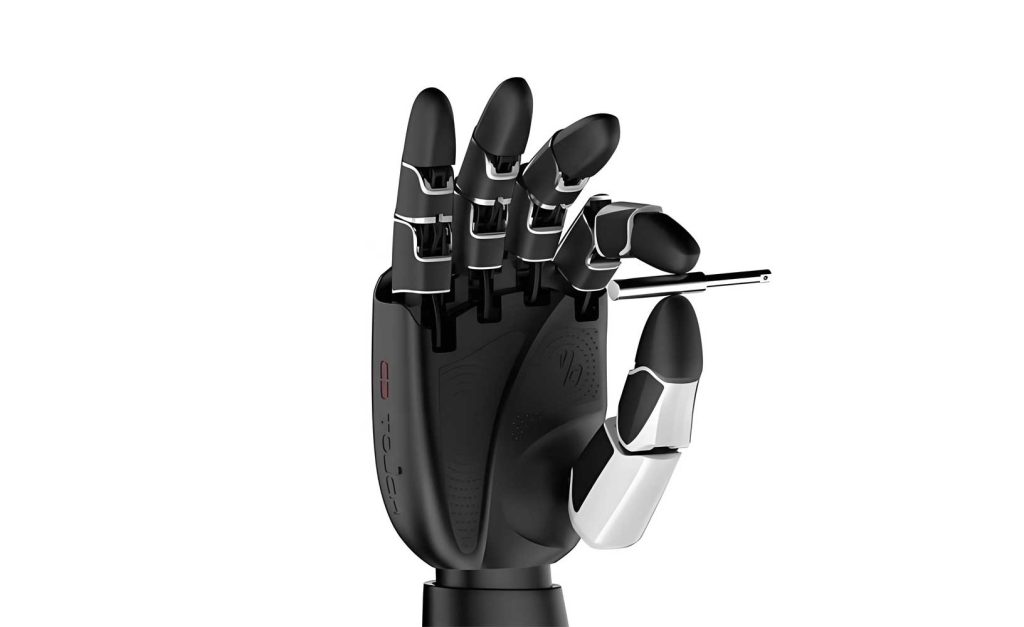
The architecture of the AeroTendon dexterous robotic hand is bio-inspired, featuring a five-fingered, 17-degree-of-freedom (DoF) configuration. A deliberate DoF allocation strategy is employed to balance complexity and capability. The thumb, essential for opposition, is granted 3 joint DoFs controlled by 2 active tendon drives, enabling flexion/extension and a basic abduction/adduction. The remaining four fingers (index, middle, ring, little) are designed modularly, each possessing 3 joint DoFs for flexion/extension, actuated by a single tendon per finger. Crucially, the index and little fingers are augmented with an additional active abduction DoF at their root joints, powered by the pneumatic airbag system. This brings the total active DoFs to 7 (5 tendons + 2 airbags), intelligently governing the 17 kinematic DoFs.
The finger joint mechanism is elegantly simple, promoting passive adaptation. Each phalangeal joint consists of a pulley, a pin axle, and a torsional return spring. The driving tendon is anchored at the distal phalanx, sequentially routed through the pulleys of the distal interphalangeal (DIP), proximal interphalangeal (PIP), and metacarpophalangeal (MCP) joints, and finally connected to a linear actuator in the palm. Upon actuation, tendon tension causes the joints to flex cooperatively. The absence of rigid gearing allows the phalanges to conform to object geometry during enveloping grasps. Upon release of tension, the integrated return springs restore the finger to its extended state. This underactuated, adaptive design is fundamental to the versatility of our dexterous robotic hand.
The pneumatic abduction module is the cornerstone of our design innovation. It comprises six primary components: a silicone airbag, a tension spring, a rotary connector, a bearing, a circlip, and a palm-mounted support. In the neutral state, the airbag is deflated, and the tension spring is pre-tensioned, holding the finger in its adducted position. When abduction is required, a pump injects air into the airbag. The constrained axial expansion of the airbag generates a force that overcomes the spring tension, rotating the finger’s base about the bearing axis and producing lateral movement. Ceasing inflation allows the spring to retract the finger. This system provides a wide, controllable range of motion with minimal mechanical parts and weight. The airbag material, a 3D-printed silicone with a Shore A hardness of 30 and an elongation at break of 450%, is selected for its durability, elasticity, and predictable behavior under pressure.
| Actuation Method | Advantages | Disadvantages | Complexity |
|---|---|---|---|
| Direct Motor (e.g., SCHUNK) | High precision, high force | Heavy, bulky, expensive | High |
| Tendon-Coupled (e.g., Shadow Hand) | Remote actuation | Control coupling, friction | Medium-High |
| SMA Spring (e.g., Prior work) | Compact, silent | Slow response, hysteresis, small strain | Medium |
| Pneumatic Muscle | High force-to-weight | Slow contraction, non-linear control | Medium |
| Pneumatic Airbag (This work) | Simple, lightweight, fast, good stroke | Requires air supply, force limited | Low |
Kinematic and Static Analysis of the Dexterous Robotic Hand
Analyzing the kinematics is essential to understand the workspace and control of the dexterous robotic hand. We model a modular finger (excluding thumb) as a 3-revolute-joint planar serial chain. Using the Denavit-Hartenberg (D-H) convention, we establish coordinate frames at each joint. The base frame {0} is located at the finger’s MCP joint. The parameters are defined as follows, where $L_i$ are link lengths and $\theta_i$ are joint angles.
| Joint $i$ | $\alpha_{i-1}$ | $a_{i-1}$ | $d_i$ | $\theta_i$ |
|---|---|---|---|---|
| 1 | 0 | $L_1$ | 0 | $\theta_1$ |
| 2 | 0 | $L_2$ | 0 | $\theta_2$ |
| 3 | 0 | $L_3$ | 0 | $\theta_3$ |
The homogeneous transformation matrix from frame {i-1} to frame {i} is given by:
$$ ^{i-1}_{i}T = \begin{bmatrix}
\cos\theta_i & -\sin\theta_i & 0 & a_{i-1}\\
\sin\theta_i\cos\alpha_{i-1} & \cos\theta_i\cos\alpha_{i-1} & -\sin\alpha_{i-1} & -d_i\sin\alpha_{i-1}\\
\sin\theta_i\sin\alpha_{i-1} & \cos\theta_i\sin\alpha_{i-1} & \cos\alpha_{i-1} & d_i\cos\alpha_{i-1}\\
0 & 0 & 0 & 1
\end{bmatrix} $$
For our planar case with $\alpha_{i-1}=0$ and $d_i=0$, this simplifies. The forward kinematics, giving the fingertip position $[x, y, 0]^T$ in the base frame, is derived from the cumulative transformation $^0_3T = ^0_1T \cdot ^1_2T \cdot ^2_3T$:
$$ x = L_1 \cos\theta_1 + L_2 \cos(\theta_1+\theta_2) + L_3 \cos(\theta_1+\theta_2+\theta_3) $$
$$ y = L_1 \sin\theta_1 + L_2 \sin(\theta_1+\theta_2) + L_3 \sin(\theta_1+\theta_2+\theta_3) $$
Given the joint limits $\theta_1, \theta_2, \theta_3 \in [0, \frac{\pi}{2}]$, and using representative phalangeal lengths ($L_1=37.2$mm, $L_2=30$mm, $L_3=32.3$mm), the reachable workspace can be plotted. Monte Carlo simulation with 15,000 random joint angle sets within the limits generates the dense point cloud representing the finger’s flexion workspace, confirming a large and contiguous region for object interaction.
The analysis of the pneumatic abduction system focuses on the static equilibrium between the airbag expansion force and the restoring spring force. The airbag is modeled as a cylindrical actuator. The force generated upon pressurization is:
$$ F_{bag} = P \cdot A_{eff} $$
where $P$ is the internal gauge pressure and $A_{eff}$ is the effective cross-sectional area resisting expansion. For axial expansion, this area is approximately the radial cross-section: $A_{eff} \approx \pi r^2$, with $r$ being the airbag’s nominal radius (2.5 mm).
The restoring force from the pre-tensioned linear spring follows Hooke’s Law:
$$ F_{spring} = k (x_0 + \Delta x) $$
where $k$ is the spring constant, $x_0$ is the pre-compression length at neutral position, and $\Delta x$ is the additional elongation due to abduction.
At a given abduction angle $\phi$, geometric relations link $\Delta x$ to $\phi$. For a simplified rotary model with effective lever arm $R$, the displacement is $\Delta x \approx R \phi$. At equilibrium, the moments balance:
$$ F_{bag} \cdot R_{bag} = F_{spring} \cdot R_{spring} $$
where $R_{bag}$ and $R_{spring}$ are the moment arms for the respective forces. Substituting the force expressions allows solving for the abduction angle as a function of pressure:
$$ \phi(P) = \frac{P \cdot A_{eff} \cdot R_{bag} – k x_0 R_{spring}}{k R_{spring} R} $$
This model shows a linear relationship between pressure and angle in the operational range, providing a straightforward control mapping. Using system parameters (max pump pressure $P_{max}=0.15$ MPa, $r=2.5$mm, $R \approx 15$mm), the theoretical maximum abduction force at the fingertip (length $L_f \approx 99.45$mm) and maximum abduction angle are calculated:
$$ F_{tip, max} = P_{max} \cdot (A_{radial}) \approx 0.15 \times 10^6 \cdot (40 \times 10^{-6}) = 6 \, \text{N} $$
$$ \tau_{tip, max} = F_{tip, max} \cdot L_f \approx 0.597 \, \text{Nm} $$
$$ \phi_{max} = \arcsin\left(\frac{\Delta x_{max}}{R}\right) \approx \arcsin\left(\frac{5.5}{15}\right) \approx 21.5^\circ $$
| Parameter | Value | Description |
|---|---|---|
| Total Mass | < 500 g | Including actuators and pneumatics |
| Total Joint DoF | 17 | Kinematic degrees of freedom |
| Active DoF | 7 | 5 tendons + 2 airbags |
| Max Finger Flexion | ≈ 90° per joint | Under tendon actuation |
| Max Abduction Angle (Index/Little) | ≈ 21.5° | |
| Max Abduction Force at Fingertip | ≈ 6 N | At 0.15 MPa |
| Primary Actuation | Miniature Linear Servos | Embedded in palm |
| Abduction Actuation | Silicone Airbag | 3D-printed, pneumatic |
System Integration, Control, and Experimental Validation
The efficacy of the dexterous robotic hand is validated through comprehensive system integration and experimental testing. A centralized control architecture is implemented. An embedded microcontroller (e.g., STM32 or Arduino Mega) serves as the main controller, receiving high-level commands from a host PC. It generates Pulse-Width Modulation (PWM) signals for the five linear servo actuators and controls solid-state relays for the two miniature air pumps and exhaust valves governing the airbags. The control flow is sequential and deterministic, enabling precise coordination between tendon flexion and pneumatic abduction.
The hand’s structure is fabricated using lightweight nylon via fused deposition modeling (FDM) 3D printing. This allows for complex internal channels for tendon routing and cavities for actuator housing while minimizing weight. The phalangeal links are printed as hollow shells. Fingertips are coated with a layer of soft silicone to increase the coefficient of friction during grasping and to provide a modicum of passive compliance for delicate objects.
The first set of experiments focuses on quantifying the isolated and combined motions. The tendon-driven flexion of each finger is tested, confirming a full range of motion from fully extended to fully curled, forming a fist. The pneumatic abduction of the index and little fingers is characterized, measuring the achieved angle against the input pressure command. The results closely match the theoretical model, demonstrating a near-linear relationship up to the maximum angle of approximately 21 degrees. The combination of these motions enables the dexterous robotic hand to replicate fundamental human hand gestures, such as displaying numbers (1 through 5), a peace sign, or an “OK” gesture, highlighting its independent finger control and anthropomorphic capability.
The core validation lies in grasping experiments across a spectrum of objects, evaluating both power (enveloping) and precision (pinch) grasps. The experiments are designed to test the adaptive nature and enhanced workspace provided by the pneumatic abduction.
- Precision Pinch Grasps: The abduction capability proves crucial here. By slightly abducting the index finger, a more natural and stable two-finger pinch between the thumb and index finger is achieved for small objects like a pen, a USB drive, or a small ball. The thumb’s independent actuation allows for opposition, while the adjustable posture of the index finger optimizes contact points.
- Tri-Pod Grasps: The dexterous robotic hand successfully executes three-finger precision grasps using the thumb, index, and middle fingers to hold objects like a plastic bottle or a marker. The ability to orient the index finger independently improves the stability of the grasp compared to a purely flexion-based grip.
- Enveloping Power Grasps: This is where the design’s full adaptability shines. When tasked with grasping larger, irregularly shaped objects like a stress ball, an orange, or a small water bottle, all fingers flex under tendon tension. The underactuated joints allow each phalanx to conform to the object’s surface. Concurrently, the abduction of the index and little fingers allows the hand to open wider initially, accommodating larger diameters, and then wrap more completely around the object, increasing contact area and grasp security. The lightweight nature of the dexterous robotic hand prevents excessive inertial forces during such operations.
The integration of abduction significantly increases the effective workspace of the hand. A comparative kinematic simulation of the index finger, with and without the abduction DoF, visually demonstrates this expansion. The 3D point cloud for the finger with abduction is a swept volume generated by rotating the original flexion workspace about the abduction axis, creating a much larger spatial envelope for potential object capture. This directly translates to the hand’s ability to grasp objects with a wider variety of sizes and shapes.
Discussion and Future Perspectives on Dexterous Robotic Hand Development
The presented AeroTendon dexterous robotic hand validates the proposed hybrid actuation paradigm. The pneumatic airbag system for finger abduction demonstrates a successful application of soft robotics principles to solve a specific problem in a rigid-link mechanism—adding a DoF with minimal weight and complexity. Compared to alternative methods like direct motor drives or coupled tendons, this approach offers an excellent trade-off between performance, simplicity, and cost, making advanced dexterity more accessible for research and applications.
The underactuated, tendon-driven finger design provides inherent passive adaptability, a critical feature for robust grasping in uncertain environments. It reduces the need for complex sensing and control algorithms for every joint, as the mechanical system naturally distributes forces and conforms to shapes. This makes the dexterous robotic hand particularly suitable for tasks where object geometry is not perfectly known a priori.
However, several challenges and opportunities for improvement exist. The current pneumatic system is open-loop, controlling pressure rather than directly measuring or controlling the abduction angle. Integrating a small rotary encoder or a pressure-deformation model with feedback would enhance accuracy. The force output of the airbags, while sufficient for posture adjustment and light grasping, is limited. Exploring different airbag geometries or materials could improve the force-to-pressure ratio.
The next evolutionary steps for this dexterous robotic hand are clear. The integration of tactile sensing is paramount. Embedding flexible sensor arrays in the fingertips and phalanges would provide crucial haptic feedback for grip force regulation, object slip detection, and texture recognition, enabling truly intelligent manipulation. Furthermore, investigating variable stiffness mechanisms within the fingers could allow the hand to switch between compliant shaping for safe interaction and rigid holding for forceful tasks.
| Research Direction | Potential Approach | Expected Benefit |
|---|---|---|
| Tactile Sensing Integration | Flexible piezoresistive/capacitive arrays on phalanges | Enable force control, slip detection, object identification |
| Closed-Loop Abduction Control | Miniature rotary encoder or internal pressure modeling | Precise angular positioning and force control |
| Enhanced Grasping Intelligence | Learning-based grasp planners using visual & tactile feedback | Autonomous selection of optimal grasp type and posture |
| Variable Stiffness Joints | Jamming layers or antagonistic tendons with locking | Dynamic tunability from soft to rigid for multi-modal tasks |
| Wrist Integration | Adding a 2-DoF active wrist module | Dramatically increase the total operational workspace |
In conclusion, this work has presented the design and validation of a novel, lightweight, and functional dexterous robotic hand. By fusing the reliability of tendon drives with the simplicity and compliance of pneumatic airbags for selective abduction, we have created a platform that achieves an expanded workspace and more anthropomorphic motion without excessive complexity. The experimental results confirm its capability for diverse grasping tasks. This design provides a foundational architecture upon which future research in sensing, control, and manipulation intelligence can be built, contributing to the ongoing endeavor of creating robotic hands that match the versatility of their biological counterparts.