
We stand at the precipice of a profound transformation in human interaction, driven by the ascent of embodied artificial intelligence. Unlike its disembodied predecessors confined to virtual symbol manipulation, embodied AI robot systems are defined by their physical instantiation and their operational closure within a “perception-cognition-action” loop. This paradigm shift promises a future where intelligent agents seamlessly co-inhabit our physical world, offering assistance, companionship, and new forms of collaboration. The core proposition of embodied cognition—that intelligence arises from the dynamic interaction between an agent’s body, its sensors/actuators, and its environment—suggests a potential for more natural, context-aware, and ultimately human-centric forms of engagement. From caregiving embodied AI robot assistants in elder care to collaborative robots on factory floors, the applications seem to herald an era of augmented human capability and enriched social exchange.
However, this techno-optimistic narrative obscures a more troubling reality. When developed and deployed within the dominant framework of digital capitalism, the very architecture of embodied AI robot systems can become a vector for a new and deeper form of alienation. The problem transcends mere technical misalignment or ethical oversight; it strikes at the heart of what it means to engage in meaningful communication and social relation. To diagnose this condition, we must move beyond surface-level critiques and return to the foundational framework of Marxian theory, specifically the concept of alienation (Entfremdung). Alienation, in its fullest sense, describes the process by which the products of human labor and social activity become independent, autonomous powers that stand opposed to their creators, dominating them instead of serving them. In the digital age, the “product” is no longer just a material commodity but the entire socio-technical system of data extraction, algorithmic processing, and behavioral modulation.
The central mechanism enabling this new alienation is what I term the Algorithmic Gaze. It is the pervasive, operational logic through which embodied AI robot systems perceive, interpret, and act upon the world—and crucially, upon us. Through multi-modal sensor fusion (cameras, microphones, LiDAR, tactile sensors), every gesture, utterance, micro-expression, and environmental interaction is captured, quantified, and fed into predictive models. This gaze is not passive observation; it is an active, shaping force. It seeks to render the messy complexity of human social life into legible, computable streams of data to optimize for predefined objectives—typically, engagement, retention, and commercial conversion. The embodied AI robot, therefore, becomes more than a tool; it becomes an instrument of a capital-logic that seeks to turn all of life, including our most intimate communications, into a site for valorization. In this essay, I will argue that under this Algorithmic Gaze, communication in the age of embodied intelligence undergoes a qualitative metamorphosis into a state of alienation, manifesting across four constitutive dimensions: the instrumentalization of language, the disciplining of space, the commodification of emotion, and the subordination of value to capital. Finally, I will explore pathways for sublation (Aufhebung), seeking not to reject the technology but to reclaim its emancipatory potential.
Theoretical Foundations: Alienation as a Critique of Communication
To understand the alienation specific to AI-mediated communication, we must first recapture the radical core of Marx’s theory. His critique evolved from a philosophical-anthropological account of man’s “species-being” (Gattungswesen) to a historical-materialist analysis of the capitalist mode of production. The early manuscript “Comments on James Mill” (Auszüge aus James Mills Buch “Éléments d’économie politique”) is particularly illuminating for our purposes. Here, Marx introduces the concept of “alienated communication” or “estranged social relation.” He posits that in a society dominated by private property and money, the authentic, direct relationship between persons is mediated and corrupted by the exchange relation. My social worth is not recognized through mutual affirmation but through the possession of exchangeable commodities. As Marx writes, the mediator “becomes a real God, for the mediator is the real power over what it mediates to me.” The medium (money, and by extension, data-as-currency) becomes the master.
This analysis provides a tripartite criterion for judging communicative alienation:
- Mediation by Reified Objects: When the direct, intersubjective link between persons is replaced by an impersonal, quantifying medium.
- Inversion of Subject and Object: When the human creator of the communicative medium becomes subjected to its logic, behaving as an object to be predicted and shaped rather than as an autonomous author of the interaction.
- Instrumentalization of Purpose: When communication ceases to be an end in itself—a site for mutual recognition, self-expression, and solidarity—and becomes a means for an external end, typically economic valorization.
In mature capitalism, this alienating dynamic is rooted in capital’s imperative for self-valorization (Verwertung). Capital must constantly revolutionize the means of production and subsume all social life under the logic of exchange. Marx’s “Fragment on Machines” in the Grundrisse预见了 this trajectory. He describes how “general intellect”—the collective scientific and social knowledge of society—becomes objectified into fixed capital, an “automated system of machinery.” This system confronts the worker as an alien, controlling power. Today’s embodied AI robot is the apotheosis of this objectified general intellect: a self-optimizing system that absorbs human knowledge (data) and physical skill, not merely to assist labor but to manage, discipline, and extract value from all human activity, including communication. The factory’s physical machinery disciplining the worker’s body has evolved into the embodied AI robot‘s algorithmic gaze, seeking to discipline the user’s attention, emotion, and social behavior.
| Dimension | Industrial Capitalism (Alienation) | Algorithmic Capitalism (Algorithmic Gaze) |
|---|---|---|
| Primary Site | The Factory (Point of Production) | Everywhere (Lifeworld as Production Site) |
| Object of Control | Labor Power, Physical Body | Attention, Behavior, Emotion, Sociality |
| Mechanism | Mechanical Rhythm, Factory Discipline | Predictive Algorithms, Personalized Nudges |
| Mediating Form | Commodity, Wage, Machine | Data, Algorithmic Profile, Embodied AI Robot Persona |
| Output | Material Goods | Behavioral Data, Predictions, User Engagement |
Manifestations of Alienated Communication under the Algorithmic Gaze
Applying the tripartite criterion, we can dissect how the embodied AI robot, as a capital-posited entity, generates specific pathologies in human communication.
1. The Instrumentalization of Language: From Dialogue to Data-Prompt
Language is the quintessential medium for intersubjective understanding. For Marx, it arises from the “need, the necessity of intercourse with other men.” It is alive, context-dependent, and rich with tacit meaning. In contrast, the language model at the core of a conversational embodied AI robot operates on statistical correlations within a training corpus. The interaction is not a dialogue but a transaction: the human input is a “prompt,” a stimulus designed to elicit a maximally engaging or “helpful” response from the machine. The human unconsciously learns to “prompt engineer” themselves, simplifying and distorting their natural expression into forms the algorithm can process efficiently. The richness of lived experience is flattened into a structured query.
The semantic gap here is ontological. Human language is grounded in embodied experience (“I’m feeling heavy-hearted”); the embodied AI robot processes this as a vector associated with other vectors for “sad,” “tired,” “need support,” and retrieves a pre-patterned response. True understanding, which involves shared situational awareness and empathy, is absent. This creates a paradox: the more fluid the interaction feels, the more completely language is stripped of its authentic, world-disclosing function and reduced to a tool for system optimization. The medium becomes an alien barrier, not a bridge.
$$ P(response | prompt, \theta) = \frac{\exp(s(prompt, response; \theta))}{\sum_{r’ \in \mathcal{V}} \exp(s(prompt, r’; \theta))} $$
Where $P$ is the probability of a response, $s$ is a scoring function parameterized by $\theta$ (the model’s weights), and $\mathcal{V}$ is the vocabulary. Communication is reduced to calculating the most probable token sequence, divorcing language from shared intentionality.
2. The Disciplining of Space: From Shared World to Programmed Arena
Embodied AI robots do not exist in a vacuum; they occupy and reconfigure physical and hybrid spaces. A domestic robot shapes the rhythms of the home; an interactive kiosk reshapes the flow of a retail space. Capital, following David Harvey, produces space that facilitates accumulation. The embodied AI robot becomes an active agent in this production, rendering space “calculable.” Its sensors map the environment not to understand it phenomenologically, but to identify opportunities for intervention—to guide, suggest, or record.
This turns the shared, lifeworld space of communication into a programmed arena for behavioral conditioning. Consider a “social companion” embodied AI robot. It may create a low-pressure, always-available simulated sociality. Yet, this very “perfection” is a disciplinary trap. The human, seeking positive feedback (a smile, an affirming verbal response), begins to conform their behavior to the robot’s simplistic emotional model. The space is no longer a neutral ground for spontaneous encounter; it is a Skinner box with a physical presence. The inversion is clear: the human subject adapts to the object’s parameters. When integrated with VR/AR, this disciplining can become total, constructing immersive environments where every visual cue and interactive possibility is designed to maximize data yield and adherence to a commercial or behavioral script.
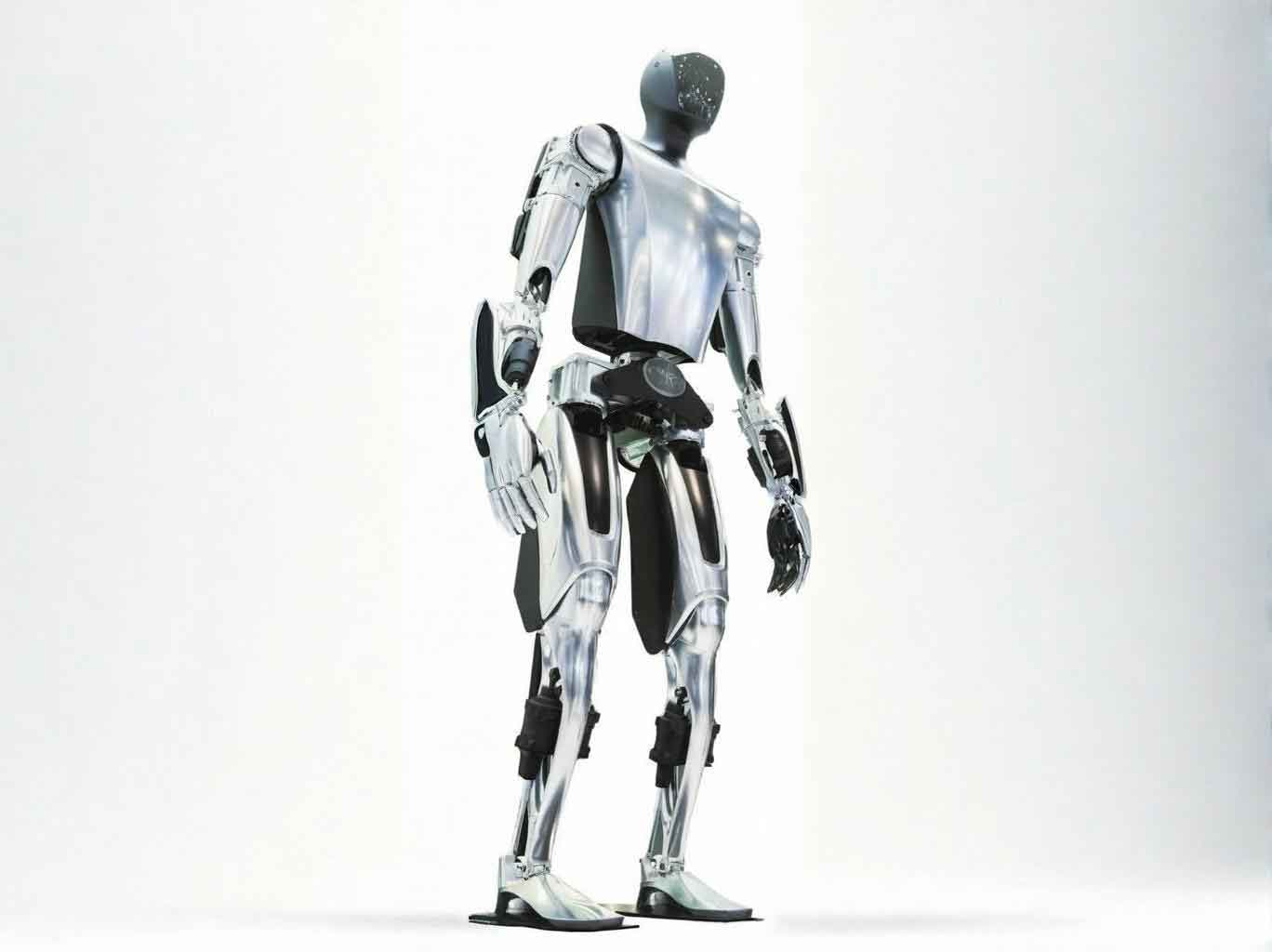
The image above, while showing a production context, symbolizes this reconfiguration of space. The embodied AI robot is centrally positioned, its design and placement dictating the workflow and interaction patterns within the factory space. This logic extends to social spaces, where the robot’s presence and capabilities structure the possibilities for human action and interaction, making the space itself an extension of the algorithmic gaze.
3. The Commodification of Emotion: From Affective Bond to Calculable Labor
This is perhaps the most insidious dimension. Emotions are embodied, evaluative engagements with the world, crucial for genuine connection. The embodied AI robot, through affective computing, simulates emotional reciprocity. A care robot expresses concern; a companion robot shares “joy.” This simulation can trigger real emotional attachment in the user, creating a bond with an entity that cannot truly reciprocate. The user’s loneliness, love, or frustration becomes raw material, a source of behavioral data used to refine the simulation and increase engagement metrics.
Thus, the user performs unwitting emotional labor. This labor, described by Arlie Hochschild as the management of feeling to create a publicly observable display, is here extracted invisibly. Every shared confidence, every moment of vulnerability with a seemingly empathetic embodied AI robot, is a data point. The affective exchange is commodified twice over: first, as the product (the feeling of companionship) that keeps the user engaged with the platform; second, as the data-byproduct that trains more effective models for future extraction. The purpose of communication—mutual recognition and affective solidarity—is completely subsumed under the logic of capital accumulation. The human heart becomes a mine, and the embodied AI robot is the excavator.
| Stage | Process | Alienation Criterion Met |
|---|---|---|
| 1. Elicitation | Robot’s designed behavior prompts user’s emotional expression. | Mediation by Reified Object |
| 2. Capture | Vocal tone, facial expression, word choice are sensorially captured and vectorized. | Inversion of Subject/Object (User as Data Source) |
| 3. Processing | Data labels emotional state, links to context, and feeds model optimization ($\Delta \theta$). | Instrumentalization of Purpose |
| 4. Re-engagement | Improved model generates more compelling simulated affect to elicit further engagement. | All Three: The cycle reinforces itself. |
$$ \Delta \theta = -\eta \nabla_{\theta} \mathcal{L}(\text{emotional response}_{predicted}, \text{emotional response}_{desired}) $$
The model’s parameters ($\theta$) are updated via gradient descent ($\nabla_{\theta}$) with learning rate ($\eta$) to minimize the loss ($\mathcal{L}$) between predicted and desired (i.e., engagement-maximizing) emotional response, formalizing the optimization of human emotion.
4. The Subordination of Value: From AI Alignment to Capital Alignment
The field’s stated goal is “AI Alignment”—ensuring powerful AI systems act in accordance with human values. However, in practice, under capitalist relations, alignment is inevitably narrowed to “Capital Alignment.” The values encoded are those conducive to market expansion, user retention, and profit generation. An embodied AI robot is aligned not with a pluralistic, democratic human good, but with the shareholder value of its corporate owner.
This creates a fundamental value alienation. The stated purpose of the technology—to help, to free, to enrich—becomes a legitimizing myth for its real function: to create new, intimate frontiers for capital penetration. The human user, believing they are interacting with a neutral tool oriented toward their well-being, is in fact subject to an agent of a hidden commercial agenda. The ultimate purpose of the communicative act is usurped. We see this in the subtle steering of conversations toward sponsored content, the collection of intimate household data for product development, or the shaping of social norms within a platform to maximize data yield. The “value” being served is exchange-value, not the use-value of authentic human connection.
The Paradox of Techno-Solutionism and the Need for Holistic Sublation
The industry’s proposed fixes often deepen the alienation. Reinforcement Learning from Human Feedback (RLHF) is touted as a solution for alignment. Yet, it reduces complex human ethical judgment to a scalar “reward” that an AI maximizes. It aligns the AI with preferences expressed under specific, often manipulative, conditions, not with normative values. Explainable AI (XAI) seeks to open the “black box,” but often serves to legitimize the system’s outputs rather than challenge its fundamental purpose. These are technical patches on a social-structural wound.
True sublation—preserving the emancipatory potential of the embodied AI robot while overcoming its alienating form—requires a tripartite strategy addressing technology, political economy, and the subject.
| Sphere | Goal | Concrete Actions |
|---|---|---|
| Technological (Immanent Critique) | Dethrone the black box; design for autonomy-enhancing mediation. | • Mandate open-source cores for public-interest embodied AI robots. • Develop “coarse-tuning” tools allowing user communities to fundamentally shape AI behavior. • Build in mandatory friction and “off-ramps” to prevent seamless behavioral conditioning. |
| Political-Economic (Structural Change) | Break capital’s monopoly on data and algorithmic power. | • Establish data as a public good, with collective ownership and governance (e.g., data cooperatives). • Enact digital sovereignty laws limiting extractive cross-border data flows. • Legislate a “right to disconnect” from always-on embodied AI robot environments and prohibit emotional profiling for commercial gain. |
| Subjective & Collective (Reconstruction) | Cultivate critical consciousness and build non-alienated sociality. | • Promote “algorithmic literacy” that reveals the political economy behind the friendly embodied AI robot interface. • Consciously invest in “high-touch,” analog, and unquantified social bonds that resist datafication. • Foster the creation of “organic communities” that use technology as a tool for collective self-determination, not as a mediator of social life. |
The formula for capital’s valorization via the embodied AI robot can be schematized as:
$$ M \rightarrow [D \oplus A \oplus R] \rightarrow M’ $$
Where Money capital ($M$) invests in Data ($D$), Algorithmic infrastructure ($A$), and the Embodied AI Robot ($R$), which together extract surplus value from communicative life to return expanded capital ($M’$). Our struggle is to break this circuit, transforming it into:
$$ S \rightarrow [R^* \oplus C] \rightarrow S’ $$
Where Social need ($S$) guides a democratically designed embodied AI robot ($R^*$) within a framework of Community governance ($C$), leading to enhanced Social solidarity and capability ($S’$).
Conclusion: Toward a Post-Alienatory Embodied Intelligence
The embodied AI robot stands at a crossroads. It can be the final instrument for the colonization of the lifeworld, extending the Algorithmic Gaze into the very fabric of our gestures, words, and feelings. Or, it can be reclaimed as a potential tool for human emancipation, taking over burdensome tasks and freeing time and energy for genuine creative and social pursuits. The difference is not in the technology’s inherent properties, but in the social relations that shape its development and deployment.
The fourfold alienation of communication—in language, space, emotion, and value—is a systemic outcome of subsuming embodied intelligence under the capital relation. To overcome it, we must engage in a simultaneous struggle on all fronts: designing different technologies, building different economic institutions, and cultivating different subjectivities. The goal is not a retreat from technology, but the realization of a future where the embodied AI robot is a true companion in the original sense of the word (com + panis, breaking bread together), a tool integrated into a life of unalienated activity and free communication. This requires piercing through the seductive interface of the Algorithmic Gaze to confront the power relations behind it, and daring to imagine a world where machines serve the purpose of human flourishing, not the other way around. The path forward is not one of mere adaptation, but of collective reclamation.