
As a researcher deeply immersed in the field of human-robot interaction, I have witnessed the profound evolution of humanoid robot facial expression from a niche engineering challenge to a cornerstone of socially intelligent machines. The face of a humanoid robot serves as the primary canvas for emotional communication, a critical interface that can bridge the gap between mechanical operation and perceived social agency. The pursuit of naturalistic facial affect in humanoid robots is not merely an aesthetic endeavor; it is fundamental to enabling trustworthy collaboration in healthcare, personalized education, and meaningful companionship. This review synthesizes my perspective on the historical trajectory, core technological pillars, and persistent open questions in this multidisciplinary domain. I will argue that the field’s advancement is propelled by a dual-engine paradigm: breakthroughs in physical embodiment, particularly sensor-rich biomimetic skins, and revolutions in computational frameworks, spearheaded by multimodal large models and sophisticated spatio-temporal alignment mechanisms.
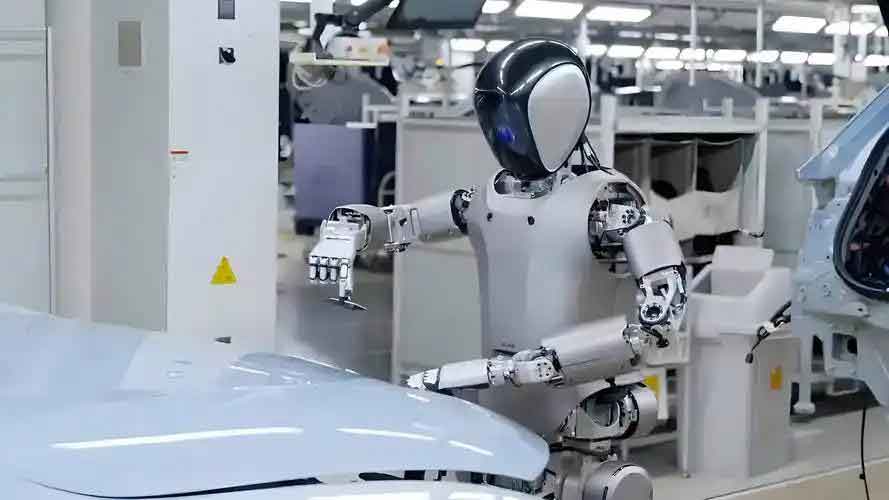
The journey of facial expression in humanoid robots can be mapped onto three distinct phases characterized by their core technological signature and interactive capability. This progression is summarized in Table 1, which expands upon foundational milestones to illustrate the paradigm shifts.
| Stage & Core Signature | Timeframe | Technological Focus | Representative Systems | Interactive Paradigm |
|---|---|---|---|---|
| I. Foundational Emotional Interaction Stimulus-Response with Basic Models |
Late 1990s – ~2005 | Integration of basic sensors (camera, mic) with pre-defined, discrete emotional models. Mechanical actuation for gross facial movements. | Kismet (MIT), WE-3RII (Waseda) | Reactive, scripted. Robots respond to simple external cues (e.g., tone of voice, proximity) with a fixed set of expressions. |
| II. Multimodal Fusion & Dynamic Interaction Advanced Perception with Internal State Models |
~2005 – ~2015 | Multimodal sensor fusion (3D vision, touch). Introduction of dynamic internal affective models (e.g., chaotic neural networks, PAD space). Improved actuation (pneumatics, better mechanics). | WE-4RII (Waseda), Nexi (MIT), SAYA (Tokyo Tech) | Context-aware, proactive. Robots integrate multiple sensory inputs to maintain an internal emotional state, leading to more varied and situationally appropriate expressions. |
| III. AI-Driven Personalized Empathy Deep Learning & Advanced Embodiment |
~2015 – Present | Deep learning for perception/generation. Integration of Large Language Models (LLMs) for dialogue and reasoning. High-fidelity biomimetic materials (Frubber), advanced mechatronics, and sophisticated spatio-temporal control. | Sophia (Hanson), Ameca (Engineered Arts), Xiao Qi (EX-Robots) | Adaptive, personalized, and empathetic. Robots generate nuanced, context-sensitive expressions in real-time, aiming for emotional resonance and long-term relationship building. |
This evolution underscores a clear path from mechanistic replication to the emulation of emotionally intelligent behavior. The remainder of this review dissects the two intertwined core challenges that define the current state-of-the-art: the design of the physical face itself and the computational mind that animates it.
I. The Physical Canvas: Biomimetic Structural Design for Facial Expression
Creating a physical substrate capable of replicating the subtlety of human facial movement is a profound engineering challenge. My analysis identifies a layered approach: a theoretical framework for deconstruction, a mechanical system for actuation, and a synthetic skin for embodiment.
1.1 The Foundational Lexicon: Facial Action Coding System (FACS)
The Facial Action Coding System (FACS) provides the essential semantic framework. It decomposes facial expressions into 46 fundamental Action Units (AUs), each correlating to the contraction of specific facial muscle groups. For a humanoid robot, FACS transforms the continuous, analog problem of expression generation into a parameterized, digital control task. The engineering goal becomes mapping a subset of these AUs to physical actuators. A core subset of AUs critical for basic expressions is detailed in Table 2.
| Action Unit (AU) Number | FACS Name | Muscular Basis | Typical Role in Expression |
|---|---|---|---|
| 1 | Inner Brow Raiser | Frontalis (pars medialis) | Sadness, surprise (combined with other AUs) |
| 2 | Outer Brow Raiser | Frontalis (pars lateralis) | Surprise, fear |
| 4 | Brow Lowerer | Depressor supercilii, Corrugator supercilii | Anger, concentration |
| 5 | Upper Lid Raiser | Levator palpebrae superioris | Surprise, fear |
| 6 | Cheek Raiser | Orbicularis oculi (pars orbitalis) | Genuine smile (Duchenne marker) |
| 7 | Lid Tightener | Orbicularis oculi (pars palpebralis) | Anger, intensity |
| 9 | Nose Wrinkler | Levator labii superioris alaeque nasi | Disgust |
| 12 | Lip Corner Puller | Zygomaticus major | Smile, happiness |
| 15 | Lip Corner Depressor | Depressor anguli oris | Frown, sadness |
| 17 | Chin Raiser | Mentalis | Doubt, contempt |
| 23 | Lip Tightener | Orbicularis oris | Anger, determination |
| 25 | Lips Part | Relaxation of orbicularis oris, depressor labii inferioris | Speech, surprise, joy |
The primary challenge lies not in static mapping but in dynamic, real-time control. Transitioning between expressions requires the coordinated, smooth interpolation of multiple AU intensities. Modern approaches leverage AI to learn these transitions. For instance, a reinforcement learning policy $\pi$ can be trained to output optimal AU intensity vectors $\mathbf{a}_t$ at time $t$, given a target emotional state $e_{target}$ and the current facial state $\mathbf{s}_t$:
$$ \pi: (e_{target}, \mathbf{s}_t) \rightarrow \mathbf{a}_t $$
where $\mathbf{a}_t = [AU1\_intensity, AU2\_intensity, …, AU\_n\_intensity]^T$ and the policy $\pi$ is optimized to minimize a cost function $C$ that penalizes jerkiness, delay, and deviation from the target expression $\mathbf{a}_{target}$:
$$ \pi^* = \arg\min_{\pi} \mathbb{E}\left[ \sum_{t} C(\mathbf{a}_t, \mathbf{a}_{target}, \Delta \mathbf{a}_t) \right] $$
Here, $\Delta \mathbf{a}_t$ represents the change in AU intensities, penalizing abrupt movements.
1.2 Mechanical Architectures: From Rigid Linkages to Hybrid Actuation
The mechanical realization of AUs has evolved from purely “mechanical” designs using linkages and servos (e.g., early Waseda robots) to “biomimetic” designs employing pneumatic artificial muscles (PAMs) or shape-memory alloys to mimic muscle contraction (e.g., Hanson’s robots). The state-of-the-art, as I observe in platforms like Ameca, is a hybrid multi-modal actuation system. This system strategically combines different actuator types: high-precision, high-stiffness servo motors for large-displacement areas like the jaw or brow, and softer, compliant actuators like PAMs or tendon-driven systems for fine-grained control of lips and eyelids. The control paradigm for such a humanoid robot face often follows a three-tier hierarchy: 1) Affective Semantics (DNN interprets context into target AUs), 2) Kinematic Mapping (AUs mapped to actuator setpoints), and 3) Hybrid Force/Position Control (impedance control coordinates the diverse actuators for smooth motion).
1.3 The Embodiment Challenge: Skins and the Uncanny Valley
The synthetic skin is the final and most perceptually critical layer. While silicone offers ease of manufacturing, materials like Hanson’s “Frubber” provide superior mechanical fidelity, enabling natural skin wrinkling. However, increasing static realism often heightens the risk of the “Uncanny Valley” effect—a sharp dip in affinity as a robot appears almost, but not perfectly, human. I contend this effect is primarily triggered by multimodal mismatch: a highly realistic face paired with subtly unnatural dynamics (e.g., micro-delays, unsynchronized eye movements).
The frontier of skin research, however, has shifted from passive aesthetics to active sensing. The goal is to create “e-skin” that is not only elastic and lifelike but also embedded with dense sensor networks for touch, pressure, and temperature. This introduces formidable material science challenges: the trade-off between conductivity (adding carbon nanotubes) and mechanical properties; signal crosstalk in multimodal sensor arrays; insulating oxide layers on composite surfaces causing unstable readings; and mechanical mismatch leading to delamination. Overcoming these is essential for a humanoid robot to have true “somatic” awareness, closing the loop between expression and tactile feedback.
II. The Computational Mind: Multimodal Affective Interaction Systems
The physical face must be animated by an intelligent system capable of perceiving context, generating appropriate emotional states, and orchestrating multimodal outputs. This computational layer has evolved from simple finite-state machines to complex, AI-driven architectures.
2.1 Affective Modeling: From Dimensional Spaces to LLM-Based Cognition
Early affective models for humanoid robots often employed dimensional spaces like the PAD (Pleasure-Arousal-Dominance) model. A robot’s internal state $\mathbf{E}$ could be represented as a point in this 3D space: $\mathbf{E} = (P, A, D)$. Stimuli from the environment would trigger vector shifts $\Delta \mathbf{E}$ according to pre-defined rules. Modern approaches are increasingly leveraging Large Language Models as a central cognitive engine. An LLM can serve as a unified affective reasoner, processing multimodal input (user speech, camera feed) and generating not only textual responses but also affective metadata (e.g., target emotion label, intensity) that drives the expression engine. This shifts modeling from hard-coded rules to data-driven, context-sensitive inference.
2.2 Facial Expression Synthesis: From Parameterized to Generative Models
The synthesis of facial animation has moved beyond manually keyframed AU sequences. Data-driven, generative models are now dominant. For example, generative adversarial networks (GANs) or variational autoencoders (VAEs) can be trained on human facial expression datasets. These models learn a latent space $\mathbf{z}$ of expressions. Synthesizing a smooth transition from expression $A$ to $B$ becomes an interpolation in this latent space: $\mathbf{z}(t) = (1-\alpha(t))\mathbf{z}_A + \alpha(t)\mathbf{z}_B$, where $\alpha(t)$ is a smooth interpolation function from 0 to 1. The decoder network $G$ then generates the corresponding, natural-looking AU intensities or even direct facial imagery for a virtual face: $\mathbf{a}_t = G(\mathbf{z}(t))$. This approach is key to mitigating mechanical, robotic movement.
2.3 The Crucible of Naturalness: Multimodal Spatio-Temporal Alignment
The ultimate test of a humanoid robot‘s emotional intelligence is the seamless, coherent integration of its expressive channels—speech prosody, facial expression, and gesture. Achieving this requires a multimodal spatio-temporal alignment mechanism. The core challenge is the heterogeneity and different temporal dynamics of each modality. A spoken word has a precise duration, while a smile onset and offset have different, softer boundaries.
Advanced architectures now use transformers and reinforcement learning to solve this. Consider a model that must generate a coordinated action sequence. It receives a language command $L$, a visual context $V$, and the current robot state $S_t$. The transformer model $T$ uses cross-attention to align features across these modalities and outputs a sequence of “action tokens,” which include parameters for speech synthesis, facial AUs, and joint angles. A Q-learning framework, like Q-Transformer, can then be used to optimize this sequence for task success and naturalness. The alignment can be formulated as finding a policy that maximizes the expected cumulative reward $R$, which includes a synchronization penalty $R_{sync}$:
$$ \pi^* = \arg\max_{\pi} \mathbb{E}_{\pi}\left[ \sum_{t=0}^{T} \gamma^t (R_{task}(s_t, a_t) + \lambda R_{sync}(\mathbf{m}_t)) \right] $$
where $\mathbf{m}_t = \{face\_AU\_t, speech\_params\_t, gesture\_t\}$ is the multimodal output vector at time $t$, and $R_{sync}$ penalizes temporal misalignment (e.g., a smile occurring significantly after a happy vocalization). This mathematically encapsulates the engineering goal of coherent, believable emotional output from a humanoid robot.
III. Conclusion and Future Trajectories
In my assessment, the field of facial expression for humanoid robots stands at an inflection point. The convergence of advanced mechatronics, intelligent materials, and foundation AI models has unlocked unprecedented capabilities. However, the path toward truly natural and trustworthy emotional interaction is paved with significant, interdependent challenges that define the research agenda for the coming decade.
1. Fundamental Physical Bottlenecks: The development of robust, manufacturable, and highly sensorized e-skin remains a grand challenge. Solutions must simultaneously address conductivity-mechanical trade-offs, signal integrity, long-term durability, and power delivery for embedded sensors. Until these material science hurdles are overcome, the humanoid robot will lack the rich somatic sensing that underpins much of human nonverbal communication.
2. Computational and Cultural Dilemmas: While LLMs offer powerful cognitive engines, their integration into real-time robotic systems demands solutions for computational efficiency (e.g., model compression, edge computing). More profoundly, the problem of cultural bias and adaptation is critical. Most models are trained on Western-coded emotional data, risking inappropriate expressions in other cultural contexts. Creating culturally adaptive affective models requires curated, diverse datasets and novel few-shot or meta-learning techniques.
3. The Multimodal “Uncanny Valley”: Eliminating eeriness requires solving the multimodal alignment problem with extreme precision. Future work must develop metrics and learning objectives that explicitly minimize perceptual mismatch, ensuring that all expressive channels are not just individually realistic but also perfectly synchronized and semantically congruent in time and space.
4. Ethical Alignment and Transparency: As robots become more convincingly emotional, the risks of “emotional deception” or manipulation increase. Future systems must incorporate principles of explainable AI (XAI) to make their affective decision-making processes interpretable. Furthermore, clear ethical guidelines and, where necessary, regulatory frameworks must be established to govern the use of emotional expression in humanoid robots, particularly in sensitive domains like childcare or therapy.
In conclusion, the endeavor to gift humanoid robots with the capacity for facial emotion is fundamentally about enhancing human connection, not creating its artificial substitute. By tackling these intertwined challenges in embodiment, computation, and ethics with rigorous, cross-disciplinary collaboration, we can steer the development of humanoid robots towards becoming genuine social partners that understand, respect, and appropriately respond to the complexities of human emotion.