
The global technological landscape is witnessing a paradigm shift, moving from specialized machines to versatile, general-purpose agents. At the forefront of this revolution stands the humanoid robot, a synthetic embodiment of advanced artificial intelligence, precision engineering, and novel materials. As the physical instantiation of next-generation productive forces, the humanoid robot represents not merely an incremental improvement but a foundational technology poised to redefine manufacturing, services, and daily life. Its development is increasingly seen as a critical benchmark for a nation’s or region’s capability in high-end innovation and future industrial competitiveness.
This convergence is largely catalyzed by breakthroughs in generative artificial intelligence and large language models, which provide the cognitive architecture for these machines. The path to a truly intelligent humanoid robot is governed by a synergistic integration of hardware and software. We can conceptualize the core challenge as optimizing a system where perception, decision-making, and actuation are seamlessly aligned. A simplified representation of this control objective can be framed as minimizing a cost function $J$ over time:
$$
J = \int_{0}^{T} ( \mathbf{x}_d(t) – \mathbf{x}(t) )^T Q ( \mathbf{x}_d(t) – \mathbf{x}(t) ) + \mathbf{u}(t)^T R \mathbf{u}(t) \, dt
$$
where $\mathbf{x}_d(t)$ is the desired state vector (e.g., position, posture, manipulated object state), $\mathbf{x}(t)$ is the actual state, $\mathbf{u}(t)$ represents the control inputs (joint torques), and $Q$ and $R$ are weighting matrices balancing tracking accuracy against control effort. Solving this in real-time for a high-degree-of-freedom humanoid robot in unstructured environments is the holy grail of robotics.
Global Dynamics and Strategic Posturing
The international race for humanoid robot supremacy is intensifying, characterized by massive investments, strategic corporate alliances, and national-level industrial policies. The market potential is staggering, with projections indicating a transformation from niche research to a mainstream industry.
| Source | Timeframe | Projected Market Size | Key Notes |
|---|---|---|---|
| Goldman Sachs | 2035 | $152 Billion | Comparable to current EV market size. |
| Industry Visionaries | Long-term | Trillions of USD | Speculation of unit numbers surpassing human population. |
| Industry Reports | 2029 | China: ~$105B (750B RMB) | Anticipated to constitute ~32.7% of global total. |
Investment momentum is overwhelmingly positive. Tech titans and venture capital are placing strategic bets across the entire value chain. NVIDIA, OpenAI, and Amazon are leading funding rounds for startups like Machina Labs, 1X Technologies, and Agility Robotics’ Digit, respectively. This signals a strong belief in the enabling role of AI and the commercial viability of humanoid robot platforms. Currently, primary application efforts are concentrated on Business-to-Business (B2B) and research scenarios. For instance, initial deployments of advanced prototypes are targeted at automating complex tasks in manufacturing logistics and assembly, a testing ground before eventual Consumer (B2C) adoption.
Nationally, strategic guidance is becoming explicit. Leading economies have issued development guidelines, such as the “Innovation Development Guidance for Humanoid Robots,” which outline roadmaps for breaking through key technologies, cultivating products, expanding applications, and fostering industrial ecosystems. This is often backed by specialized funding schemes to de-risk early-stage development.
Anatomy of a Competitive Edge: Foundations and Capabilities
Developing a region as a hub for humanoid robot innovation requires a robust foundation across several dimensions: whole-machine integration, core component supply, and AI brainpower. A preliminary analysis reveals a promising, though evolving, ecosystem.
Whole-Machine Pioneers: The most visible layer of the ecosystem consists of companies capable of integrating a complete humanoid robot. Success here depends on mastering the dynamic control (“cerebellum”) and mechanical design. Key performance indicators for a bipedal platform include walking speed, stability margin, and payload-to-weight ratio. The stability of a walking humanoid robot is often analyzed using the concept of the Zero Moment Point (ZMP). For stable walking, the ZMP must remain within the support polygon defined by the feet:
$$
\mathbf{r}_{ZMP} = \frac{\sum_{i=1}^{n} m_i (\mathbf{\ddot{r}}_i – \mathbf{g}) \times z_i – \sum_{i=1}^{n} I_i \dot{\mathbf{\omega}}_i}{\sum_{i=1}^{n} m_i (\ddot{z}_i – g_z)}
$$
Where simplified, stability requires $\mathbf{r}_{ZMP} \in \text{Support Polygon}$. Companies that have demonstrated public, dynamic motion in their platforms hold a significant early-mover advantage.
Critical Components and Enabling Technologies: The performance of the whole machine is dictated by its constituent parts. The supply chain for a humanoid robot is specialized and demanding.
| Component Category | Technical Requirements | Key Challenges |
|---|---|---|
| Actuators (e.g., Harmonic Drives, Planetary Roller Screws) | High torque/weight ratio, backdrivability, precision. | Cost, durability, power efficiency. |
| Servo Motors & Drivers | High response frequency, compact size, reliability. | Heat dissipation, control bandwidth. |
| Force/Torque Sensors | High dynamic range, accuracy, integrated design. | Calibration, signal noise, cost. |
| Vision Systems (2D/3D) | Real-time processing, robustness to lighting, depth accuracy. | Computational load, sensor fusion. |
| Embedded AI Compute | High TOPS/Watt, low latency, neural network acceleration. | Power budget, thermal management. |
The “Brain”: Embodied AI and Cloud Integration: The true differentiation of a humanoid robot will be its intelligence. This moves beyond pre-programmed motions to adaptive, learning-based interaction. The architecture often involves a hybrid model: an on-board “brainstem” for low-level reflexive control and a cloud-connected “cortex” for high-level task planning, knowledge retrieval, and model training. The development of large multimodal models fine-tuned for physical interaction—Embodied AI models—is crucial. The learning process for a manipulation task can be modeled as optimizing a policy $\pi_\theta(\mathbf{a}_t | \mathbf{o}_t)$ that maps observations $\mathbf{o}_t$ to actions $\mathbf{a}_t$ to maximize expected reward $R$:
$$
\max_\theta \mathbb{E}_{\tau \sim p_\theta(\tau)} \left[ \sum_{t=0}^{T} \gamma^t r(\mathbf{s}_t, \mathbf{a}_t) \right]
$$
where $\tau = (\mathbf{s}_0, \mathbf{a}_0, …, \mathbf{s}_T, \mathbf{a}_T)$ is a trajectory, and $p_\theta$ is the trajectory distribution induced by policy $\pi_\theta$.
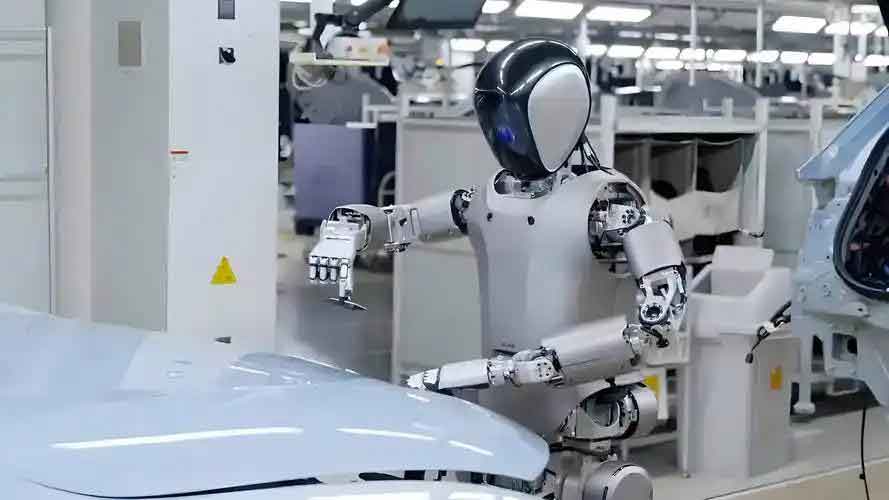
The transition from research prototypes to commercial products faces a “Valley of Death,” where challenges in cost, reliability, and safety must be overcome. Key hurdles include achieving sufficient battery energy density for practical operational duration, ensuring fail-safe mechanisms for human-robot collaboration, and developing simulation-to-reality (Sim2Real) pipelines that allow efficient training of AI models in virtual environments before real-world deployment.
Building a Conducive Ecosystem: Strategic Imperatives
Cultivating a thriving humanoid robot industry transcends supporting individual companies. It requires a holistic, system-level strategy that addresses innovation, commercialization, and adoption in parallel.
1. Integrated Policy and Strategic Clustering: Clear, forward-looking industrial policy is a catalyst. This involves not just financial subsidies but the strategic creation of innovation districts or special zones that co-locate R&D labs, component suppliers, testing facilities, and startups. The goal is to minimize transaction costs and foster serendipitous collaboration. A comparative analysis of policy tools is essential.
| Mechanism Type | Typical Instruments | Potential Impact on Humanoid Robot Development |
|---|---|---|
| Financial & Fiscal | R&D tax credits, innovation grants, dedicated industry funds. | De-risks capital-intensive early R&D attracts venture investment. |
| Infrastructure & Platform | Open-source software platforms, shared testing grounds, national innovation centers. | Lowers entry barrier for startups; accelerates validation and iteration. |
| Demand-Side & Adoption | Public procurement of innovation, application scenario subsidies, regulatory sandboxes. | Creates early-market demand; provides real-world data for improvement. |
| Talent & Ecosystem | Specialized university programs, talent attraction schemes, international conference hosting. | Builds sustainable talent pipeline; enhances global visibility and network effects. |
2. Fostering Application-Led Innovation: Technology pushes must be met with market pulls. Proactively creating and opening application scenarios is vital for iterative development. Priority sectors include:
- Advanced Manufacturing: For non-ergonomic, repetitive, or hazardous assembly and logistics tasks.
- Healthcare and Assistive Services: As aids for rehabilitation or elderly care, requiring gentle and compliant interaction.
- Emergency Response & Inspection: In environments dangerous for humans, such as nuclear sites or disaster zones.
Establishing public-private “living labs” where humanoid robot prototypes can be tested and refined in real operational environments is a powerful tool to bridge the gap between lab and market.
3. Cultivating a Synergistic Supply Network: A resilient and advanced local supply chain is a strategic asset. The focus should be on moving component suppliers up the value chain—from generic parts manufacturers to specialized partners for the humanoid robot industry. This involves fostering deep technical collaboration between integrators and suppliers on next-generation actuator design, sensor fusion techniques, and lightweight materials. Mapping the local supply chain in detail—creating “competency maps”—helps identify critical gaps and opportunities for import substitution or breakthrough innovation.
4. Securing the Talent and Capital Flywheel: The competition for talent in AI, robotics, and advanced mechatronics is global and fierce. A successful hub must offer compelling career trajectories, world-class research institutions, and a vibrant community of practitioners. Similarly, financing the long development cycles of hardware-AI fusion requires patient, specialized capital. Beyond government seed funding, the growth of private venture capital and corporate venture arms focused on deep tech is a key indicator of ecosystem maturity.
In conclusion, the era of the humanoid robot is dawning, propelled by convergent advances in AI and robotics. Its development trajectory will be shaped by complex interactions between technological possibility, economic incentive, and strategic foresight. Regions that can successfully architect ecosystems integrating bold vision, foundational research, agile commercialization, and dynamic talent will not only capture a significant share of this future industry but will also shape the very role these artificial entities play in our collective future. The journey is as much about building machines as it is about building the collaborative human networks that bring them to life.