
The field of robotics stands at a fascinating crossroads, where mechanical engineering, computer science, and biology converge. As a researcher deeply immersed in this interdisciplinary domain, I see the bionic robot, particularly the quadrupedal form, as a pivotal evolution in machine capability. It represents not merely a machine with legs, but a sophisticated integration platform—a fusion of mechanics, electronics, control theory, sensing, and artificial intelligence. This synthesis creates a highly adaptable, resilient, and intelligent system capable of operating in environments that are unstructured, hazardous, or inaccessible to humans and conventional wheeled or tracked vehicles. The true potential of the bionic robot lies in its ability to decouple body motion from foot placement, granting it an active suspension-like capability that ensures stability and smooth payload transport over the roughest terrain.
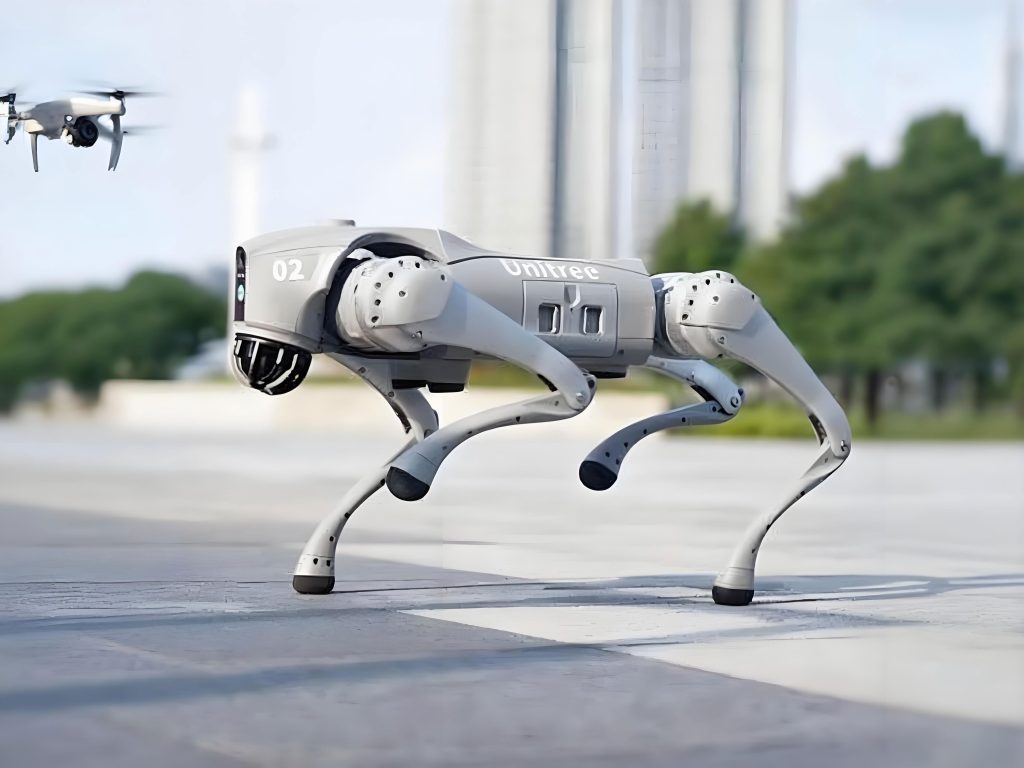
The fundamental advantage of a legged bionic robot over its wheeled counterparts is grounded in the principles of discontinuous contact. Wheels require a continuous path of support, their performance ultimately limited by the worst terrain feature they encounter. In contrast, a legged system uses discrete, optimized footholds. Its flexibility is limited not by the worst terrain, but by the availability of viable footholds within its reachable workspace. This allows a bionic robot to navigate rocky ground, stairs, debris, and steep slopes with a dexterity that mimics biological counterparts. The motion of its body \( \mathbf{p}_b(t) \) and the trajectory of its feet \( \mathbf{p}_{f,i}(t) \) are decoupled, a relationship that can be conceptually modeled as:
$$ \mathbf{p}_b(t) = \mathcal{F}( \mathbf{p}_{f,1}(t), \mathbf{p}_{f,2}(t), …, \mathbf{p}_{f,n}(t), \mathbf{u}(t) ) $$
where \( \mathbf{u}(t) \) represents the control inputs and \( \mathcal{F} \) is a complex function describing the body dynamics. This decoupling is the key to the bionic robot‘s superior adaptability.
Core Technological Pillars of the Modern Bionic Robot
The journey from a mechanically ambulatory machine to an intelligent, autonomous bionic robot hinges on breakthroughs in several interdependent technological areas. These are the pillars upon which true environmental fusion and useful autonomy are built.
1. Terrain Perception and Modeling
For a bionic robot to move intelligently, it must first understand its world. Animals seamlessly fuse visual and proprioceptive data to adjust gait and posture. Similarly, a robotic system requires real-time fusion of exteroceptive (terrain) and proprioceptive (self-pose) information. This creates a critical “terrain understanding and gait behavior” control loop. The primary tools for this are vision and LiDAR-based Simultaneous Localization and Mapping (SLAM) systems. The challenge is to process this data into a actionable world model—identifying traversable regions, obstacles, and optimal footholds—with sufficient speed and accuracy to inform real-time control decisions. The quality of perception directly constrains the agility of the bionic robot.
Table 1: Comparison of Perception Technologies for Bionic Robots
| Sensor Type | Advantages | Disadvantages | Primary Role in Bionic Robot |
|---|---|---|---|
| Stereo Vision | Rich texture/color data, passive, lower cost. | Sensitive to lighting, computationally heavy for dense 3D. | Terrain classification, visual odometry, object recognition. |
| LiDAR (2D/3D) | High-accuracy depth data, works in low light. | Higher cost, can be affected by weather (e.g., fog). | High-precision mapping, obstacle detection, foothold planning. |
| Depth Camera (e.g., ToF, Structured Light) | Good balance of cost and dense 3D data, compact. | Limited outdoor range, sensitive to sunlight. | Short-range obstacle avoidance, indoor navigation. |
| Inertial Measurement Unit (IMU) | High-frequency body pose (orientation, acceleration). | Drifts over time (no absolute reference). | Body state estimation, fusion with vision/LiDAR for stability. |
2. Dynamic Gait and Stability Control
The soul of a bionic robot is its gait controller—the algorithm that orchestrates the rhythmic, stable movement of its legs. Modern controllers are sophisticated hybrids, often combining multiple theoretical models to achieve robustness. The core objective is to maintain the robot’s balance (often modeled as controlling its Center of Mass (CoM) and angular momentum) while executing desired motions, even under external disturbances.
Key control paradigms include:
- Central Pattern Generators (CPG): Bio-inspired neural oscillators that generate rhythmic leg movement signals. They offer natural robustness and gait transitions. A simple CPG model for a single leg joint can be represented as coupled oscillators:
$$ \ddot{\phi}_i + \alpha (\phi_i^2 – r^2)\dot{\phi}_i + \omega^2 \phi_i = \sum_{j} w_{ij} \phi_j $$
where \( \phi_i \) is the phase of oscillator \(i\), \( \alpha, r, \omega \) are parameters, and \( w_{ij} \) are coupling weights.
- Spring-Loaded Inverted Pendulum (SLIP): A highly simplified yet powerful template model for dynamic running. It treats the leg as a spring and the body as a point mass, capturing the essential energy exchange of galloping or hopping.
Table 2: Primary Gait Control Models for Bionic Robots
| Model | Description | Strengths | Weaknesses |
|---|---|---|---|
| CPG (Central Pattern Generator) | Network of coupled nonlinear oscillators generating rhythmic signals. | Natural gait transitions, inherent robustness to perturbations. | Less optimal for precise trajectory tracking; parameters can be hard to tune. |
| SLIP (Spring-Loaded Inverted Pendulum) | Template model treating body as mass and leg as spring. | Excellent for modeling energetic, dynamic gaits like running. | Oversimplified; requires careful anchoring to full robot model. |
| MPC (Model Predictive Control) | Optimizes a sequence of future control inputs based on a dynamic model. | Explicitly handles constraints (force, friction), previews future terrain. | Computationally expensive; reliant on accuracy of dynamic model. |
| WBC (Whole-Body Control) | Formulates control as a quadratic program (QP) optimizing all joint tasks. | Unified framework for mobility and manipulation; respects physical limits. | Complex to implement; requires solving QP at high frequency. |
| Reinforcement Learning (RL) | Trains control policy through trial-and-error interaction with a simulator. | Can discover highly robust and adaptive gaits without explicit programming. | Massive data/compute requirements; sim-to-real transfer challenge. |
The state-of-the-art lies in hybrid approaches, such as using WBC to manage instantaneous force distribution while MPC plans the CoM trajectory, or employing RL to train a robust policy that is then fine-tuned with model-based methods.
3. Swing Leg Trajectory and Foothold Planning
Moving beyond fixed, periodic gaits is essential for a bionic robot to handle complex terrain. This requires intelligent, real-time planning of where each foot should land during its swing phase. The process involves: 1) Using perception to identify safe, stable regions (footholds), 2) Generating a collision-free trajectory for the foot from its lift-off point to the target foothold, and 3) Executing this trajectory via precise joint control.
Simple trajectories like sinusoidal curves are insufficient as they lack control over intermediate velocity and are not adaptable. Bézier curves are a powerful alternative. An n-th order Bézier curve for foot trajectory in one axis is defined by:
$$ B(t) = \sum_{i=0}^{n} \binom{n}{i} (1 – t)^{n-i} t^i P_i, \quad t \in [0, 1] $$
where \( P_i \) are the control points. By adjusting \( P_i \), one can precisely shape the path, speed, and acceleration of the foot, ensuring a swift yet safe placement. Once the Cartesian foot trajectory \( \mathbf{p}_{foot}(t) = [x(t), y(t), z(t)]^T \) is planned, joint angles \( \mathbf{q} = [q_1, q_2, q_3]^T \) are computed using inverse kinematics. For a simple 3-DOF leg, this involves solving:
$$ \mathbf{p}_{foot} = f_{kin}(\mathbf{q}) $$
where \( f_{kin} \) is the forward kinematics function of the leg chain.
4. Manipulation on a Floating Base
The ultimate utility of a mobile bionic robot is often realized when it can interact with and manipulate its environment. Integrating a robotic arm onto the dynamic, “floating” base of a legged robot presents a profound control challenge known as “whole-body coordinated control.” The key difficulty is that forces and torques generated at the arm’s end-effector (e.g., when lifting a weight or pushing a door) directly affect the balance of the entire platform.
The solution involves dynamically mapping the external wrench \( \mathbf{F}_{ext} \) at the end-effector to the robot’s CoM. This is done using the arm’s Jacobian \( \mathbf{J}_a \) and the base Jacobian \( \mathbf{J}_b \). The resulting disturbance force on the base must be compensated for by the legs’ contact forces. This is typically formulated as a force distribution optimization problem within a WBC framework. An impedance control model at the arm’s end-effector can be used to manage interaction forces:
$$ \mathbf{M}_d \ddot{\mathbf{e}} + \mathbf{D}_d \dot{\mathbf{e}} + \mathbf{K}_d \mathbf{e} = \mathbf{F}_{ext} $$
where \( \mathbf{e} \) is the pose error, and \( \mathbf{M}_d, \mathbf{D}_d, \mathbf{K}_d \) are the desired inertia, damping, and stiffness matrices. The estimated \( \mathbf{F}_{ext} \) is then fed into the whole-body balance controller. This integration of “foot-eye-brain-hand” systems is critical for turning a mobile bionic robot into a versatile field operative.
Application Scenarios: The Bionic Robot in Action
The theoretical capabilities of the bionic robot are being validated in real-world scenarios, demonstrating its transformative potential across several industries.
Table 3: Current and Emerging Applications for Bionic Robots
| Application Domain | Key Tasks | Technical Requirements | Example |
|---|---|---|---|
| Security & Defense | Reconnaissance, surveillance, explosive ordnance disposal (EOD), patrol. | Silent operation, high terrain mobility, payload for sensors (cameras, X-ray, chemical). | Deployment in police units for building clearance; military use for perimeter patrol and hazard detection. |
| Industrial Inspection | Automated patrol of plants, substations, offshore platforms; reading gauges, detecting leaks (thermal). | Long endurance, precise navigation, ability to climb stairs and step over pipes, hazard-proofing. | Inspecting electrical substations or offshore oil & gas platforms, accessing confined or hazardous spaces. |
| Search & Rescue (SAR) | Exploring collapsed structures after disasters, assessing stability, locating victims. | Extreme terrain negotiation (rubble, steep inclines), robust comms tethering, gas/thermal sensing. | Deployment in earthquake or explosion sites to map interiors and locate survivors before human entry. |
| Public Safety & Logistics | Crowd monitoring, delivering supplies in hazardous areas, hospital support. | Safe human-robot interaction (HRI), navigation in dense dynamic environments, manipulation for delivery. | Park patrol for social distancing enforcement, delivering medicine in quarantine zones. |
Future Trajectory and Concluding Perspective
The development of the bionic robot is accelerating globally, driven by national research initiatives and growing market recognition of its unique value proposition. The focus is shifting from achieving basic dynamic locomotion to enabling high-level autonomy and dexterous manipulation in unpredictable environments. The future roadmap involves several critical avenues:
- Enhanced Intelligence through AI: Deeper integration of machine learning, particularly reinforcement learning and sim-to-real transfer techniques, to develop more adaptive, resilient, and “teachable” control policies for the bionic robot.
- Component-Level Innovation: Breakthroughs in core hardware are essential. This includes high-torque-density actuator modules (often called “robotic joints” or “smart actuators”), energy-dense batteries, lightweight yet strong composite materials, and more robust, compact sensors. Improving the power-to-weight ratio is a constant pursuit.
- Multi-Robot Collaboration: Enabling teams of bionic robots to cooperate on complex tasks, such as carrying large objects, coordinated search patterns, or relay-based communication in denied environments.
- Improved Human-Robot Interface (HRI): Developing more intuitive methods for human operators to task and supervise bionic robot teams, ranging from high-level mission commands to immersive teleoperation with haptic feedback.
The journey of the bionic robot is a testament to the power of interdisciplinary engineering. It is more than a machine; it is a platform for exploring the intersection of autonomy, mobility, and interaction. From inspecting critical infrastructure to saving lives in disaster zones, the bionic robot is poised to become an indispensable partner, extending human capability into realms once considered too dangerous or difficult. The challenge ahead is not merely to make it walk or run, but to endow it with the perceptual intelligence and physical competence to operate seamlessly and usefully in our complex world. The evolution of this bionic robot represents a fundamental step towards a future where intelligent machines work alongside us, enhancing safety, productivity, and our ability to explore and understand our environment.