
As I reflect on the rapid advancements in artificial intelligence, I am struck by the growing consensus that the next frontier lies in embodied AI, particularly in the form of AI human robots. The so-called “ChatGPT moment” for these AI human robots—a pivotal point where they achieve widespread adoption and trigger a surge in industry shipments—is a topic of intense speculation and excitement. In this article, I will explore the current state, challenges, and future prospects of AI human robots, drawing on industry trends and technological insights. I will use tables and formulas to summarize key points, ensuring a comprehensive analysis that highlights the potential of AI human robots to transform sectors like manufacturing, healthcare, and daily life.
The concept of a ChatGPT moment for AI human robots refers to a breakthrough similar to the explosive growth of language models, where a single innovation catalyzes mass deployment. Currently, I observe that the development of AI human robots is in its early stages, with many companies and research institutions focusing on foundational technologies. For instance, the hardware components, such as actuators and sensors, are still being refined to enable more fluid and human-like movements. The performance of an AI human robot can be modeled using a simple equation that relates hardware capabilities to software intelligence: $$ \text{Robot Performance} = \alpha \cdot \text{Hardware Efficiency} + \beta \cdot \text{AI Model Accuracy} $$ where $\alpha$ and $\beta$ are weighting factors that vary based on the application. This formula underscores the interdependence of physical and cognitive aspects in AI human robots.
In terms of applications, AI human robots are gradually moving from laboratories to real-world environments. I have compiled a table below that summarizes the primary sectors where these robots are being tested or deployed, along with their current capabilities and limitations. This highlights the diversity of use cases for AI human robots, from industrial settings to personal assistance.
| Sector | Current Applications | Key Challenges | Potential Impact |
|---|---|---|---|
| Industrial Manufacturing | Assembly line tasks, quality inspection, material handling | High cost, limited adaptability to dynamic environments | Increased efficiency and reduced labor costs |
| Hazardous Environments | Nuclear waste handling, firefighting, pipeline inspection | Safety risks, need for robust AI decision-making | Enhanced human safety and operational reliability |
| Education and Research | Teaching aids, experimental platforms for AI development | High initial investment, limited functionality | Accelerated learning and innovation in robotics |
| Healthcare and Elderly Care | Rehabilitation exercises, companionship, basic nursing tasks | Complex user interactions, ethical concerns, high development costs | Addressing workforce shortages and improving quality of life |
| Logistics and Services | Warehouse automation, delivery services, customer interaction | Navigation in unstructured spaces, real-time processing demands | Streamlined supply chains and enhanced service efficiency |
From my perspective, the journey toward the ChatGPT moment for AI human robots is fraught with technical and economic hurdles. One major challenge is the cost-effectiveness of these systems. For example, the production cost of an AI human robot can be expressed as: $$ C_{\text{robot}} = C_{\text{materials}} + C_{\text{manufacturing}} + C_{\text{AI development}} $$ where $C_{\text{materials}}$ includes components like sensors and actuators, $C_{\text{manufacturing}}$ covers assembly processes, and $C_{\text{AI development}}$ involves training and fine-tuning AI models. Currently, high costs limit accessibility, but economies of scale could drive prices down, similar to trends in consumer electronics. I believe that once the cost drops below a threshold—say, $20,000 per unit—the adoption of AI human robots could accelerate dramatically, especially in service industries.
Another critical aspect is the AI intelligence behind these AI human robots. The evolution of embodied AI models can be described by a learning curve: $$ L(t) = L_0 \cdot e^{kt} $$ where $L(t)$ represents the learning progress over time $t$, $L_0$ is the initial capability, and $k$ is a constant dependent on data availability and algorithmic improvements. This exponential growth mirrors the trajectory of large language models like ChatGPT, suggesting that a breakthrough in AI human robot cognition is imminent. In fact, I anticipate that within the next three to five years, we will see AI human robots capable of general-purpose tasks, such as navigating homes or assisting in complex surgeries, thanks to advances in multimodal AI that integrate vision, language, and motor control.
Safety and reliability are paramount for AI human robots, particularly as they integrate into daily life. A risk assessment formula can be applied: $$ R = P_{\text{failure}} \times I_{\text{impact}} $$ where $R$ is the overall risk, $P_{\text{failure}}$ is the probability of system failure, and $I_{\text{impact}}$ is the consequence of such failures. For AI human robots operating in homes or healthcare, $I_{\text{impact}}$ is high, necessitating robust fail-safes and ethical guidelines. I have observed that regulatory frameworks are still evolving, but initiatives like public-private partnerships are crucial for establishing standards that ensure AI human robots are both safe and trustworthy.
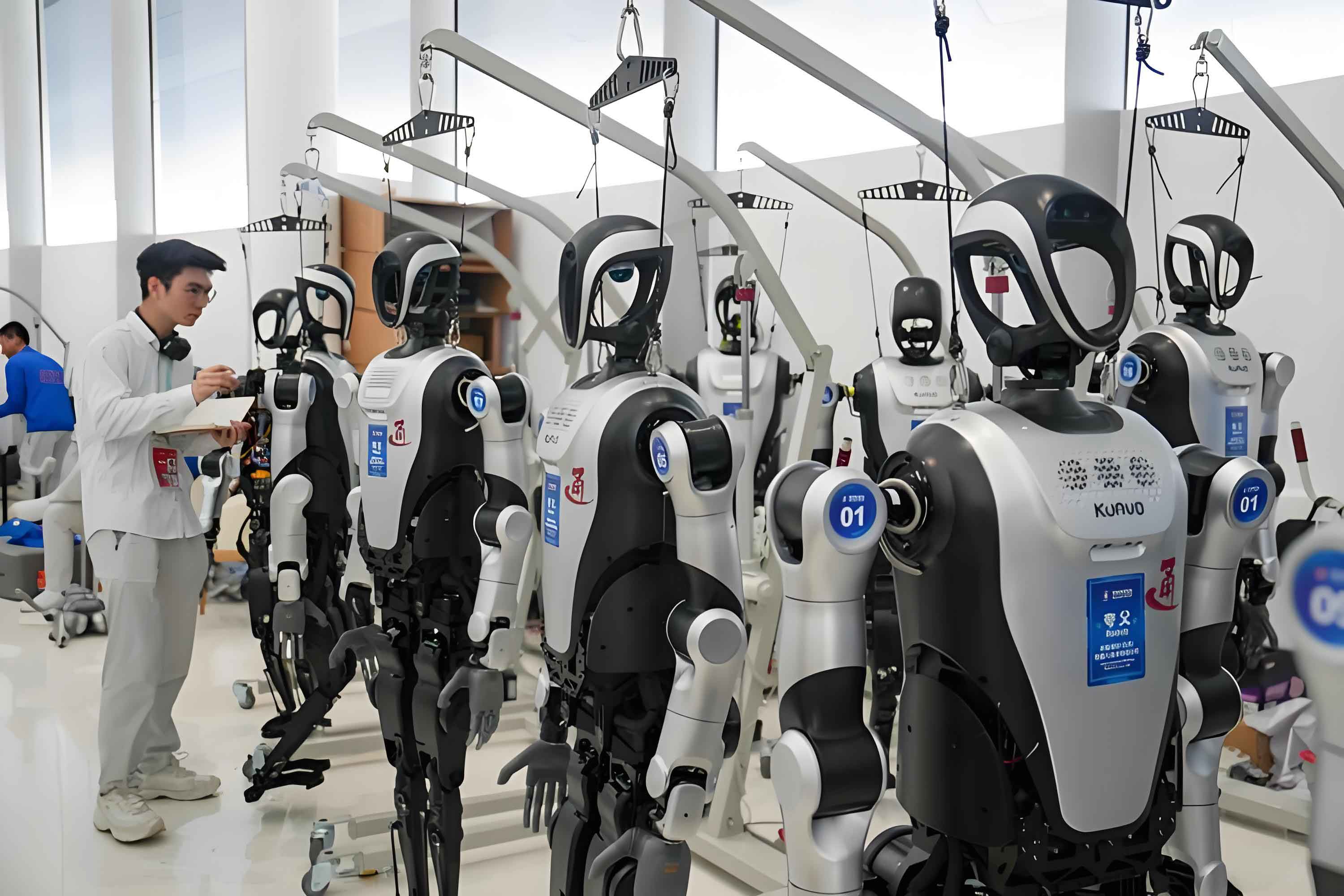
Globally, the race to dominate the AI human robot market is intensifying. I have analyzed the competitive landscape and created a table that compares the strengths and weaknesses of key regions. This underscores the collaborative yet rivalrous dynamics in the development of AI human robots.
| Region | Strengths | Weaknesses | Notable Trends |
|---|---|---|---|
| North America | Leading AI research, strong venture capital funding, innovation in software algorithms | Higher production costs, regulatory complexities | Early adoption in logistics and healthcare; focus on general-purpose AI human robots |
| Asia | Mass manufacturing capabilities, large talent pool, government support | Less mature AI foundational models, intellectual property challenges | Rapid prototyping and deployment in industrial sectors; emphasis on cost reduction |
| Europe | Strong regulatory frameworks, expertise in precision engineering | Slower commercialization, fragmented market | Focus on ethical AI and safety standards; applications in automotive and healthcare |
In my view, the ChatGPT moment for AI human robots will likely be triggered by a convergence of factors, including cost reductions, AI model breakthroughs, and scalable applications. For instance, the adoption rate of AI human robots can be modeled using a diffusion equation: $$ \frac{dA}{dt} = r A \left(1 – \frac{A}{K}\right) $$ where $A$ is the number of adopters, $r$ is the growth rate, and $K$ is the carrying capacity of the market. Based on current trends, I predict that this moment could occur within the next five years, driven by innovations in AI human robot cognition and mobility. Specifically, advances in reinforcement learning and simulation-based training are enabling AI human robots to learn complex tasks faster, reducing the time from development to deployment.
Moreover, the economic impact of AI human robots is substantial. I estimate that the total addressable market for AI human robots could reach trillions of dollars by 2050, with applications spanning multiple industries. A cost-benefit analysis for businesses adopting AI human robots can be represented as: $$ \text{Net Benefit} = \sum (\text{Revenue Gains} – \text{Operational Costs}) \times \text{Time} $$ where revenue gains include productivity improvements and cost savings from automation. In sectors like elderly care, the benefits of AI human robots extend beyond economics to social welfare, as they can alleviate caregiver shortages and enhance independence for aging populations.
However, I must acknowledge the uncertainties. The development of AI human robots is not just a technical challenge but also a societal one. Public acceptance, ethical considerations, and job displacement fears could slow adoption. To address this, I advocate for inclusive policies that promote education and retraining, ensuring that the rise of AI human robots benefits humanity as a whole. In conclusion, the ChatGPT moment for AI human robots is on the horizon, and I am optimistic that with continued innovation and collaboration, these intelligent machines will soon become integral to our daily lives, revolutionizing how we work, live, and interact.
As I wrap up this analysis, I want to emphasize that the future of AI human robots hinges on interdisciplinary efforts—combining robotics, AI, and human-centered design. The formula for success in this field is multifaceted: $$ S = I_{\text{tech}} \times C_{\text{collab}} \times P_{\text{policy}} $$ where $S$ represents overall success, $I_{\text{tech}}$ is technological innovation, $C_{\text{collab}}$ is global collaboration, and $P_{\text{policy}}$ is supportive policy frameworks. By fostering these elements, we can accelerate the arrival of the ChatGPT moment for AI human robots, ushering in an era where these machines are as ubiquitous and transformative as smartphones are today.