
Let me tell you a story. It’s a simple, everyday moment, but it’s at the very heart of why we do what we do. I’m in my office, a typical workspace in a bustling city. With a simple voice command, I connect to my parents’ home thousands of miles away. The screen comes to life not with a static image of them waiting by a device, but with a live, flowing view of their living room. My mother is reading a book in her favorite armchair, natural light from the window illuminating the page. My father is pottering about in the background.
“Mom, what are you doing?” I ask.
“I’m reading,” she replies, glancing up with a smile but not moving an inch.
“You should turn on the lamp, it’s getting dark in there,” I suggest.
“Oh, you’re right,” she says, reaching casually for the switch. The conversation flows seamlessly—no lag, no echo, no need for them to stop their activity or fumble with a ‘connect’ button. They are in their space; I am in mine. Yet, we are sharing the same moment. The device facilitating this sits on their coffee table, a good seven or eight meters from where my mother sits. The clarity is impeccable. This is not a video call. This is a window. This is the promise of the intelligent **companion robot**.
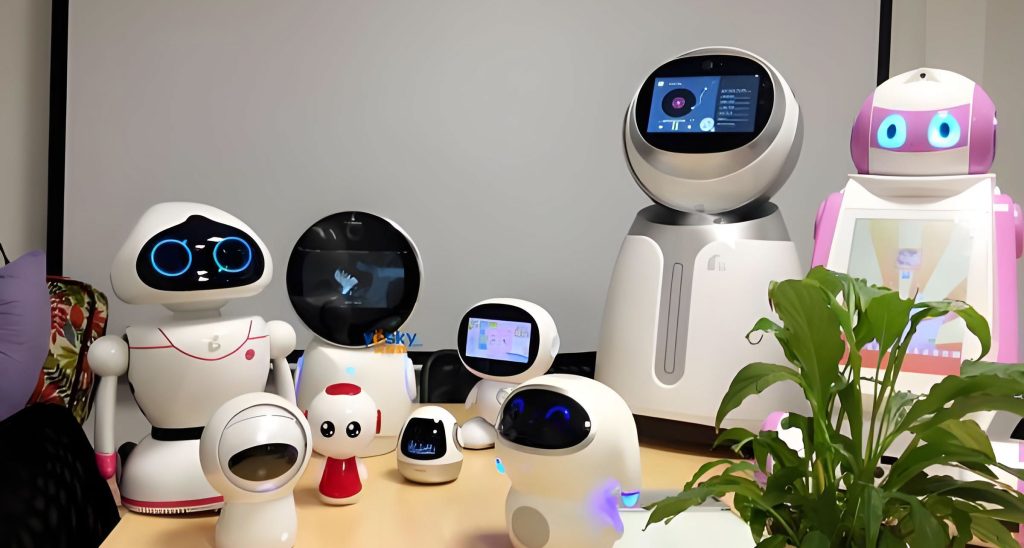
When people first see our product, a common reaction is: “My smartphone can do video calls. What’s the difference?” This question is the perfect starting point to explain our fundamental innovation. A smartphone is a personal, portable communication device designed for interruptive, task-oriented communication. Its paradigm is one of intrusion and direct engagement. Our **companion robot** is designed for ambient, presence-oriented connection. It is a stationary portal meant to blend into the domestic environment, enabling what we call Fragmented Real-Time Communication (FRTC).
To understand this distinction mathematically, we can model the “cost” or “friction” of a communication act. Let $C_{total}$ represent the total friction of initiating and maintaining a communication session. It is a function of several variables:
$$C_{total} = f(T_{setup}, E_{interruption}, D_{formality}, P_{presence})$$
Where:
- $T_{setup}$: Time and steps required to establish connection (e.g., finding phone, unlocking, opening app, dialing, waiting for answer).
- $E_{interruption}$: The cognitive and physical effort required to stop the current activity to engage.
- $D_{formality}$: The perceived weight or formality of the communication act.
- $P_{presence}$: The lack of ambient awareness of the remote party’s context.
For a traditional smartphone video call, all these factors are high. For our **companion robot**, we engineered to minimize each one, particularly $E_{interruption}$ and $P_{presence}$. The result is a friction coefficient approaching zero, which directly increases communication frequency $F$ and duration $D$ within a family unit. We can express this relationship as:
$$F \times D \propto \frac{1}{C_{total}}$$
As $C_{total} \to 0$, $F \times D \to \infty$. In human terms: lower friction leads to more frequent, longer, and more natural interactions.
| Feature | Telephone Call | Smartphone Video Chat | Messaging (e.g., WeChat) | Companion Robot (FRTC) |
|---|---|---|---|---|
| Primary Mode | Interruptive, Audio | Interruptive, Audiovisual | Asynchronous, Fragmented | Ambient, Fragmented Real-Time |
| Setup Friction ($T_{setup}$) | Medium | High | Low | Very Low (Always-on, voice-initiated) |
| Interruption Level ($E_{interruption}$) | Very High | Very High | Low | Very Low (Continue activity) |
| Context Awareness ($P_{presence}$) | None | Low (Framed, staged view) | None | High (Wide-angle, ambient view of room) |
| Core Value | Information Transfer | Face-to-face information transfer | Asynchronous updates | Shared Presence & Companionship |
This shift from interruptive to ambient is technologically non-trivial. It demands excellence in several domains simultaneously: acoustic engineering for far-field voice pickup and clarity, optical engineering for wide-angle, high-quality video in variable light, and robust network protocols to ensure seamless synchronization without latency or jitter. Our team’s heritage from leading global firms in unified communications, cloud-based audio/video services, and consumer hardware was not an accident; it was a prerequisite. Building a true **companion robot** requires fusing the reliability of enterprise-grade telepresence with the simplicity and aesthetics of consumer electronics. The core audio processing pipeline, for instance, involves sophisticated algorithms for noise suppression, acoustic echo cancellation (AEC), and beamforming that can be summarized by a simplified transfer function:
$$Y(\omega) = H_{bf}(\omega) * [S(\omega) \cdot H_{room}(\omega) + N(\omega)] – \hat{E}(\omega)$$
Where $Y(\omega)$ is the processed output signal in the frequency domain, $H_{bf}$ is the beamforming filter, $S$ is the source speech, $H_{room}$ is the room impulse response, $N$ is ambient noise, and $\hat{E}$ is the estimated echo to be canceled. Achieving this reliably at a distance of 8 meters in a typical living room is the “technical forte” that makes the magic of a natural conversation possible.
The hardware is just the beginning, the enabler. The true product is the experience and the platform. We designed the **companion robot** to facilitate a “virtual shared space.” Users can create family circles. When my spouse is talking to our parents via their device, I receive a gentle notification and can “drop in” instantly, creating a spontaneous multi-party interaction. One device can have multiple “rooms,” acting as a key to different private or shared spaces—a grandparents’ living room, a partner’s workshop, a child’s play area. The **companion robot** dissolves geographical boundaries, creating a persistent, accessible nexus for the modern distributed family.
The societal need is profound and quantified. The “4-2-1” family structure (four grandparents, two parents, one child) common among generations born in the 70s and 80s has created immense pressure. Consider the scale:
| Demographic Group | Estimated Population in China | Core Need |
|---|---|---|
| “Empty Nester” Elderly | > 100 Million | Daily connection, safety, reduced loneliness |
| Elderly with limited self-care ability | > 30 Million | Remote check-ins, coordination of care |
| Left-Behind Children | > 60 Million | Parental presence, homework help, emotional bonding |
| Geographically dispersed families | Tens of Millions | Shared daily experiences, maintaining familial cohesion |
This is the first layer of value: connection as a service. But the intelligence of a **companion robot** unlocks a second, deeper layer: insight as a platform. This is where our vision expands from a communication device to a central node for the smart home and O2O (Online-to-Offline) services.
When used daily, a **companion robot** becomes a rich sensor of household patterns and needs—all with user consent and privacy safeguards. It understands rhythms: when the family wakes up, when an elderly member typically takes medication, when the child returns from school. Through its interactive features, it can learn preferences. This data, anonymized and aggregated, forms a dynamic model of the household $H$:
$$H(t) = \{ D_m, P_a, S_r, R_o, E_c \}$$
- $D_m$: Demographic data (age groups present).
- $P_a$: Activity patterns (sleep, meals, downtime).
- $S_r$: Service requests (implicit or explicit, e.g., “I wish I had some congee,” “The light in the hallway is flickering”).
- $R_o$: Routine observations (medication reminders, mood indicators from interaction frequency/tone).
- $E_c$: External context (weather, time of year).
This model allows the **companion robot** to evolve from a passive portal to an active agent. It can provide proactive, personalized suggestions. More importantly, it creates an unparalleled platform for service delivery. Imagine a scenario where the system, noting that an elderly user has been coughing more frequently and has mentioned feeling unsteady, can:
- Gently suggest scheduling a telemedicine consultation via the device.
- After the consultation, offer a one-touch button to order the prescribed medicine from a partnered pharmacy for same-day delivery.
- Notify a family member in the family circle about the doctor’s advice.
- Later, suggest a light, nutritious meal from a local restaurant that delivers congee.
This is not science fiction; it is the logical extension of a connected, intelligent **companion robot**. The business model inherency shifts. We do not aim to profit primarily from the communication between families. That is the foundational, value-creating layer. The monetization occurs on the platform layer, through targeted, high-convenience, high-trust O2O services: meal delivery, grocery restocking, medicine, home repair, pet care, tutoring, entertainment subscriptions. The value equation for the platform can be modeled as a function of network size and data depth:
$$V_{platform} = N_{active}^{ \alpha } \cdot \Gamma( \int_{t} Data_{richness}(H(t)) \, dt )$$
Where $N_{active}$ is the number of active households, $ \alpha > 1$ represents the network effects (more households attract better service providers, which in turn attract more households), and $\Gamma$ is a function quantifying the actionable intelligence derived from the continuous stream of rich household data.
This platform potential is what energizes our team and our investors. The journey from a hardware startup to a platform company is challenging but clear. Our roadmap involves:
- Perfecting the Core Experience: Relentlessly improving audio/video quality, AI features (like automatic camera framing and activity recognition), and user interface simplicity.
- Expanding the Ecosystem: Opening APIs for developers to create skills and integrations for the **companion robot**, from smart home control to educational games.
- Building the Service Marketplace: Curating and integrating trusted service providers, ensuring seamless, secure transactions facilitated by the device.
- Advancing the AI: Developing more sophisticated contextual awareness and predictive algorithms to make the **companion robot** genuinely proactive and helpful.
The wave of smart hardware is full of devices that seek to automate tasks. Our vision for the **companion robot** is different. It is not about replacing human interaction; it is about augmenting and sustaining it across distances life imposes. It’s about turning a house into a home that’s always open to loved ones, and turning that home into a hub for care and convenience. The ultimate metric of success is not units sold, but moments of connection facilitated and needs seamlessly met. In a world of increasing physical separation, the **companion robot** stands as a testament to the idea that technology, at its best, doesn’t isolate us—it weaves us closer together, one fragment of real-time presence at a time.