
The integration of robotics into healthcare represents one of the most transformative technological frontiers of our era. As a researcher deeply embedded in this interdisciplinary convergence, I observe that the field of dental medicine stands at a particularly fascinating inflection point. The medical robot, once a figment of science fiction, is now an evolving reality within the oral cavity—a confined, complex, and sensitive operating environment. The journey of dental medical robot technology, spanning nearly three decades, has transitioned from theoretical concepts and phantom-based experiments to tangible systems assisting in live clinical procedures. This evolution is not merely about mechanizing manual tasks; it is fundamentally about augmenting human capability, enhancing precision beyond physiological limits, standardizing outcomes, and redefining the paradigms of patient care, education, and surgical planning. The core motivation stems from a compelling need: to translate diagnostic data into therapeutic action with sub-millimeter accuracy, minimize procedural invasiveness, and reduce the physical and cognitive burden on the clinician. In this extensive overview, I will delve into the current state of dental medical robot applications, analyze their operational principles through technical frameworks, and project their future trajectory, underscoring the profound role they are poised to play in the next revolution of oral healthcare.
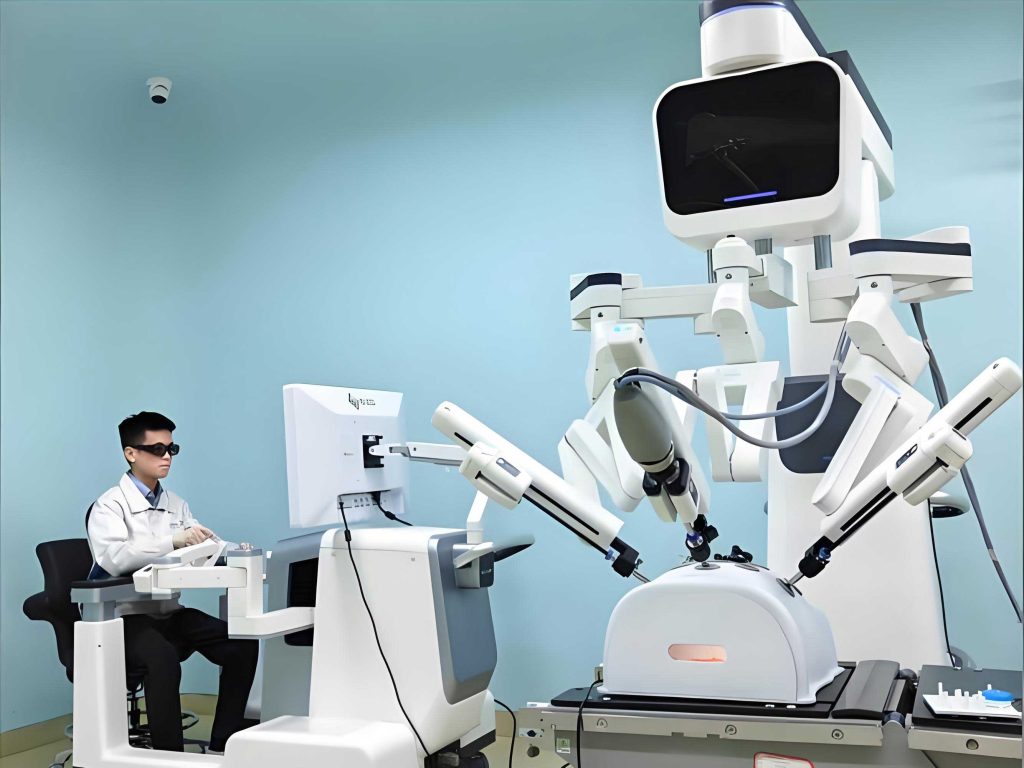
The foundational principle enabling modern dental robotics is the seamless integration of digital data flow. This pipeline, often referred to as the “digital thread,” begins with high-fidelity 3D data acquisition of the patient’s anatomy. The process can be mathematically described as mapping a physical volume $V_{patient}$ to a digital model $M_{digital}$. This is typically achieved via Cone Beam Computed Tomography (CBCT) for hard tissues and intraoral scanners for soft tissues and dentition.
$$ M_{digital} = \int_{V_{patient}} \rho(x, y, z) \, dV $$
where $\rho(x, y, z)$ represents the radiographic density or optical surface data at each point in space. This model $M_{digital}$ becomes the substrate upon which treatment is virtually planned. Surgical planning software allows the clinician to define optimal implant axes, orthodontic tooth movement paths, or resection margins. This plan, essentially a set of target poses $T_{target}$ for the robot’s end-effector (e.g., a drill, laser, or scalpel) in the coordinate frame of $M_{digital}$, is the critical input. The central challenge for the medical robot is to execute this plan in the physical coordinate frame of the patient $V_{patient}$, accounting for potential movement. This is achieved through dynamic registration and tracking, often formulated as solving for a transformation matrix $R$ that minimizes error:
$$ \min_{R} \sum || T_{target} – R \cdot T_{actual} ||^2 $$
where $T_{actual}$ is the real-time tracked position. The robot’s control system then uses this information to guide its actuators, often with integrated force-torque sensing for haptic feedback and safety compliance. This closed-loop system of imaging, planning, registration, and robotic execution forms the bedrock of contemporary applications.
Current Application Domains: A Technical Analysis
The application of medical robot systems in dentistry has proliferated across various specialties, each presenting unique technical challenges and solutions. The following table summarizes the key domains, their technological enablers, and clinical impact.
| Application Domain | Core Robotic Function | Key Enabling Technologies | Reported Advantages & Current State |
|---|---|---|---|
| Implantology | Dynamic surgical navigation & precision osteotomy. | CBCT, optical/n electromagnetic tracking, haptic (force-feedback) guidance, pre-operative planning software. | Increased placement accuracy (angular deviation < 2°, apical deviation < 1 mm), flapless surgery potential, reduced operative time. Systems are commercially available (e.g., Yomi) and in advanced research. |
| Orthodontics | Automated, patient-specific archwire bending. | Intraoral scanning, CAD/CAM software, multi-axis robotic arm with precise bending mechanisms. | High-fidelity reproduction of virtual setups, consistency, time savings for clinicians. Commercial systems (e.g., SureSmile) are established. Research focuses on full-treatment automation. |
| Periodontics / Prophylaxis | Teleoperated or semi-autonomous ultrasonic scaling. | 3D visualization systems, force-sensitive manipulators, multi-DOF robotic arms for intraoral access. | Potential for reduced aerosol exposure to clinician, mitigation of operator fatigue, consistent application of force. Primarily in prototype/research stage. |
| Maxillofacial Surgery | Teleoperated assistance for endoscopic/transoral procedures. | Master-slave robotic systems (e.g., da Vinci), high-definition 3D endoscopy, tremor filtration, articulated instruments. | Enhanced visualization and dexterity in confined spaces (oropharynx, tongue base). Adopted from general surgery, application is growing. |
| Dental Education & Simulation | High-fidelity patient simulation and skill assessment. | Anthropomorphic robot patient (simulates movement, gag reflex), force feedback in simulated tissue, performance analytics software. | Standardized, repeatable training scenarios; objective assessment of student skill progression. Systems are commercially available and deployed in institutions. |
Deep Dive: Implant Robotics and Precision Metrics
Implantology serves as the flagship application for dental medical robot technology. The clinical success of an implant is critically dependent on its three-dimensional position, aligning with prosthetic goals while avoiding vital anatomical structures. Robotic systems address this by converting a static surgical guide into a dynamic, feedback-controlled process. The system’s performance is quantitatively evaluated by two primary error metrics: entry deviation ($\Delta E$) and apex deviation ($\Delta A$), which measure the linear discrepancy at the coronal and apical points of the osteotomy, respectively, and angular deviation ($\Delta \theta$).
$$ \Delta E = || P_{planned}^{entry} – P_{actual}^{entry} || $$
$$ \Delta A = || P_{planned}^{apex} – P_{actual}^{apex} || $$
$$ \Delta \theta = \arccos \left( \frac{\vec{v}_{planned} \cdot \vec{v}_{actual}}{||\vec{v}_{planned}|| \; ||\vec{v}_{actual}||} \right) $$
where $P$ denotes position vectors and $\vec{v}$ denotes the direction vectors of the planned vs. actual implant axis. A state-of-the-art medical robot system aims to minimize these parameters. Furthermore, the integration of real-time tracking allows for compensation of patient movement, a significant advantage over static guides. The control law for such a system often incorporates both position and force control:
$$ \tau = J^T ( K_p (x_d – x) + K_d (\dot{x}_d – \dot{x}) ) + \tau_{force} $$
where $\tau$ is the motor torque, $J$ is the Jacobian, $K_p$ and $K_d$ are gain matrices for position and damping, $x_d$ and $x$ are desired and actual end-effector poses, and $\tau_{force}$ is the torque adjustment based on measured force feedback to prevent excessive bone loading. This combination enables the robot to be both precise and safe, a non-negotiable requirement for a clinical medical robot.
Deep Dive: Orthodontic Robotics and Process Automation
In orthodontics, the medical robot transforms the digital treatment plan into a physical therapeutic appliance. The process begins with the digital setup—the virtual positioning of teeth into their desired final positions. The robotic challenge is to fabricate the archwire that will apply the forces to achieve this movement. This involves computing the complex series of bends, twists, and compensations needed. For a given wire segment between two bracket slots, the required bend can be defined by an angle $\alpha$ and a plane of rotation. The robot’s bending mechanism must apply these precisely. The accuracy of a bending medical robot can be modeled by a repeatability error $\sigma_{bend}$:
$$ \sigma_{total} = \sqrt{ \sigma_{bend}^2 + \sigma_{material}^2 + \sigma_{calibration}^2 } $$
where $\sigma_{material}$ accounts for springback of the wire alloy, and $\sigma_{calibration}$ for machine calibration errors. Advanced systems use closed-loop control with vision systems to measure the actual bend angle $\alpha_{actual}$ and compare it to $\alpha_{planned}$, making iterative corrections. This level of automation ensures that the clinical prescription is not subject to manual variability, leading to more predictable treatment outcomes and efficient use of chairside time.
Future Trajectories and Paradigm-Shifting Technologies
The future of the dental medical robot is not merely an extrapolation of current capabilities; it is poised for fundamental shifts driven by advancements in adjacent fields. The convergence of robotics with artificial intelligence, advanced materials science, and micro-engineering will unlock new functionalities and applications.
1. The Rise of Microrobotics and Nanorobotics: A significant trend is the dramatic miniaturization of robotic systems. Future medical robot systems may not always be external arms but could be cohorts of microscopic agents operating at the cellular or sub-cellular level. Imagine microrobots designed for targeted, non-contact biofilm disruption in periodontal pockets or for the precise delivery of remineralizing agents to incipient carious lesions. The mobility and control of such agents in the fluidic oral environment present fascinating challenges, often modeled using Stokes flow equations due to the low Reynolds number:
$$ Re = \frac{\rho v L}{\mu} \ll 1 $$
where $\rho$ is density, $v$ is velocity, $L$ is a characteristic length, and $\mu$ is dynamic viscosity. At this scale, inertial forces are negligible, and motion is dominated by viscous forces. Control might be achieved via external magnetic fields, chemical gradients, or acoustic propulsion. This represents a leap from macro-scale procedural assistance to micro-scale therapeutic intervention.
2. Embodiment of Intelligence: AI-Driven Autonomous Systems: The next-generation medical robot will be deeply cognitive. Machine learning algorithms, trained on vast datasets of clinical images, plans, and outcomes, will transition robots from passive tools following pre-set instructions to active collaborators capable of real-time intraoperative decision support. For instance, an AI-integrated implant robot could analyze real-time CBCT data during surgery to suggest minor trajectory adjustments to avoid an unforeseen anatomical variation, or a diagnostic robot could autonomously scan the dentition and flag regions suspicious for pathology with quantifiable confidence intervals. This shifts the role from “automation of action” to “augmentation of perception and judgment.”
3. The Soft Robotics Revolution: The rigid links and joints of traditional robots, while precise, are not ideal for safe interaction with the compliant, irregular tissues of the oral cavity. The emergence of soft robotics, using compliant materials like elastomers and employing pneumatic or tendon-driven actuation, promises a new paradigm. A soft robotic medical robot manipulator could gently conform to the palate or cheek for retraction, or navigate the sulcus for subgingival procedures with inherently safe contact. The kinematics of such systems are often described using continuum mechanics models rather than rigid-link Denavit-Hartenberg parameters. Their compliance and adaptability could make them ideal for patient-specific anatomy and for procedures requiring delicate tissue manipulation.
4. Advanced Haptic Feedback and Multisensory Integration: Future systems will move beyond basic force sensing to provide rich, multimodal haptic feedback to the operator. This could include the rendering of tissue stiffness differentiation (e.g., distinguishing caries from healthy dentin) or the sensation of cutting through different bone densities. Furthermore, sensory fusion will combine haptics with augmented reality (AR) visuals, overlaying vital structure boundaries or planned cutting paths directly onto the surgeon’s view of the operative field, creating a truly immersive and informative interface for the medical robot operator.
Conclusion: Toward a New Era of Personalized Oral Healthcare
In reflection, the trajectory of dental medical robot technology is one of accelerating convergence and capability. We are moving decisively from systems that assist with discrete, repetitive tasks to intelligent platforms capable of contributing across the entire continuum of care—from automated diagnosis and personalized treatment planning to precise, minimally invasive execution and long-term maintenance. The core value proposition remains steadfast: to elevate the standard of care by making procedures more accurate, predictable, less invasive, and accessible. While challenges in cost, regulation, clinical validation, and integration into existing workflows remain, the technological momentum is undeniable. As these systems become more intelligent, softer, smaller, and more integrated, they will cease to be perceived as mere tools and will become essential partners in the clinical team. The ultimate beneficiary of this evolution is the patient, who will receive care that is increasingly tailored, efficient, and of the highest possible quality. The ongoing research and development in this field are not just engineering pursuits; they are fundamental investments in the future of global oral health, promising to redefine what is possible in dental medicine.