
In the landscape of precision mechanical transmission systems, few technologies embody the principles of compactness, high reduction ratio, and positional accuracy as elegantly as the harmonic drive gear. My first encounter with this technology revealed a system fundamentally different from conventional gear trains. Rather than relying solely on the rigid engagement of teeth, it harnesses controlled elastic deformation—a concept that initially seemed counterintuitive for a durable transmission. This article synthesizes my exploration and understanding of harmonic drive gear systems, delving into their fundamental principles, design mathematics, application spectrum, and their pivotal role in modern engineering education.
The core innovation of a harmonic drive gear lies in its three primary components: the wave generator, the flexspline, and the circular spline. The wave generator, typically an elliptical cam surrounded by a specially designed “Flexible Bearing,” serves as the input and the source of the controlled deformation wave. The flexspline is a thin-walled, flexible cylindrical cup or ring with external teeth. The circular spline is a rigid, non-deformable ring with internal teeth. Critically, the number of teeth on the flexspline (\(N_f\)) is slightly less than that on the circular spline (\(N_c\)), usually by a difference equal to the wave number. This tooth difference is the key to its high reduction capability.
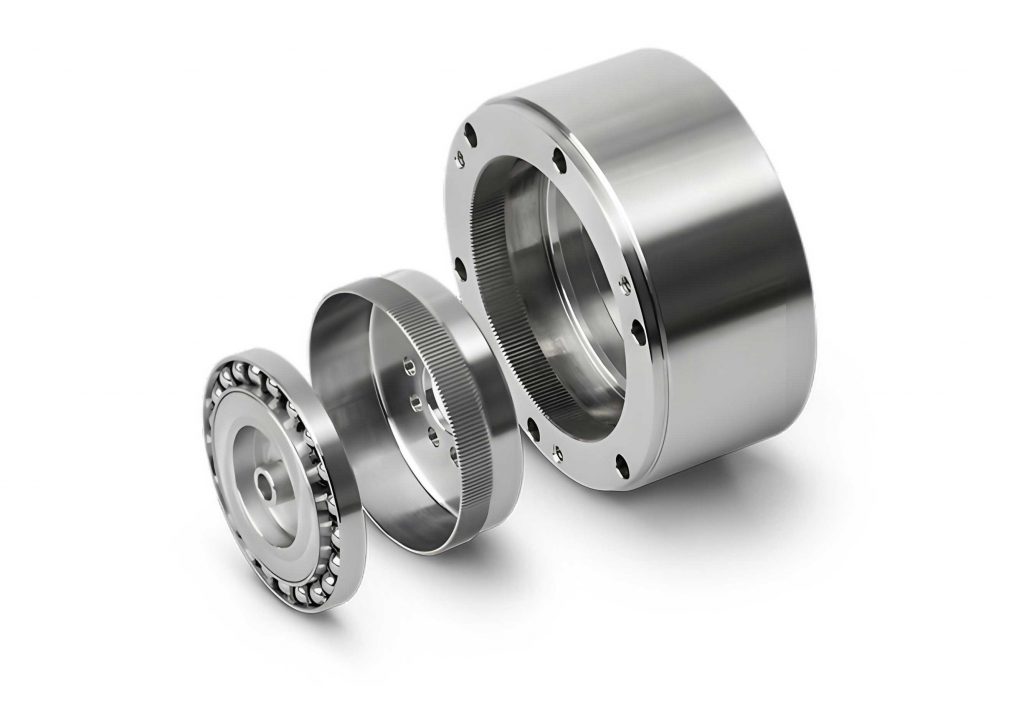
My analysis of the operational principle begins with assembly. When the elliptical wave generator is inserted into the flexspline, it forces the flexible component into an elliptical shape. At the major axis of the ellipse, the external teeth of the flexspline fully engage with the internal teeth of the circular spline. At the minor axis, the teeth are completely disengaged. The regions in between are in various states of mesh and unmesh. As the wave generator rotates, the points of maximum engagement travel around the circumference, creating a moving wave of deformation. Because the flexspline has fewer teeth, each complete revolution of the wave generator results in a small relative rotation between the flexspline and the circular spline in the opposite direction. This process is the essence of motion transfer in a harmonic drive gear.
Mathematical Foundation: Kinematics and Ratios
The kinematic relationship is straightforward yet profound. Defining the rotational speeds: \(\omega_{wg}\) for the wave generator, \(\omega_{fs}\) for the flexspline, and \(\omega_{cs}\) for the circular spline, the fundamental speed equation is derived from the constant meshing condition:
$$(N_c – N_f) \cdot \theta_{wg} = N_c \cdot \theta_{cs} – N_f \cdot \theta_{fs}$$
Where \(\theta\) represents angular displacement. From this, the standard transmission ratios can be derived for different configurations. For the most common case where the circular spline is fixed (\(\omega_{cs} = 0\)) and the wave generator is the input, the reduction ratio (\(i\)) for the flexspline output is:
$$i = \frac{\omega_{wg}}{\omega_{fs}} = -\frac{N_f}{N_c – N_f}$$
The negative sign indicates the output direction is opposite to the input. Conversely, if the flexspline is fixed and the wave generator is the input, the circular spline becomes the output, with a ratio:
$$i = \frac{\omega_{wg}}{\omega_{cs}} = \frac{N_c}{N_c – N_f}$$
This ratio is always positive. The magnitude of the reduction is governed by the tooth difference (\(N_c – N_f\)), which is typically 2 for a double-wave generator, the most prevalent configuration. This yields high single-stage reduction ratios, often between 50:1 and 160:1.
| Fixed Component | Input Component | Output Component | Reduction Ratio (i) | Direction |
|---|---|---|---|---|
| Circular Spline | Wave Generator | Flexspline | \(-N_f / (N_c – N_f)\) | Opposite |
| Flexspline | Wave Generator | Circular Spline | \(N_c / (N_c – N_f)\) | Same |
| Wave Generator | Flexspline | Circular Spline | \(N_c / N_f\) | Same (Speed Increase) |
Component Design and Material Considerations
The reliability and performance of a harmonic drive gear are dictated by the design and material science of its components. The flexspline is the heart of the system, undergoing cyclical elastic deformation. Its design involves complex stress analysis to prevent fatigue failure. The tangential stress (\(\sigma_t\)) and radial bending stress (\(\sigma_b\)) on the flexspline cup wall can be approximated by formulas involving the deformation force (\(F\)), wall thickness (\(h\)), and cup radius (\(R\)):
$$\sigma_t \propto \frac{F}{2\pi R h}, \quad \sigma_b \propto \frac{M}{Z}$$
where \(M\) is the bending moment and \(Z\) is the section modulus. Materials must have high endurance limit, good elasticity, and high tensile strength. Common choices include high-grade alloy steels like AISI 4340 or maraging steel, often subjected to nitriding or carburizing for surface hardness.
| Component | Material Requirements | Common Choices | Key Properties |
|---|---|---|---|
| Flexspline | High fatigue strength, toughness, good elastic limit | Alloy Steel (e.g., 30CrNiMo8), Maraging Steel | σ_ut > 1500 MPa, High endurance ratio |
| Circular Spline | High rigidity, wear resistance | Case-hardened Steel (e.g., 16MnCr5), Stainless Steel | High surface hardness (HRC 58-62) |
| Wave Generator Bearing | Low friction, high durability under deformation | Special “Flexible Bearing” with thin cross-section | Precision Grade (ABEC 7/9), Special heat treatment |
| Cam / Housing | Structural rigidity | Aluminum Alloy (e.g., 7075), Steel | High stiffness-to-weight ratio |
The wave generator’s elliptical profile is not a simple ellipse but is often designed as a “cam contour” to optimize stress distribution in the flexspline. A common profile is based on a cosine function to ensure smoother force transition. The radial deflection (\(\delta\)) of the flexspline neutral line as a function of angular position (\(\phi\)) relative to the wave generator can be modeled as:
$$\delta(\phi) = \delta_0 \cdot \cos(2\phi)$$
for a double-wave generator, where \(\delta_0\) is the maximum deflection at the major axis. The tooth geometry itself is also specialized. Unlike involute gears, harmonic drive gear teeth often use a “S-shaped” or “conjugate” profile to accommodate the changing contact angle and sliding action during engagement, minimizing wear and backlash. The pressure angle (\(\alpha\)) varies dynamically during mesh.
Advantages, Disadvantages, and Performance Characteristics
The unique operating principle of the harmonic drive gear confers a remarkable set of advantages. First is its exceptional compactness and high power density; a large speed reduction is achieved in a single stage within a very small volume. Second is its near-zero backlash and high positional accuracy, which is repeatable and can be pre-tuned, making it ideal for servo applications. Third is its high torque capacity relative to size, stemming from the fact that a significant percentage of teeth (often 15-30%) are engaged simultaneously compared to 1-2 teeth in a standard gear mesh. The co-axial input/output shaft arrangement also simplifies mechanical design.
However, a balanced engineering assessment must acknowledge its limitations. The primary drawback is torque ripple and hysteresis caused by elastic deformation and friction. The efficiency, while good for high-ratio drives (typically 65-90% per stage), is lower than that of precision planetary gearboxes due to sliding friction and elastic hysteresis losses. Torsional stiffness, although high, is finite and nonlinear due to the flexspline’s compliance. Furthermore, the flexspline has a finite fatigue life, imposing a critical service life limit based on cycle count and peak torque.
| Parameter | Harmonic Drive Gear | Planetary Gear (High-Ratio) |
|---|---|---|
| Single-Stage Ratio Range | 50:1 to 160:1 (Standard), up to 320:1 | 3:1 to 12:1 |
| Backlash | Very Low (≤ 1 arcmin, often zero) | Low to Medium (1-10 arcmin) |
| Torque Density | Very High | High |
| Torsional Stiffness | High (but non-linear) | Very High (linear) |
| Efficiency (per stage) | ~70-90% | ~90-97% |
| Critical Failure Mode | Flexspline fatigue | Bearing or tooth surface fatigue |
| Primary Applications | Robotics, Aerospace, CNC, Precision stages | Industrial automation, Automotive, Heavy machinery |
Designing Educational Experiments and Laboratory Equipment
Translating the theory of the harmonic drive gear into tangible understanding requires hands-on experimentation. From an educational perspective, developing dedicated lab equipment is invaluable. A well-designed experimental platform should allow students to: 1) observe and assemble the core components, 2) measure kinematic relationships (speed, direction), 3) quantify mechanical characteristics (torque, efficiency, stiffness, backlash), and 4) potentially engage in a simplified design exercise.
A basic experimental setup I conceptualize includes a modular harmonic drive gear reducer mounted on a test bench. The input shaft (wave generator) is driven by a servo motor with a precision encoder. The output shaft (flexspline or circular spline, depending on configuration) is connected to a magnetic particle brake or similar programmable load. Torque sensors on both input and output sides, along with high-resolution encoders, provide real-time data acquisition. The housing should have transparent panels or be sectioned to allow visual observation of the tooth engagement during operation under load.
The experimental curriculum can be structured in phases. The first phase is Exploration and Assembly. Students disassemble and reassemble the unit, identifying each component, understanding the role of the wave generator in creating deformation, and observing the tooth difference. The second phase is Kinematic Validation. Students configure the drive in different ways (circular spline fixed, flexspline fixed) and measure the actual reduction ratio, comparing it to the theoretical value calculated from tooth counts:
$$i_{measured} = \frac{\text{Input RPM}}{\text{Output RPM}} \approx i_{theoretical} = \frac{N}{N_c – N_f}$$
The third, more advanced phase is Performance Characterization. Students conduct tests to plot efficiency (\(\eta\)) as a function of output torque (\(T_{out}\)) and speed:
$$\eta = \frac{P_{out}}{P_{in}} = \frac{T_{out} \cdot \omega_{out}}{T_{in} \cdot \omega_{in}}$$
They can also measure static torsional stiffness (\(k_t\)) by applying a gradually increasing load torque (\( \Delta T \)) and measuring the angular deflection (\( \Delta \theta \)):
$$k_t = \frac{\Delta T}{\Delta \theta}$$
Plotting this relationship often reveals a slight hysteresis loop, a perfect lead-in to discuss material elasticity and energy loss mechanisms within the harmonic drive gear. Finally, a Design Project challenge can be posed: given a set of requirements for a small robotic joint (e.g., maximum size, output torque, reduction ratio), students must select appropriate nominal parameters (module \(m\), tooth numbers, wave generator deflection \(\delta_0\)) and perform basic stress checks.
| Requirement | Value | Design Choice / Calculation |
|---|---|---|
| Output Torque | 30 Nm | Given |
| Reduction Ratio | 100:1 | Select \(N_c = 200\), \(N_f = 198\) → \(i = -198/(2) = -99\) |
| Max Outer Diameter | 80 mm | Constraint |
| Gear Module (m) | To be determined | Start with standard: m = 0.3 mm |
| Pitch Diameter (Circular Spline) | \(D_c = m \cdot N_c\) | \(D_c = 0.3 \cdot 200 = 60 \text{ mm}\) (Fits constraint) |
| Tooth Engagement Force (approx.) | \(F_t \approx 2T_{out} / D_c\) | \(F_t \approx (2 \cdot 30) / 0.06 = 1000 \text{ N}\) |
| Flexspline Wall Stress Check | Must be < Fatigue Limit | Use \(\sigma \approx F_t / (2\pi R h)\) to estimate required wall thickness \(h\) |
Applications and Future Directions
The application space for the harmonic drive gear is vast and growing, primarily driven by the demands of high-performance motion control. In robotics, it is the quintessential actuator for robotic joints in industrial arms, humanoid robots, and surgical robots, prized for its compactness, zero-backlash, and high torque. In aerospace and satellite systems, its reliability, light weight, and precision are critical for antenna positioning, solar array drives, and optical instrument control. Other key areas include semiconductor manufacturing equipment, precision CNC rotary tables, and medical imaging devices.
Future developments in harmonic drive gear technology focus on pushing performance boundaries. Research is active in new composite materials for the flexspline to extend fatigue life and reduce weight. Advanced lubrication techniques and surface coatings aim to reduce friction and wear, thereby improving efficiency and longevity. “Smart” integrated designs incorporating sensors for torque, temperature, and wear directly into the gear assembly are emerging for condition monitoring and predictive maintenance. Furthermore, the principles of strain wave gearing are being explored for novel applications in micro-electromechanical systems (MEMS) and compliant mechanisms.
In conclusion, the harmonic drive gear stands as a masterpiece of kinematic design, transforming a simple elastic deformation into a highly effective and reliable transmission solution. Its mathematical elegance is matched by its practical utility in some of the most demanding engineering fields. For educators and students alike, it serves as a perfect subject to bridge advanced theory—encompassing elasticity, kinematics, contact mechanics, and material science—with hands-on engineering practice. Developing a deep, experiential understanding of the harmonic drive gear is not merely an academic exercise; it is foundational training for the next generation of engineers who will design the precise, compact, and intelligent mechanical systems of the future.