
As a researcher deeply immersed in the field of advanced robotics, I have witnessed the rapid evolution of humanoid robots from mere conceptual prototypes to potential game-changers in various industries. The focus has shifted from achieving mere biomimetic accuracy in form to developing these machines as intelligent nodes that can enhance efficiency in the physical world. In this article, I will explore the current state, trends, challenges, and future directions of humanoid robot technology, drawing from extensive analysis and observations. The integration of artificial intelligence, particularly embodied AI, is pivotal in this journey, and I will emphasize key aspects through tables and formulas to provide a structured understanding.
The global humanoid robot industry is undergoing a critical transition from proof-of-concept to scenario-enabled applications. For instance, systems like Tesla’s Optimus integrate autonomous driving algorithms for end-to-end decision-making, while Fourier Intelligence’s GR-1 leverages modular joints for industrial adaptability. These advancements underscore that the competition now centers on the “intelligent core” rather than the “humanoid shell,” and on collaborative networks rather than individual capabilities. From my perspective, this shift is driven by breakthroughs in AI, sensing, and actuation, which I will delve into in detail.
To frame the discussion, let’s consider the holistic architecture of a humanoid robot. According to industry frameworks, a humanoid robot can be divided into three core components: the brain (encompassing perception, decision-making, and human-robot interaction), the cerebellum (handling motion control), and the limbs (the physical actuators and structure). Each component plays a vital role in ensuring the humanoid robot operates seamlessly in dynamic environments. Below is a table summarizing these components and their functions:
| Component | Primary Functions | Key Technologies |
|---|---|---|
| Brain | Advanced cognition, task planning, environment understanding, natural language processing | Large language models (LLMs), multimodal AI, deep learning algorithms |
| Cerebellum | Real-time motion control, balance maintenance, reflex actions, autonomous navigation | Control algorithms (e.g., PID, MPC), sensor fusion, kinematics models |
| Limbs | Physical movement, object manipulation, adaptability to terrains | Precision actuators, harmonic drives, force sensors, lightweight materials |
The brain of a humanoid robot aims for higher cognitive abilities, leveraging general-purpose AI models to enable complex task execution. For example, the decision-making process can be modeled using reinforcement learning, where the humanoid robot learns optimal policies through interaction. The reward function in such a framework can be expressed as:
$$R(\tau) = \sum_{t=0}^{T} \gamma^t r(s_t, a_t)$$
where \(R(\tau)\) is the cumulative reward over a trajectory \(\tau\), \(\gamma\) is the discount factor, \(r(s_t, a_t)\) is the immediate reward at state \(s_t\) and action \(a_t\), and \(T\) is the time horizon. This formula underscores how a humanoid robot optimizes its actions to achieve goals, mimicking human-like learning.
In the cerebellum, the focus is on natural interaction and autonomous decision-making for low-level reflexes. Motion control often involves inverse kinematics, which can be represented as solving for joint angles \(\theta\) given a desired end-effector position \(p\):
$$p = f(\theta)$$
where \(f\) is the forward kinematics function. For a humanoid robot, this requires real-time computation to ensure stability, especially during bipedal locomotion. The dynamics of a humanoid robot can be described using the Lagrangian formulation:
$$M(q)\ddot{q} + C(q, \dot{q})\dot{q} + G(q) = \tau$$
where \(M(q)\) is the inertia matrix, \(C(q, \dot{q})\) accounts for Coriolis and centrifugal forces, \(G(q)\) represents gravitational forces, \(q\) denotes joint positions, and \(\tau\) is the torque vector. These equations are fundamental in designing control systems that allow a humanoid robot to walk, run, or manipulate objects with precision.
The limbs of a humanoid robot demand robust hardware, including high-performance actuators and sensors. The torque \(\tau\) required for a joint can be related to the motor current \(I\) and the gear ratio \(N\) through:
$$\tau = K_t \cdot I \cdot N$$
where \(K_t\) is the torque constant. This highlights the importance of efficient drive systems in reducing energy consumption—a critical factor for the deployment of humanoid robots in real-world applications.
Now, let’s examine the current development status of core segments in the humanoid robot ecosystem. The brain and cerebellum, collectively forming the AI core system, have seen significant advancements. Internationally, companies like NVIDIA and Google are pioneering large models for embodied AI, while in my observations, domestic efforts are catching up with models such as Huawei’s PanGu and Ubtech’s BrainNet. Below is a table comparing key AI models applied to humanoid robots:
| AI Model/Platform | Key Features | Application in Humanoid Robot |
|---|---|---|
| NVIDIA Project GR00T | Foundation model for general-purpose robot learning, multimodal integration | Enables task planning and natural interaction for humanoid robots |
| Tesla FSD/Dojo | Autonomous driving neural networks adapted for robotics | Provides perception and decision-making for humanoid robots like Optimus |
| Google RT-2 | Vision-language-action models for robotic control | Enhances manipulation and instruction following in humanoid robots |
| Huawei PanGu Embodied AI | Large-scale model tailored for physical world interactions | Empowers humanoid robots in industrial and service scenarios |
These models often rely on transformer architectures, where the attention mechanism can be formulated as:
$$\text{Attention}(Q, K, V) = \text{softmax}\left(\frac{QK^T}{\sqrt{d_k}}\right)V$$
where \(Q\), \(K\), and \(V\) are query, key, and value matrices, and \(d_k\) is the dimension. This underpins the ability of a humanoid robot to process sequential data, such as language commands or sensor streams, for real-time responses.
On the hardware front, the limbs and key components face challenges in precision and cost. Critical parts like harmonic reducers, servo motors, and multi-axis force sensors are dominated by international players, but local manufacturers are making strides. The performance of a harmonic drive, for instance, can be evaluated by its transmission error \(\epsilon\), which affects the accuracy of a humanoid robot’s movements:
$$\epsilon = \theta_{input} – \frac{\theta_{output}}{N}$$
where \(\theta_{input}\) and \(\theta_{output}\) are input and output angles, and \(N\) is the reduction ratio. Minimizing \(\epsilon\) is essential for high-fidelity tasks. Additionally, the power density \(P_d\) of a servo motor, crucial for compact joints in a humanoid robot, is given by:
$$P_d = \frac{\tau \cdot \omega}{m}$$
where \(\tau\) is torque, \(\omega\) is angular velocity, and \(m\) is mass. Advances in materials and design are pushing \(P_d\) higher, enabling more agile humanoid robots.
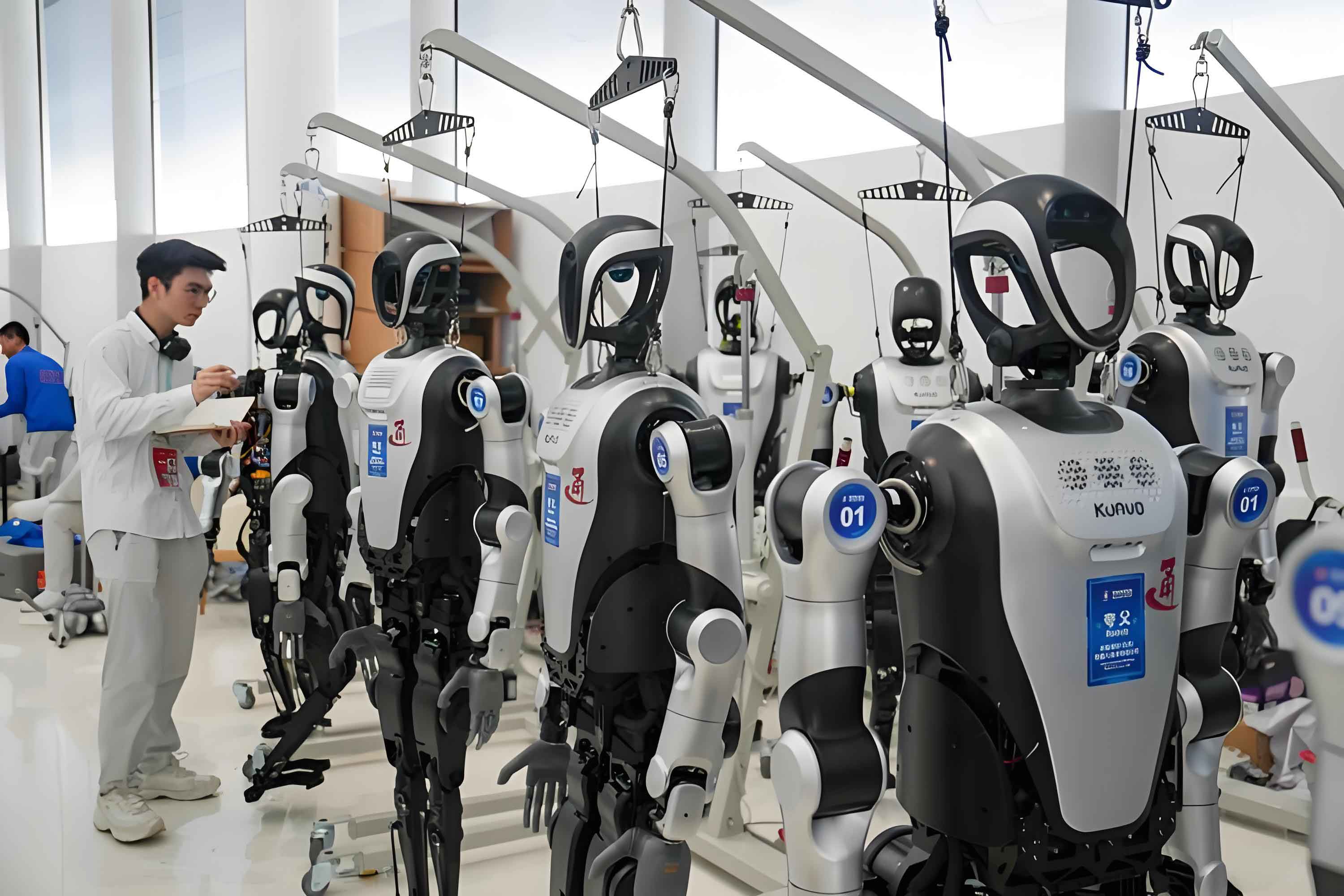
Inspection and quality control are vital in manufacturing humanoid robots, as shown in the image above. This process ensures that each component meets stringent standards, which is critical for reliability. From my experience, integrating AI vision systems for inspection can be modeled using convolutional neural networks (CNNs), where the feature extraction for defect detection can be expressed as:
$$y = \sigma(W * x + b)$$
where \(x\) is the input image, \(W\) represents learnable filters, \(b\) is the bias, \(*\) denotes convolution, and \(\sigma\) is an activation function. Such technologies not only improve production efficiency but also reduce costs, facilitating the mass adoption of humanoid robots.
Turning to technological trends, humanoid robotics is evolving through several key directions. Embodied AI is at the forefront, with algorithms enabling self-supervised learning. For example, the loss function in contrastive learning for sensorimotor skills can be written as:
$$\mathcal{L} = -\log \frac{\exp(\text{sim}(z_i, z_j)/\tau)}{\sum_{k=1}^{N} \exp(\text{sim}(z_i, z_k)/\tau)}$$
where \(z_i\) and \(z_j\) are embeddings of positive pairs, \(\text{sim}\) is a similarity measure, and \(\tau\) is a temperature parameter. This allows a humanoid robot to learn from unlabeled data, enhancing adaptability. Another trend is edge-cloud fusion architectures, where computational load is distributed. The total latency \(L\) for a task can be modeled as:
$$L = L_{\text{edge}} + L_{\text{cloud}} + L_{\text{network}}$$
where \(L_{\text{edge}}\) is processing time on the humanoid robot’s onboard computer, \(L_{\text{cloud}}\) is cloud server time, and \(L_{\text{network}}\) is transmission delay. Optimizing this balance is crucial for real-time performance in humanoid robots.
Software platforms are also advancing, with open-source ecosystems like ROS 2 enabling modular development. The reliability of a humanoid robot system can be assessed using mean time between failures (MTBF), calculated as:
$$\text{MTBF} = \frac{\text{Total operational time}}{\text{Number of failures}}$$
Higher MTBF values indicate more robust humanoid robots, which is essential for industrial deployment. Additionally, data security measures, such as federated learning, protect privacy during training. The global model update in federated learning for humanoid robots can be expressed as:
$$w_{t+1} = \sum_{k=1}^{K} \frac{n_k}{n} w_{t}^{(k)}$$
where \(w_{t}\) is the model weight at iteration \(t\), \(K\) is the number of clients (e.g., individual humanoid robots), \(n_k\) is the data size of client \(k\), and \(n\) is the total data size. This ensures collaborative learning without sharing raw data.
Regarding application scenarios, humanoid robots are gradually penetrating various sectors. In automotive manufacturing, they can handle assembly tasks, with efficiency gains quantified by the throughput rate \(\lambda\):
$$\lambda = \frac{N_{\text{tasks}}}{T_{\text{total}}}$$
where \(N_{\text{tasks}}\) is the number of tasks completed by the humanoid robot, and \(T_{\text{total}}\) is the total time. In logistics, humanoid robots like Agility Robotics’ Digit optimize picking times, reducing operational costs. For home services, the acceptance rate \(A\) of a humanoid robot can be modeled based on usability metrics:
$$A = \frac{U_{\text{satisfied}}}{U_{\text{total}}} \times 100\%$$
where \(U_{\text{satisfied}}\) is the number of satisfied users, and \(U_{\text{total}}\) is the total users. Current trials show promising but limited adoption, highlighting the need for improved interaction design. The table below summarizes key application areas for humanoid robots:
| Application Domain | Potential Tasks | Performance Metrics |
|---|---|---|
| Automotive Manufacturing | Welding, painting, assembly, quality inspection | Cycle time reduction, defect rate, ROI |
| Home Service | Cleaning, elder care, education, entertainment | Task completion rate, user satisfaction, safety incidents |
| Warehousing & Logistics | Sorting, loading, last-mile delivery | Throughput, accuracy, energy consumption |
| Specialized Operations | Nuclear inspection, rescue missions, border patrol | Success rate, environmental adaptability, risk mitigation |
Despite progress, the development of humanoid robots faces multifaceted challenges. In core technology, algorithm bottlenecks like model hallucinations in LLMs can lead to unsafe behaviors. The probability of error \(P_e\) in a decision-making module might be estimated as:
$$P_e = 1 – \text{Accuracy}_{\text{model}}$$
where \(\text{Accuracy}_{\text{model}}\) is derived from validation datasets. Reducing \(P_e\) requires extensive training data, which is scarce for humanoid robot-specific scenarios. Hardware limitations also persist; for instance, the cost \(C\) of a humanoid robot can be broken down as:
$$C = C_{\text{hardware}} + C_{\text{software}} + C_{\text{integration}}$$
with \(C_{\text{hardware}}\) often dominating due to expensive actuators and sensors. Current estimates place \(C\) in the range of hundreds of thousands of dollars, hindering scalability.
Industrialization hurdles include poor scene adaptability. The generalization gap \(G\) between simulation and reality for a humanoid robot can be defined as:
$$G = \mathbb{E}_{\text{real}}[L] – \mathbb{E}_{\text{sim}}[L]$$
where \(L\) is a loss function, and \(\mathbb{E}\) denotes expectation. Bridging \(G\) demands better simulators and transfer learning techniques. Moreover, business model innovation lags; the return on investment (ROI) for deploying a humanoid robot in a factory might be calculated as:
$$\text{ROI} = \frac{\text{Net benefits}}{\text{Total cost}} \times 100\%$$
where net benefits include labor savings and productivity gains. Low ROI in early stages discourages widespread adoption.
Ecosystem constraints further complicate matters. Data acquisition is costly, with the expense \(E_{\text{data}}\) for annotating humanoid robot motion sequences scaling linearly:
$$E_{\text{data}} = \alpha \cdot N_{\text{samples}}$$
where \(\alpha\) is the cost per sample, and \(N_{\text{samples}}\) is the number of data points. High \(\alpha\) values strain R&D budgets. Talent shortages also exist; the demand-supply gap \(D\) for humanoid robot engineers can be expressed as:
$$D = N_{\text{required}} – N_{\text{available}}$$
where \(N_{\text{required}}\) and \(N_{\text{available}}\) are the numbers of required and available professionals, respectively. Positive \(D\) indicates a deficit, slowing innovation.
Policy and standard gaps add uncertainty. The time \(T_{\text{standard}}\) to develop industry standards for humanoid robots may delay interoperability, modeled as:
$$T_{\text{standard}} = f(\text{complexity}, \text{stakeholder consensus})$$
where \(f\) is a function of technical complexity and agreement among parties. Without clear regulations, liability issues in accidents involving humanoid robots remain unresolved.
To address these challenges, I propose several recommendations based on my analysis. First, strengthen core technology R&D. Investing in embodied AI algorithms, such as meta-learning for fast adaptation, can be quantified by the improvement in learning speed \(\Delta S\):
$$\Delta S = S_{\text{new}} – S_{\text{baseline}}$$
where \(S\) represents samples needed to achieve a skill. Positive \(\Delta S\) signifies efficiency gains. Hardware innovation should focus on domestic production of key components, potentially reducing cost by a factor \(\beta\):
$$C_{\text{new}} = \beta \cdot C_{\text{current}}, \quad \beta < 1$$
This would make humanoid robots more affordable. Second, build a robust ecosystem. Establishing open platforms can accelerate development, with the innovation rate \(I\) proportional to the number of contributors \(N_c\):
$$I \propto \log(N_c)$$
as per network effects. Clustering initiatives in regions like the Yangtze River Delta can foster collaboration.
Third, promote application demonstrations. Piloting humanoid robots in high-impact areas, such as hazardous environments, can showcase value. The risk reduction \(R_r\) achieved by deploying a humanoid robot instead of a human can be measured as:
$$R_r = \frac{\text{Incidents}_{\text{human}} – \text{Incidents}_{\text{robot}}}{\text{Incidents}_{\text{human}}}$$
where \(\text{Incidents}\) refers to accident counts. Positive \(R_r\) justifies investment. Incentives like tax breaks can improve ROI, encouraging adoption. Fourth, enhance talent cultivation. Universities should offer interdisciplinary programs, increasing \(N_{\text{available}}\) over time. The growth rate \(g\) of graduates specialized in humanoid robotics can be modeled as:
$$N_{\text{available}}(t) = N_0 e^{gt}$$
where \(N_0\) is the initial number, and \(t\) is time. Policies supporting overseas talent recruitment can boost this pipeline.
Finally, refine policies and standards. Governments can expedite \(T_{\text{standard}}\) by funding consortiums. Safety certifications for humanoid robots, based on failure rate thresholds \(\lambda_f\), can ensure public trust:
$$\lambda_f < \lambda_{\text{max}}$$
where \(\lambda_{\text{max}}\) is the maximum allowable failure rate per hour. Clear guidelines will mitigate ethical concerns and spur industry growth.
In conclusion, the journey of humanoid robots from niche prototypes to integral parts of our economy is fraught with challenges but brimming with potential. As a researcher, I believe that continuous innovation in AI, hardware, and software, coupled with collaborative ecosystems and supportive policies, will unlock the full capabilities of humanoid robots. By emphasizing intelligent nodes over mere form, we can usher in an era where humanoid robots enhance productivity, safety, and quality of life across diverse sectors. The formula for success lies in integrating these elements, much like how a humanoid robot synthesizes its brain, cerebellum, and limbs to navigate the world. The future of humanoid robotics is not just about building machines; it’s about crafting partners that augment human potential, and I am optimistic that with concerted efforts, this vision will become a reality.