
In the pursuit of compact, high-ratio, and precise motion control, few mechanisms rival the elegance and utility of the strain wave gear. My exploration into this field reveals a device of remarkable ingenuity, where controlled elastic deformation replaces traditional rigid-body kinematics to achieve exceptional performance metrics. Often referred to as harmonic drives, the core of its operation lies in the systematic deflection of a flexible component to create a rolling wave of engagement between gears.
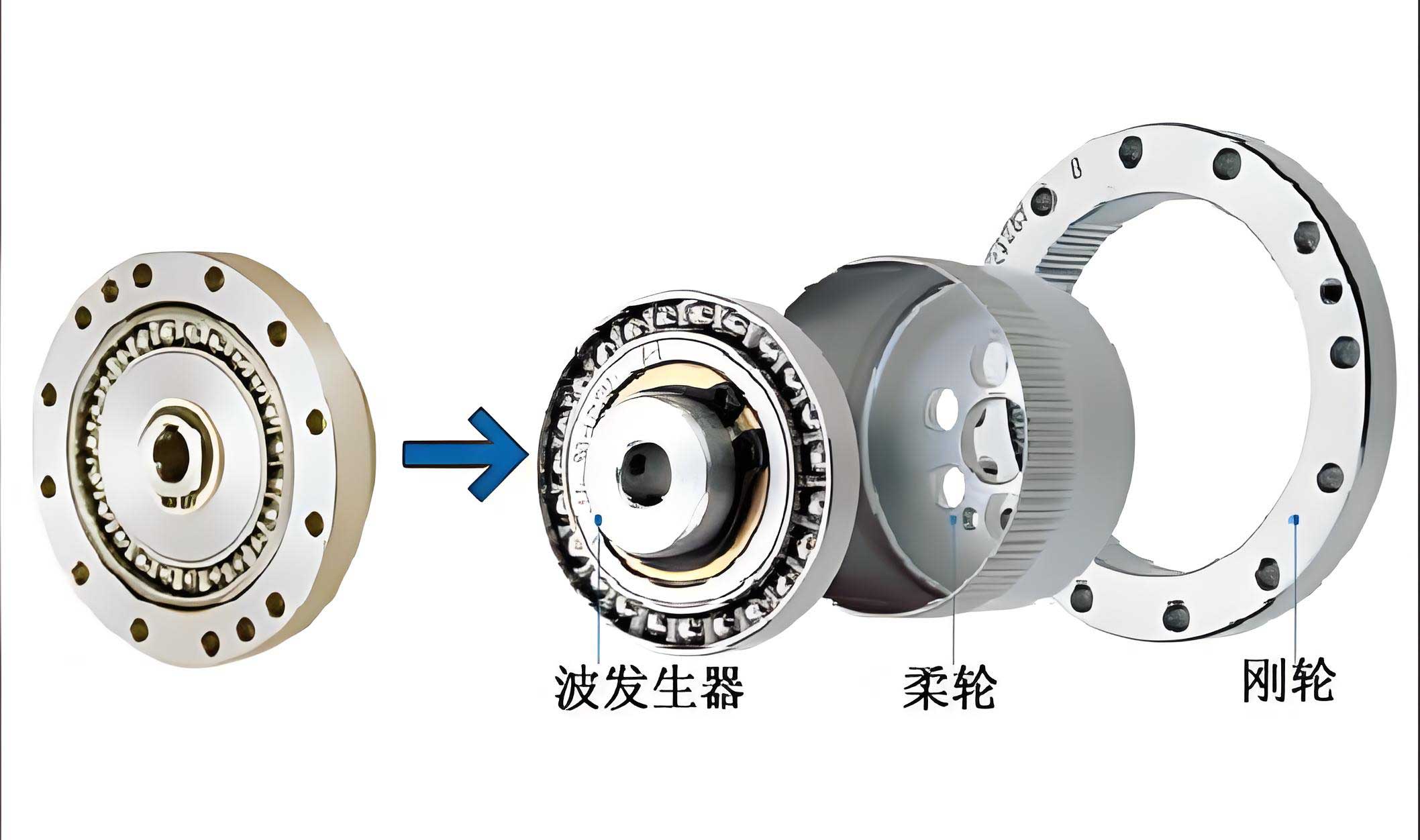
The fundamental architecture of a strain wave gear comprises three primary components, whose interaction defines its unique behavior. Understanding each part is crucial to grasping the whole.
| Component | Description | Primary Role |
|---|---|---|
| Wave Generator (Strain Generator) | Typically consists of an elliptical cam surrounded by a special thin-race ball bearing. It is the input element that induces controlled deformation. | To create a moving elliptical deflection pattern within the flexible spline. |
| Flexible Spline (Flexspline) | A thin-walled, cup-shaped or bell-shaped cylinder made of high-strength alloy steel, with external teeth machined near its open end. | To elastically deform under the influence of the wave generator and mesh with the circular spline. |
| Circular Spline | A rigid, stationary ring with internal teeth. It has a slightly different number of teeth than the flexible spline. | To provide the fixed reference gear with which the deforming flexible spline interacts, creating relative motion. |
The magic of the strain wave gear lies in the “wave” of deformation. When the elliptical wave generator is inserted into the flexible spline, it forces the initially circular gear into an elliptical shape. This deformation is not random but is a precise, elastic strain within the material’s limits. At the two major axis points of this ellipse, the external teeth of the flexible spline fully engage with the internal teeth of the circular spline. At the minor axis points, the teeth are completely disengaged. The regions between the major and minor axes represent transitional zones of partial engagement.
This state of deformation sets the stage for the principle of differential motion by elastic meshing, or “lost motion” recovery. The key parameter is the tooth difference between the two splines. For a standard configuration, the circular spline has more teeth than the flexible spline, typically by a small, even number (e.g., 2 teeth). This difference, denoted as \( N \), is central to the gear’s operation.
Consider a common two-wave generator system (creating two major axis engagement zones). As the wave generator rotates, the elliptical deformation pattern rotates with it. A point on the flexible spline does not simply rotate rigidly; it undergoes a cyclical path of radial displacement. The sequential engagement process can be broken down as follows:
- Engagement (Ingress): A tooth pair enters the zone of deformation and begins to come into contact.
- Full Mesh: The tooth pair is at the major axis, experiencing maximum engagement along the full tooth profile.
- Disengagement (Egress): The tooth pair moves out of the major axis zone, losing contact gradually.
- Complete Separation: The tooth pair is at the minor axis, fully disengaged.
This continuous cycle for every tooth is the “strain wave” from which the device derives its name. Because the flexible spline has fewer teeth than the circular spline, it cannot simply roll back to its original position after one revolution of the wave generator. For the arcs of the two splines in the engagement zones to roll without slip, the flexible spline must compensate for its shorter effective circumference. This compensation manifests as a slow rotation of the flexible spline relative to the circular spline, in the opposite direction to the wave generator’s rotation.
The kinematic relationship is elegantly derived from the condition of no-slip rolling at the pitch circles. Let \( Z_g \) be the number of teeth on the circular spline (gear) and \( Z_f \) be the number of teeth on the flexible spline. The tooth difference is \( N = Z_g – Z_f \). For one complete clockwise rotation of the wave generator, the elliptical wave pattern also completes one revolution. The meshing condition forces the flexible spline to rotate backwards (counter-clockwise) by a number of teeth equal to the difference \( N \). Therefore, the angular displacement of the flexible spline relative to the circular spline is \( -N \) teeth.
The resulting reduction ratio, when the wave generator is the input and the flexible spline is the output (with the circular spline fixed), is given by:
$$
i_{wg \rightarrow fs} = \frac{\omega_{wg}}{\omega_{fs}} = -\frac{Z_f}{Z_g – Z_f} = -\frac{Z_f}{N}
$$
The negative sign indicates reversal of direction. This formula highlights the core advantage of the strain wave gear: extremely high reduction ratios can be achieved in a single stage with compact size, as \( N \) is small (often 2). For example, with \( Z_g = 202 \) and \( Z_f = 200 \), the ratio is \( i = -200/2 = -100:1 \).
The configuration versatility of the strain wave gear system is a significant part of its application appeal. By fixing different components, we achieve various modes of operation, all stemming from the same fundamental three-component interaction.
| Fixed Component | Input Component | Output Component | Function & Speed Ratio |
|---|---|---|---|
| Circular Spline | Wave Generator | Flexible Spline | Standard High-Ratio Reduction. \( i = -\frac{Z_f}{N} \). Most common configuration. |
| Flexible Spline | Wave Generator | Circular Spline | Reduction with Same Direction. \( i = +\frac{Z_g}{N} \). Output rotates in same direction as input. |
| Wave Generator | Circular Spline | Flexible Spline | Speed Increase (Amplification). \( i = +\frac{Z_f}{Z_g} \). Low-torque input, high-speed output. |
| None | Two of the three | The third | Differential (Motion Synthesis). Output is a weighted sum of two inputs. Used in precision differential drives. |
The mathematical framework governing these modes can be derived from the kinematic constraint that the relative motion between any two components is fixed by the tooth difference. A general relationship is:
$$
\frac{\theta_{wg} – \theta_{fs}}{Z_f} = \frac{\theta_{wg} – \theta_{cs}}{Z_g}
$$
Where \( \theta_{wg}, \theta_{fs}, \theta_{cs} \) are the angular positions of the wave generator, flexible spline, and circular spline, respectively. By setting the position of the fixed member to zero and solving for the ratio of input to output, we obtain all the specific cases in the table above. This universal equation underscores the elegant predictability of the strain wave gear system.
Core Advantages and Application Rationale for Strain Wave Gearing
The decision to employ a strain wave gear is driven by a unique combination of performance characteristics that are difficult to achieve with conventional gear trains. My analysis consistently points to several overarching benefits that make it indispensable in advanced engineering.
First and foremost is Exceptional Compactness and High Single-Stage Ratio. As shown in the ratio formula \( i = Z_f / N \), a small tooth difference \( N \) yields a large ratio. Achieving a 100:1 ratio with planetary gears requires multiple stages, increasing size, weight, part count, and backlash. A single-stage strain wave gear accomplishes this in a significantly smaller envelope. This compactness is further enhanced by the co-axial input/output shaft design, which simplifies mechanical layout and saves space.
Secondly, High Precision and Near-Zero Backlash are hallmark traits. The preloaded elastic meshing of the teeth ensures constant contact in the engagement zones. There is no traditional “play” between gear teeth because the flexible spline is always under strain, pressing its teeth against those of the circular spline. This makes the strain wave gear ideal for servo applications in robotics, aerospace actuators, and optical positioning systems where positional accuracy and repeatability are paramount. The backlash can typically be maintained below 1 arcmin, and often much lower.
Third, the mechanism offers High Torque-to-Weight and Torque-to-Volume Ratios. The load is distributed over a large number of teeth simultaneously (often 10-30% of all teeth, compared to 1-2 teeth in contact for spur gears). This multi-tooth engagement allows a relatively small gearset to transmit very high torque. The use of high-strength materials for the flexible spline further optimizes this characteristic.
A particularly ingenious application feature, which I have leveraged in design, is the Hollow Shaft and Integrated Design Potential. The natural geometry of the flexible spline—a thin-walled cup—creates a large, unobstructed central aperture. This allows for the passage of cables, pneumatic lines, laser beams, or another shaft. Furthermore, it enables a radical and compact design topology: the output can be located between the motor and the gear unit. In a traditional reducer, the output shaft is at the far end. With a strain wave gear, one can fix the flexible spline, use the wave generator as the input connected to the motor, and take the output from the circular spline. This circular spline can be a gear that is physically located axially between the motor flange and the wave generator bearing assembly. This “mid-output” or “in-line” configuration is phenomenally space-efficient for applications like robotic joints, wheel drives, or any system where the driven element must be positioned centrally within a structure.
Finally, the strain wave gear provides excellent Sealing and Reliability in Harsh Environments. With only three primary moving components and the possibility of sealing the entire mechanism within a single housing, it is well-suited for vacuum, cleanroom, or other controlled environments where lubricant migration is a concern. Special lubricants and seals can be employed for long-life, maintenance-free operation.
Design Considerations and Material Science in Strain Wave Gears
The reliable operation of a strain wave gear hinges on mastering the complex interplay between elastic deformation, fatigue, and wear. My focus in design always centers on the most critical component: the flexible spline.
Flexible Spline Material and Fatigue Life: This component undergoes cyclic elastic bending stress with every revolution of the wave generator. The primary failure mode is fatigue crack initiation and propagation, usually at the critical stress-concentration regions: the tooth root fillet and the cup/shaft transition zone (the “boss” area). Material selection is therefore paramount. High-strength, high-fatigue-resistance alloys are mandatory. Commonly used materials include:
- AISI 4340, 300M, or similar high-tensile steels: Heat treated to very high strength levels (ultimate tensile strength often exceeding 2000 MPa). They offer excellent fatigue performance but require careful protection against corrosion.
- Managing Steels (e.g., 18Ni maraging steel): Provide an exceptional combination of ultra-high strength, good fracture toughness, and ease of heat treatment with minimal distortion. They are often the premium choice for high-performance, long-life strain wave gears.
- Precipitation-Hardening Stainless Steels (e.g., 17-4PH): Used in applications where corrosion resistance is a priority, offering good strength and adequate fatigue life.
The design of the flexible spline profile involves finite element analysis (FEA) to map stress distributions and optimize geometry (wall thickness, fillet radii, tooth profile) to minimize peak stresses and ensure infinite life (typically >10^7 cycles) under design loads.
Tooth Profile and Meshing Theory: The teeth on both the flexible and circular splines are not standard involute profiles. They are typically a modified “S” shape or a special conjugate profile designed to accommodate the large relative angular motion between mating teeth during the engagement cycle while maintaining smooth contact and favorable pressure angles. The fundamental meshing condition, derived from the kinematics, dictates that the conjugate profiles must satisfy the requirement of constant center distance during the rolling-with-slip motion. The design equations for the tooth profile are complex, often proprietary to manufacturers like Harmonic Drive LLC, and are based on ensuring a favorable load distribution and minimizing wear. The contact stress \( \sigma_H \) can be estimated using a modified Hertzian contact formula, accounting for the curved thin-wall geometry:
$$
\sigma_H \approx \sqrt{\frac{F_t}{b \cdot \rho_{eff}} \cdot \frac{E_{eff}}{2\pi(1-\nu^2)}}
$$
where \( F_t \) is the tangential tooth load, \( b \) is the face width, \( \rho_{eff} \) is the effective relative radius of curvature at the contact point, \( E_{eff} \) is the effective modulus of elasticity, and \( \nu \) is Poisson’s ratio.
Wave Generator Optimization: The wave generator’s profile directly controls the deflection pattern of the flexible spline. While an elliptical cam is standard, some designs use a four-roller “quill” type or a multi-lobed cam (“triple-wave” for even higher torque capacity) to create a more even stress distribution. The thin-race bearing is a critical sub-component; its outer ring must flex conform to the cam while maintaining smooth rolling of the balls. Its life calculation follows modified bearing life equations, accounting for the dynamic flexing.
Lubrication and Efficiency: A strain wave gear operates with a combination of rolling and sliding friction in the tooth contacts and at the wave generator bearing. Proper lubrication is essential for minimizing wear, reducing heat generation, and ensuring high efficiency, which can range from 70% to 90% per stage depending on ratio, speed, and load. Grease lubrication is common for sealed-for-life units, while oil bath or spray may be used in high-power applications. The overall efficiency \( \eta \) can be modeled as a function of the reduction ratio \( i \) and the loss torques:
$$
\eta = \frac{T_{out} \cdot \omega_{out}}{T_{in} \cdot \omega_{in}} = \frac{1}{1 + \frac{\omega_{in}(T_{loss, bearing} + T_{loss, mesh})}{T_{in} \cdot \omega_{in}}}
$$
The mesh losses are primarily due to the sliding friction between the gear teeth during their engagement cycle.
| Design Parameter | Key Challenge | Typical Solution/Consideration |
|---|---|---|
| Flexible Spline Fatigue | Preventing crack initiation under 10^7+ stress cycles. | Use of ultra-high-strength managing steel; precision FEA for stress optimization; super-finishing of critical surfaces (tooth roots, inner bore). |
| Torsional Stiffness | High static stiffness is needed for servo control stability. | Optimization of the flexible spline’s wall thickness and length; the high multi-tooth contact inherently provides good stiffness. |
| Heat Dissipation | Losses concentrated in a small volume can cause overheating. | Integration of cooling fins on housing; use of high-temperature lubricants; design for adequate thermal conduction paths. |
| Manufacturing Precision | Tooth profile accuracy is critical for smooth operation and load sharing. | Specialized gear hobbing and shaping machines; proprietary grinding processes for the flexible spline teeth. |
The Future Trajectory of Strain Wave Gear Technology
As someone deeply engaged with motion system design, I see the evolution of strain wave gearing progressing along several promising avenues. The demand for lighter, stronger, and more intelligent actuators in robotics, aerospace, and medical devices continues to push the boundaries.
Advanced materials are a primary frontier. Research into metal matrix composites (MMCs), carbon fiber-reinforced polymers (CFRP) for non-critical structural parts of the housing, and even advanced ceramics for wear-resistant coatings could lead to the next leap in performance. The goal is to further increase the specific torque (Nm/kg) and fatigue life of the flexible spline.
Integrated sensorization is another key trend. Embedding thin-film strain gauges or fiber Bragg grating sensors within the flexible spline wall can enable direct, real-time measurement of transmitted torque and even the health of the gear (via strain pattern monitoring). This transforms the strain wave gear from a passive transmission element into an intelligent “smart component” capable of condition monitoring and adaptive control.
Finally, additive manufacturing (3D printing) holds potential for revolutionizing complex components like the wave generator assembly or creating optimized, topology-optimized housings that reduce weight while maintaining stiffness. Printing the flexible spline itself remains a formidable challenge due to the extreme requirements for material integrity and surface finish, but it represents a long-term possibility for custom, low-volume applications.
In conclusion, the strain wave gear stands as a testament to the power of innovative mechanical design. By harnessing controlled elastic deformation, it solves fundamental challenges in power transmission with a solution that is compact, precise, and robust. Its operating principle, rooted in the elegant mathematics of differential motion, enables unique configurations like the mid-output design that save critical space in advanced machinery. As materials and manufacturing advance, the role of the strain wave gear in enabling high-performance mechatronic systems will only become more central and indispensable.