
In my ongoing research into advanced mechanical transmission systems, the harmonic drive gear stands out as a subject of immense fascination and engineering importance. Its unique operating principle, which diverges fundamentally from conventional rigid-body gearing, offers a compelling set of advantages that have secured its place in high-performance applications. Originating from theoretical concepts in elastic thin-wall theory in the mid-20th century and evolving into a critical component for aerospace and robotics, the journey of the harmonic drive gear is a testament to innovative mechanical design. This article aims to provide a detailed, first-person perspective on the harmonic drive gear, synthesizing its core principles, historical development, and the multifaceted contemporary research landscape that defines its future.
At its core, the operation of a harmonic drive gear is elegantly simple yet mechanically sophisticated. The system comprises three primary components, often called the “three key elements”: the circular spline (or rigid gear), the flexspline (or flexible gear), and the wave generator. The wave generator, typically an elliptical cam or a set of opposing rollers, is inserted into the flexspline. This action elastically deforms the initially circular, thin-walled flexspline into a slight elliptical shape. The key to its function lies in the carefully engineered difference in the number of teeth between the rigid external circular spline and the flexible internal flexspline, usually by a small number (e.g., 2, 4). When the wave generator rotates, it creates a moving, rotating wave of deformation in the flexspline. This wave causes the teeth of the flexspline to engage with those of the circular spline at two diametrically opposite regions along the major axis of the ellipse. The relative motion caused by the tooth difference results in a very high, single-stage reduction ratio, governed by the fundamental kinematic relationship:
$$ i = \frac{N_f}{N_f – N_c} $$
where \( i \) is the reduction ratio, \( N_f \) is the number of teeth on the flexspline, and \( N_c \) is the number of teeth on the circular spline. For a typical harmonic drive gear with a 2-tooth difference, if \( N_f = 200 \), then \( i = -100 \), indicating a high reduction and a reversal of rotation direction.
This principle of elastic deformation-based power transmission endows the harmonic drive gear with its signature characteristics: extremely high single-stage reduction ratios, compact size and low mass, near-zero backlash, high positional accuracy, and excellent torque-to-weight ratio. The ability to finely adjust or eliminate backlash makes it indispensable in servo systems for robotics, satellite antenna positioning, and precision manufacturing equipment. Its coaxial input/output configuration simplifies mechanical design. While efficiency can be high, it is influenced by factors like flexspline hysteresis and friction, distinguishing it from near-lossless planetary systems in some regimes.
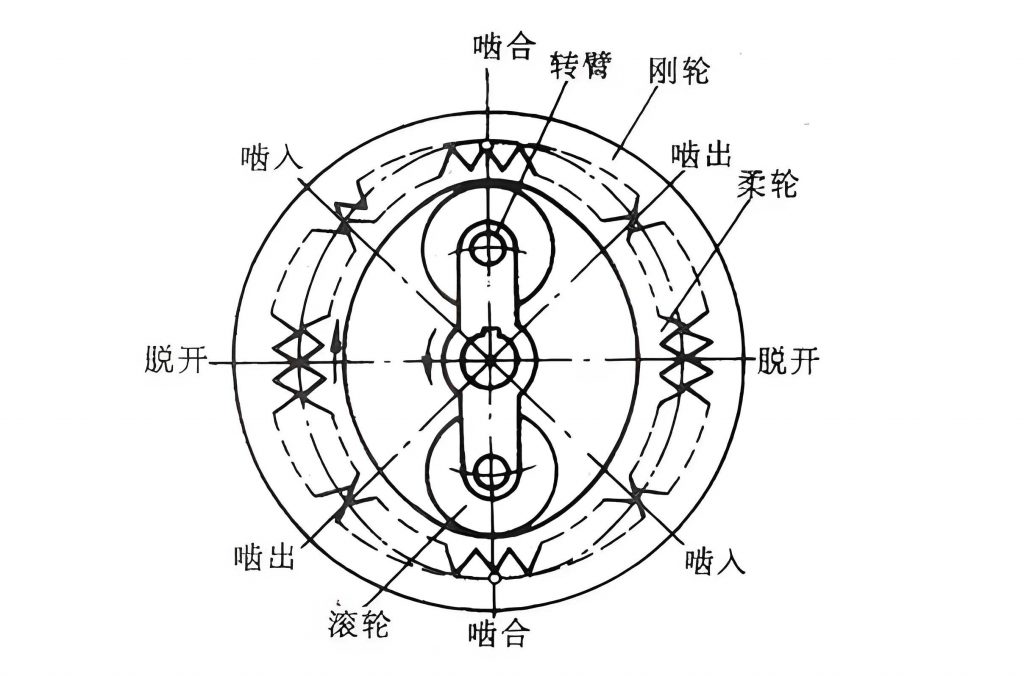
The development of the harmonic drive gear technology has followed distinct paths globally. In the United States, early commercialization by companies like USM led to standardization. Japan’s Harmonic Drive Systems Inc. (HDSI) later became a dominant force, driving mass production, advanced manufacturing, and global market expansion, particularly for industrial robots. Soviet research contributed significantly to foundational theory and alternative tooth profiles. In Europe, focused research has addressed specialized applications in aerospace and high-precision instrumentation. Domestically, progress has been steady, moving from initial theoretical studies and military applications to establishing national standards and an emerging commercial sector supporting a growing robotics industry.
The following table summarizes key developmental milestones for the harmonic drive gear across major regions:
| Region | Key Developments & Focus |
|---|---|
| United States | Initial invention and patenting (C.W. Musser), early commercialization and standardization (USM), application in aerospace and precision systems. |
| Japan | Technology acquisition and industrialization (HDSI), leadership in mass production for robotics, development of proprietary tooth profiles (e.g., “S” tooth, IH tooth). |
| Soviet Union/Russia | Early theoretical work, development of circular-arc tooth profiles, comprehensive academic studies and standardized designs. |
| China | Technology introduction in the 1960s, foundational R&D, establishment of national standards (GB/T), growing industry focused on robotics and automation. |
| Europe | Research into specialized applications (space, medical), development of novel actuation principles (e.g., magnetic harmonic drives). |
Contemporary research on the harmonic drive gear is intensive and multidisciplinary, addressing both fundamental limitations and new frontiers. The following sections detail the primary research vectors.
1. Meshing Theory and Tooth Profile Design: The accurate modeling of the meshing action in a harmonic drive gear is complex due to the dynamic deformation of the flexspline. Modern approaches go beyond simple radial deformation models to incorporate tangential strain and torsional effects. Methods like the envelope method, the tooth normal method, and the kinematic method (including the B-matrix formalism) are used to solve for conjugate tooth profiles. The quest for an optimal tooth profile is central to improving the performance of the harmonic drive gear. The evolution has moved from the initial straight-sided triangle tooth (pressure angle 28.6°), to the involute profile, and now predominantly towards dual-circular-arc profiles and their derivatives. These modern profiles offer larger contact areas, better load distribution, reduced stress concentration at the tooth root, and improved lubrication conditions. Recent innovations include proprietary profiles like the “P-shaped” tooth, characterized by a low tooth height and large root radius to enhance strength and longevity, and the CTC profile, optimized for even greater load capacity. Research also explores using spline curves for customizable “B-type” teeth.
2. Flexspline Strength and Fatigue Life Analysis: The flexspline is the most critical and life-limiting component of a harmonic drive gear. Its repeated elastic deformation induces complex, multi-axial stress states. Research methodologies combine analytical elasticity theory (modeling the flexspline as a thin-walled cylindrical shell), experimental techniques (strain gauges, photoelasticity), and sophisticated computational tools, primarily Finite Element Analysis (FEA). FEA allows for detailed visualization of stress distribution under combined loading from the wave generator and transmitted torque. The goal is to accurately predict fatigue life using criteria like von Mises stress and to understand the influence of geometry on stress concentration factors, particularly in the critical cup diaphragm and tooth root areas.
3. Structural Optimization and Lightweighting: Optimization focuses on maximizing performance while minimizing mass and volume—a key requirement for aerospace and portable robotics. This involves parametric studies on the flexspline geometry: cup length-to-diameter ratio, wall thickness transitions, fillet radii, and tooth width. The trend is toward “pancake” or “hat” designs with very short cups. Optimization algorithms (e.g., simplex method, penalty function methods coupled with FEA) are employed to find the best compromise between stress, stiffness, and weight. Furthermore, optimizing the conjugate tooth profile along the entire face width of the cup-shaped flexspline is necessary to prevent edge contact and interference due to the tilting deformation of the cup under load.
4. Transmission Accuracy and Error Analysis: The exceptional positioning accuracy of a harmonic drive gear is its hallmark, but it is affected by various errors. Research models these errors stemming from manufacturing tolerances (pitch errors, profile errors), assembly misalignments, elastic deformation under load (torsional stiffness variation), and inherent kinematic errors from non-ideal conjugate action. The total transmission error (TE) is often modeled as a combination of periodic components and random errors. Advanced measurement systems using laser interferometry or high-resolution encoders are developed to dynamically characterize TE and backlash. Understanding these errors is crucial for high-fidelity servo control in applications like robotic joint control.
5. Dynamic Performance and Vibration Characteristics: As applications demand higher speeds and precision, the dynamic behavior of the harmonic drive gear becomes paramount. Research constructs nonlinear dynamic models that consider time-varying mesh stiffness, damping from hysteresis and friction, and manufacturing errors. These models are used to predict system resonant frequencies, torsional vibrations, and dynamic transmission error, which can impact servo bandwidth and stability in robotic systems. The goal is to design harmonic drive gears whose natural frequencies lie outside the operational spectrum of the application to avoid resonance.
6. Advanced Manufacturing and Material Science: Pushing the boundaries of harmonic drive gear performance requires innovations in how they are made and what they are made from. For manufacturing, beyond traditional gear hobbing and shaping, processes like precision skiving, high-speed gear rolling, and fine wire Electrical Discharge Machining (EDM) are explored for improved accuracy and surface finish. In materials science, while high-strength alloy steels (e.g., 40CrNiMoA) remain standard for the flexspline, research investigates alternatives to reduce weight and damping. These include hybrid designs with a composite (e.g., carbon fiber) cup body bonded to a metallic tooth ring, which shows promise for lower vibration and noise. The feasibility of engineering plastics for low-load applications is also studied. For micro harmonic drive gears, fabrication techniques like the LIGA process are essential for creating high-aspect-ratio metallic micro-gears.
7. Miniaturization and Novel Actuation Principles: The drive for miniaturization has led to the development of micro harmonic drive gears with outer diameters as small as 8 mm, enabling their use in micro-robotics and medical devices. Furthermore, the fundamental principle of using controlled elastic waves for motion is being extended beyond mechanical wave generators. This includes research into piezoelectric harmonic drives, where the wave generator is replaced by piezoelectric actuators that directly excite ultrasonic standing waves in the flexspline, and magnetostrictive or electromagnetic harmonic drives, which use magnetic fields to induce the deformation wave. These “gearless” or direct-drive configurations aim for even finer resolution, faster response, and vacuum/cleanroom compatibility.
The table below provides a concise overview of the key research frontiers in harmonic drive gear technology:
| Research Frontier | Primary Objectives & Methods |
|---|---|
| Tooth Profile Design | Optimize load distribution, reduce stress, improve lubrication. Methods: Dual-circular-arc, CTC, “P” tooth, conjugate theory, FEA contact analysis. |
| Flexspline Analysis | Predict fatigue life, optimize geometry. Methods: Analytical shell theory, Experimental stress analysis, Nonlinear FEA. |
| Transmission Accuracy | Model and minimize errors. Methods: Kinematic error modeling, stochastic error analysis, high-precision dynamic measurement systems. |
| Dynamics & Vibration | Avoid resonance, ensure stability. Methods: Lumped-parameter & FE-based dynamic modeling, modal analysis, experimental modal testing. |
| Advanced Materials | Reduce weight, increase damping, improve longevity. Materials: Hybrid metal-composite flexsplines, advanced high-cycle fatigue steels, engineered polymers. |
| Micro & Novel Drives | Enable new applications. Directions: Micro-fabrication (LIGA), piezoelectric/magnetic wave generation, ultra-compact “pancake” designs. |
In conclusion, the harmonic drive gear represents a pinnacle of precision mechanical engineering, whose development is far from static. My analysis confirms that it is a field rich with ongoing challenges and opportunities. Critical issues persist, such as the fundamental stress-life trade-off in ultra-short flexspline designs, the precision manufacturing of极小模数 (extremely small module) gears, and the development of comprehensive nonlinear dynamic models that fully capture the interaction between time-varying stiffness, friction, and control systems. The future trajectory of the harmonic drive gear is clearly towards higher precision, greater reliability, increased power density, further miniaturization, and smarter integration with electronic controls. The growing demands of industries like collaborative and industrial robotics, semiconductor manufacturing, and next-generation aerospace systems will continue to be the primary drivers for innovation in harmonic drive gear technology. Success in this competitive field will depend on a deep, synergistic investment in theoretical research, advanced materials science, precision manufacturing capabilities, and rigorous testing and validation protocols.