
As I survey the landscape of modern technological innovation, two distinct developments recently captured my professional imagination. They represent seemingly disparate paths: one, a monument to large-scale additive manufacturing, static and permanent; the other, a vision of agile, mobile autonomy. The first is the creation of the world’s largest 3D-printed plastic pedestrian bridge in Shanghai. The second is the conceptual demonstration by a German conglomerate of a future delivery paradigm featuring an agile robot dog. While one is a realized structure of polymer and glass fiber, the other remains a speculative leap into a future of autonomous logistics. This juxtaposition invites a deep exploration into the materials, mechanics, and societal integration of such technologies, compelling me to analyze their implications from a first-principles engineering perspective.
The Shanghai bridge, a 15-meter span, is not merely an architectural feat but a testament to the maturation of polymer science for structural applications. The core innovation lies in the material selection: Acrylonitrile Styrene Acrylate (ASA) reinforced with a calculated percentage of glass fibers. This composite is engineered to meet a stringent set of criteria that bridge the worlds of 3D printing and civil engineering. Let’s formalize the key material properties that were critical for this application. The performance of such a composite can be analyzed through a simplified rule of mixtures for certain properties, though the interfacial bonding and fiber orientation (crucial in 3D-printed layers) create a more complex anisotropic reality.
For a unidirectional fiber composite, the longitudinal modulus \( E_c \) can be approximated by:
$$ E_c = E_f V_f + E_m V_m $$
where \( E_f \) and \( E_m \) are the moduli of the fiber and matrix (ASA) respectively, and \( V_f \) and \( V_m \) are their volume fractions (\( V_f + V_m = 1 \)). The high elastic modulus required for minimal deflection under load is thus achieved by optimizing \( V_f \). Similarly, the long-term durability against environmental stress cracking, a key aspect of “high weatherability,” involves resistance to ultraviolet radiation and thermal cycling, properties enhanced by the ASA matrix and the stabilizing effect of the fibers.
The following table summarizes the critical property enhancements provided by the glass-fiber-reinforced ASA composite versus neat ASA, explaining its suitability for the bridge:
| Material Property | Neat ASA Polymer | Glass-Fiber-Reinforced ASA Composite | Significance for 3D-Printed Bridge |
|---|---|---|---|
| Elastic Modulus (E) | Moderate (2-3 GPa) | High (>5 GPa, depending on V_f) | Reduces creep and excessive deflection under sustained pedestrian load. |
| Yield Strength (σ_y) | Moderate | High | Prevents permanent deformation under peak loads (e.g., crowds). |
| Impact Strength | Good | Very High | Absorbs energy from accidental impacts without brittle fracture. |
| Weatherability | Inherently High (vs. ABS) | Enhanced Stability | Withstands prolonged UV exposure, rain, and temperature swings without significant degradation. |
| Dimensional Stability | Subject to thermal expansion | Greatly Improved | Minimizes warping and internal stress from layer-by-layer fabrication and outdoor service. |
The successful deployment of this bridge validates a formula for future construction: Advanced Material + Additive Process = Novel Structural Form. It moves 3D printing from prototyping into the realm of durable public infrastructure. Yet, as I reflect on this achievement, my mind is drawn to the other, more kinetic technological vignette: the robot dog leaping from an autonomous vehicle to complete a delivery.
The demonstration by the German company, in partnership with a Swiss robotics firm, presented a compelling narrative. An autonomous vehicle acts as a mothership, and a nimble quadrupedal robot dog acts as the final-meter courier. The robot dog navigates “the last ten meters” of complex terrain—curbs, stairs, uneven park paths—that are insurmountable for wheeled robots, reaches the doorstep, and performs the delivery. This vision addresses the critical “last-mile” and “last-ten-meter” problem in logistics. However, the fundamental question of platform choice arises: why a legged robot dog versus a wheeled or tracked robot? The answer lies in terrain adaptability and obstacle negotiation, which can be framed through the concept of mobility.
The mobility of a legged system over irregular terrain can be contrasted with a wheeled system by considering the critical obstacle height \( h_{max} \) they can surmount. For a simple wheeled platform of radius \( R \), overcoming a step requires a torque sufficient to induce rotation over the edge. For a leg with a effective length \( L \) and a control system capable of lifting the foot to a height \( h_{step} \), the condition is simpler in theory:
$$ h_{step} \approx L \cdot \sin(\theta_{max}) $$
where \( \theta_{max} \) is the maximum joint angle. A robot dog with articulated legs can set \( h_{step} \) close to \( L \), allowing it to climb stairs or step over debris that would stop a wheeled robot cold. The trade-off is immense complexity in control, balance, and power efficiency. The stability of a static walk for a quadruped can be analyzed by ensuring the projection of the center of mass (CoM) lies within the support polygon formed by the feet in contact with the ground. For dynamic trotting or running gaits, the analysis involves zeromoment point (ZMP) or more complex centroidal dynamics.
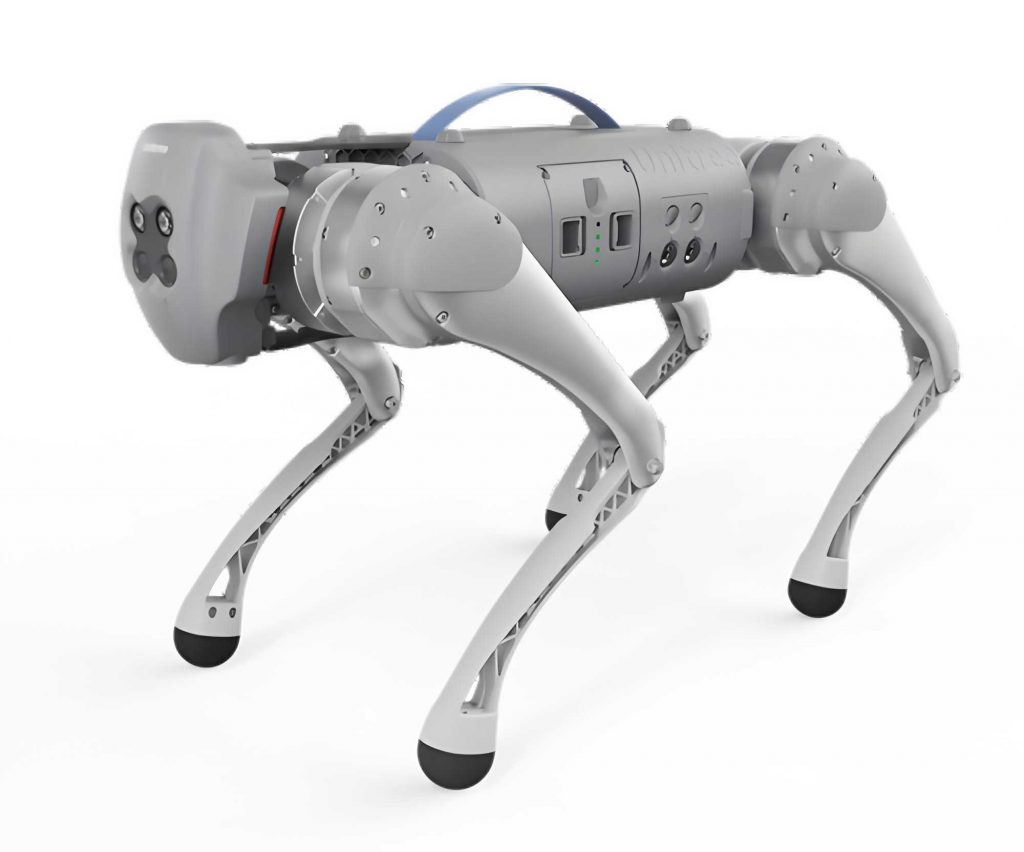
The image above perfectly encapsulates the morphological advantage of the quadruped form factor. The robot dog depicted possesses a low center of gravity, articulated limbs with multiple degrees of freedom, and a compact body, all hallmarks of a platform designed for stability and adaptability in unstructured environments. This is the physical embodiment of the delivery robot dog concept. Yet, the article rightly points out the chasm between demonstration and deployment. The dream is “grand,” but the path to reality is fraught with challenges. Let’s quantify some of these challenges through a comparative analysis of delivery robot platforms.
| Platform Type | Example/Proponent | Key Advantages | Key Disadvantages for Widespread Delivery | Current State |
|---|---|---|---|---|
| Quadruped Robot Dog | ANYbotics, Boston Dynamics (Spot), Agility Robotics | Superior terrain traversal (stairs, rubble, curbs), high public engagement/visibility. | Extremely high unit cost; high power consumption; complex maintenance; slower average speed on flat terrain; public anxiety/perception issues. | Concept demos (as described); limited commercial availability for other uses (inspection). |
| Bipedal Robot | Agility Robotics (Digit), others | Designed for human environments (uses doors, stairs built for humans). | Even greater balance and control challenges; likely higher cost and fragility than quadrupeds. | Early prototype stage for delivery applications. |
| Wheeled/Tracked Robot | Starship, Nuro, many startups | Relatively low cost, simple and reliable mechanics, energy efficient on paved surfaces, easier to scale. | Cannot navigate stairs or significant obstacles; limited to sidewalks and smooth pathways. | Actively deployed in limited trials for food/grocery delivery on college campuses and some urban areas. |
| Aerial Drone | Wing (Alphabet), Zipline | Extremely fast, bypasses ground obstacles entirely. | Regulatory hurdles, limited payload, weather sensitivity, noise, privacy concerns, precise drop-off logistics. | Advanced trials for medical supply and retail delivery in approved zones. |
The table starkly illustrates why, as noted in the source material, “most companies still prefer the time-tested wheeled robot” for last-mile delivery. The economic and reliability equations currently favor simplicity. The cost-benefit analysis for a robot dog delivery system is formidable. We can model the total cost of operation (TCO) for a fleet over time \( T \):
$$ TCO_{dog} = N \cdot (C_{capital} + \int_0^T (C_{power}(t) + C_{maintenance}(t) + C_{deployment}(t)) dt) $$
where \( N \) is the number of units, \( C_{capital} \) is the high initial purchase price, and the operational costs for power, maintenance (for complex leg actuators and sensors), and deployment/oversight are significant. For wheeled robots, \( C_{capital} \) is an order of magnitude lower, and \( C_{maintenance} \) is substantially reduced.
Furthermore, the public interaction component is non-trivial. The social dynamics of a robot dog approaching a home are qualitatively different from a small wheeled box. While potentially less intimidating than a human stranger, it could also evoke fear or curiosity leading to interference. The demonstration’s whimsical touch of the robot dog dancing after completing its task is a direct attempt to program positive anthropomorphism, aiming to soften its mechanical nature. The effectiveness of such behavioral programming in ensuring safe public coexistence is an open research question in human-robot interaction (HRI).
So, where does this leave us? On one side, we have the 3D-printed bridge: a finished, functional object that solves a clear engineering problem (creating a complex, durable structure with a novel method) and whose value proposition—reduced waste, design freedom, on-site fabrication potential—is immediately tangible and quantifiable. Its success can be measured in meters, load-bearing capacity, and years of service life.
On the other side, we have the delivery robot dog: a compelling vision that solves a hypothesized future problem (the inefficiency of the final ten meters) with a currently inefficient and expensive platform. Its value is speculative, resting on a future where the cost of advanced robotics plummets, control software becomes infallibly robust, and societal acceptance is universal. The mathematics of its viability are not yet favorable. The journey from a trade-show demo, where a robot dog navigates a staged “park ruin,” to a cost-effective, all-weather, vandal-resistant system completing thousands of deliveries per day is extraordinarily long.
In my view, these two stories represent different phases of the innovation lifecycle. The bridge is a deployment, a technology crossing the chasm into practical application. The robot dog delivery concept is an exploration, a “moonshot” that tests the boundaries of mobility and automation. It serves as a powerful research and development driver, pushing forward the underlying technologies in actuation, computer vision, and navigation that will eventually benefit other, more immediately practical forms of robotics. Perhaps the first widespread application of the robot dog form factor will not be on our doorsteps, but in industrial inspection, search and rescue, or hazardous environment exploration—domains where its high cost can be justified by the value of the task or the removal of human risk.
Ultimately, both endeavors are united by a core engineering spirit: the application of material science, mechanical design, and computational control to expand the boundaries of the built and automated world. One gives us new forms of static space, printed layer by layer. The other promises new dynamics of movement, step by careful step. The bridge stands as a testament to what is possible today with polymers and printers. The robot dog scampering through our imagination is a question about what might be possible tomorrow, a question whose answer depends entirely on solving a daunting array of technical, economic, and social equations. As I conclude this reflection, I am certain of the ingenuity behind both, cautiously optimistic about the future of the first, and endlessly fascinated by the persistent, challenging dream of the latter.