
In my analysis of contemporary technological evolution, I observe a profound synthesis occurring at the intersection of robotics, materials science, and bio-inspiration. The development of adaptive machines capable of navigating complex, unstructured environments represents a pinnacle of interdisciplinary engineering. Central to this advancement is the paradigm of the bionic robot, a class of machines whose design principles, locomotion strategies, and sensory apparatus are directly inspired by biological systems. A bionic robot does not merely mimic form; it seeks to capture the underlying efficiency, robustness, and adaptability of living organisms. This article explores the integrated landscape where breakthroughs in functional materials, such as novel perovskites for sensing, converge with innovative mechanical designs to push the boundaries of what a bionic robot can perceive and achieve.
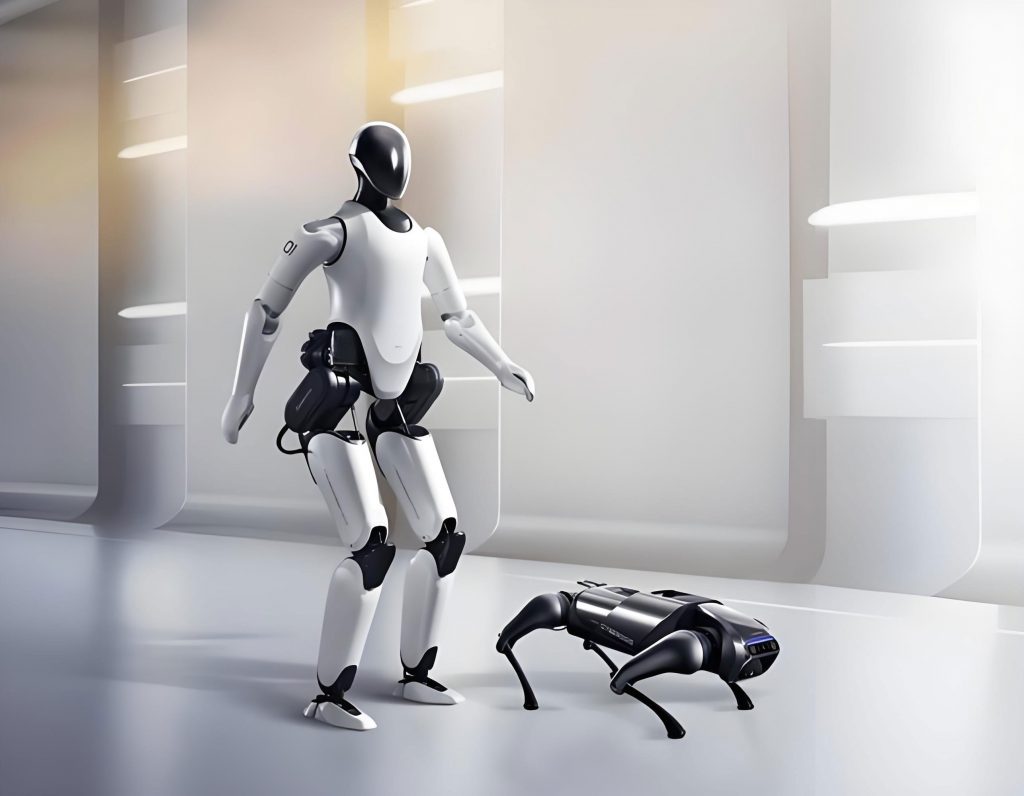
The fundamental motivation behind a bionic robot is to overcome the limitations of traditional robotics in dynamic real-world settings. Nature offers exquisite solutions for mobility across heterogeneous terrains—running on ground, swimming in water, and transitioning between mediums. Recent prototypes have demonstrated this capability vividly. For instance, inspired by the kinematics of cockroaches and lizards, a novel amphibious bionic robot employs a transformative wheel-propeller mechanism. This design allows for rapid terrestrial scurrying and efficient aquatic locomotion, embodying the core concept of a multi-modal bionic robot. Its performance parameters can be summarized as follows:
| Locomotion Mode | Mechanism | Max Speed (Approx.) | Key Bio-Inspiration |
|---|---|---|---|
| Terrestrial (hard ground) | Spinning propellers acting as wheels | 3.6 m/s | Cockroach running gait |
| Terrestrial (grass, gravel) | Adjustable tilt-angle propellers for traction | > 1.5 m/s | Limb compliance and posture control |
| Aquatic (surface running) | High-speed propeller rotation for planing | To be optimized | Basilisk lizard water-running |
| Aquatic (low-speed swim) | Propellers acting as fins | Low, stable | General fin-based propulsion |
The dynamics of such a system involve complex interactions between thrust, buoyancy, and contact forces. A simplified model for the transition from terrestrial to aquatic motion can be considered. The buoyancy force $F_b$ ensuring surface flotation is given by Archimedes’ principle:
$$ F_b = \rho V g $$
where $\rho$ is the fluid density, $V$ is the displaced volume, and $g$ is gravitational acceleration. For a bionic robot to achieve water-running, the vertical component of the propeller thrust $F_{thrust}$ must counteract the robot’s weight $mg$ minus the buoyancy force during the stride cycle. The net vertical force $F_{net,y}$ becomes:
$$ F_{net,y} = F_{thrust} \sin(\theta) + F_b – mg $$
Here, $\theta$ is the instantaneous angle of the propeller axis. Meanwhile, the horizontal thrust component $F_{thrust} \cos(\theta)$ propels the bionic robot forward. The condition for sustained aquatic locomotion without sinking is $ \langle F_{net,y} \rangle_{cycle} \ge 0 $, where the angle brackets denote averaging over a locomotion cycle.
However, the true potential of a sophisticated bionic robot is unlocked not just by movement, but by perception. This is where the symbiotic relationship with advanced sensor technology becomes critical. A bionic robot operating in search-and-rescue or agricultural monitoring requires a distributed, robust, and highly sensitive sensory skin. Recent progress in flexible and wearable strain sensors provides a pathway to this goal. One promising approach involves fabric-based sensors integrated directly into a potential “skin” for a bionic robot. These sensors utilize conductive yarns—often a composite of spandex (e.g., Lycra) core and silver-coated nylon windings—sewn into a textile substrate using a lock-stitch technique. The lock-stitch creates a repeating pattern that enhances mechanical durability and defines the sensor’s electromechanical response.
The electrical response of such a textile strain sensor is paramount. The relative change in resistance $\frac{\Delta R}{R_0}$ as a function of applied strain $\epsilon$ is a key performance metric. For many composite conductive yarns, the relationship can be modeled by a piecewise or power-law function. A common empirical model is:
$$ \frac{\Delta R}{R_0} = G \cdot \epsilon^n $$
where $G$ is the gauge factor (sensitivity) and $n$ is an exponent often close to 1 for linear regions or 2 for regimes involving crack propagation in the conductive layer. For the described yarn-in-textile structure, the integration via lock-stitch drastically improves the operable strain range and sensitivity compared to the bare yarn. The stitch geometry introduces controlled buckling and contact point variations, enhancing the gauge factor. The sensor’s performance can be characterized by parameters like working range, sensitivity (Gauge Factor, GF), hysteresis, and durability, as summarized below for typical implementations:
| Sensor Component | Material/Structure | Key Parameter | Typical Value/Range |
|---|---|---|---|
| Conductive Yarn Core | Spandex (Elastane) Fiber | Maximum Elastic Strain | > 200% |
| Conductive Coating/Winding | Silver-coated Nylon Yarn | Initial Conductivity | High (Resistance ~ Ω/cm) |
| Integration Method | Lock-stitch with Polyester Thread | Stitch Density (stitches/cm) | 3 – 8 |
| Complete Textile Sensor | Yarn integrated in substrate | Effective Strain Range | 0% to 40%+ |
| Gauge Factor (GF) | 2 – 50+ | ||
| Durability (Cycles) | > 5000 |
For a bionic robot, an array of such sensors could map strain on its “exoskeleton” or flexible joints, providing proprioceptive feedback for adaptive control and detecting external contacts. Imagine a bionic robot crawling through rubble: strain sensors on its limbs could differentiate between solid contact, slipping, and load-bearing, enabling real-time gait adjustment.
Beyond flexible strain sensing, the quest for more efficient, multifunctional materials for perception drives research into novel semiconductors. Hybrid perovskite materials have emerged as a fascinating platform, not only for photovoltaics but also for photoferroelectric applications. The ferroelectric property—a spontaneous electric polarization switchable by an external field—can be harnessed in sensing and non-volatile memory for robotic control systems. In a 2D layered hybrid perovskite, the order-disorder transition of organic cations within inorganic layers drives the ferroelectric phase transition. The Curie temperature ($T_c$), the point above which ferroelectricity is lost, is a critical parameter for practical device operation.
The central challenge lies in rationally elevating $T_c$. Recent strategies involve the concept of “confined pore rotors,” where organic amine cations are spatially confined within the layered architecture. The rotational freedom of these “molecular rotors” is directly constrained by the inorganic framework’s thickness. As the number of inorganic layers increases, the confinement effect strengthens, raising the energy barrier for the rotational disorder that destroys ferroelectric order. This relationship can be conceptually framed. The activation energy $\Delta E$ for the order-disorder transition is enhanced by a confinement energy term $E_c(n)$ that depends on the layer number $n$:
$$ \Delta E_{total}(n) = \Delta E_0 + E_c(n) $$
According to the Arrhenius-like behavior for such transitions, the $T_c$ is approximately proportional to this activation barrier. Therefore, one expects:
$$ T_c(n) \propto \Delta E_0 + E_c(n) $$
Experimental evidence strongly supports this. For instance, a 2D trilayer perovskite showed a significantly higher $T_c$ (~370 K) compared to a bilayer analog (~326 K). These materials are also photoconductive, opening the possibility of developing novel opto-ferroelectric sensors that could be integrated onto a bionic robot for simultaneous light detection and piezoelectric/ferroelectric response, creating a multi-modal environmental perception layer.
The integration pathway for these technologies into a cohesive bionic robot system is complex. We must consider a hierarchical architecture:
| System Layer | Technology Enabler | Function for Bionic Robot | Current State / Challenge |
|---|---|---|---|
| Structural & Actuation | Transformative wheel-propeller mechanisms; Soft actuators | Multi-modal locomotion (run, swim, crawl) | Prototype demonstrated; Scaling and energy efficiency optimization ongoing. |
| Proprioceptive Sensing | Wearable textile strain sensor arrays | Real-time measurement of joint angles, limb deformation, and external contact forces. | High sensitivity and durability achieved in lab; Integration into robot body and signal processing need development. |
| Exteroceptive Sensing | Hybrid perovskite photodetectors & ferroelectrics; Traditional cameras, LiDAR | Environmental mapping, light detection, potentially combined optical/pressure sensing. | Perovskite devices show promise but require stability and integration studies for robotic use. |
| Energy & Power | High-density batteries; Energy harvesting (solar, kinetic) | Providing sustained operational life for autonomous missions. | Major limiting factor; Novel materials may enable on-robot energy harvesting from motion. |
| Control & AI | Neuromorphic computing; Adaptive gait controllers | Processing sensor data, making real-time locomotion decisions, and learning from environment. | Active research area; Bridging the gap between low-level control and high-level task planning. |
The energy efficiency of a bionic robot is another dimension where biological inspiration is crucial. The cost of transport (COT), the energy used per unit weight per unit distance, is a standard metric. For a legged or amphibious bionic robot, the COT is typically higher than for wheeled robots on flat ground but becomes superior in complex terrains. The theoretical COT for a running or swimming bionic robot can be related to its dynamics. For steady-state running, a simplified model derived from the Spring-Loaded Inverted Pendulum (SLIP) model, often used to describe animal running, gives insights. The energy dissipated per step $\Delta E_{step}$ relates to the system’s stiffness $k$, damping, and touchdown kinematics. The average power $P_{avg}$ is:
$$ P_{avg} = \frac{\Delta E_{step}}{T_{stride}} $$
where $T_{stride}$ is the stride period. The COT is then:
$$ COT = \frac{P_{avg}}{mg v} = \frac{\Delta E_{step}}{mg \cdot \text{stride length}} $$
where $v$ is the forward velocity and stride length = $v \cdot T_{stride}$. Optimizing the actuator control and mechanical compliance to minimize $\Delta E_{step}$ is a direct lesson from biology that every bionic robot engineer must learn.
Looking forward, the trajectory for the next generation of bionic robot systems points toward greater autonomy, resilience, and sensory intelligence. The fusion of advanced functional materials like stable hybrid perovskites and durable textile electronics will enable robots with a sensitive “nervous system” covering their structure. This sensory skin will feed data to neuromorphic processors, potentially built from other novel materials, enabling real-time, low-power processing for reflexive and adaptive behaviors. The amphibious bionic robot of today, which can traverse a variable landscape, will evolve into a truly environmental bionic robot, one capable of long-term deployment in agricultural fields for monitoring crop health, in disaster zones for locating survivors, or in ecological preserves for biodiversity studies. It will sense pressure, strain, light, chemicals, and temperature, all while efficiently moving through the world with a grace and adaptability that mirrors the living organisms that inspired its creation. The journey to create such a machine is not just an engineering challenge; it is a fundamental exploration of the principles that unite life and machine, perception and action, inspired relentlessly by the elegant solutions found in nature.