
The rapid evolution of artificial intelligence (AI), marked by the rise of large language models (LLMs) like ChatGPT and the subsequent “phenomenal” emergence of models such as DeepSeek, signals a pivotal shift toward more generalized artificial intelligence. This progress is intrinsically linked to, and in many ways dependent upon, parallel breakthroughs in specialized computing hardware. In this article, I explore the latest advancements across three interconnected domains: the state-of-the-art in LLMs, the burgeoning field of embodied intelligence, and the innovative hardware—from digital and analog AI chips to photonic and quantum neural networks—that underpins this computational revolution.
1. The Evolving Landscape of Large Language Models
The generative AI landscape has moved beyond simple text prediction. Modern LLMs are evolving into multi-modal, reasoning systems that combine fast, intuitive processing with slower, deliberate thought. The release of GPT-5 and the rise of open-source contenders like DeepSeek represent key milestones in this journey.
DeepSeek’s ascent is particularly noteworthy for demonstrating that highly capable models can be developed with significantly lower computational budgets, challenging the paradigm that scale is the sole path to performance. Its architecture emphasizes efficiency in reasoning and agentic capabilities, focusing on lowering the cost-per-inference, a metric that is becoming central to the commercial viability of AI.
GPT-5, on the other hand, refines the path of its predecessors by integrating a “System 1 / System 2” cognitive architecture. This design mimics human thought processes: a fast, reactive pathway for immediate responses and a slower, deliberate pathway for complex reasoning and planning. This dual-process approach aims to reduce “hallucinations” (fabricated information) and improve performance on tasks requiring deep logical analysis and coding. The core advancements in contemporary LLMs can be summarized across several axes, as shown in the table below.
| Advancement Area | Key Trends & Innovations |
|---|---|
| Architectural Evolution | Multi-modal understanding/generation; Fusion of generative flow and autoregressive models; Fast-slow thinking systems (System 1/System 2). |
| Performance & Efficiency | Focus on reasoning capability and agentic AI; Reduction in hallucination rates; Dramatic improvement in coding proficiency; Lower cost-per-inference. |
| Safety & Alignment | Improved robustness against adversarial attacks; Advanced techniques for constitutional AI and value alignment; Better control over model outputs. |
| Deep Application Integration | Seamless integration into scientific research (hypothesis generation, code for simulations); Advanced autonomous agents for workflow automation; Sophisticated human-AI collaboration frameworks. |
The training and deployment of these models, such as GPT-3 which required an estimated 5,000 petaflops-days of computation, have created an insatiable demand for computational power. This demand directly fuels innovation in AI-specific hardware, setting the stage for the next sections of our discussion.
2. The Rise of Embodied Intelligence and AI Agents
Embodied intelligence represents the frontier where AI meets the physical world. It refers to intelligent agents—often robots or simulated entities—that perceive their environment through sensors, reason about it using models like LLMs, and take actions to achieve goals. An embodied AI robot is not merely a programmed machine but a system that learns from and adapts to its physical context.
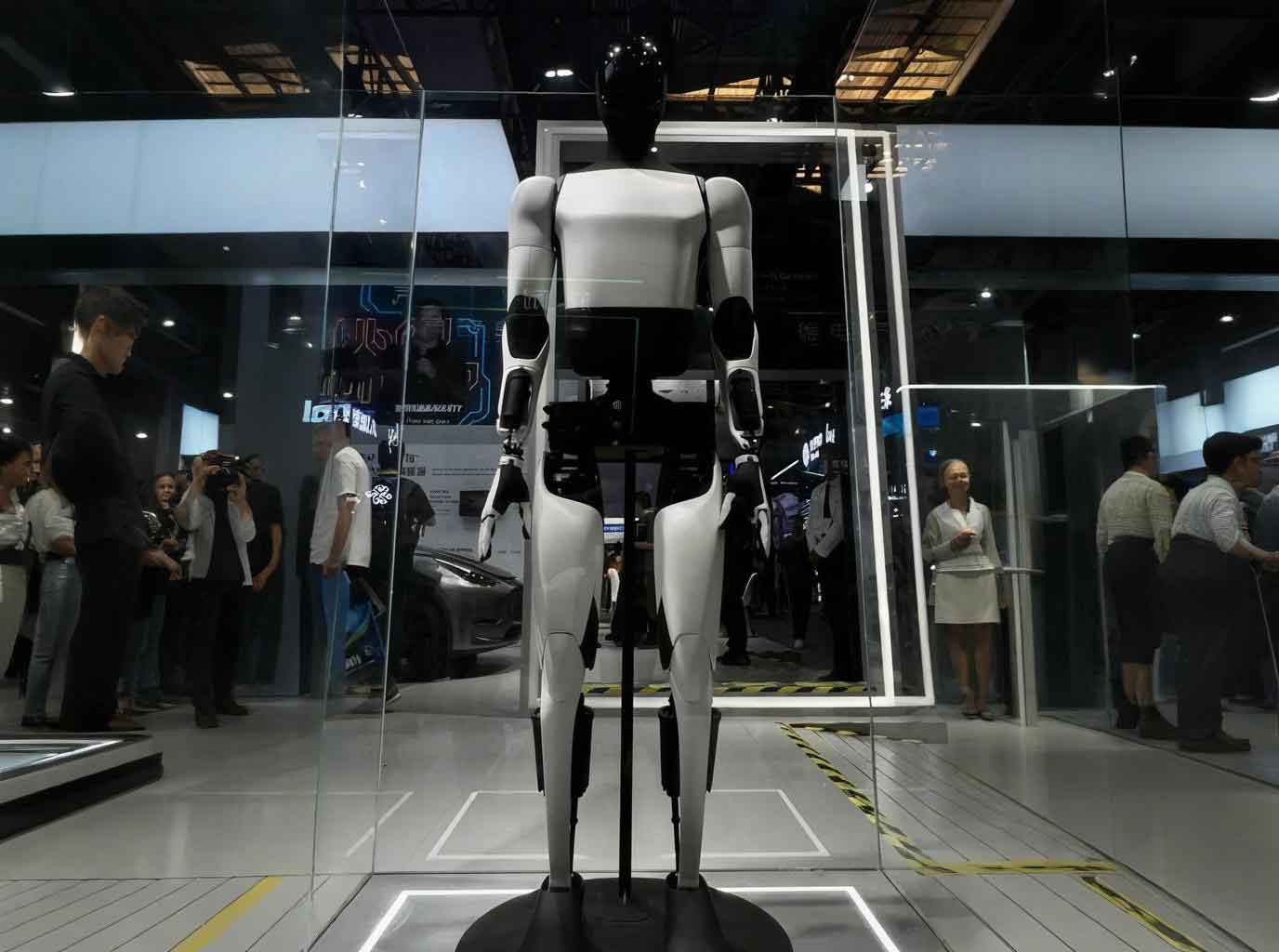
The core premise is that intelligence is not purely abstract but is shaped by interaction with a physical environment. The recent explosion in LLM capabilities has acted as a catalyst for embodied intelligence, providing these agents with a powerful “brain” for planning, natural language understanding, and commonsense reasoning.
2.1 Frameworks, Algorithms, and the LLM Core
Modern frameworks for embodied intelligence are complex, layered systems. They often feature a cloud-edge-fog computing architecture, where heavy reasoning tasks are handled in the cloud (using large LLMs), while time-critical perception and control loops run on edge devices (the robot itself). Neuromorphic computing, which mimics the brain’s structure and event-driven operation, is being explored for ultra-low-power, high-speed sensor processing in embodied AI robot systems.
The integration of LLMs as the central reasoning engine is transformative. An LLM-powered embodied AI robot can understand high-level natural language commands (“tidy up the living room”), break them down into a sequence of actionable steps, and even learn from few-shot examples or human feedback. This enables zero-shot generalization to novel tasks and environments. Key research directions include creating multi-modal models that jointly process visual, linguistic, and physical proprioceptive data, and developing scalable methods for automatic labeling of large-scale robotic interaction datasets.
2.2 Human Interaction, Environment, and Ethics
For embodied AI robot systems to be effective and accepted, they must navigate complex human interactions and ethical landscapes. Research is advancing in areas like affective computing, where robots attempt to recognize and respond to human emotion, and explainable AI (XAI), where the robot’s decisions are made transparent to build trust.
Adaptive retrieval-augmented generation (RAG) allows robots to dynamically access relevant knowledge bases or past experiences when making decisions. Theories like the Global Workspace Theory (GWT), which posits a “conscious” access to information within a brain, are being computationally modeled to create agents with a more coherent sense of their state and environment. A critical ethical focus is on developing embodied AI robot systems with simulated empathy, ensuring they can operate safely and beneficially in human-centric spaces like homes and hospitals.
2.3 Application Innovations
The fusion of embodied intelligence with LLMs is unlocking revolutionary applications:
- Healthcare: Surgical robots with enhanced perception and decision support; companion robots for the elderly.
- Industrial Automation: Flexible robots that can understand verbal work instructions and adapt to production line changes.
- Autonomous Vehicles & Drones: Systems that reason about complex urban scenarios and explain their actions.
- Domestic Robots: General-purpose home assistants capable of performing a vast array of chores from natural language prompts.
- Space Exploration: Autonomous rovers and system maintenance robots that can diagnose and repair issues with minimal ground control intervention.
3. The Engine of Progress: AI Chips and Quantum Neural Networks
The ambitions of LLMs and embodied intelligence are ultimately grounded in hardware. The von Neumann bottleneck—the inefficiency of constantly shuffling data between separate memory and processing units—has driven the exploration of novel computing paradigms. Today’s landscape features several parallel technological paths.
3.1 Digital AI Chips: Scaling Performance and Efficiency
Digital AI accelerators, primarily GPUs and TPUs, remain the workhorses for training and running large models. The trend is toward increasingly specialized architectures. For instance, NVIDIA’s Blackwell platform emphasizes not just raw flops but efficiency in inference, which is critical for the cost-effective deployment of AI agents and embodied AI robot brains. Advanced packaging and interconnect technologies like NVLink are essential to scale these systems beyond single chips.
At the transistor level, the move to 2nm node technology with Gate-All-Around (GAA) nanosheet transistors promises significant gains in power efficiency and density, directly enabling more powerful on-device computing for edge applications. Research in digital AI chips is multifaceted, focusing on new accelerator architectures, co-design of algorithms and hardware, power optimization, and hardening systems for safety and reliability in critical applications. The table below highlights key innovations.
| Innovation Focus | Specific Examples |
|---|---|
| Novel Accelerator Arch. | Layer-fused execution on heterogeneous dataflows; Wide-link, high-bandwidth Network-on-Chip (NoC) designs (e.g., 645 Gb/s/link). |
| AI-Assisted Design & Power | AI-guided optimization of SoC performance parameters; Software-assisted peak current regulation for optimal power-limited inference. |
| Security & Reliability | Detection of novel side-channel attacks in matrix accelerators (AMX); Reinforcement learning-based fault-tolerant routing in NoCs; Studying neutron radiation effects on edge AI SoCs. |
| Application-Specific Chips | Ultra-low-power processors for wearable epilepsy detection; Mixed-signal near-sensor convolutional imagers for IoT vision; Reliable DPU architectures for space-grade FPGAs. |
3.2 Analog AI and Compute-in-Memory
To fundamentally break the von Neumann bottleneck, Compute-in-Memory (CIM) architectures perform calculations directly within the memory array, avoiding costly data movement. This is often implemented in the analog domain, using the physical properties of devices like resistors or transistors to perform Multiply-Accumulate (MAC) operations. The core computation for a vector-matrix multiplication in an analog crossbar can be expressed as:
$$ I_j = \sum_{i=1}^{N} G_{ij} \cdot V_i $$
where \( I_j \) is the output current on column \( j \), \( G_{ij} \) is the conductance (representing the weight) of the device at row \( i \) and column \( j \), and \( V_i \) is the input voltage (representing the activation).
Two main CIM flavors exist:
- Digital CIM: Uses standard SRAM or DRAM bit-cells but integrates digital processing elements within the memory array/ periphery. Focus is on high precision (floating-point support), security, and compatibility with mainstream digital flows.
- Analog CIM: Uses non-volatile memories like Resistive RAM (ReRAM) or novel device physics. Focus is on extreme energy efficiency (achieving TOPS/W), 3D heterogeneous integration for density, and overcoming device non-idealities (variability, noise).
These chips are ideal for the low-power, always-on sensory processing required by embodied AI robot systems at the edge.
3.3 Photonic Neural Networks and AI Chips
Photonic computing uses light (photons) instead of electricity (electrons) to perform computations. Its inherent advantages are ultra-high bandwidth, low latency, and the potential for massive parallelism using different wavelengths of light. A fundamental linear operation in a photonic neural network, like a matrix transformation, can be performed by a mesh of Mach-Zehnder Interferometers (MZIs). The transformation for a single MZI is given by:
$$
\begin{bmatrix}
E_{out1} \\
E_{out2}
\end{bmatrix}
=
\begin{bmatrix}
\cos(\theta) & i \sin(\theta) \\
i \sin(\theta) & \cos(\theta)
\end{bmatrix}
\begin{bmatrix}
E_{in1} \\
E_{in2}
\end{bmatrix}
$$
where \( \theta \) is a tunable phase shift, and \( E \) represents the optical field.
Innovations are happening at two levels:
- System-Level Photonic Neural Networks: Using free-space optics, fibers, and modulators to create high-speed, specialized processors for tasks like RF signal processing, nonlinear equalization in optical communications, and time-series prediction.
- Integrated Photonic AI Chips: Building miniaturized versions on silicon or silicon-nitride photonic integrated circuits (PICs). Trends include large-scale integration with on-chip lasers (III-V on Si), co-packaged optical I/O for bandwidth, and exploring non-linear photonic materials for all-optical activation functions. These chips could provide the ultra-fast, low-power interconnect and processing backbone for future embodied AI robot compute clusters.
| Technology Path | Key Development Directions |
|---|---|
| Silicon Photonics | Large-scale, heterogeneous integration (lasers, modulators, detectors); Broadband optical neural network engines; On-chip nonlinear activation modules. |
| Photorefractive & Novel Optics | All-optical crossbar arrays using holography in crystals; Large-scale nonlinear computing in scattering media; Exploiting multiple degrees of freedom (wavelength, spatial mode). |
3.4 Quantum Neural Networks
Quantum Neural Networks (QNNs) are hybrid models that combine parameterized quantum circuits with classical neural network layers. They run on Noisy Intermediate-Scale Quantum (NISQ) computers. The hope is to leverage quantum properties like superposition and entanglement to process data in high-dimensional Hilbert spaces, potentially offering advantages for specific machine learning tasks. A basic parameterized quantum circuit layer might apply a series of rotational gates \( R_y(\theta_i) \) to encode data and entangling gates \( CNOT \) to create correlations:
$$ |\psi(\theta)\rangle = \prod_{i} [U_{ent} \cdot R_y(\theta_i)] |0\rangle^{\otimes n} $$
Research is focused on making QNNs efficient, accurate, and robust against quantum noise. Architectures like Quantum Convolutional Neural Networks (QCNNs) and models with quantum self-attention are being explored. While still in early stages, applications are being investigated in communication (for resource management and error correction), healthcare (for medical image classification), chemistry (for molecular property prediction), and complex system optimization—all domains that could eventually inform the design of supremely efficient planners or sensors for advanced embodied AI robot systems.
Conclusion
The trajectory of artificial intelligence is clear: it is moving from purely digital, statistical models toward integrated, interactive, and physically-grounded systems. The synergy between large language models—which provide reasoning and knowledge—and the field of embodied intelligence—which provides a framework for action—is creating a new generation of capable AI agents. This convergence, however, is computationally demanding, pushing the boundaries of hardware innovation across multiple frontiers. From the continued scaling of digital AI accelerators and the energy-efficient promise of analog compute-in-memory, to the speed-of-light potential of photonic chips and the exploratory power of quantum neural networks, the underlying hardware ecosystem is diversifying and specializing. The future of intelligence, particularly for an embodied AI robot operating in our complex world, will depend not on a single technology, but on the intelligent orchestration of all these advances: algorithms, architectures, and physics, working in concert.