
As an observer of technological evolution, I have witnessed a fascinating intersection between physical robotics and digital blockchain innovations. In recent times, the deployment of robot dogs in high-stakes environments and the surge of non-fungible tokens (NFTs) have captured global attention, each representing a leap in how we interact with machines and assets. This article delves into these developments from my perspective, exploring their implications, applications, and potential future synergies. I will use tables and formulas to summarize key aspects, ensuring a comprehensive analysis that highlights the pervasive role of robot dogs in modern industry.
The incident involving a spacecraft prototype test vividly illustrates the utility of robot dogs. After an experimental launch, where a vehicle ascended to approximately 10 kilometers before descending and landing, only to explode unexpectedly, a robot dog was deployed to inspect the aftermath. This robot dog, equipped with sensors, navigated the hazardous site to assess damage and detect leaks, showcasing its ability to operate in dangerous conditions without direct human intervention. Such scenarios underscore the growing reliance on robot dogs for tasks like surveillance, inspection, and data collection in perilous settings. The robot dog’s agility—enabling it to run and overcome obstacles—makes it ideal for these roles, as it can access areas that might be unsafe for humans.
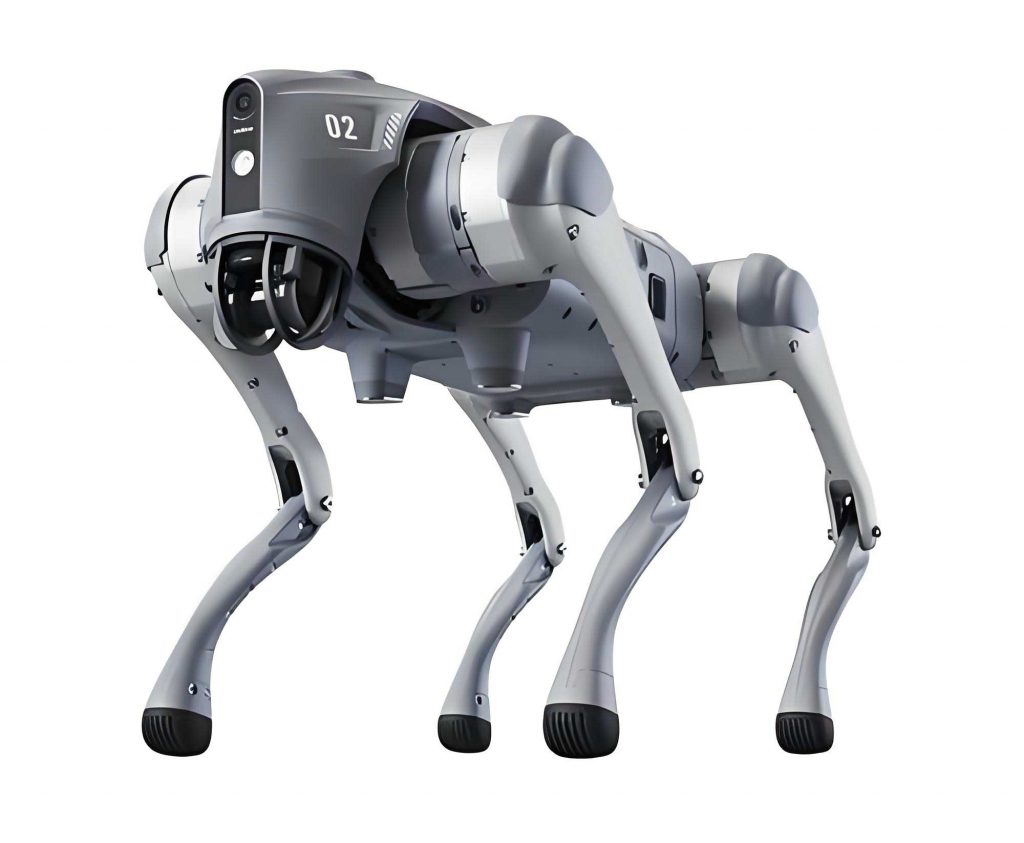
From my analysis, robot dogs are not limited to space exploration sites. They have been integrated into law enforcement agencies, where they assist in operations such as opening doors, entering risky zones, and providing reconnaissance during incidents like hostage situations. This reduces human exposure to danger, enhancing safety in critical missions. The versatility of the robot dog is evident in its adaptability to various environments, from industrial complexes to urban police departments. To summarize the applications of robot dogs, consider the following table that categorizes their uses based on functionality and sector:
| Functionality | Sector | Example Tasks | Key Benefits |
|---|---|---|---|
| Inspection and Monitoring | Aerospace, Energy | Assessing engine damage, sniffing hydrocarbon leaks | Reduces human risk, provides real-time data |
| Surveillance and Security | Law Enforcement, Military | Patrolling areas, entering hazardous zones | Enhances safety, enables remote operations |
| Data Collection | Research, Industrial | Recording mechanical readings, environmental sensing | Improves accuracy, supports decision-making |
| Assistance and Mobility | Disaster Response, Healthcare | Navigating rough terrain, carrying equipment | Increases efficiency, extends reach in crises |
The effectiveness of a robot dog can be modeled using kinematic equations. For instance, its position during movement can be described by: $$x(t) = x_0 + v_0 t + \frac{1}{2} a t^2$$ where \(x(t)\) is the position at time \(t\), \(x_0\) is the initial position, \(v_0\) is the initial velocity, and \(a\) is the acceleration. This formula helps in planning trajectories for the robot dog in dynamic environments. Additionally, the robot dog’s ability to avoid obstacles relies on algorithms that can be summarized with: $$F_{\text{avoid}} = k \cdot \frac{1}{d^2}$$ where \(F_{\text{avoid}}\) is the avoidance force, \(k\) is a constant, and \(d\) is the distance to an obstacle. Such mathematical representations are crucial for optimizing the performance of robot dogs in real-world scenarios.
Transitioning to the digital realm, the rise of NFTs has introduced a novel way to tokenize unique assets on blockchain networks. NFTs, or non-fungible tokens, are cryptographic tokens that represent ownership of distinct digital items, such as art, music, or collectibles. Unlike cryptocurrencies like Bitcoin, which are fungible and divisible, each NFT is indivisible and unique, akin to a digital certificate of authenticity. This uniqueness is achieved through blockchain technology, which ensures tamper-proof records. For example, a social media post was sold as an NFT for millions, highlighting how even ephemeral digital content can gain substantial value when tokenized.
The market for NFTs has expanded rapidly, with platforms offering digital collectibles like sports cards generating significant trading volumes. In one case, a digital basketball card series saw transactions exceeding hundreds of millions in a month, attracting tens of thousands of buyers. This demonstrates the growing appetite for NFT-based assets, which bridge physical and digital worlds by providing a verifiable link to real-world items. To illustrate the characteristics of NFTs, here is a table comparing them with traditional assets and fungible tokens:
| Asset Type | Fungibility | Divisibility | Example | Ownership Verification |
|---|---|---|---|---|
| NFT (Non-Fungible Token) | Non-fungible (Unique) | Indivisible (Minimum unit 1) | Digital art, tweets, virtual land | Blockchain-based, transparent |
| Fungible Token (e.g., Bitcoin) | Fungible (Interchangeable) | Divisible (e.g., 0.1 BTC) | Cryptocurrencies, utility tokens | Blockchain-based, but identical units |
| Traditional Physical Asset | Varies (e.g., art is unique) | Depends on asset (e.g., real estate is indivisible) | Paintings, real estate, cars | Paper deeds, legal systems |
The uniqueness of an NFT can be expressed mathematically through hash functions. For a given digital item \(m\), its NFT representation involves a cryptographic hash: $$H(m) = \text{SHA-256}(m)$$ where \(H(m)\) is the unique identifier stored on the blockchain. This ensures that each NFT is distinct, as even a minor change in \(m\) produces a completely different hash. Moreover, the value \(V\) of an NFT might be modeled as: $$V = f(S, R, D)$$ where \(S\) is scarcity, \(R\) is reputation or provenance, and \(D\) is demand factors. Such formulas help in understanding the economic dynamics behind NFT valuations.
In my view, the convergence of robot dogs and NFTs presents intriguing possibilities. As robot dogs become more prevalent in特种作业, their digital twins could be tokenized as NFTs, allowing for ownership tracking, licensing, or even trading of robot dog functionalities. For instance, a robot dog used in a mission might have its performance data recorded on a blockchain as an NFT, creating a verifiable history for maintenance or insurance purposes. Conversely, NFTs could be used to control access to robot dog services, where a token grants permissions for specific operations. This fusion could enhance transparency and efficiency in robotics deployment.
Consider a scenario where a robot dog is deployed in a disaster zone. Its actions and sensor data could be minted as NFTs, providing immutable records for analysis or fundraising. The robot dog’s ability to navigate and collect data would be complemented by the blockchain’s security, creating a robust system for crisis management. To summarize potential synergies, here is a table outlining how robot dogs and NFTs might interact in future applications:
| Application Area | Role of Robot Dog | Role of NFT | Expected Outcome |
|---|---|---|---|
| Asset Management | Physical inspection and maintenance of assets | Tokenizing asset ownership and history | Enhanced traceability and reduced fraud |
| Security and Surveillance | Patrolling and monitoring in real-time | Securing access credentials or event logs as NFTs | Improved accountability and access control |
| Digital Collectibles | Capturing unique moments or data in the field | Minting captured content as limited-edition NFTs | New revenue streams and fan engagement |
| Autonomous Operations | Executing tasks based on smart contracts | Using NFTs to trigger actions or payments | Increased automation and efficiency |
The integration can be further analyzed through network models. For a system where robot dogs interact via blockchain, the efficiency \(E\) might be given by: $$E = \frac{N_{\text{transactions}}}{\tau \cdot C}$$ where \(N_{\text{transactions}}\) is the number of NFT-based interactions, \(\tau\) is the time delay, and \(C\) is the cost per transaction. This highlights how robot dogs could leverage NFTs for seamless coordination in decentralized networks.
Reflecting on the broader implications, I believe that the proliferation of robot dogs raises important questions about utility and risk. While robot dogs offer undeniable benefits in safety and efficiency, their deployment in sensitive areas like policing or military operations necessitates careful ethical consideration. The potential for misuse, such as autonomous weaponization or privacy invasion, cannot be ignored. Similarly, the NFT boom, though promising for digital ownership, may harbor bubbles due to speculative trading. As these technologies evolve, it is crucial to balance innovation with regulatory frameworks that ensure responsible use.
In conclusion, the advancements in robot dogs and NFTs signify a transformative period in technology. From my perspective, the robot dog exemplifies how robotics can augment human capabilities in hazardous environments, while NFTs redefine value in the digital age. By employing mathematical models and tabular summaries, I have aimed to capture the essence of these developments. The future may see deeper integration, where robot dogs operate within NFT-governed ecosystems, fostering new paradigms in automation and asset management. As we navigate this landscape, continuous evaluation of both opportunities and challenges will be key to harnessing their full potential.
To further elaborate on the technical aspects, let’s consider a formula for the operational cost of a robot dog over time. If \(C_{\text{initial}}\) is the initial cost, \(M(t)\) is the maintenance cost function, and \(B(t)\) is the benefit function from tasks performed, the net value \(NV\) can be expressed as: $$NV = \int_{0}^{T} [B(t) – M(t)] \, dt – C_{\text{initial}}$$ where \(T\) is the operational period. This helps in assessing the economic viability of deploying robot dogs in various sectors. For NFTs, the liquidity \(L\) in a market might be modeled as: $$L = \frac{V_{\text{traded}}}{P_{\text{avg}} \cdot N_{\text{holders}}}$$ where \(V_{\text{traded}}\) is the total traded volume, \(P_{\text{avg}}\) is the average price, and \(N_{\text{holders}}\) is the number of unique holders. Such formulas provide insights into market dynamics.
In summary, the journey of robot dogs from experimental tools to mainstream assets parallels the rise of NFTs from niche concepts to broad applications. I anticipate that as both fields mature, they will increasingly influence each other, driving innovation across industries. Whether it’s a robot dog inspecting a crash site or an NFT representing a digital masterpiece, the fusion of physical and digital realms continues to reshape our world, offering endless possibilities for exploration and growth.