
As an industry observer and technology enthusiast, I have been closely tracking the rapid evolution of energy storage systems and their profound impact on emerging fields like robotics. The narrative that has captured my attention revolves around the imminent commercialization of solid-state batteries and their pivotal role in powering the next generation of humanoid robots. In this comprehensive analysis, I will explore the technological milestones, market trajectories, and the symbiotic relationship between these two domains, drawing from recent forecasts and developmental roadmaps. The core thesis is straightforward: solid-state batteries are not just an incremental improvement for electric vehicles; they are the key enabler for the widespread adoption of sophisticated humanoid robots, unlocking a market with trillion-dollar potential.
Let me begin by examining the state of solid-state battery technology. The fundamental shift from liquid electrolytes to solid electrolytes represents a quantum leap in battery science. From my perspective, the advantages are multifaceted and game-changing. The primary benefits include significantly enhanced safety profiles, as the solid electrolyte eliminates the risk of leakage and thermal runaway—a common concern with traditional lithium-ion batteries. Furthermore, the energy density potential is staggering. While current lithium-ion batteries typically offer energy densities around 250-300 Wh/kg, solid-state prototypes are consistently demonstrating capabilities exceeding 400 Wh/kg. This can be expressed through the basic energy density formula:
$$E_d = \frac{E}{m}$$
where \(E_d\) is the gravimetric energy density, \(E\) is the total energy stored, and \(m\) is the mass of the battery. The pursuit of higher \(E_d\) is central to both automotive and robotics applications.
The industry’s timeline for deployment is becoming increasingly concrete. Based on aggregated announcements and expert consensus, the journey towards mass adoption follows a clear path. Initial functional prototypes and small-scale validation are occurring now, with pilot-scale production and first vehicle integrations targeted for around 2027. True, large-scale manufacturing capable of supplying entire vehicle fleets and other industries is expected to mature by 2030. This 5-10 year scaling period is critical for refining manufacturing processes and driving down costs. To summarize the publicly indicated timelines from various automotive and battery players (without naming specific entities), I have compiled the following overview:
| Development Phase | Estimated Timeframe | Key Milestones |
|---|---|---|
| Technology Validation & Prototyping | 2024-2026 | Lab-scale success, patent surges, functional sample batteries, initial robot power tests. |
| Pilot Integration & Demonstration | ~2027 | First batch installations in electric vehicles, extended field testing in humanoid robots. |
| Ramp-up & Early Commercialization | 2028-2030 | Increased production volumes, cost reduction efforts, broader model adoption. |
| Mass Market Maturity | Post-2030 | Economies of scale achieved, becoming a mainstream option for EVs and robotics. |
The rationale behind this accelerated push is clear. The automotive sector’s relentless drive for longer range and absolute safety is a powerful catalyst. However, from my vantage point, an even more compelling and perhaps larger addressable market is emerging: the realm of humanoid robots. The potential here is not merely additive; it is multiplicative. A humanoid robot, by its very design, demands a power source that is dense, light, safe, and reliable. Traditional battery packs often become the limiting factor, adding excessive weight and posing safety hazards in dynamic, human-centric environments. This is where solid-state batteries enter as a perfect solution.
Let’s delve into the market projections for humanoid robots. The figures are nothing short of astonishing. Recent analyses, such as those from global financial institutions, forecast the humanoid robot market to reach approximately $75 billion by 2035. The long-term vision is even more ambitious, with projections suggesting a market value soaring to $1 trillion by 2050, with global unit sales potentially exceeding 70 million. This growth can be modeled using a simplified exponential growth function:
$$M(t) = M_0 \cdot e^{rt}$$
where \(M(t)\) is the market size at time \(t\), \(M_0\) is the initial market size, \(r\) is the compound annual growth rate, and \(e\) is Euler’s number. Applying this to the humanoid robot sector, with an assumed high growth rate, illustrates the explosive potential. The following table breaks down these forecasts and associated application segments:
| Application Area for Humanoid Robots | Key Drivers | Estimated Contribution to 2050 Market | Critical Battery Requirements |
|---|---|---|---|
| Industrial Manufacturing & Logistics | Labor shortages, precision tasks, 24/7 operation. | ~35% | High cycle life, rapid charging, stability under vibration/impact. |
| Elderly Care & Healthcare Assistance | Aging demographics, need for companionship and physical aid. | ~25% | Ultra-safe operation, lightweight for mobility, long single-charge runtime. |
| Domestic Service & Personal Companionship | Smart home integration, convenience, entertainment. | ~20% | Compact form factor, aesthetic integration, absolute safety in homes. |
| Hazardous Environment Operations | Disaster response, mining, space exploration. | ~15% | Extreme temperature tolerance, high energy density for extended missions. |
| Retail & Customer Service | Automation of service roles, interactive experiences. | ~5% | Reliability, all-day operation, quick swap/charge capabilities. |
The demand for elderly care robots, for instance, is a poignant example. Studies suggest this niche alone could grow at a compound annual rate around 15%, becoming a multi-billion-dollar segment within a decade. Each of these applications for the humanoid robot imposes unique but overlapping demands on its power core. The common denominator is the need to maximize operational time while minimizing the system’s weight and footprint—a challenge perfectly addressed by solid-state technology.
Why is the humanoid robot so dependent on this battery breakthrough? The answer lies in physics and practical deployment. A mobile humanoid robot is essentially a complex system of actuators, sensors, and processors, all competing for space and energy. The battery cannot be an afterthought; it must be a core architectural component. The gravimetric energy density (\(E_d\)) I mentioned earlier becomes the paramount metric. A higher \(E_d\) directly translates to longer operational periods between charges or a reduction in overall robot weight for the same runtime. The relationship between required operational time (\(T\)), average power draw (\(P\)), and battery mass (\(m\)) is:
$$T = \frac{E_d \cdot m}{P}$$
For a desired \(T\) and a given \(P\), reducing \(m\) is only possible by increasing \(E_d\). This is non-negotiable for a humanoid robot intended for extended, untethered work. Furthermore, the volumetric energy density is equally crucial for designing sleek, anthropomorphic forms. Solid-state batteries, with their potential for simpler packaging and the elimination of bulky safety systems needed for liquid electrolytes, offer superior values here as well.
Safety is the other non-negotiable pillar. A humanoid robot operating alongside people, in homes, or in crowded facilities cannot afford any risk of fire or explosion. The solid electrolyte is inherently more stable. Its mechanical strength contributes to better resistance against dendrite formation—a primary cause of internal short circuits in lithium-ion batteries. This intrinsic safety allows for simpler battery management systems and opens doors for more flexible integration within the structure of a humanoid robot. Imagine a scenario where battery cells could be distributed throughout the robot’s frame, akin to a musculoskeletal system, optimizing weight distribution. This level of integration is far riskier with conventional batteries.
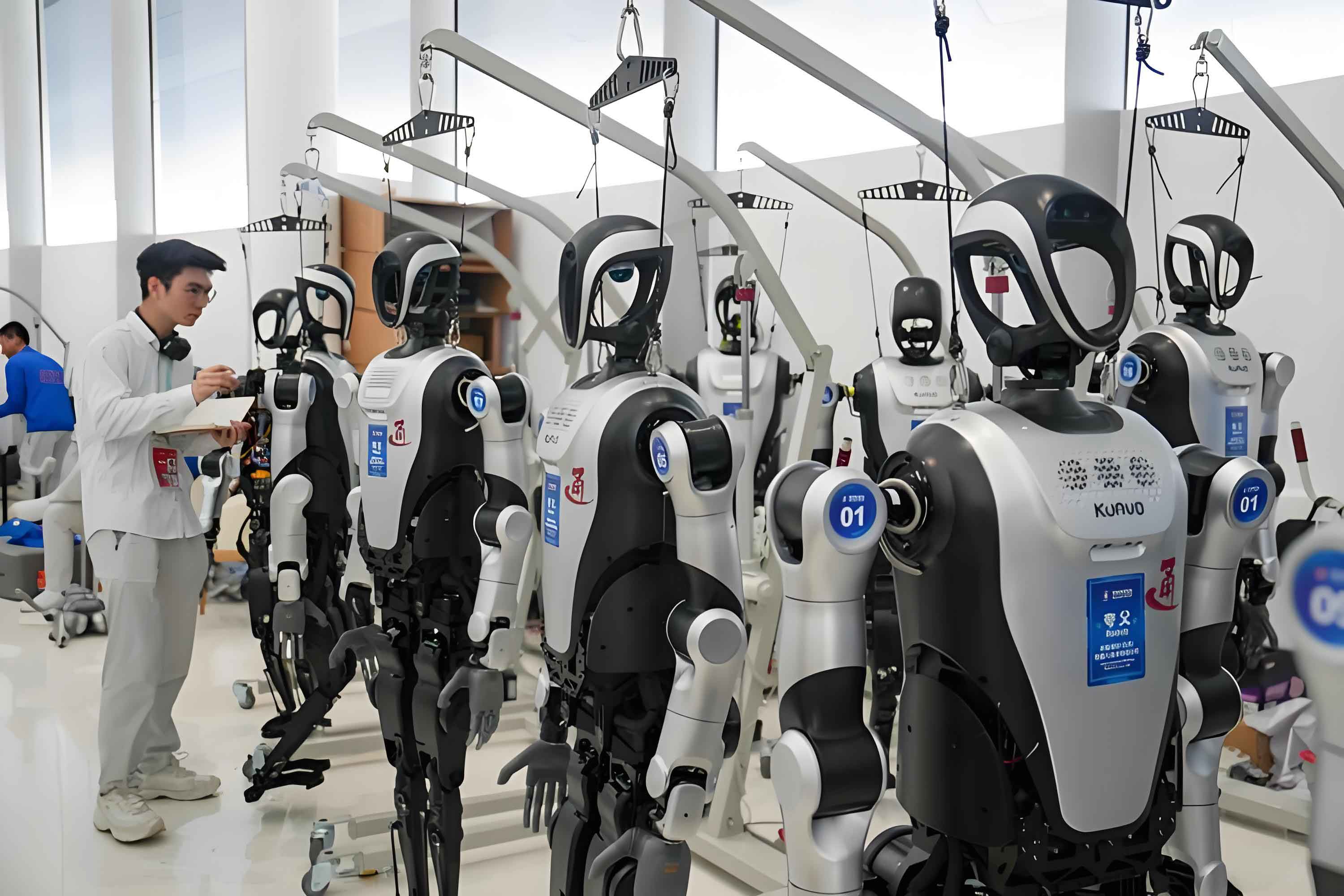
The visual representation of humanoid robots in quality inspection or assembly roles highlights the precision and dexterity required. To power such advanced capabilities for shifts lasting 6, 8, or even 12 hours, the energy source must be impeccable. This is precisely why several pioneering projects have already announced plans to integrate solid-state batteries into their next-generation humanoid robot platforms. The promise is a continuous operational window that finally meets practical commercial and industrial requirements, moving beyond short demonstrations.
From a supply chain perspective, the synergy is creating a powerful feedback loop. The automotive industry’s investment in scaling solid-state battery production will inevitably benefit the humanoid robot sector by driving down costs and improving manufacturing yields. Conversely, the unique demands of the humanoid robot—such as even higher energy density targets or specific form factors—will push battery developers to innovate further. Some battery manufacturers have explicitly stated that the specifications for humanoid robot applications surpass those for passenger cars in terms of energy density, lightweight design, and safety margins. They recognize that flexible, high-performance pouch cell designs, which align well with solid-state chemistry, are ideally suited for the dynamic form factors of a humanoid robot.
Let’s consider the performance implications with a more detailed technical comparison. The table below contrasts key parameters of traditional lithium-ion batteries with the projected capabilities of mature solid-state batteries, specifically in the context of powering a humanoid robot.
| Battery Parameter | Advanced Lithium-ion (Current) | Projected Solid-State (2030+) | Impact on Humanoid Robot Design |
|---|---|---|---|
| Gravimetric Energy Density (Wh/kg) | 250 – 300 | 400 – 500+ | ~40-60% longer runtime or proportionally lighter chassis. |
| Volumetric Energy Density (Wh/L) | 600 – 750 | 800 – 1000+ | More compact power unit, allowing for better weight distribution and sleeker design. |
| Cycle Life (to 80% capacity) | 1000 – 1500 cycles | >2000 cycles | Longer operational lifespan, reducing total cost of ownership. |
| Charge Rate (Typical Fast Charge) | 1-2C (1-0.5 hour charge) | Potential for 3-5C (20-12 min charge) | Reduced downtime, enabling more efficient multi-shift operation. |
| Operating Temperature Range | -20°C to 60°C (with limitations) | -40°C to 100°C (projected wider range) | Reliable function in extreme environments, expanding application scope. |
| Inherent Safety (Leakage/Fire Risk) | Requires complex management systems | Dramatically reduced risk | Enables safer human-robot interaction and simpler internal packaging. |
The implications of these numbers are profound. For a humanoid robot weighing 70 kg, a battery mass of 10 kg with current technology might provide 4-5 hours of active work. With solid-state technology, the same 10 kg could deliver 6-8 hours, or the runtime could be maintained while reducing the battery mass to 6-7 kg. This weight saving directly improves dynamic performance, agility, and reduces wear on joints—a critical factor for a humanoid robot expected to operate for years.
The economic model for deploying humanoid robots also hinges on this. The total cost of operation (TCO) includes not just the initial purchase but also maintenance, downtime, and energy costs. A battery that lasts longer per charge, charges faster, and survives more cycles directly lowers the TCO. We can express the TCO influence of battery performance as:
$$\text{TCO} = C_{\text{robot}} + N_c \cdot (C_{\text{energy}} + C_{\text{downtime}}) + \frac{T_{\text{op}}}{T_{\text{batt-life}}} \cdot C_{\text{batt-replace}}$$
where \(N_c\) is the number of charge cycles per year, \(C_{\text{downtime}}\) is the cost of time spent charging, \(T_{\text{op}}\) is total operational years, and \(T_{\text{batt-life}}\) is battery lifespan in years. Superior battery parameters reduce \(N_c\), \(C_{\text{downtime}}\), and increase \(T_{\text{batt-life}}\), thereby shrinking TCO and accelerating adoption of humanoid robots.
Looking at specific use cases, the requirements become even more vivid. A humanoid robot deployed in a manufacturing plant for quality inspection may need to traverse long aisles, climb stairs, and perform precise visual and tactile checks for an entire 8-hour shift. It cannot be tethered to a power outlet. A healthcare-assistance humanoid robot helping an elderly person at home must be capable of sudden movements, lifting support, and constant sensor operation without presenting a fire hazard. The stability of a solid-state electrolyte under physical stress or accidental impact is a major advantage here. Similarly, a humanoid robot designed for search and rescue in disaster zones requires a battery that functions reliably in both high-heat and sub-zero conditions, which the wider operating window of solid-state chemistry promises to deliver.
In my analysis, the period between 2027 and 2035 will be the most fascinating to observe. This is when the paths of solid-state battery production scaling and humanoid robot commercialization will intersect decisively. We will likely see the first generation of humanoid robots powered by solid-state batteries achieving meaningful commercial deployments in controlled environments like factories and warehouses. These early adoptions will provide invaluable real-world data, further refining both the robot’s design and the battery’s specifications. The feedback loop will intensify. Battery makers will learn from the unique load profiles and duty cycles of a humanoid robot, leading to even more optimized cell designs.
Furthermore, the innovation won’t stop at the cell level. System-level integration for a humanoid robot offers fascinating possibilities. With enhanced safety, batteries could be modular and distributed. For instance, smaller solid-state battery packs could be embedded in the torso, limbs, and even the base of a humanoid robot, improving balance and reducing the need for heavy power cables running through joints. This biomimetic approach to power distribution could be a key differentiator. The energy management system for such a distributed network would be complex, governed by algorithms that dynamically allocate power based on task demand. The overall system efficiency (\( \eta_{\text{sys}} \)) could be modeled as:
$$\eta_{\text{sys}} = \frac{\sum P_{\text{task}}}{\sum P_{\text{draw}} + P_{\text{loss}}}$$
where \(P_{\text{task}}\) is the useful mechanical/sensory power, \(P_{\text{draw}}\) is the power drawn from batteries, and \(P_{\text{loss}}\) includes conversion and transmission losses. A distributed, high-efficiency solid-state battery system minimizes \(P_{\text{loss}}\).
The global race is undoubtedly on. While this analysis refrains from naming specific companies or national programs, it is evident from patent filings and roadmap announcements that significant resources are being allocated. The goal is to establish leadership not just in making the batteries, but in defining the standards for how they integrate into advanced robotic platforms. The humanoid robot is becoming the benchmark application for pushing battery technology to its limits. Success in this arena will have spillover effects across electric aviation, portable electronics, and grid storage.
To conclude this extensive exploration, I am convinced that the story of solid-state batteries and humanoid robots is one of mutual necessity and accelerated destiny. The technical specifications required to make humanoid robots viable, safe, and economical on a large scale are precisely the strengths offered by solid-state battery technology. The market forecasts for humanoid robots are staggering, but they are predicated on solving the power challenge. As solid-state batteries move from laboratory breakthroughs to pilot lines in the coming years, and as they find their first automotive applications around 2027, the foundation will be laid. The subsequent decade will see this technology become the heart of millions of humanoid robots, transforming industries and societal functions. The equation is simple: without the high energy density, safety, and lightweight properties of solid-state batteries, the vision of a ubiquitous humanoid robot workforce remains constrained. With them, it becomes not just possible, but inevitable. The convergence is not merely a trend; it is the blueprint for a new era of automation and human-machine collaboration.